

My in-laws spent their working years in Saudi Arabia, working for the Arab American Oil Company. Well, he did. She taught ballet to princesses, ran the high school musical, created works for art and visited the souk very regularly. When they came back to the states, the always generous benefits included moving the contents of their household. This is the only explanation that can exist for how an incredibly, incredibly carved wooden display case with thick glass doors came from swirling deserts sands to suburban New England.

We call it the Iranian Chest. But, as was her wont, the card for the purchase has been kept with it. The address clearly shows the store was the “Arabic Palace of the 17th Century, in the middle of the Street called Straight, the largest oriental store. Damascus, Syria”. It’s origin is the street on which the Apostle Paul was baptized. So while the piece may well have been made in Iran well before the Revolution, that’s part is shrouded in mystery and history. It’s also not a chest. Miriam Webster defines a chest “a container for storage or shipping
especially : a box with a lid used especially for the safekeeping of belongings”. This piece of furniture is certainly not a box for shipping.

After six months of expense, irritation, dust, construction etc. our new room – the solarium – is ready for occupation. The furniture arrived on Saturday, and sits sort of awkwardly in a corner waiting to be lived in. I spent all yesterday visiting consignment stores trying to find inspiration for the right piece of furniture. (Why consignment? The color of the decade in furniture seems to be beige and I want this room to be rich in depth of color and pattern. So used furniture will suit my needs much better. Plus I like it.) I found this great side table, which I meant to take the place of the chest, for $60 with tax, but it’s too tall for a coffee table. So the quest continues.

From the beginning, we’d had plans from the beginning to make the awkward corner of this new room the home to the glassware and barware, mostly because the dimensions suited the Iranian Chest perfectly, which had previously lived slightly awkwardly in a corner of our living room.
For the first time in the life of my children, I cleaned out the chest thoroughly, marveling and wondering at it. It’s an object that has real presence, and one that has forever been in my sons’ lives. I find it a bit of a contradiction. The entire front, with a clever double-hinged set of doors that allows it to open more than 90 degrees, is heavily carved with a rich floral pattern, hiding the second set of hinges. It has clawed feet raising it up off the floor. The top lip has a cresting wave of flowers creating a protective ridge for whatever is placed on top of it. But the actually wood, despite the excellent workmanship on the carving, is as rough as it had come out of the planer. There’s no attempt at sanding or polish. It’s richly stained, but you can see that the color of the underlying wood differs significantly. And in some spots – especially the wood keeping in the glass panes, it’s clear that the wood is either of poor quality or very, very old. Or both. I have no idea how old this chest is, other than “older than 25 years”.
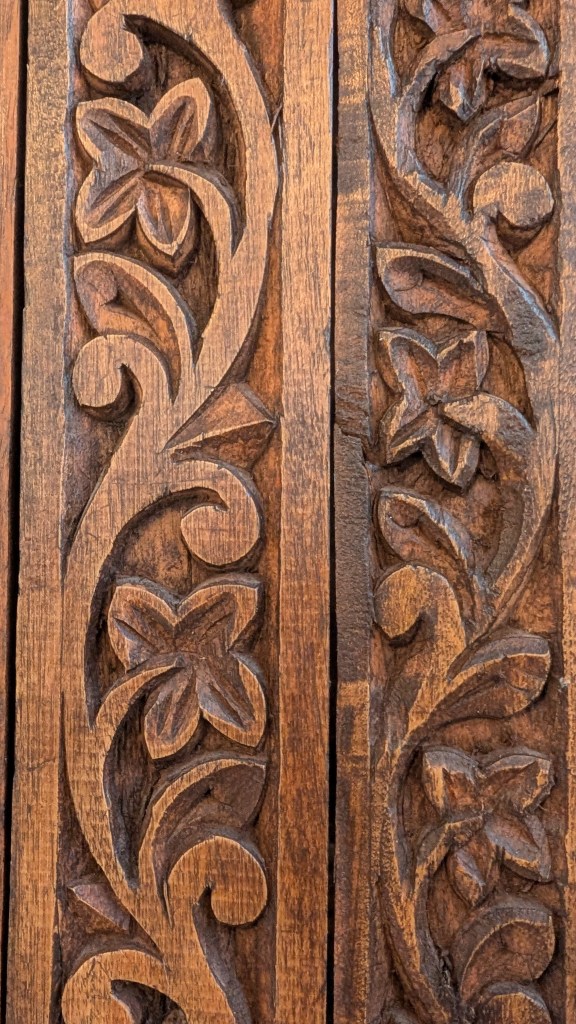
The real terror of this piece of furniture, though, is the glass. It has two glass shelves and they terrify me. If you are older than 40, most of the glass you’ve dealt with is delicate, generous, light… safe. You missed the era of the true plate glass. The shelves are the better part of an inch thick. In one or two spots, they’ve chipped off and bend the light with a wicked carelessness. The edges of the shelves are sharp enough that they’d slice flesh easily. And if they were to shatter, the shards would be fearsome foes that might, like a serpent, bit hard in death. I confess to wanting to defang this furniture. I’d rather buy some tempered high weight bearing, non-fatal glass and have it cut to size and fear my furniture less. But that’s the kind of thing you’ll “do later” aka when you’re dead and your kids inherit your stuff and have to decide whether they want to keep it.

I wonder how many years it will be before the Iranian Chest moves from this spot. Maybe we rethink the room and move it again. (Or not – it was VERY HEAVY and I don’t think we could have moved it without moving straps!). Maybe it is here when I leave this house for the last time, and my sons keep it where it stood. Maybe something else. As I refilled it with the accumulation of glasses (mostly sets which have at least one broken), it pleased me to take a moment to truly look at – truly think about – something so deeply as I got to with this object today. It’s the first accumulation of memories in this new room, kneeling on this warm tile and putting memories back into an old object from another land and time.
The next day….
Having quickly written up the mystery and the artifact, and gotten into the car to go visit my eldest at college on a day best spent indoors with hot cocoa, I figured I’d call my mother-in-law, and get the actual scoop. This serves, I think, as a useful example of how my mind and imagination work.
1) She’s never called it the Iranian Chest and had no idea what we’re talking about. Only my husband has ever called it that.
2) It was purchased at Desert Dreams in Dhahran Saudi Arabia. They would take old furnishings or carvings like doors or windows and repurpose them to modern use. So the reason it looks like two totally different styles of workmanship and wood is because it is in fact from at least two totally different eras. She says that the front doors were reclaimed from old windows. I wonder if the hinging was original or added? I’m guessing original.
3) The card in it came from ANOTHER purchase, most likely of a marquetry backgammon set we have hanging on the wall of our game, I mean, dining room. She remembered George immediately.
4) Aramco would seriously ship anything home. This display case was bought probably 40 years ago.

 My Truant Pen