Sacrificial Offerings

OGHS - Haiti Response: Two years later

We just reassigned our church officer duties in January. I went from chairing the Hospitality Committee to being a part of the Stewardship Committee. As part of my new responsibilities, I needed to delivery the inaugural “Word for Children” in our big build-up to “One Great Hour of Sharing”. This is an ecumenical offering – usually coordinated with Easter/Passover. Many different denominations (and even religions) participate in One Great Hour of Sharing to support shared goals of feeding the poor, responding to disasters and helping those in poverty dig their way out.

I was doing some background reading for my big delivery, when I was struck by the story of how the offering began. The tale is this: just after the conclusion of World War II, a group of church leaders got together to discuss the plight of European and Asian countries after the complete devastation of the war. On a Saturday night, they broadcast “One Great Hour” – a call to all the American listeners to make a “sacrificial offering” in support of those in Europe and Asia who had suffered in the war. The listeners were called on to go to their churches the next morning and give their offerings.

Reading this, I was completely caught up short. There so many things in this to give pause, to cause a rethinking. I imagined what it would be like to be one of those radio listeners. It was Saturday, March 26th 1949 – 10 pm eastern – when the broadcast came over the radio 1. An appeal went out for that sacrificial offering. I think of those men and women listening. They had just emerged from what must be the hardest 20 years in our nation’s history. These were people for whom the Great Depression was no distant memory, but as far away as the ’80s are to us. During those grim years, they had been homeless, or feared homelessness. They had taken in relatives. They gathered scrap metal for sale, made a pot roast last a week, and gone hungry. They had walked the soles through on their shoes and resewn old dresses over and over to try to make them last. They cut the buttons off shirts that had truly been worn through, used the rags, and reused the buttons on a new shirt. They had made great sacrifices.

Then, with the bombing of Pearl Harbor, these same people had been pulled into the great incommunicable horror of war. They spent whatever money they had on war bonds. Sugar, silk, rubber and other commodities were rationed. Front lawns were converted to victory gardens. But this was the smallest part of the sacrifice. The greater part were the farewells to fathers, brothers, husbands, sons, cousins and friends. A generation of young men, knowing well how fatal war could be after the previous generation’s “War to end all wars” shipped out to Europe or Asia. In the best case, the sacrifice was of years of youth. In the worst cases, the ultimate sacrifice was given. And in the middle, men came back maimed and damaged, to live with their wounds for the rest of their lives.

So those radio listeners on March 26th were people who knew sacrifice, who had looked it in the face, who had watched tremendous sacrifices made by those who had not made it back to the living room for a Saturday night broadcast.
And then the civic and religious leaders had the courage – the gall – to ask these men and women who had already given so much to give a “sacrificial offering”… to benefit the very enemies whose armies had killed brother and son, husband and father. A people just emerging from want and scarcity were asked to dig deep for people they had every reason to resent.

And they did. As many as 75,000 churches participated. The sacrificial offering was made to help rebuild Europe and Asia. (An aside … we have not since had a war with Germany or Japan, and not just because we defeated them. They are our close allies and friends now because after we militarily defeated them, instead of “sowing the soil with salt” after we did in World War I, we helped them build a country worth living in.)

This is interesting thinking in our current long-running economic difficulties. How many times have we heard that this is not a good time to ask Americans for sacrifices (or tax increases or donations or special offerings). We’ve suffered too much lately. We’ve lost too much lately. It seems a pale excuse compared to what our grandparents suffered and lost. What would a sacrificial offering look like for us?
The historians of the future

While I was home on my whirlwind watch-my-brother-get-ordinated trip this December, I said something about how I could take 700 pictures at the ceremony, knowing I’d keep perhaps 70 and print probably 10 (20 if you count the fact that I send my grandmother prints regularly).

What I kept
What I kept

Now, my father is a historian. A bona-fide, written a book and has a contract for another one signed historian. He specializes in historical photos and runs a business taking people’s old black and white photographs and digitizing/archiving them. As I was lauding the convenience of the digital age, he lamented how I was making the job of future historians harder by destroying this original evidence.

I thought about that for a while. (Well, if you’re counting, I thought about that for three months.) And Dad, I understand where you’re coming from, but I think you may be wrong.

I’m increasingly convinced that the historians of the future will not need to wrest a compelling narrative from charred wooden sticks and a few hieroglyphs carved on a rock. They won’t even be putting it together from a shoebox full of black and white pictures with light pencil notes on the back, like my father does. The key skill of the historian of the future will be finding some way, some algorithm, some method of sorting through the vast and vaster amounts of information we throw off. It will not be finding the needle in the stratus, it will be finding the needle in the haystack.

Consider just my blog. In this WordPress blog I have 562 posts. And I’m missing about 3 years of posts from Livejournal. I also have about 8 paper journals that I wrote as a young girl. And several boxes of letters written and received. Oh letters! I’m using 8.3 gigs of space on Google’s servers, between my letters and my pictures. 8 gigs. Do you know how many 3 1/4 in floppy disks that is? Do you know how vast we thought those floppies back in 1992? We said things like, “All the literature in the world can fit into one bookcase with these floppies.” (Just a back of the envelope calculation… those floppies help 1.44 mb. So my email and pictures would require 8000 of them. Give or take. I should mention Wikipedia has quite a long discussion on just how much they held.) I’m a one woman content creation machine! Oh, and then there are Facebook posts. And Tweets. And text messages. And – let’s be honest – I’m doing well if only 95% of my material is completely worthless.

I imagine the poor historian of the future, who sits down to write a story on some recent event – the Arab Spring perhaps. First this historian starts with the summaries of the summaries – the writings on it that have been proved by the test of time. Then this historian reads the contemporary published writings (many of which were done too quickly and too poorly edited in order to take advantage of “the market”). The historian then moves on the famous non-published writings and pictures. She must be nearly through her PhD by now… only to begin looking at the non-famous sources. Perhaps she picks a person or two. Then, for her period of interest, she reads through the gigs and gigs of material, pictures, posts, updates, emails and LOL-cat forwards for those people. How impossibly daunting.

Our historical anonymity is almost as guaranteed by our vast hordes of information as by the paucity of prior millenia… with one exception. If, for some reason, people WANT to know about you in the future they will be able to. They’ll know it all. When you were sick, and how. (Perhaps they’ll be able to access your medical records and xrays?) Who you contacted. Where you were. What you saw. Everything. But that will happen for so few of us – only the Elvises and Kennedys of the next generation (whose mothers are cheerfully documenting everything from their birth story to their potty training to what kind of trouble they’re having in school).

So what do you think? Are you careful to archive your own history? Or do you prefer to curate, and keep an edited summarized version of your life somewhere that might actually be readable? Or do you think that, as we continue to grow as a people, our descendants will have an even wider range of interest and no previous historical person will be uninteresting and banal? Do you think we might do our children’s children favors in their PhD theses not by saving everything, but by deleting most things?

I'll create terabytes of data in my lifetime!

The Magic is gone

Some animals are exceptional, at least in their owner’s eyes. Our cat Justice, for example, is the friendliest and most social cat you’ve ever met. He invites himself in to new houses, makes friends, and may be better known in the neighborhood than I am. Other pets are just who they are – not exceptional but no less loved.

Christmas Magic
Christmas Magic

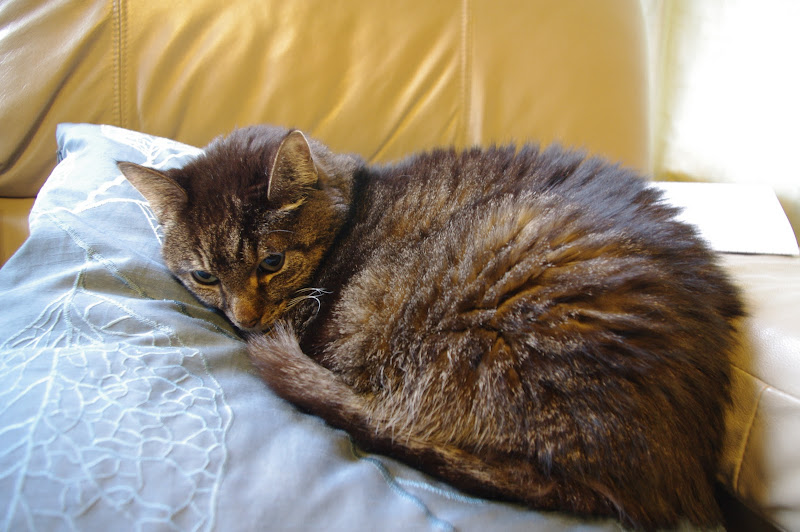
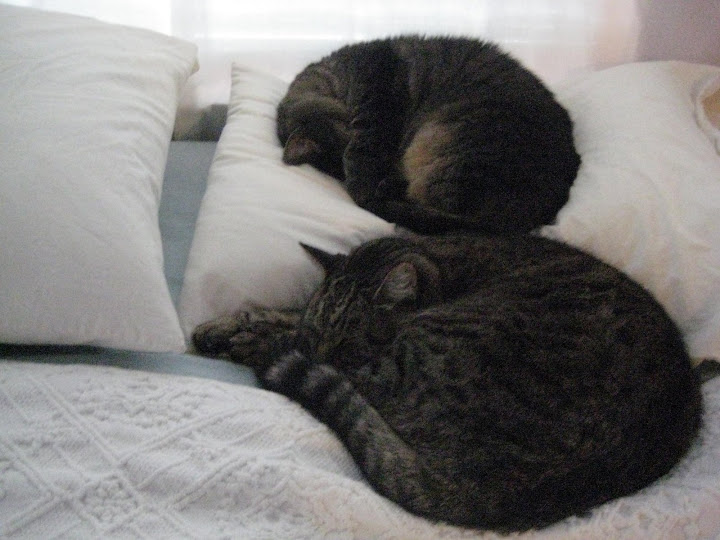
Magic was just such an animal. After noticing Justice was going completely crazy at home by himself, we decided a logical solution would be to get a second cat for him to play with. We went to a now-defunct animal shelter in Arlington where one of our friends volunteered. Magic was always a little funny looking – she had a tiny head with ginormous eyes and a big body. At first glance, she looked a lot like Justice, but further examination would show she was nothing at all like him. She was purry and affectionate from the get-go, but only tolerated a certain amount of petting before suddenly baring claw or fang to the offending hand. Magic loved to eat and to sleep. She was a comfortable house cat – a fixture on cushions, with a funny wheezy snore. She never longed to go outside, happily lounging inside where it was comfortable, like a sensible and comfort loving cat.

This morning she died. She was an elderly cat, and has been on medication for several years. She had gotten less and less active lately. Last night she began throwing up. As we got ready to go this morning, she was trembling and looking terribly unhappy. I had the boys talk to her, telling her they loved her and petting her. Adam took her to the emergency vet this morning, but she died as she was brought in, with his kind and loving hand touching her.

The house is quiet now. No snoring cat lies in the corner. An extra food bowl and litter box can be put away now. Justice’s sister and friend will no longer play with him. My sons face a feline farewell for the first time, faces grave.

Farewell, Magic. May there be sunbeams where you are, and bowls overflowing with food. May no one clip your claws, or want to sit on the seat you’re sitting on. May they leave cans of tuna unguarded on the counter. May you have scritches under your chin and behind your ears – but not too many. You will be missed, and your absence keenly felt.

Brother and sister
Brother and sister

Those of you who knew her: do you have any favorite Magic memories or pictures?

I was born with music playing in my ears

Little boy, little guitar

When I was about ten, my parents signed me up for piano lessons. The genesis of this decision is lost in memory to me. Did I beg and plead? I know I exhibited musical interest, but piano lessons require a piano. Pianos are expensive, and I know for sure we didn’t already have one. (We bought a player piano so that my father, who is not a musical genius, could also play pian.) My parents were far from wealthy, but somehow there it was. A piano. And there I was in lessons with Mr. Hunter, while his two young children listened in the next room.

I have an excellent memory, so I’m a little appalled at how little I recall of these lessons. They went on for years with two teachers. I remember that my mom combined the piano lessons with my brother’s weekly trips to Yelm for futile vision therapy. I remember the silver books and the arpeggios. I remember that I was terrible at site reading but could memorize pretty easily. I remember some recitals most vividly playing “Take 5” with Tyler in a duet. I don’t remember practicing particularly diligently. And I certainly don’t – can’t – remember being successful. After years of piano lessons, we were left to conclude that maybe I wasn’t so musical after all. Then I got a trumpet, got my pride in a huff and became one of the best high school trumpet players in the state — playing in a premier Youth Symphony. I briefly considered going to conservatory for college.

All this is to say: I love music, I care about music, I want my children to love and play music, and I know that sometimes you have to try a few instruments before you get to the right one.

Grey and Thane both show musical interest and some aptitude. They both sing nicely, and have at least partially inherited their parent’s tendency to sing often. Last year, we tried a piano lesson for Grey. It went ok. But he was dutiful instead of passionate. We didn’t do a second one. Then Grey started asking for drum lessons. Heaven help me, he wants to be a percussionist. My orchestra-snob instincts rebelled. I mean, do percussionists even use notation? Can they read music? I struck a bargain: become a competent guitar player (still a cool rock ‘n’ roll instrument) and I’ll consider your percussion request. He reminded me several times: how about guitar lessons, mom?

Finally, I found a school (right next to our library!) and took him to a free trial lesson. His teacher, shy with distracting earlobe extensions, emerged from the room half an hour later. “We don’t usually take kids this young. But Grey seems really passionate, and ready to work hard. He’ll need a half size guitar, but I think I can teach him.”

And so it is. We tracked down an adorable half-size guitar for him. He’s gone to two lessons so far. He’s supposed to spend 5 minutes at a time pressing down on the frets to build up finger strength so he can actually play. He talks about the “1-2-3-4” (clearly he’s being taught to count time). He daydreams about sounding like Simon and Garfunkel. He looks proud as punch with his guitar strapped to his tiny back.

A few years ago, on a cold night, we were camping in the White Mountains of New Hampshire. The boys were scattered across the floor of the test, and Adam and I tried to catch some chilly sleep, knowing that Thane would wake us up at a brutal hour. In the campsite a few twigs away, friends were gathered around a fire. One of them, some anonymous voice, pulled out his guitar and sang. Despite our weariness, the cold, the knowledge of an early morning, Adam and I listened and loved every moment of it – this shadowed serenade.

My son may give up after a few months of guitar, with no mastery. He may rise to the level of mediocrity through years of practice, as I did with piano. He might find an enjoyable level of accomplishment – enough to break out his guitar around a campfire and make his attempting-to-sleep neighbors glad instead of grumpy. Or perhaps he will become a master – classical, jazz, rock. Perhaps he will forget that it is possible to have uncalloused fingers, and find it hard to imagine not knowing how to turn those strings to music. Whichever way he ends up, I wish him the joy and the love of it.

A boy and his guitar

Has your family tried them, powdermilk?

We were driving home from church today. It’s a bright, sunny cold February day here in New England, and the roads were clear of traffic as we came home. It had been a good church service: an excellent sermon on Sabbathing even from church commitments, both my husband and I in the pews for once, a series of hymns with modern words and ancient tunes, and a little bit of honkey-tonk piano to round it out. I had my traditional post-service “Grande two-pump nonfat extra hot no whip mocha” in hand. The boys were goofing off in the back seat – being brothers. Thane has not had an “incident” in 24 hours. And Garrison Keillor was on the radio talking about Powerdermilk biscuits. My, they’re tasty and expeditious.

And I was washed over with a sense of well-being and contentment.

Well-being and contentment are not such common emotions to me that I fail to notice them. In fact, it’s been quite some time since I’ve felt them without threat looming at the edges of them, as though I better enjoy them now, quickly, because if I start thinking about the wrong things they will go away. No, I just felt happy, and like I very well might stay happy all the way through the end of the Superbowl tonight (and beyond, when the Pats cream the Giants!)

By the time the Ketchup Advisory board commercial came on, we were eating funny curly spaghetti-type pasta (bought from our local butcher), and giggling around the kitchen table. Garrison made a joke about radio, and how no one was listening to it, and it got me thinking.

I remember when NPR started being part of our life. It was shortly after we moved to Mineral, perhaps 1988, with the long car rides that entailed. Before that, we listened to oldies on the radio, and tuned in specially to listen to Paul Harvey. It was before the real rise of talk radio. With NPR, suddenly, the news entered my life. I struggled to catch up and figure out what the Iran-Contra affair was. I was completely snookered by an April Fool’s joke announcing that Starbucks was building a trans-continental coffee pipeline. I joked that I was getting my NPR PHD, and I listened all the time, even during lunch at school to Ray Suarez (who was infinitely preferable to Juan Williams IMO) while eating a pizza pocket and drinking apple juice. The theme song to “Talk of the Nation” still generates a Pavlovian mouth-water reaction and a great desire for pizza pockets.

These NPR shows were a very important part of my family’s lives. Every week we listened to a somewhat younger Garrison Keillor, after our own Protestant church services. He spoke of a world more familiar to us than the urban and urbane one that dominates most media. We too lived in a small town with a lake and a good network of gossip. Saturday mornings were also precious radio-wise. I woke early and joyfully (those of you who know me know how incredibly implausible that is – but true!) on Saturdays to take the hour and a half trip in to Tacoma to the Tacoma Youth Symphony rehearsals. My commute was accompanied by “Rewind” and “Car Talk”. I usually passed the Tacoma Dome as they ran the Car Talk credits. I remember I was leaving a rehearsal the day that Yitzak Rabin was assassinated, and was just old enough to weep for the chance for peace that bled out with his assassin’s bullets. My family would again gather in the evening to hear “Wait Wait Don’t Tell Me” trying to guess the quiz answers before the guests. If we perhaps scheduled it so we could be sure to catch our shows, well, that only made sense.

As I shared some of those same moments with my young and growing family, I thought of how lovely it is. The most precious of these radio shows are still on, with their original casts. Click and Clack are still there. Garrison somehow still finds new material in a gentler age that fades into memory. “Wait Wait Don’t Tell Me” is still wicked funny. (Rewind didn’t survive, but you take what you can get.) In tv, even the best shows only last a decade, if that. M*A*S*H only lasted 11 seasons. The entire world of media has fundamentally shifted in the fifteen or twenty years since I was a kid at home listening with my parents. Everything is change and newness. Except these things, which mean so much to me.

But for now, for at least this bright cheerful Super Bowl Sunday, Dusty and Lefty are still out there herding cattle on the prairie, just like they were when I was a girl. You can still win Carl Kasell’s voice on your home answering machine (as if anyone has one of those), even though he laid down his serious news microphone. And Car Talk’s official statistician is still Marge Innovera. And there are still bright Sunday mornings to be filled with the joy of living and family.

Preparing to exit disability

Me, my boys and my brace

Four weeks ago tomorrow, I had ACL replacement surgery, as well as two meniscus tear trimmings. Since then, nearly every step I have taken has been taken with a ginormous brace on my knee. I spent the first week after the surgery on the couch with a near constant ice pack on my knee. I didn’t work at all that week. The second week I was on two crutches, plus big brace. I still spent hours with my knee iced. I worked from home for 6 – 7 hours a day, and was totally exhausted. The third week I returned to work, on crutches. I started putting a bit more weight on it, and feeling and looking better. This last week, I ditched my crutches. I’ve started taking the stairs with alternating feet, like a normal person (even if normal people don’t usually have a death-grip on the hand rail). I’ve sped up, and the pain is more or less gone.

I’ve been in physical therapy twice a week since the second week. I am pretty far ahead of “plan” for returning to normal knee function. My brace has created near permanent welts in my withered left leg – stripes of rashy skin at regular intervals. I’m sincerely hoping to get permission to ditch the darn thing at my physical therapy tomorrow. When that happens, I will more or less be as ok as I was before surgery (you know, when I just had three torn tendons). The brace actually makes me limp (I can’t quite have normal motion with it), so once it’s gone, people will be unlikely to be able to see that my ability is different than normal. And in another week or two, it will probably BE pretty normal, although I have a long road to full strength and agility.

This is a transition I am very lucky to make. There’s nothing like wearing an ankle to thigh metal brace to let people know you’re disabled. By my disability, such as it is, is a fleeting one. It’s not an identity, it’s a condition. But my time on crutches and limping has given me a greater sympathy and understanding for those who can’t leave their disabilities behind with a month of PT and icing.

This summer, I went on a hike with my family, including my Dad. I have always known that my father was considered medically disabled, but with the self-centeredness of youth, I never considered what it felt like for him. I never thought about what was scary, or hard, or tiring. My knee with the three torn tendons was probably about on par (or maybe a bit better) than the knee function my father has had since the 70s. I found that many of the mannerisms I think of as “Dad” (going down stairs one foot at a time, for example) are things that you have to do when your knees don’t work. But I never remember him complaining about it, or shying away from uneven ground, or popping Ibuprofen after a long walk.

I’ve also gotten the “what’s wrong with you attention”. Other than my fervent desire to have a better story than I do, I haven’t minded. Everyone notices I’m limping. Everyone says, “What’s wrong”. Depending on the time and my mood I joke about it “You should see the other guy!”, explain in a positive way, “I had surgery a few weeks ago, and now I’m thrilled that I’m down to just a brace and no crutches!” or go into the dire details, “So about 13 years ago I went skiing for the first time….” But it’s not my identity. It’s a phase, not my life. And it’s visible and well marked, so when I’m going slowly everyone waits. People hold the door for me, and don’t start inching forward when I’m crossing the street. No one treats my Dad with that courtesy – not even his thoughtless middle child.

I will be supremely grateful for a fully functional knee. You don’t know how much you miss kneeling until you have to give a two year old a bath without kneeling. I miss being active and bouncing my way up the stairs. I miss it being inconsequential to go up to the third floor. I’m tired of thinking about my leg, the footing. I’m tired of thinking when I need to get out of bed to check on a crying child, “I should really put on my brace first. The bedroom in the dark is exactly the kind of situation where I could take a horribly wrong step.” I’m tired of planning my wardrobe around what is loose enough or tight enough to work with my metal accessory. I’m so delighted that my recovery has been as fast as it has, and my movement and strength are returning. But most of all, I’m grateful I will be able to leave my disability behind. And I spend a moment thinking of all those who live with disability – visible and invisible – at all times.

My mind’s distracted and diffused

It’s a rainy September night. It’s 9:45 and the rest of my family is asleep – my eldest son only beating my husband to bed by scant minutes. It is also my 33rd birthday. My email was crammed to overflowing with birthday wishes today, which warmed my heart with one-line reminders of friendship. My mailbox was empty. Can I admit something to you? For most of my life, my grandmother has faithfully sent me a birthday card on my birthday. Everyone else might forget, or be late. But grandma always remembered. Last year, for the first time ever, I didn’t get a birthday card from her. I was hoping to see the familiar hand an on envelope again this year. But no. I know she loves me. I know she probably even has a birthday card put aside for me (somewhere, where she’s probably forgotten it). But she always remembered. Now I just hope that she doesn’t remember that she’s forgotten!

Ah, fall rain makes me melancholy.

When I envisioned my fortnight or more of surgery recovery, I imagined that this would be my big chance to really make something of this blog. I would write out all those posts lingering in draft with an evocative line or two. I would marshall my pictures, tag them, and record them. I would be witty, engaging, full of pathos and good descriptions. My profound and moving writing would get retweeted, and my readership would finally break a 30 average. Instead, I didn’t feel well, didn’t write much except boring medical updates with, and didn’t even do all that well with Zelda. It can be a dire thing to face our true inner selves and discover that we are not actually an astonishing writer waiting to be discovered. No, we are a mediocre Zelda player trying to figure out how to navigate this level of the dungeon without getting killed.

The rain quickens and slants across the windowpanes. I loved the rare rains when I lived with my grandmother in California. The roof seemed to echo joyfully with each drop that fell on the parched desert.

I have updates on my knee. I went to the orthopedic surgeon on Wednesday. He was very pleased with how the wounds were healing, and how my swelling was (aka nonexistent). That ice pack thingy truly worked wonders. So I am recovering very well from the procedures. However, he sat me down for a long talk. The tear in one of my menisci was very extensive. (I continue to be amazed at how well my poor knee functioned.) He had to remove more than half of it. They do not replace meniscus. What I have remaining is what I have. I am therefore permanently and for the rest of my life forbidden from being a runner. I am very grateful I ran a 5k for the first time last year, because it will also be my last. I was beginning to really enjoy running, and to envision myself as maybe a person who did 5ks or 10ks. I wanted to be one of those people confidently striding across the pavement – mostly because I like being outdoors and I wanted to be fit and healthy. I don’t have a good backup plan. The other things I’ve enjoyed (basketball, raquetball) are also high impact. Swimming is hard logistically. I’m scared of bicycles since my sister’s near-fatal accident.

The Sox and Yankees were rained out today, so this line of clouds must extend all the way down past New York. I like a rain that stays and endures – one that rocks you to sleep and wakens you in the morning.

Today I did physical therapy for the first time. I was quite pleased with the results. Again, no swelling. I walked across the room with hardly any limp, if tentatively, sans crutches. I am supposed to use the crutches for safety, not because I require a prop. The strength tests he gave I did well in. I should recover quickly.

I miss sitting in the quiet of my childhood home, watching the rain fall on ancient hills, softening the stern outlines of the firs. In that moment in my memory, listening to Simon and Garfunkel and seeing past the thin veneer of civilization to the implacable mountains as they must have been through time immemorial, I ached for the impossible loveliness and loneliness of it all with all the romantic passion of a teenage heart.

My morning started my day badly. I was taking Grey to school and we were running late. I am not used to having deadlines for him. At the last moment as he was leaving and gathering his things, I said, “Hurry up!” His shoulders slumped. His face took on an injured cast. He shuffled, forlorn, to the front door of the school – a tiny kindergarten-sized bundle of woe in front of a vast concrete edifice. I was struck with remorse. What I should have said was, “I love you. Have a great day, kiddo.” I carried it with me all day that I had, for 20 seconds of gain, sent my child to school chastised instead of cherished. I went to get him a bit early, since I was working from home. Just him. And I asked him to help me make a birthday cake. He read the ingredient list and got all of them out – distinguishing baking powder from baking soda! He measured, poured, cracked eggs, mixed, and sampled. He wore his robot apron and joked with me in the kitchen. We made a really fantastic chocolate cake together, and ended our day eating the fruits of our labors, blessed by the hymnic “Happy Birthday”.

Of all the great songs Simon and Garfunkel wrote, my very favorite is Kathy’s Song. Back to that living room moment – I had Sound of Silence on LP. You know, “long play”. A record. Vinyl. This was well into the CD age, but on a rainy afternoon, thinking poetic, romantic thoughts, I played it on the record player instead and each word pierced my heart.

I hear the drizzle of the rain
Like a memory it falls
Soft and warm continuing
Tapping on my roof and walls

And from the shelter of my mind
Through the window of my eyes
I gaze beyond the rain-drenched streets
To England where my heart lies

My mind’s distracted and diffused
My thoughts are many miles away
They lie with you when you’re asleep
And kiss you when you start your day

And a song I was writing is left undone
I don’t know why I spend my time
Writing songs I can’t believe
With words that tear and strain to rhyme

And so you see I have come to doubt
All that I once held as true
I stand alone without beliefs
The only truth I know is you

And as I watch the drops of rain
Weave their weary paths and die
I know that I am like the rain
There but for grace and you go I.

Good night, all. Tomorrow is a new, fresh and joyful day.

Thucydides, naval warfare and sandwiches

I have now finished reading Thucydides’ abbreviated account of the Peloponnesian War. Which could perhaps be more aptly named “The war the Athenians would’ve won if they’d actually kept focusing on the Spartans instead of getting distracted every other year”. The history, written in the 5th century BC, goes on for 554 modern, tightly written pages. OK, with lots of maps, but it is still a tremendously extensive history. You find yourself wondering how there were enough papyrus reeds, or sheep, or whatever they were using to write on in those days for all of it. More astonishingly, the text ends abruptly, mid-paragraph, in the 21st year of the war. Given that there are some passages that show signs of later editing, it is entirely possible that the book went on for another couple hundred pages – but the remainder got lost. (You can just imagine the banal or tragic circumstance. Used to mop up spilled milk? Dropped from the desperately clutching hand of a man hanging with his other hand to the rigging of a boat? Forgotten when a family packed up and moved?)

Reading Herodotus and Thucydides back to back has led to a pretty darn decent grounding in ancient Greek history (and an EXCELLENT understanding of ancient Greek geography). The two authors are very different. Herodotus was very interested in sociology, social custom and anecdote (especially any of those that have to do with having sex in weird ways). I don’t remember any particular speeches in his story. Thucydides only gives you sociology when it is required for the storyline, and switches between event narratives and speeches. The speeches are really excellent.

Towards the beginning of the recounting, when Pericles fires the blood of the Athenians, you find yourself SO GLAD that you’re from Athens. As time goes on, your pride turns to ashes in your mouth as the Athenian public opinion squanders opportunities and reaches for unattainable and stupid goals. It’s possible, just possible, that I might have seen some corrolaries between those Athenenians and my own people, in character, confidence and (um) lack of focus.

Anyway, the seventh book is dedicated to the events of the siege of Syracuse. The Athenians, having left the Spartans and their allies strong and regrouping on their near border, decide it’s an awesome time to go and invade Sicily – mostly at the importunings of Alcibiades. Alcibiades is the most important and intriguing historical figure you’ve never heard of. If his decisions had gone another way, the whole history of the Mediterranean would have been different. Perhaps Alexander would have been a vassal, not a King. And had that happened, the world would have been different.

Anyway, long distance naval warfare was a relatively new concept. And Athens and Sicily were separated by a not insignificant expanse of water. Triremes were not ships – they were boats. They were not intended to be slept in. There were no facilities for preparation of food. So if you were in a trireme, you needed to stop on land in order to eat or sleep. This has an obvious restraining quality on who you can attack by sea in trireme warfare.

In one of the peculiarities of this form of warfare, the Greeks expected their soldiers to feed themselves from their wages (or booty). So they would pull ashore, find a market, have everyone eat dinner, go to bed, and then do battle the next day. At one point, to the end of the Syracusan campaign, the Syracusans arrange with a market to be held right on the shore. They pull off to get dinner, and the Athenians go and do likewise. But the Syracusans arranged to buy all the prepared food in the market, so the Athenians have to go further inland to try to find dinner. Meanwhile, the Syracusans have a quick dinner from the arranged market and then go back to attack while their opponents are still haggling over mutton. This was a decisive move. The Syracusans won that naval battle against the greatest naval power the world had ever seen. It was all downhill from there for the Athenians. A scant handful of the flower of their military forces survived to return from Italy.

While I was reading this, all I could think of was sandwiches. Seriously, if they just had sandwiches on those triremes, what an advantage it would have been! What a tremendous tactical flexibility this would’ve offered!

This war was brutal and bloody. Men died horribly. Women were enslaved and raped. (Seriously, the only time women appear in this narrative is to either be enslaved or, obnoxiously, widows told by Pericles that their greatest honor will be in being completely invisible to the real people.) But especially in the beginning, it was civilized enough to have some assumed graces. In the beginning of the war, you started in the morning and fought until dinner time. Then the living stopped, had dinner and gathered their dead under truce – to begin again on the morrow. Anyone violating these rules could generate an advantage – but it made warfare that much more awful. No dinner, just sandwiches, was what I would’ve suggested if I was an Athenian general. The next battle in Syracuse ended up being fought at night – with no lights, torches, uniforms. Men were killed by their compatriots, who in daylight knew them because they _knew them_ not by some other marker. This let the Syracusans defeat a superior number of Athenians, speeding the boulder of their defeat downhill with increasing momentum.

We are not done optimizing our lives and our battles. An innovation like sandwiches can be easily copied by the enemy. It brings a decisive but fleeting advantage, after which war is permanently even more miserable for all participants.

I think we still do this. Would you have invented sandwiches on triremes, or would you have left well enough alone? What are the modern equivalents, in warfare or in life? What do you think?

Jubilate Musica

My first semester of freshman year in college, I took Music History 204 (having skipped the prerequisites due to 6 years of orchestra and a strong passion for music history). Professor Stoner walked us through about 600 years of music, from “Hey, we can write this down so we don’t forget”, through hocketing to the Baroque. I fell for early music, and I fell hard. I still haven’t recovered from that first passionate discovery.

My sophomore year, having quite quickly exhausted the early music resources of a school that definitely wasn’t strongest in music and definitely definitely wasn’t strongest in early music, I did an independent study on Wind Instrumental Ensembles in Italy from 1450 to 1620. That website is actually how (why) I learned HTML, which led to a 10 year career as a programmer. I digress. I love love love early music. Of all early music, I love best the wind ensemble music of 16th century Italy. Of that, I *heart* Giovanni Gabrieli’s wind ensemble compositions most of all, and daydream about hearing them with authentic instruments. I made my husband go with me to Venice, just to stand in St. Marks and imagine what it sounded with Gabrieli’s opposing choirs.

So when I got a note from one of my favorite local early music ensembles (Blue Heron) mentioning in a small postscript that their conductor was going to be leading a bunch of young musicians playing period instruments in a program of Gabrieli and Praetorius, well…. I had to be there.

It was with a light heart this morning, in summer sunlight, that I turned my steel chariot to transport me to Back Bay for the concert. I had planned on taking the T, but I was running a bit behind and figured that I’d probably be able to find street parking, and if I didn’t, I could park in one of the lots down there. That was ok with me. Heaven forbid I be late. There were cornetti and sackbuts! Tickets sold at the door! Late was not an option.

About halfway down 93 I noticed that there were a lot, and I mean a LOT of small planes and helicopters circling over the city. I passed a digital billboard with yellow, black and a “B” in the middle. It was 11:25 am on Saturday the 18th.

Whoops.

Reckoning that my original course was still my best option, I pressed on to the city, encountering surprisingly little traffic. But when I got to Back Bay, route after route was closed for the parade. And parking? Completely non-existent. I crawled through the streets looking desperately for pay parking, meter parking or permit parking where I would only get ticketed, not towed. How horrible and appalling it would be to drive past the church where this music was to take place (several times) and yet be denied! I started to panic. Then, just when my situation was getting dire, I found a great spot at a meter (no charge for weekends) which didn’t even require me to use my (non-existent) parallel parking skills. The day was saved! I rushed breathless to the church.

Taking advantage of my single status, I ante’d up my $10 and walked in. There was no assigned seating. I noticed, Presbyterian-like, that only a few people were sitting in the very front row. I made myself one of them. The church quickly filled behind me.

And oh glory! There were cornetti and sackbuts! There were recorders and theorbos. There were bass viols and violones. There was a harpsichord and organ. And there were glorious singers – clear crisp sopranos, warm confident mezzos, firm authoritative tenors and profound basses. They sang in Latin and German. There was counterpoint across the balconys. In fact, the only downside of this concert is that I was directly under the balcony that held the sackbuts, so I didn’t get to watch them except for one piece where they were in the center area of the stage. One of my favorite conductors (Scott Metcalfe who [how cool is this?] does a conducted sing-along once a year so interested amateurs like myself can remember how much fun it is to make music. He’s an EXCELLENT rehearser!) was center stage, animated, bringing the musicians along with him.

For an hour and a half, I glowed. My heart sang. At several Gabrieli chords, tears came to my eyes. It was superb.

The glow has come through the day with me. I feel nourished and restored. I feel extremely tempted to pull out my cornetto and see if I can get good enough to get called in. (Apparently, talking with one of the cornettists afterwards, they’re extremely hard to come by and perhaps the standard is lower than it might be for other musicians.) The day was clear and warm. The city was full of celebrations. And I had the sounds of Gabrieli in my ears.

These are the moments of our life to which we aspire, and which we must hold firmly in memory. It was glorious.


My soul magnifies the Lord,
and my spirit has rejoiced in God my savior.

Adventure-uncovered secrets

Yesterday, a friend came over. Our plan A had included a picnic in the Middlesex Fells, but the weather was chancy, so we opted for a shorter, more local walk. I offered to show my husband, friend and eldest son the hidden tunnel running under I93, where in former years a train had run, that is the future path of the Tri-Community Bikeway and currently home to a very talented set of artists.

Tri-county bikeway - tunnel graffiti

We got there and marveled, but our feet felt light, my mother-in-law (the saint!) was home with Thane, and we had no deeds to do or promises to keep. I offered to take us home the long way or the short way. With a lazy Saturday afternoon in front of us, under overcast skies, we took the long way.

And so we walked. I have always, always loved going on walks. I fondly remember the Connecticut College Arboretum, and the green. I love evening walks, right before bed, in bitingly cold or fondly warm dark. I love daytime walks through seemingly familiar but unexpectedly new paths. I have a tendency to drag people through bush, briar and bramble long past the polite mark, explaining that we’ve come so far that the fastest way home is forward. Sometimes this is even true. But I confess, I have never tried this with my eldest. I know my weakness is to push people past when I’m tired, and I’m an indefatigable walker.

But the path stretched so freely in front of me, and the company was so congenial, I decided to begin teaching my five year old my love of walking adventures.

We stopped at McDonald’s for ice cream and coffee. We stopped at Woodcraft to admire all the possible ways to remove digits and daydream of lives with room for whittling. We ducked off the road to try to identify an old abandoned building, and then circled back to it. We quoted each other poetry, discussed programming design patterns and explained some small section of the world to Grey.

We were getting a bit tired, by the time we walked past the gate.

The welcoming gate
The welcoming gate

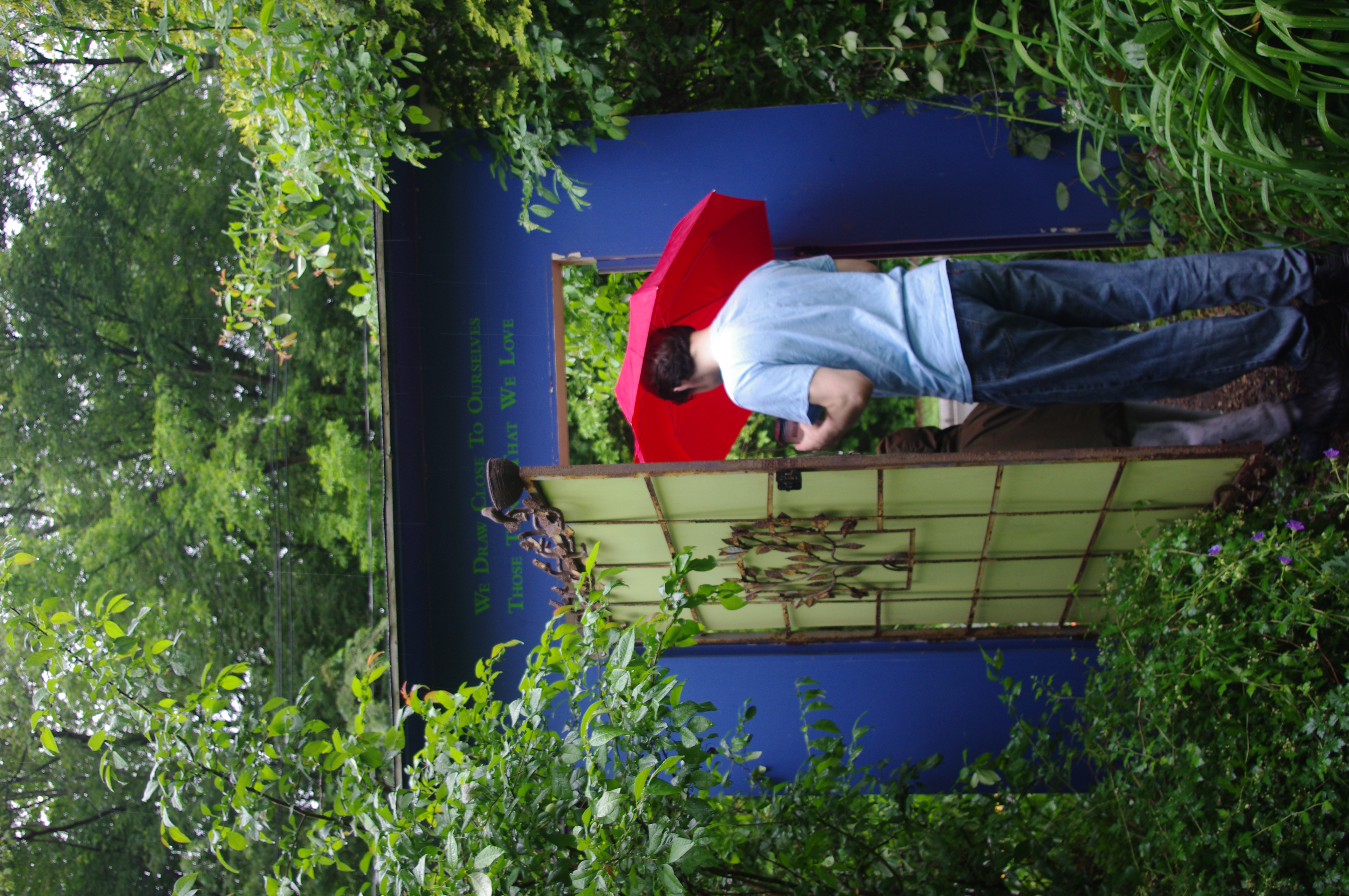
The poem on the door reads:

Welcome to the Cotton-Arbo retum;
Please do step inside.
Here you’ll find a peaceful respite
And a feast for weary eyes.

Weary from a world that’s become
Plentiful with neon signs,
Blaring out wherever you go,
Up ahead and from behind.

Now the chaos of a crowded garden
Overwhelming seems to be,
But once you center your attention
Focus on the true beauty
Of a tree’s bright leaves or flowers,
Of a waterfall’s great power,
Soon you’ll find your vision shifting,
As the minutes roll to hours.

And to unwind you begin,
Like pluming grasses in the wind,
As a breeze can comfort you
And help you see the world anew.

The war with life’s resounding din
Can sound like raining rocks on tin.
This battle we hope you will win;
So take the first step,
Please come in.
– Mindy Arbo

We entered the hidden garden

Finding ourselves ready for both adventure and respite, we went in. It was probably an average sized suburban lot – maybe a little larger than the uniform green lawns we’d been walking past, but not unusually so. But this garden was so invested with love, you could palpably feel it. There were statues tucked into corners, poems printed on gates, pools of water with koi or fountains of cheerful water. There were blocks of rose quartz and a thousand varieties of plant. And through it all was the warm sense of welcome – to be invited as strangers into this labor of love and trusted to tread there with light and respectful feet. What a precious gift to give to strangers – the labors of your years!

The adventurers in the secret garden

We weren’t the only ones who liked the garden:

Baby bunny, big world

We left with light feet and light hearts, to return home.

Return to the world
Return to the world

The next block, we found a candy shop:

The advisability of stopping at a Gingerbread house while tired on a long adventure is not lost on me

Grey, admittedly, got tired by this point. The entire journey was about 4 miles, which is rather a long walk for a five year old. I talked about the plants we passed on our long walk home: the walnut trees, foxglove, dogwood. (I got accused of making things up.) With tired feet, we came home – infinitely richer for our adventures.

I had forgotten. I had forgotten how many secrets you cannot see from the thirty-five-miles-an-hour world I live in. I had forgotten how lovely it is to walk with friends. I had forgotten the infinite variety of homes people live in. I had forgotten how liberating it is to step off the path and onto another path that does not lead to your goal.

I am so grateful to have remembered, and to have won a battle against “life’s resounding din”.