Never say never

Fashion-wise, my life is an interesting synthesis. Clothes were not very important to me growing up. In fact, I recall distinctly that being enormously unstylish was a great way to drive my sister nuts. There was one particular hideous orange shirt I wore for years because she couldn’t stand it. In junior high one of my favorite outfits was an ankle length black skirt (with black keds from Payless — I don’t remember the sock color and blanche at the thought because I don’t think I owned black socks), a white turtle neck and my volleyball windbreaker (black, with white and green writing) over it. Stylin’. Through high school I regularly wore the light blue sweatshirt with puff paint displaying a winter scene with a dominant element being St. Bernards rescuing skiing penguins. It had a little plastic penguin charm, if memory serves. Towards the end of high school I started getting fancy with black slacks and jewel-colored silk shirts, and began to wear jewelry like a trumpet pendant. And, well, the trumpet pendant. (Oh Lord, let me have had black socks! Tell me I didn’t wear all this black with white socks!)

Fashion was never very important to me. I liked to dress up and look pretty, but invested hardly any effort or money in doing so, most of the time. I had rather baroque ideas of what pretty was. I generally wore very long skirts, not feeling comfortable that I could pull off/knew how to wear short skirts. I never wore heels or makeup. Anything I did wear, barring outside examples, was liable to be put to the same rigorous use (see also: hiking, tree climbing, river fording) that was my normal activity during those days. Yes, even (or especially?) on dates.

Me in the middle - probably my nicest outfit at the time

So through the most socially insecure times of life I generally dressed entirely pragmatically, with an emphasis on St. Bernards.

Then I went to college. I met this GUY. Eventually, I figured out this GUY had parents, who lived very far away and therefore weren’t particularly relevant. However, as we got seriouser and seriouser I began to realize that when you get married you get these things called in-laws. Finally, I met my mother-in-law.

Fashion-wise, she was diametrically opposed to where I was. Here I was in baggy jeans and a t-shirt. She was wearing more jewelry than I’d ever owned and was immaculately dressed in something extremely stylish. I seem to recall leopard print. Gradually, oh so gradually, she got to work on me. First it was a few summery dresses from Thailand. Who can say no to summery dresses from Thailand? Then it was some sweaters. They were nice sweaters! Then she helped me out when I needed to clean my closets. Closet cleaning is always easier with someone else.
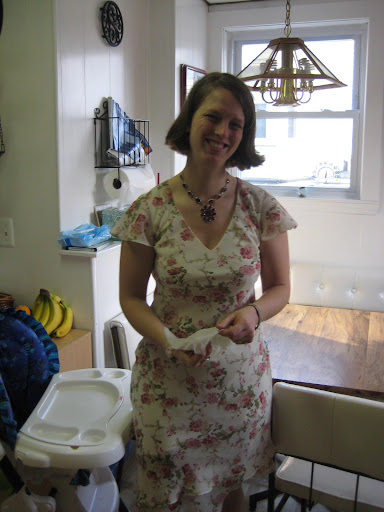
Easter - apparently the camera adds wrinkles. I don't have those!

By the time Grey was born, when she came to visit we were having regular sessions of “What Not To Wear”. She’d bring me an item of clothes that pushed my boundaries a bit. Maybe it hugged where I was used to baggy. Perhaps there were colors that weren’t in my standard palette. Possibly it was a little more stylish than I was used to. And of course, every time she came to visit there was a new piece of jewelry for me. Yeah, I know. I suffer. And she’d point things out. Did I notice how the fit on this dress was baggy at the bust? How about how this one caught at the hip? She wouldn’t let her aged mother out in public in those shoes: why would she let her beautiful daughter-in-law? (All the training is accompanied, I should add, with copious praise.) The clothes got better fitting and more fashionable. The shoe selection got more diverse. The jewelry got bigger.

I started to catch on — to see the fun of wearing things that look good and fit. I learned to match the elements of my increasingly extensive wardrobe together. I figured out what MY style was and communicated it back to my mother-in-law, who promptly helped me focus in on those areas. (For example, I own nothing with leopard print.) I started having fun with it.

Thanksgiving - I take the pictures so I'm rarely in them

Yesterday we went shopping together, and I crossed a milestone. You see, for years I’ve declared all capri pants strictly out of bounds. Why? I’m not entirely sure except that I’d never worn them. But yesterday she found a pair with this really cute embroidery, and urged me to just try it on. What could it hurt? Well, she was right. They’re adorable, comfortable and fit beautifully.

I swore I’d never wear capris. Never say never.

I still think I’m in the sweet spot. I now know enough about fashion to be able to present myself in the way I choose, and to feel really good about how I look most mornings. But I also still have that early sensibility, of practical over fashionable. I don’t value myself or others based on clothing, or the state of a manicure. I don’t feel unsightly because I haven’t put makeup on. I’m not dependent on my external appearance in order to feel ok about myself — I know that’s not what matters. But neither do I rule out the entire arena of clothing as something other people do.

My current style vs. functionality in a nutshell

PS – In case you love the original jewelry my mother-in-law has made for me, she does sell her work. Here’s a gallery of some of her recent creations

Let me introduce you to my BFF…

There are all sorts of ways that the new digital paradigm is changing how we relate to each other. If you read Advice Columns, there are lots of questions about how to deal with your wife’s ex-husband on Facebook, or what to do if your boss sends you an invite to be friends. It’s all in flux, and many of the old rules of relationships need to be rewritten to deal with new venues.

The other day, a friend of mine posted on Facebook about Dragonbreath: Attack of the Ninja Frogs (which I highly recommend, by the way). I had the moment of “Squee!! I know the author of that book, Ursula Vernon!” And in some ways I do. I can tell you that her cat, Ben, has had some health scares lately. I know that she has an enormous chicken statue in her garden. I know all about her divorce, how much weight she lost through the stress of it, the amount of time she spent recovering, and her apparently pretty awesome new boyfriend. I know what she’s planted in her garden, and her favorite boots to wear to a Con. So I definitely know her. The thing is, she very likely does not know me, at all. I could walk up to her and tell her all my online identities, and she’d likely get a confused but polite expression. This happens to her a lot. She’s a very popular blogger/author/painter, and there are thousands of us who read her musings. Of course she doesn’t know us all back.

Then there’s my other BFF (Best Friend Forever), Amy Storch. Her sons are the same age as my sons! She’s gone through lots of the same things, but plenty of unique challenges too. Dude, Levar Burton once replied in Tweets to her post about the traumatic experiences she suffered with Reading Rainbow! She’s the friend you go to for advice about moisturizer choices, or who you want to get a pedicure with. We totally hang out all the time! Or, well, we would. Except once again, she may not even know who I am, although she did answer one of my questions in her advice column once.

Now, I might be feeling a little “oh woe is me no one knows who I am!” but this is an experience I’m encountering from both ends. I’m a small-time blogger (even smaller since I stopped being able to update daily). I average fewer than 75 hits a day (although much better when Boston.com puts me on the front page!) I suspect that 90% of my regular readers are people I know in real life. The rest of them are looking for radish recipes or night life advice for the Indian city of Thane. (Sorry googlers!) But I have definitely encountered people who know me quite well from my writings, who don’t write themselves. While I have some vague ideas about who they are, they know everything about me. That’s what it means, when you put yourself up here on the internet, and your friends, family, enemies, acquaintances and complete strangers can all see your life, laid out plainly.

In a real conversation there’s a back and forth. You learn some things, you share some things. In this new paradigm of online conversations, it ain’t necessarily so. Some people are only consumers of other’s writings…. they listen but they never share. My husband is one of these. Others only talk and never read. Most people do a balance of both. But all throughout the world, not only are people wrestling with what to do about the knowledge they obtained due to a drunk post by their former coworker, but they are dealing with these asymmetrical relationships, when the people they know best are not ones who even know they exist.

What about your online life? Are you a balanced creator/consumer of content? Do I know you? You know me, or you can know me pretty well with a cruise through my archives. Do you like the anonymity of reading? Do you wish it was more reciprocal? Comment, and turn my monologue into a dialog!

The order in which things happen

So often, through fortune and fate, things transpire like this.

1) You get unexpected money (raise, bonus, birthday)
2) Something unexpected and expensive happens (cat breaks his leg)
3) You curse fortune

Consider the same features, but a different order

1) You sign up for an expensive vacation to Istanbul
2) Your cat breaks his leg and needs emergency splitting (and xrays, and medication, and a radiologist, for crying out loud)
3) Your oil change arrives with word that you need new brakes
4) Your husband comes home with news of an unexpected bonus and raise
5) Midas says you don’t really need new brakes after all

Theoretically, the brake stuff would neutralize each other, and the unexpected costs and unexpected extra moolah would be just the same as if you’d gotten the moolah first and the costs second. But no! When it happens the other way around, instead of bemoaning fate that has wrested your so-recent money from you, you bless fate for providing you with an unexpected windfall with which to pay your cat’s vet!

So much of life, the joy or the annoyance, is wrapped up in the perspective from which you look at it. Your cat comes home with a broken leg. Do you focus on the joy that your cat came home, or the troubles of the broken leg? You need to do yardwork. Do you focus on the unfairness of spending Saturday afternoon mowing, or rejoice that you have a home with green grass for playing on? I try to remind myself often that I have only a certain degree of control about what happens in my life, but I have quite a lot of control about how I view and approach the facts I can’t change.

In more concrete terms, you’ll be glad to hear that Justice is doing quite well. We’ve made Justice and Grey roomies, so that Justice doesn’t do stupid stuff like pick fights with his sister or attempt the stairs. He’s eating, drinking, using the litter box and sleeping quite a lot. He’s ungainly when he tries to move — he can’t get far without resting — but I’m guessing once it starts to knit he’ll look pretty funny tearing around with this big blue cast on!

How fast the time flies

I remember the longest hour that ever existed. It was in Mr. Johnson’s math class — geometry, I think. I remember having the time to notice every single thing about that hour — the droning buzz of chainsaws from the nearby hill being logged, the way the sunlight was golden on the fading azaleas in the interstices of the school, the hum of the overhead projector with the thick black pen markings disappearing into scroll-like rolls, the drone of his voice explaining arcane mathematical phenomenon I did not then and have not now mastered, the coldness of the computer room behind the math room with all the proud ’80s era Macintosh computers sitting under dust covers (it was the mid-90s). There was no whirling of time, no speeding by of concepts or ideas, no blurring together of moments. Every single long second, all (60 x 60 x 1) of them had my complete and full attention, without the distraction of, you know, things of interest. I’m not sure why that was the longest hour of my life, but I do believe it was.

Lately, however, I’ve noticed a phenomenon I had been warned about. Time is clearly speeding up. This makes sense, from one point of view. If you consider each hour as a percentage of your time alive and aware, as you grow older it becomes a smaller and smaller percentage. Perhaps that 16 year old me in that corner-classroom was the optimum point between awareness of time and watch-ownership, and percentage of life an hour represented. In truth, I’ve heard that time stretches out when you are confronted with novelty, because your brain has to explicitly save more of it. For example, you’re unlikely to remember every minute of your commute home tonight. Your brain doesn’t need to save that information: it’s just like yesterday’s version and likely very similar to tomorrow’s. So why bother? The first time you scuba dive, however, every single sensation and view you experience is unlike all others you’ve experienced and your brain saves far more of the information. It’s why a new road you’ve never driven that takes 20 minutes is so much longer than your 20 minute commute, or at least feels that way.

Into my fourth decade, I encounter fewer and fewer novelties in my daily living. My brain relies on the tropes, stereotypes and previous experiences. Whole days, I have no doubt, go by without creating a single memory that will endure past the year. No wonder time seems faster, when I remember less of it.

All this is an extremely long lead in to a statement I never thought I’d say in my entire life in New England. But here it is. Where did the winter go? See, I’m totally used to summer flying by in a flurry of sunscreen and “just keep driving” fantasies as I head on Northward roads towards a climate controlled office. Spring is inevitably fleeting. Fall has the enduring quality, but still slips through my fingers like ribbon on a birthday present being opened with eager hands. The five minutes of Christmas when I deeply breathe of the scent of balsam and stare at twinkling lights persists, but the remainder of the month is gone. However, I can usually rely on January, February and March to provide me with the unchanging interminability of misery that is winter. Ah, winter! The one time of the year that you aren’t pressed on all sides by missed opportunities! Winter! The season when you go to work thinking that at least you’re not missing out on anything fun. Winter, that usually returns three or four times after you dare to hope it’s left for good! Winter, when it is what it is and you can’t complain but you do anyway.

This year, through phenomenon unknowable, winter went really fast. I can’t blame the kids — this is Grey’s 4th winter and Thane’s 2nd. I had a mix of old job, time off and new job (which the novelty of the latter should’ve slowed time down, according to my above hypothesis). It wasn’t a supremely easy winter. I shoveled a fair amount of snow. Granted, Spring did come a bit early and it was one of the warmest Springs on record. I’m sure that plays a role. But in previous winters I remember dramatically complaining that my marrow had frozen and there was insufficient heat in the fast-fleeting summer to melt it before the dreaded chill arrived again. This winter, my marrow was barely refrigerated.

With such a scientifically minded readership, I’m sure none of you will go thinking I’m jinxing Spring by talking about it – as though it’s a no-hitter. I, personally, am often bemused by just how superstitious I really am. But it’s almost May. I’m headed to FRANCE next weekend, for reals. It’s a matter of weeks until our first camping trip of the year. The leaves on the tree out my kitchen window are in full spring color and bloom, fast approaching full size! Could even the most powerful of jinxes bring winter back now? I think not.

So here it is, spring. And here comes summer, hazy, turgid and fleeting as it is. May I find enough novelty, enough observation and enough patience to make many memories that endure for colder winters ahead.

Father and brother
Father and brother

Son
Son

Grandfather and grandson

Faure’s Requiem and Mull of Kintyre

It’s a rainy day here, and that has doubtless informed my music-while-coding choices. I have a playlist on my iPod built from pretty much all the music I loved and listened to over and over again before I graduated from college. That was back when you could only listen to music that was either played on radio, or which you had purchased (or painstakingly bootlegged). This playlist is heavy on the King Singer’s, Peter, Paul and Mary, Faure’s Requiem, “The Civil War” by Ken Burns, Handel’s Water Music and “All the Best From Scotland vol. 2” which is quite possibly the high point of Celtic music ever. Or, more likely, just a trip back in memory lane for me.

I’m sometimes still amazed at just how the music can bring me back to who I was. Each piece is precious in its evocation of a prior me — the child who gazed out the window of her home at tall mountains and dreamed dreams and for whom the world was a simpler place. I’m not surer that all the lessons I have learned since are well learned, or even true. While perhaps the possibilities of magic I learned from Tolkein and Lewis have never been my lot, I’m not so sure that the lessons of CNN and NPR aren’t just as skewed towards the venal, frustrating and cruel. The kindness and exultation of humanity are not news items.

I feel lucky that I have such a consistent and kind way to reach back to who I was and what I felt. I can’t be that person again, but I can remember what it was like to be 12 and in love with magic, mystery and music.

I remember weeping from the beauty of the cello in “Watching the White Wheat”. I had the Canadian Brass version of Pachabel’s “Canon in D” on constant loop on my fidgety portable CD Player as we drove past the ancient winding rivers of Yellowstone — and possibly that was the moment I truly and finally fell in love with my trumpet. We drove across the Missouri river in the dead of night on an impossibly high bridge, my father, brother and I, listening to the Kingston Trio’s lament on the same theme. Lying in my bed with the rhythm of the rain tapping on my windowpane, I longed to assure Paul Simon that by no means did his words “Tear and bend to rhyme”. In one of the last moments of my childhood, driving through a late spring snowstorm coming out of Missoula Montana listening to Therese Shroeder-Sheker’s Geography of the Soul, which would be the theme music of my thesis-writing, and falling in love as thick snowflakes drifted past dark pines on an impossibly distant road.

There is so much beauty there, in those memories.

For someone to whom music is so important, and reaches so deeply, I often feel like I have not maintained my connection. Sure, in the last few years I’ve added in Folk Rock in the form of Steeleye Span. There’s Kate Rusby, who’s released the same album about 4 times. (Or maybe they just all sound the same.) There’s Madeleine Payreoux. I’ve made a few forays which I haven’t ended up loving, as well. It seems like one more way where I am starving my soul of the nutrition it so desperately needs, through my own neglect. But I hardly know where to start, or how.

There is one completely new form/kind of music I’ve fallen head-over-heels for this year, though. It’s so new to me I’m not even entirely sure what genre it falls into. The music is from Symphony of Science

I like the beat. And for me, listening to what I listen to, Auto tune is actually new and exciting. (I KNOW I KNOW!) But what I really, really, really like about this is the poetry and optimism. I’m pretty sure that generally this would be called techno or electronica, but is it standard for techno/electronica to be cheery, uplifting and speak towards the hopeful future of our species? And there is no genre designation for “Good lyrics/uplifting”. So given that I have downloaded/purchased all their existing albums, help me oh great internet. Who else out there is doing this? Is anyone setting poetry to this kind of beat? The good stuff, too. Is there a Donne/techno or a Spenser/electronica? Is there a fantastic lyricist I should track down? How do I expand this newfound fondness of mine? Or, as I fear, is Symphony of Science a unique exemplar of it’s kind?

Old Stone Walls

I’ve lived in New England for approaching 14 years now. I have the sneaking suspicion that as the years pile on, I’ll never really be OF New England, although I may end up parenting native New Englanders. It’s funny how that works. Anyway, there are some parts of New England I’ve adopted. I’ve come to expect the displays of kosher food that appear in grocery stores this time of year (hint: they do not appear in grocery stores on the dry side of Washington State). I’ve fallen hard for the Red Sox, just like everyone else. I sometimes use the word “wicked” in the place of “very”, although rarely unironically.

But the charms of New England still seem novel to me. The common phenomenon of the little town center, with all the tall white buildings gathered around a common with the war monuments. The paths that run across it, where paths have run for hundreds of years since first the docile cows appeared where once the old forests stood. The neighborhoods of regular old houses, all of which are over a hundred years old. The bells that sound out over the town, the plaques in front of houses, the brick mills lining the rivers, the old burying-grounds with the skeleton-heads emblazoned upon them — all these charming things that come together to be New England.

One uniquely New England phenomenon I’ve been noticing lately are the old stone walls. My commute changed, along with my job. Now at my exit, in those wasted triangles of land between off-ramp and freeway, there is a criss-crossing tangle of old stone walls winding their way between the middle-aged trees. These walls are a wonder to me. They are so intentional, so old, so archaic. They remain almost universally only in wooded areas. You find yourself wondering how they managed to build such a straight line between so many trees before recalling that the wall came first, the trees later. They often seem a little pointless, no more than knee high. What inspired the hours of back-breaking labor that went into their crafting? A sentiment of “This is mine and that is yours?” The neat ordering or society? Or: I”, a poor immigrant whose family through the reaches of history has never even owned the dirt floor upon which we slept — I own this land and it is mine and no others!” Or is it more simply a “now that I’ve plowed this rocky soil what do I do with the big stones I turned up?”

And they are so old. In the West, if we had even one of these stone walls it would be carefully maintained, with a historical marker. People would come look, and it would be mentioned in the books. There would be fieldtrips from 6th graders. It would carry a name. Surely we should treat these walls with greater reverence and protection than their current falling-down existence in the few unused margins of our land? But no. There are so many. My rather densely populated suburban commute has example after example, and they stretch out that way across all of New England. They are old, but not rare.

So I watch them and I wonder. How long until they become rare? How ancient is that example I see? A hundred years old? Three hundred? Whose hand set those stones, one on the other. What did he think as he did so? What animals or fields were so guarded? How did New England look then — a land of far-reaching fields, where now it is scrub forests hiding housing developments? What would he, anonymous crafter, have thought of the high-tech job I scurry to as I gaze upon his labors? Would it be so alien as to be beyond his imagining? And this asymmetrical, glass-walled, cube-filled, climate-controlled building I currently occupy… what farm or field or house, hundreds of years old, did it displace?

Wherever humans have stood, for as long as they have stood there, there is history. The question is whether we know it and can see it. There were people who roamed the mountains of my youth. I once found a hand tool carved by them. But they were few and transient where I lived, and they did not build edifices that have lasted through time. There is history in those hills, but I cannot reach it. Here, I gaze left as I wait at the light, and I am brought into connection with it. I wonder what it would be like to live in a place even thickly settled with layers of history, reaching back as far as mankind set one stone upon another – a Rome or Jerusalem or Cairo. Do you grow inured? Do you gain perspective on how fleeting you are? Do you think about the feet that have trod the same stones you now traverse? Or do you only think of your destination: that place to which you are going?

I do not know. I suspect I will never become entirely used to it.

Bored with yourself

One of my friends is also the parent of two small children, working full time, volunteering at her church and generally strapped for time and kept very busy. She mentioned the other day that she felt desperately dull. Hoo boy. Do I know that one. Every parent struggles with different aspects of the changes that come with being parents. Some mothers really struggle with the changes to their body and autonomy. Some fathers have trouble changing their identity to match with “person who gets up with the kids at 6:30” and not “guy who hangs out with his buddies on Wow until 3 am”. Plenty of parents hit hard between the difference between who they think they are (and probably who they were) and the realities of the sleep-deprived, Dora-enhanced, macaroni-and-cheese-only life they currently live.

There are a few reactions to this. I think we’ve all met people who have decided the appropriate response is to sign over their entire identity to parenthood. This is an understandable reaction to the overwhelming demands of parenting, especially if you have special needs children, or more than one or two kids. There simply isn’t a lot of time for crafting and maintaining your separate personhood. The downside to this comes in about two decades, which is a long time to think about the downside. That’s when all of a sudden, your children no longer want you to identify yourself by them. They become adults. They don’t call home regularly from college. You have free time. Suddenly, the question of “who am I?”, if you have been answering that question with “Mom” for the last 20 years, can hit you like a Mack truck.

I don’t necessarily think that the absorbing parent identity is a bad or horrible thing — it can be a joyful and realistic one, I think — but it’s not what I want. Underneath the laundry, the job, the church roles, the dinner-cooking, the story reading… I still want there to be a me that uniquely belongs to me, and who I find interesting. Most critically, to be happy, I need to have something to think about.

You’d think this would be easy, wouldn’t you? How much time does it take to have interesting thoughts? I see my mind like an old grain-mill on a river, with heavy granite grindstones. You feed the wheat in. The slow, powerful river moves the stones day and night without ceasing. And out comes flour – the nourishment I so desperately need.

The problem is that in my life as it is right now, there’s no grain coming in. The stones mill the few kernels I pass in finer and finer. Eventually the stones grind only against each other. There’s no flour coming out. The mill threatens to bind and break. And I don’t have enough time to go gather and bring the plentiful wheat in the fields. When this happens, my life gets dreary and boring. I don’t have anything to daydream about. I don’t have anything to write about. I don’t have anything to think about. I don’t (this is the worst) have anything to dream about. My dreams grow terribly prosaic and boring. There is no space between the reality of my day and the escapes of my sleeping mind.

The grain in my mill analogy could be anything. It could be literature, or Economist articles, theological concepts, or interesting concepts on NPR. Some things have heavier harvests than others. For example, rereading Tolkein for the 93rd time, while fun, is pretty slim-pickings for grain harvest. The bounty that came from reading the Odyssey for the first time, however, kept my mill happily humming for about two months. Lately I have been feeding it with all the new things I’ve been learning at work. While there is a great deal of volume in these new people, technologies and places, the flour that comes out isn’t particularly nourishing. The night’s dreams are too much like the day’s realities.

I want the Me — now buried under the mounds of laundry in the basement, the piles of dishes rising above the filthy kitchen floor, the edifices of un-put-away blocks — to be an interesting person when she has a chance to re-emerge. I want to have vibrant dreams. I want the boundaries of my world to keep pushing out and expanding. The universe is so large the walls of my world would never have to stop growing, so long as I continue to push. There truly are nearly an infinite number of interesting ideas to pursue.

For example, one of the best harvest-books I’ve read in the last ten years was Power, Sex and Suicide: Mitochondria and the Meaning of Life. It had all these amazing new ideas and concepts, but was written so a non-scientist like me could approach and learn. More recently, The Happiness Project has given me good thinking. The Sarantine Mosaic was full of rich images and ways of looking at the world. I look upon Lois McMaster Bujold as a great, gift-bringing prophetess of new thoughts. I can’t tell you how many nights I’ve mulled over Miles’ personality quirks or had an astonishing revelation about the naming of Sergyar, thanks to her rich, idea-filled writing.

I am time-broke. I’m pulling time-pennies out from under couch cushions and hitting my relatives up for loans. I’m doing without and buying the economy version, when it comes to time. I cannot afford to invest in something that doesn’t work. I can’t reread a book for comfort, or nostalgia. I have to be heartless when it comes to tossing aside the dregs of books that do not inspire, or who have great stuff if only I had the patience to get to it. I need dense, accessible, rich works. These are actually harder to come by than you might think.

For my friend, I came up with my criteria for fields to harvest, books to read.

1) It should be new. Although rereading books means that the quantity and quality are known, you won’t get as much new stuff to think about (unless you were like 12 the last time you read it).
2) It should have depth. I love reading the pattern-heavy romances and fictions as well as the next girl, and probably better. But when starving for thoughts, you can’t afford to spend your time eating cotton candy.
3) It should be lovely. I would not want to find enough time to read and invest your scarce energy into a book, only to have it be full of the DEPRESSING DOOM OF DESPAIR (for example, from what I’ve heard, The Doomsday Book would qualify easily for 1 & 2, but it fails my criteria for depressing).
4) It should be readable. I love Chaucer in Middle English. Now is not the time of my life when I have the unbroken concentration and energy to plow through remembering that “eke” means “also” and “yclepd” means “called”. That was a once-and-future time.

The Odyssey was a great example of a book that met these criteria. It was full of new thoughts and delightful turns of mind. I’d never read it before. (I KNOW!) It was truly lovely. And thanks to a good translation, it was eminently readable. Next up will be Plato’s Republic, for a reading group a friend is putting together.

So what about you? Are you a parent whose identity risks submersion? Have you come out the far side of parenthood and had to rethink who you are? Does your sleeping mind starve for new thoughts? How do you feed it? Do you dream astonishing dreams, or prosaic ones? What should I read to ride on the wings of new dreams?

An earthquake

Unless you’ve been living with your head under a rock, you know that recently there have been two major earthquakes. On January 12, a magnitude 7 earthquake struck near the Haitian capital of Port au Prince. We will likely never have an exact casualty toll, but estimates on the number people killed range between 217,000 and 230,000. That’s about as many people as died last year in the US from pneumonia, strokes and murder — combined. (1). The toll continues to rise, as people suffer from secondary effects of the quake like malnutrition, untreated infections from injuries, poor water quality and other issues.

On February 27th, a quake measure 8.8 hit near the Chilean city of Concepcion. This was such a powerful shaking of the earth that it may have actually shortened the length of the day by 1.26 milliseconds (2). I could not find a definitive death toll, but estimates range between 300 – 800 people, although that toll may rise as the evaluation continues.

I was struck by the difference between these two quakes. The Chilean quake was 500 times more powerful than the Haitian quake. But the death toll in Haiti was more than two orders of magnitude larger than the toll in Chile? Why is that?

I’m no expert. I know there are a lot of natural factors involved, including the proximity of the epicenter to a population center, the depth of the earthquake, and population density.

But here in this natural disaster, one of the key differences between 230,000 people dead and 700 people dead was not nature at all, but human preparation and planning. I’m here to tell you that architects save lives. Simply put, Chile has strong government enforcement of building codes designed to help buildings and their inhabitants withstand serious earthquakes. Haiti, a poverty-stricken country, did not have the rigorous building codes, nor did it have the laws and enforcement to back up the codes it did have. While the difference in building codes doesn’t account for all the difference in the loss of life that followed the quakes, it played an important role.

This is not to blame Haiti or Haitians for their own disaster. The poverty that underlies the lower construction quality has complicated roots reaching back centuries. And unlike Chile, Haiti had not had recent earthquakes to serve as warnings and reminders.

But still, I’m struck by how much human decisions can impact the outcome of natural disasters.

It’s by no means close to the tragedy of these two seismic events, but I’ve been close to a little earthquake myself this last week. On Sunday night, I got an email from the CEO of my new company informing all of us that we have entered an agreement to be acquired. For those of you unfamiliar with how this works, being acquired is usually a great thing for shareholders, often a good thing for clients, but a time of great uncertainty for employees. The ground shakes beneath your feet. Are you going to be part of the “efficiency”? Your entire department? Will the new employer scrap the parts of the company you like? How many of the other folks packing the cafeteria with you to listen to the announcement will be working somewhere else this time next year? Or is it you who will have yet another new cube?

But what can you do? It’s like a natural disaster — totally out of your control!

This is where that stark contrast comes into play. If Chile had thrown up it’s hands in the face of seismic uncertainty and said “What can you do? It’s a natural disaster!” many more of their citizens would not have seen the sun rise on February 28th. Instead, they planned, they prepared and they invested in ways to make sure that however the ground moved, the buildings will stand.

We can do the same in our lives, against our smaller disasters. We can make sure we have disability insurance. We can make some sacrifices in order to have that emergency savings account. We can actually read through those lists of preparations and stash the backpacks with emergency equipment in our basements. We can put aside enough water for 5 days per member of the household, and practice fire drills with our children. We can set up points of contact for if we are separated from our loved ones in times of tumult. We can make sure our skills and network stay up to date, even when we have no intention of switching jobs. We can continue to learn new technologies and master new tools.

Like Haiti, poverty or inability may prevent us from preparing the way we should. But for those for whom that isn’t the case, take this as a wakeup call. Are you as prepared as you can be for the disasters that can shake the foundations of your life? Because you are not helpless against them.

How Are You Doing?

It’s a question we get asked often. “How are you doing?” Most of time time, the asker doesn’t really expect a response, past “Fine, and you?” In many circumstances, it’s a social faux pas to actually answer the question. On those other circumstances, looking into someone’s eyes and clasping their hand for an extra split-second to convey you really mean it, you might hear an abbreviated version. “My sister is in the hospital.” “I’ve been really worn down lately.” Sometimes you still get a stoic “fine” which translates as either I don’t want to talk about it, or I don’t believe you want to hear it.

I’ve been reading The Happiness Project by Gretchen Ruben lately, and it got me thinking about how I talk about my own state of being. She talks about how awareness and mindfulness of your own happiness — thinking of your blessings as you might call it — enhances and to some degree even creates your state of happiness. (Otherwise, I fear, happiness is rewarded retroactively. When things go bad you might recall that you were happy then, and didn’t even realize it.)

I’d been under the impression that I do a good job of acknowledging and being present in my joy. That’s how it seems to me, that when I am happy (which is not rare) I know my own happiness and hopefully radiate it back out to those around me. This has been a happy period for me, with unprecedented leisure (between jobs), a healthy fun family, small children in the most fleeting time of their lives, a good balance of things I do for others and things I do for myself, and an ample supply of coffee. I even set out to very intentionally NOT complain about how fast my break flew by or how it was still finite.

Then the other day my husband said to me, “You’ve seemed so unhappy lately.” WHAT? Really? Here I am, knowing that I am happy in my heart and thinking that it shows, and the person who knows me best is worried that I’m UN-happy.

So I pondered where this disconnect arose between what I know I am feeling (joy!) and what I am showing (stress!). There are a few things. I’ve been working on some challenges in my life where the only person who can really listen as I work through them is my husband, so he’s probably heard a disproportionate amount about those things. But perhaps mostly, I realized, it’s how I answer HIS questions about “How are you doing?”

With people I do not love dearly, I’m liable to give a very positive reply. “Fantastic!” or “Great!” But in the partnership of marriage? I get defensive about my happiness. On some subconscious level, I’m afraid if I tell HIM I’m happy or doing well, he’ll decide I don’t need his help and support. Even in the best of marriages there’s a certain jockeying for finite privileges, like getting to sleep in or who’s going to put the kids to bed when we both just want to collapse and/or do something fun. We handle these things pretty well, I think, but in my back-brain I’m convinced that if I tell him I’m feeling happy and well-rested, the logical conclusion will be that I should definitely do the tooth-brushing then. So instead I answer, “Well, I didn’t sleep well last night.” Or “I just got done doing another load of laundry” or instead of the “Fantastic!” a stranger might get, I reply, “Ok, I guess.” That “fantastic” is really the more true answer, but instead we get into a subtle competition about who’s more legitimately tired.

How sad. How wrong. My subconscious doesn’t even really have much to go on in this diminution of joy, either. My husband always does his share. But out of this defensive mechanism of mine, I’m hiding my joy in him and in the life we have built together. I’m not entirely sure how to resolve this, except to be more open and less defensive. To share more equally of my joys. To volunteer a little more brightly when I see or feel something that is good.

I am a happy person. I am living a happy life. I hope that the joy of it does not just lurk unspoken in my heart, but shines forth to my husband, my children and my community.

One of Gretchen’s blog posts that really struck a nerve was about the cost of being joyful in our society. She shared a prayer by St. Augustine:


Tend your sick ones, O Lord Jesus Christ;
rest your weary ones; bless your dying ones;
soothe your suffering ones; pity your afflicted ones;
shield your joyous ones.
And all for your love’s sake.

So. How are YOU doing?

One year ago

Mike and Laureen
Mike and Laureen

There are moments in time that are seared into your memory. For me, I can watch them as though remembering a scene in a movie. A year ago, in the middle of the night, was one such moment.

My husband’s father was sick. He’d been sick for a very long time. Shortly before we conceived Grey, his father was diagnosed with stomach cancer. They removed most of his stomach, followed by radiation treatment. Michael never fully recovered. He couldn’t, without most of his stomach, pull the nutritional value from the foods he ate. This was a great horror to him, a constant discomfort and embarrassment. For the next four years, he fluctuated between terribly sick and maybe, possibly getting better. When Grey was born, he was very, very sick. He looks older than his father-in-law in those pictures. But with courage, optimism and hope he always kept striving. We’d hear about the amazing improvement he’d made with the latest treatment attempt. My mother-in-law could rattle off the protein content of many foods, and was constantly researching and trying new supplements or foods, hoping to find the one that he could eat, that would bring him back to health and vitality.

But that week, my indomitable mother-in-law sounded frazzled, tired, and at the end of her rope. She sounded like she was going to cry. I’d never heard her sound like that before, or since. And he was very sick. Things weren’t going well, not at all. That afternoon, feeling a bit foolish, I’d bought my husband tickets to go down to see them. His Dad might not have needed him, but his Mom did.

And then, in the dark of the night, our months-old baby down the hall, the telephone rang. It took me a minute — we hadn’t had land line phones for quite a while. It did not take my husband a minute. He vaulted out of our bed as though he’d been waiting for this call all night. He stood, shivering, in the dark hallway. “Oh, Mom. I’m so sorry. Oh God.” I laid there in bed, staring at the ceiling, listening to my husband hear that his father had died.

After a while, she asked to speak to me. All she got out was “I’m so sorry” before she burst into weeping.

Two days later my husband boarded the planned flight, to be with his mother and clear out his father’s closet and make fond jokes about the man who had raised him.

That day at work, I wrote about Michael.

It’s been a year since then, and we still miss him. I thought, when I got this new job, just how proud of me he’d be. He was my father-in-law, but I started dating his son when I was 17. He was a father figure for nearly my entire adult life. My husband, as he increases his roles and extends into management, laments that he can’t call his dad for advice. My mother-in-law still sleeps with his vest and wears his old Timex watch, even though the velcro is giving.

Last night, for bedtime story, Grey and I read the story that he and Papa Flynn wrote over a year ago, about Forest Ranger Grey and the Falling Acorns. We watched the precious snatch of video that captures a moment in that writing. We looked at pictures of Papa Flynn and I told him some stories about him. Grey expressed his theme of disappointment, Papa Flynn is STILL dead?!?!?. Seriously, isn’t a year long enough to get over the whole dead thing?

Thane, my sweet Thane, oh child. He will have no memories of his grandfather who died when he was months old. We have a few pictures of Michael holding him. Mike looks like hell in all of them. But when he stops trying to eat the monitor, I’ll show him and tell him too.

Michael, you are greatly missed. You are not forgotten. We have not put you on a pedestal of perfection, instead we miss the exuberant, raunchy, crazy-smart, crazy-making man you really were.