So long, and thanks for all the fish

So I have now wrapped up all but one of the tasks I need to do for my old employer. My desk is nearly clean — the drawers hollow and coveted office supplies reallocated back to the central office supply location. My code is checked in. My documents backed up.

I’m done. I’ll come in tomorrow to do a little more knowledge transfer, and that will be the end of my 7.5 year tenure here.

This job has been such a long position for me that it’s very hard to imagine not being responsible for those things I’ve always been responsible for. It’s difficult to conceive of just walking away from the tasks and people and locations that have been mine for nearly my entire adult life. I find it hard to fathom not driving this drive, walking up the stairs, lurking for the mail, or changing the water on the water cooler. How will the plants I have nurtured for 3/4ths of a decade survive when I am no longer here to water them? It has become not my problem. I was always very careful, in my professional life, never to claim that things were “not my problem”. It goes against my own personal training to, with great intention, turn my back on the consequences of my departure (past the reasonable point, of course).

But there you have it. Tomorrow, I will turn in my keys. I, the only one who didn’t lose her mail key. I, the one with the server room key and the original card that opens the back door, when all newer cards do not. I will hand over this fob, this object that has inhabited my pocket every week day for longer than my eldest son has existed. I will pass it out of my hands, and know it no more.

I’m an extrovert in a nearly silent office with lots of quiet, heads-down programmers. Hours can pass in our office without a word being spoken. So in order to not go crazy, I have long wandered the halls of the historic old mill that houses our office. I visit restrooms floors away. I check on the mail hours before I know it will come. I answer phone calls while pacing uneven wooden floors. I’ve gotten to know well the other wanderers. My farewells to them have been almost as wrenching as those to my colleagues. The building manager had tears in his eyes and a tight grip when I told him I was leaving. People who have made up the casual cast of characters of my life are being set aside, to be met no more. Those I know the least, the shadowy figures, will never even be told that I am leaving. That an extra in the film of their lives is walking off the set.

Nails in the floor
Nails in the floor

Through bare branches I watch the Merrimack hurrying past, on its way to the sea. Construction has not yet closed down the old iron bridge, although it will soon. The floor under my feet is studded in the interstices between the boards with hundred-year-old cobbler’s nails, relics of the days when greater labors were done here. This place has known me through four pregnancies, two long springs and summers of pumping in a cold server room, heart break, headache, and cheerful Tuesday mornings. I have known it through flood, hot summer, changing walls and brittle winter chills. I know how the puddles in the parking lot ripple, even when there is no wind. I remember walking an empty cavern of a warehouse, calling the doctor for my first ever pregnancy visit. That cavern is gone, filled with refinished offices. I consulted with the owner on the colors of the walls, and discussed the filling up of the old building.

Here have I wandered, but no more. Here my feet know well the routes, my eyes note quickly the smallest changes. I greet strangers with the confidence that I can help them find their way. I watch the ebb and flow of the seasons across the mighty river.

No more.

My view of the bridgework and river

The limited power of words

I love it when two divergent streams of thought crash together in my head to create a new realization. This usually only happens when I’m taking in sufficient forms of new thoughts. Sadly, my intellectual diet is more than a touch anemic these days. I do miss college for a rich diet of new perspectives. Anyway, enough lamenting.

When I expressed interest in learning more about sales strategies as part of my “I’m bored at work, what new thing can I learn” phase that predated my job change, my husband bought me some books. One of them is Influencer: The Power to Change Anything. You really never know what you’re getting when you buy these books — all the copy about them is written by the same guy with the same vocabulary. Sometimes it’s a good blog post, in the form of a hardcover. (That was two books back.) Sometimes, it’s the completely obvious stated and restated. Sometimes it’s more narrative (I did enjoy “How To Make Friends and Influence People”). Sometimes the entire books seems to be about how IMPORTANT and LIFE CHANGING the lessons of the book are. Sadly, those lessons can usually be summed up in about 3 bullet points like:

  • Stop being a jerk to people, or they’ll get back at you
  • Eat fewer calories, exercise more and you will lose weight
  • Hamsters are funny

    Anyway, the Influencer book falls into the slightly academic and actually somewhat useful category, with slight side trips into the obnoxiously-telling-you-how-important-it-is genre. One of the points it made was that we, as people, tend to over-rely on telling people things with words and not do enough with showing and demonstrating things. It talked about the influence of example, instead of lecture. I read, and pondered how to apply this to the difficult challenge of getting a 4 year old to actually EAT his DINNER already.

    The next day, our pastor’s sermon was on Jeremiah. Jeremiah was a terribly popular prophet who went around telling the Isrealites that they were dooooooomed and that they had to shape up or Babylon would lay the smackdown on. Shockingly, they didn’t listen. Rod even mentioned that Jeremiah used some of the techniques discussed in the Influencer, namely visual metaphors and field trips. (Er, Rod didn’t make the Influencer connection. That was me.)

    Rod’s sermon on Jeremiah

    Anyway, that got me wondering. Is there a cultural bias in Western, Christian culture towards believing words are critically important in part because of this early tradition of prophecy? In the Gospel of John, Jesus is described as The Word, Logos (I’m going to get in trouble here — dear Greek scholars, be kind!). Throughout the Bible, words and speech are given special privilege and power, as they so explicitly are for Jeremiah. But that’s hardly the only place, “Thy word have I hid in my heart….”

    I think it would be fair to argue that the Bible is the most influential cultural element in Western Culture. (I’m sure you could argue con, but it has to be up there). Does the Bible reflect a baseline human passion for words and speaking? Or instead, did a particular interest in language reflected in the Bible nudge Western culture towards an extra emphasis on the value of words and language — possible sometimes to the detriment of example and action? Are there other cultures where language is less influential or important, where actions or even visual arts are more important? Does Western society over-emphasize language at the cost of other effective communication?

    My pondering continued into the offering. I have heard stories about times when powerful and eloquent speech moved hostile crowds to change their minds, their actions and their lives — moments when one person standing in front of the masses spoke and the world changed because of it.

    I have never experienced that moment. My mind is not easily changed by rhetoric or blog posts. I consider the facts available and weigh them with my experiences and values. I think about things. I’m rarely caught up in the enthusiasm of a crowd. I’m not sure I listen well enough, and with a sufficiently open mind, to be changed by a modern prophet, should one arise.

    We greatly weigh words, but do we listen anymore? Does the great cacophony of the modern age diminish the influence of any one set of words? What does it mean if we become immune to something we consider so critical to our understanding of the world?

    Many questions, no answers. What do you think?

  • The walls are closing in

    So I’m practicing for weekend blog updates. I’m thinking I need to streamline my boot-up procedures a little, and maybe put the writing first.

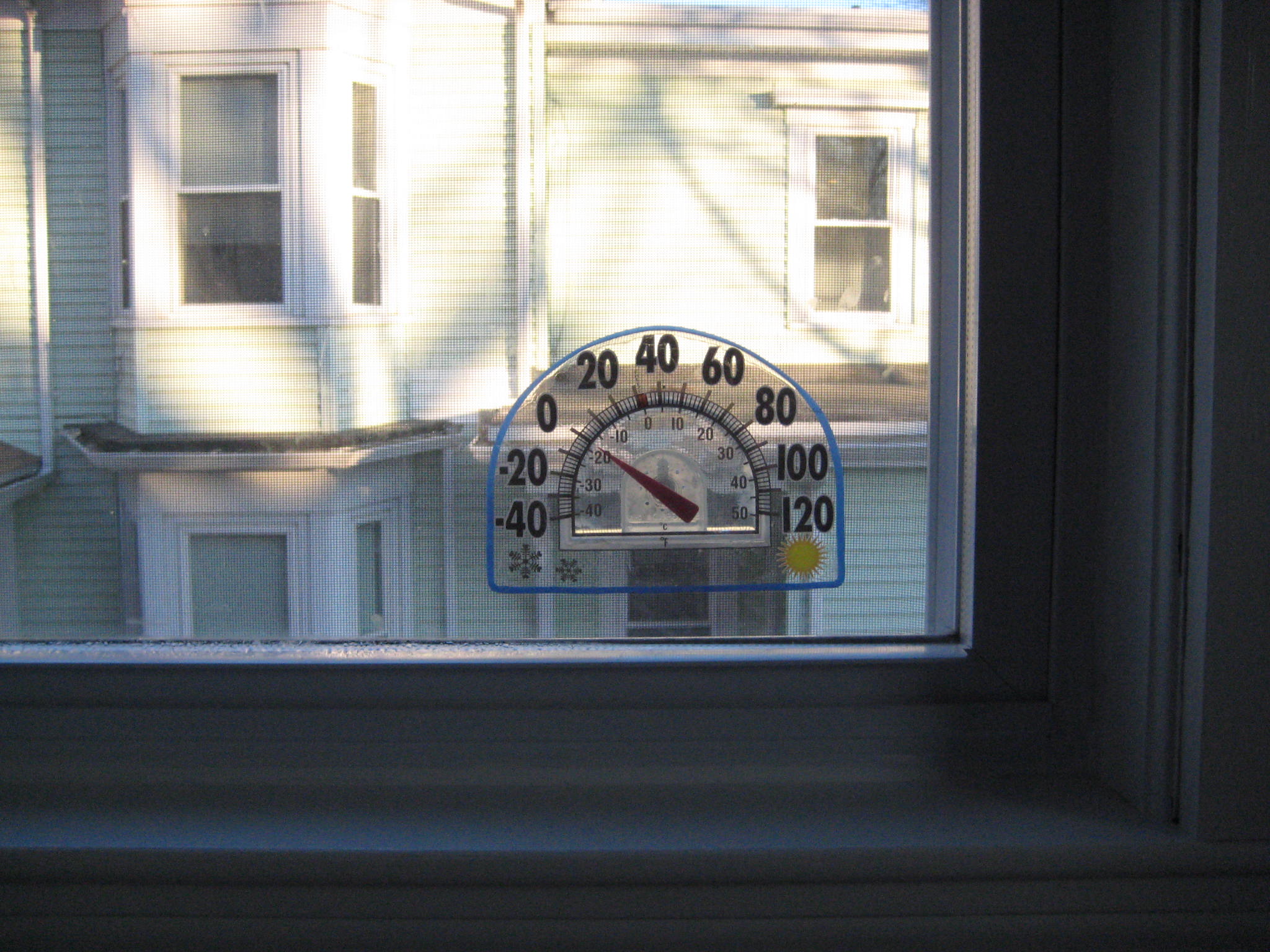
    Anyway, this is the time of year in New England that the walls start closing in on us. Today looks deceptive. The sun is bright and the pathways are clearer than normal, due to quite a thaw last week. One’s mind turns to wild adventures like walking to the library, or taking Grey and Thane somewhere that is not our house. But then one turns to the thermometer.

    Brutal
    Brutal

    Yes, that says 0 degrees.

    At a certain temperature, even indoor activities not in your own house seem daunting. Does it require taking the T? Parking and walking in? How many layers will you need to pack your toddler in, and how many of those will be appropriate once you’ve arrived in the safety of another heated location? At about 10 degrees, the cars stop keeping up, and are not comfortably warm. Easier just to stay put!

    But after a few days or weekends of staying put, you get very bored. Or at least my children do. They both love adventures and outings. It’s one of the guaranteed ways of getting Thane to settle when he’s grumpy. The last weekend of January it’s bad. The last week of February is downright grim. A winter storm in March? Heaven forfend.

    I’ll get Grey out in a little bit for aikido, and then he and I are going to a fundraiser for Haiti tonight. Thane is doomed to a pajamas day. Adam’s at aikido right now. There’s church tomorrow — always good to get out for.

    Last night I looked out Thane’s window. The moon was exceptionally bright — so bright it threw dark shadows of trees across the pale and blowing old snows. The shadows danced in the frigid wind. I find myself wondering how, before the niceties of blown-in-insulation and central heating, how did humanity survive in these winters? I hesitate to expose my healthy 15 month old to 10 minutes of layered, blanket-wrapped stroller journey. The native tribes who welcomed those first pilgrims had no walls or Goretek or natural gas heating. I know that part of the answer was that they did not all survive the coldest winters. But how miserable must it have been? How would they have longed for the walls which currently encircle me? The sensation of warmth and fullness must both have been so fleeting in winter, and warm spells nearly life-giving in their welcomeness. Meanwhile, I am surprised by the brief visit of chill to my fingers and toes, and consider it entirely optional and to be avoided.

    Modernity is a marvelous thing.

    Old miscarriages, years later

    I have this mental list of topics that I will write about here someday. You know, that day when I don’t have anything else to say, when I have time to write and think, and when I’m feeling particularly emotionally strong. Shockingly, that particular combination of events comes up less often than you’d think (although the “don’t have much to say” is a less unusual phenomenon).

    Probably top on my list of things I think about but don’t discuss are the two miscarriages I had between the boys. I thought about them and — unusually — talked about them at the time. But then as soon as I was out of the throes of emotional convulsion, it didn’t seem like quite the thing to talk about anymore. Really, nothing kills a conversation like the following:

    Me) Yeah, that week my husband got a new job, we placed an offer on a house, the Sox clinched a World Series berth and I found out I was pregnant! It was crazy!
    Them) Really? I thought Thane was only ____ old!
    Me) Yeah, the house, job and World Series worked out, but the pregnancy? Not so much.

    So, like millions of women before me, I just don’t mention it.

    I had two miscarriages, and they were both appallingly hard in their own unique ways. The first one took me completely by surprise. I got pregnant easily enough. It was a second pregnancy, so I thought I knew the drill. I was feeling a little better than I had the last time, so in my optimism I decided I was carrying a girl. She became Kitty, in my mind, after Schroedinger’s cat. (I had made a joke about how I was Schroedinger’s pregnant in that interim period when you know you might be pregnant but you don’t know if you are, and the moniker stuck. I found it highly ironic, later.) I was a low-risk pregnancy, so we didn’t do a 6 week ultrasound or any fancy-schmancy monitoring.

    At about 10 weeks, I saw a tiny amount of spotting. Sure I was being paranoid over nothing, I called my midwife and went in for an “of course everything’s ok” ultrasound. I laid down, and told the tech that I wanted to see the heartbeat. She did standard ultrasoundy stuff. Then she moved the screen away so I couldn’t see it. Lying there on the ultrasound table the back of my brain processed. She was super quiet — usually the ultrasound techs are chatty and informative. Finally she said, “I need to call your doctor. Wait here.” And I knew. I knew I knew I knew. By the time my midwife was on the line with the “I’m sorry but” I was already into the shock and grief and it seemed like I’d always known. I went home and called my parents, pacing the sunny back yard. I gamed that night, and laughed and cried.

    But. I was still pregnant.

    They didn’t want to “take care of it” right away because there was a tiny chance (I knew there was no chance based on my home pregnancy tests) that the dates were off and it was just too early to see a heartbeat. So, we waited a week. The second ultrasound showed the same thing: no heartbeat. No growth. Nothing. My doctor told me to schedule a D&C. But the more I thought about it, the less I wanted it to happen that way. Unconscious in a sterile room with people I didn’t know, having something done TO me? Did. Not. Want. I asked if I could have the chemical versions. They didn’t have experience with them or confidence in them. I put my foot down, refused the scheduled surgery time, and found a study that was investigating how the drugs work in women with missed miscarriages. I had to wait a while longer before I could get that, though. In the interim, I attended my brother’s college graduation, praying the whole time that the issue would just take care if itself. I felt like a ticking timebomb, pregnant with a child who was, to put it quite bluntly, dead. God, that was the hardest part. By the time I actually got the drugs to induce the miscarriage, I was so ready to be done. I was 12 weeks pregnant by the time it took affect.

    It had, of course, a huge impact on me. It took me a few months to feel like I was ready to try again. My previous cavalier attitude vanished. There were almost two traumas — the fact that I had already crafted this child in my imagination, my Kitty, and she was gone and would never be. And then the ordeal of enduring and arranging to no longer be pregnant — to have to be so intentional! — was a second layer of hard.

    Then came that weekend in late October when I found out I was pregnant again. There was no reason to believe I would have any further trouble. In fact, my problem seemed to be staying pregnant when I shouldn’t, not an inability to carry a viable pregnancy. But I’d gotten myself put in a higher risk pool. So when I showed up at my midwife’s office right after the first positive, we immediately started doing bloodwork and ultrasounds. The entire pregnancy was like a “That’s good. No that’s bad” joke. The second blood test came back with levels of hormones that were lower than they should’ve been. The ultrasound showed an embryo smaller than it should’ve been. But then the hormones would go up and the embryo would be still grow. After a week where it didn’t, I went in for the “confirming” ultrasound that I had another missed miscarriage and…. there was a heartbeat. Half the speed it should’ve been, but there was a heartbeat. I have, somewhere in a box, the CD that has pictures of that heartbeat. None of us expected it, but there it was, bright blue and red.

    I miscarried the next day, on my own this time. It sucked too. I never named that one, and I actually regret it. It’s as though without a name, I didn’t acknowledge the existence, and there WAS for a flicker of a moment, a heartbeat.

    There is, of course, a happy ending to my saga. Two months after that miscarriage, I got pregnant again. This pregnancy was text-book (except for some placental excitement we didn’t find out about until after a safe and healthy birth) and Thane is a thriving happy boy. I am not overwashed with sorrow for the children I did not bear. The grooves of sorrow are being washed away by the waters of time.

    So why do I share this? Why interrupt my happy mommy blog and talk about this ancient sorrow and risk nasty comments (which will, by the way, be deleted if you make them)?

    After my first miscarriage, I actually gave a sermon on the topic. I was never shy about talking about what was going on with me. And the number of women who came up to me, confessed their own past sorrows and their relief at knowing they weren’t alone, shocked me. The statistics vary, but I’ve read that one in four or five pregnancies ends in miscarriage. So every other woman you know who has two kids likely also had a miscarriage. I think that in this century of oversharing, the stigma and loneliness is diminished, but I still wanted to offer my story, and my support, to the other women out there who might be going through the same thing.

    You are not alone.

    What having children teaches you about yourself

    I’d like to show you something very revealing about my personality.

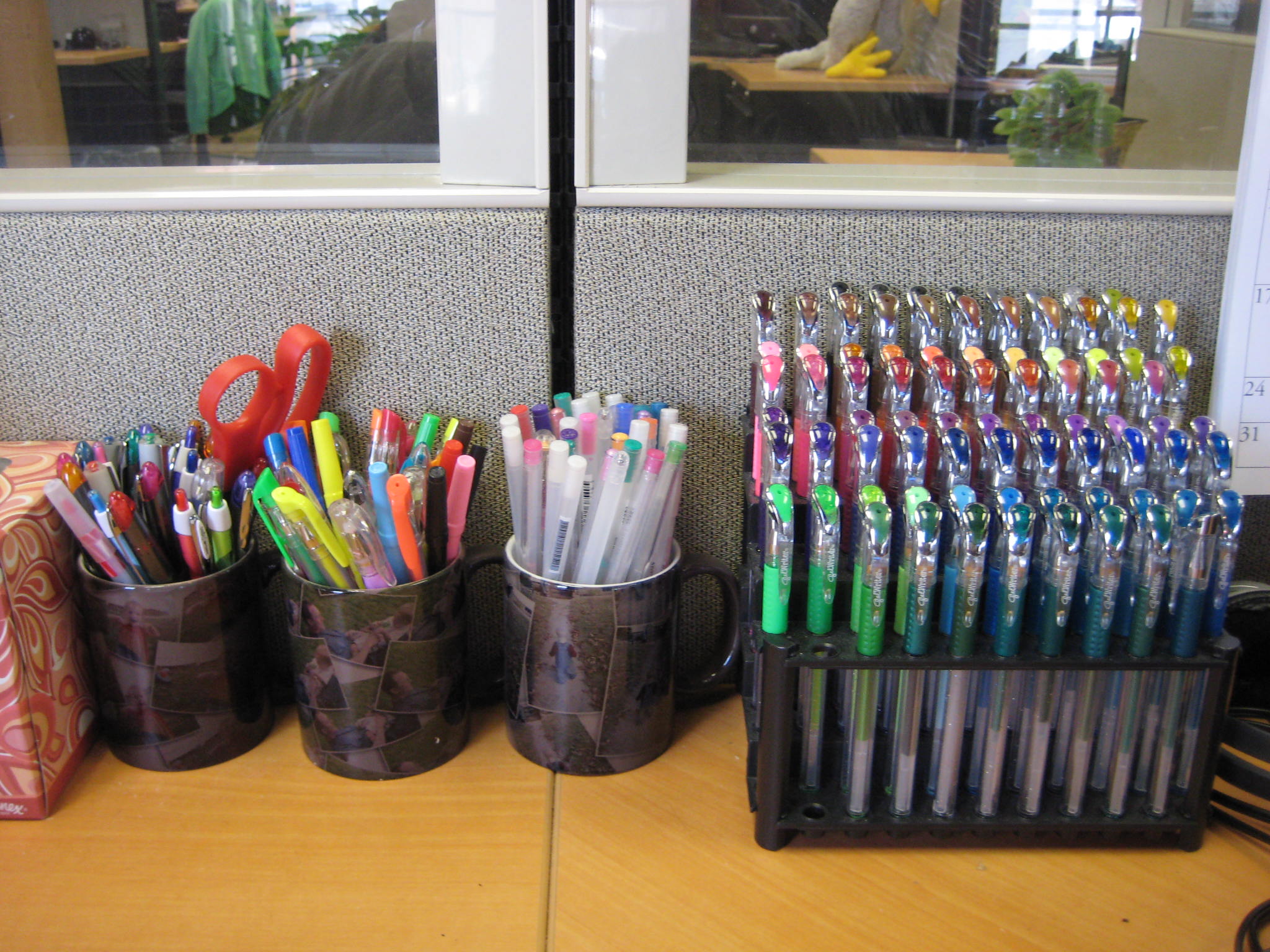
    This is a small portion of my desk at work:

    Need a writing implement?
    Need a writing implement?

    Notice anything? Anything spring to mind? Anything?

    Why yes, I might have a pen or two. Or, more likely, around a hundred, with almost no duplicates for style/color/ink type. I have more in my desk drawer. Really. I also have a larger collection at home. Really.

    I love variety, especially in color. I love having today be slightly different than yesterday. I love rainbows and bold hues. I think my general taste for adventure and a kaleidoscopic life most clearly represents itself in my love of colors, which most clearly represents itself in my love of exciting writing implements. This is not an aspect of my personality I’d thought much about. I figured that the poor sods with one or two Bics on their desk were too broke to get real pens, or were trying to show off their grownupness, or possibly developed emotional attachments to their pens. (I have certain pens I always use for certain tasks — I figured that’s similar.)

    Then I met my son Grey. A while back, we bought Grey these awesome LED nightlights. They come in 8 standard colors, but there’s a setting where you can make them morph non-stop between different colors. I can tell you in a heartbeat that’s what I’d choose, because it’s like not even having to make a choice, like getting them all in constant of variety. I would’ve loved that. So OBVIOUSLY that’s what Grey was going to pick, right? Right? I mean, who wouldn’t? Or at least he’d pick a different color every night, if the movement made him quesy? So teal and then pink and then green and then yellow?

    No. That’s not him. He likes the green colored lights. Not the changing, not the pink or the red. Not the white or the yellow. Just green. Every night.

    OK, I reasoned, maybe he like comfort and familiarity at bedtime. That makes sense, I guess.

    Now I’ve spent time watching him make art. He picks his marker. Often, it’s black, gray or brown. Then he draws with that one color, for the whole drawing. And then the next. He doesn’t color (as in make things colors) ever. He draws. Monochromatically. I can always tell what he did himself vs. what he was “helped” with. Does it have more than two colors? Someone else made him do it.

    After long consideration I was forced with a realization: Grey is a different person than I am. Shocking, no? He’s made out of parts of me, was created within my own flesh, has never known a world without me in it. But yet, where my desires blossom out into an infinite appetite for color, he is content with one, the same, not lacking.

    I suspect that when he is a grownup, if he has a desk, it will have one or two pens on it. They’ll likely be black, or maybe blue. It won’t be because he’s unaware that there are other colors, but because he does not desire other colors. It is, I have learned, not a universal desire.

    This may not seem like a big thing, but it helps me understand just a tiny bit what it means to be human. We truly, really, do not all desire the same things. What is my chief delight may not delight you at all. This is good to hold on to, that we may understand others are not wrong, but only see the world differently.

    My charity of choice

    Sometimes, figuring out the right thing is as hard or harder than doing the right thing. Take, for example, charity. Let’s say that you have $100 that you’ve decided to give to charity. Now what? What are your priorities? Do you give to the charity that is always bugging you (and, not coincidentally, spends a greater portion of the funds given to them on bugging people)? Do you prefer a local charity? Are you more interested in making sure people have food, or making sure animals in a shelter are not euthanized? Where would helping ensure a poor kid has a present under their tree fall in that spectrum? And what about the fact that $200 in a developing world can mean a matter of life and death for a child, where $200 barely scratches the surface of getting a politician whose policies you believe in elected? And then once you’ve decided that you want to help tsunami survivors in Indonesia, you need to figure out which organization is most likely to offer the greatest benefit to the actual survivors. This can be akin to rocket science.

    I’ve certainly wrestled with this question a lot. Our church is by far our largest donation, which is likely true for many worshipers, and will continue to be true. I also regularly send a check to WBUR. I figure they are worth as much or more to me as my subscription to the Economist, and in a very similar way, so I almost see that more as a cost obligation than a donation. After that, I usually support the Greater Boston Food Bank. When Bad Stuff happens, I usually direct donations to help to the Presbyterian Disaster Assistance because I saw their work in Mozambique and know that they go about really smart disaster relief. I always make sure I mark my check for general funds, because it’s much cheaper and better to prepare for disasters than react to them (like stockpiling supplies in areas that have historically gotten cut off by flooding, to name one example).

    But lately, I’ve been trying to “optimize” my charitable giving even more, and that’s required me to think about what is really important to me.

    I’m particularly interested in:
    *Decent quality of life for all the world’s people. To me that means at a minimum: basic healthcare, adequate water, sufficient food, safe housing, basic education
    *Sustainability/climate change/making sure we all don’t die and civilization doesn’t collapse
    *Reducing suffering for all people
    *I also have a real soft spot for parents not having their children die. Every time I realize that people in other places love their kids as much as I love mine — but watch them die for lack of resources — my heart breaks into little itty bitty pieces.

    Looking at those priorities, the most obvious solution seemsto be ensuring that every woman has only as many children as she chooses to have. Furthermore, helping women feel confident in having fewer children by making sure that the children she does bear have a good chance at surviving.

    In America, we take as given our right to only have as many kids as we want. Don’t want more kids? There’s a myriad of options from the pill, implants, condoms, surgery or abstinence. Many of these options are NOT available to women in other countries, including abstinence. In Africa, rape is an ENORMOUS problem. Women often do not have the right to not have sex with their husbands, and in many war torn countries rape is used as a weapon of war. For a woman without contraceptives in place, this often means pregnancies and children for whom they do not have food, resources or energy. Many women still die in childbirth, leaving all their children orphaned. For other women, their only chance of feeding themselves and their children is sex work, which can often lead to more children and AIDS. Finally, nearly TWO MILLION children a year die of diarrhea alone. So parents in some cultures may have many children in the hopes that some will survive to adulthood to take care of their parents.

    Shortly after I gave birth to Thane in a safe, well-stocked, well-attended birth in a sterile hospital with a bevy of medical professionals looking on, I read an article about an organization that was working to help make births safer by very simple safe birthing kits. You know, really advanced stuff like clean plastic sheeting and sterile razor blades to cut the umbilical cord. This same organization was also taking incredibly practical, sensible steps like creating ways to reduce diarrhea deaths and supporting the manufacture and distribution of female condoms that actually work and are affordable.

    I did more research on this organization, called Path and found out that it has Charity Navigator’s highest possible rating for how it uses donations.

    That’s when I decided that Path was my charity of choice going forward. For my giving priorities and values, this organization does the best job of making a real difference in people’s lives per dollar I can give. So for Christmas, the gift I asked for was the gift of reducing the number of parents who have to bury their children, or children orphaned by preventable causes.

    What are your giving priorities? How do you decide between local or international giving? How have you found the charities you most believe in? Does the complexity of the question ever stop you from giving as much as you otherwise might?

    These women love their babies as much as I love mine
    These women love their babies as much as I love mine

    Odometer moments

    I’m a big fan of this time of year, media-wise. My non-internet media consumption is pretty much limited to NPR, the Economist, and Dirty Jobs marathons on Discovery (watched while folding the laundry). This time of year NPR starts running stories you KNOW they recorded in October about breeding stocks of White Rhinos and the Economist totally throws in the towel, writes four page spreads on the history of Rice in Japan or the Ponzi Scheme that is the US (all actual examples) and takes a week off.

    We’re all given this odometer moment, as the number ticks over, to think back and head. Given that most folks consider this the end of the decade, it’s a bigger odometer moment than usual.

    So here I am, taking stock of the year past and the decade past.

    The decade past is pretty much my adult life. I think about where I was 10 years ago. I was about to get married, just finishing college, and completely unclear about what I wanted to do when I grew up. Now, I’m happily married, two kids, decent career, and completely unclear about what I want to do when I grow up. In the last ten years I got married, stayed married, have gone through three jobs, and three new homes, bought a house, bought two cars, got pregnant four times and gave birth twice. Since 2003, I’ve documented every detail in painful minutia.

    In those 10 years I’ve made mistakes and grown oh-so-much, but I regret pretty much none of it. I’m not sure there’s a single thing I’d go back and make totally different.

    Then there’s the looking ahead. Where will I be in 2020? I mean, we’re already impossibly into the future. Will I have my flying car yet? Or at least an electric/hybrid? But in many ways, the outlines of my hopes are much clearer than they were in 2010. I entirely anticipate still being gaga for my husband. My eldest son will be 14, and we will have some insight into what kind of man he is growing into. My Thane will be 11, still a child. My mortgage will still be several eternities away from being paid off, but my student loans will be done. Hopefully, I’ll have renovated the bathroom by then. Maybe I’ll have done that master suite that I daydream about. But where will I be professionally? What great surprises will life hold? What labors and joys will the coming decade bring? Will I still be documenting it all in painful detail (probably)?

    And of course, there are the great left-turns life takes. You get a phone call asking if you’ve ever considered going to Mozambique. Or it turns out your child is an incredibly gifted, er, something (musician/athlete/web entreprenuer/face painter) that requires lots of practice (as long as it doesn’t involve ice rinks, I’m happy.). Or an opportunity comes that cannot be passed by. Or a tragedy visits. Or there’s an unanticipated additional child.

    I work full time, am an engaged mom, get together with my friends as often as possible, and do a lot with my church. The result of this is that I feel as though I keep my eyes down, and focused on close objects. My thoughts and speech run with the details of daily living. I try as often as I can to raise my eyes and look to the horizons. It is that rising of perspective that make art, literature, music and philosophy so precious. Writing, for me, offers a chance to step back and examine my own life from the larger perspective. Whenever I do that, I feel much happier. The broad strokes of my life are so joyful, even when I might be tired, sleep-deprived, annoyed and snot-covered.

    It was a good decade. It was a good year. Here’s hoping it was for you too. And for all of us, past reasonable expectation, may the coming year and decade be full of joy.

    Joy cometh in the morning
    Joy cometh in the morning

    The other side of advice columns

    I read a lot of advice columns. I love them. I’m not sure why, but I regularly read five or so advice columns a day, and have a few weekly ones I look forward to. One of the universal tropes of the advice column (and, I suspect, hard-to-solve problems humans generally experience) is what to do in a relationship that isn’t working. For example, perhaps there’s a friend who never pays their share of dinner, or is a complete downer, or says racist things. Often there is a two step solution: give them a chance to know what is wrong and change, and then if they are unwilling or unable, end the relationship. If the relationship in question is a family relationship, there’s usually a three part solution: warning, cutting down on exposure and cutting off. If there’s any abuse, the advice is pretty much always “leave now”.

    I always wonder about the other side of that advice. I don’t know many people who know they are bad people. (Actually, in fairness, I don’t know many bad people at all.) But I suspect that these other people — the mooch, the depressing, the racist, the abusive… that’s not how they see themselves. Instead, from their point of view, they might be the clueless, the one the world treats unfairly, the funny joker, the person who others have always wronged who has to be careful not to get hurt again.

    For example, recently Annie had a couple write in asking why no one ever came to their parties. “What is wrong with other people that they don’t come?” the message implies. For the next 2 weeks, nearly every column has run a list of reasons: out of control pets, out of control children, messy homes, unlikeable personalities, racist jokes… this person is on the other side of countless advice givings that ask “Why do you spend time with people you don’t enjoy?”

    This raises two conundrums for me. First, what do I not know about myself? How often have you told someone why you REALLY don’t see them anymore? “I’m sorry, but you’re too negative and you get me down every time I’m around you” isn’t something we say. Or “Every time I’m with you we end up gossiping and I feel ashamed of myself later”. Or “With everything you say about everyone else, I wonder what you say about me”. Or “Your conversation is equal parts awkward pause and awkward discussion.” Instead, we’re busy, or take too long to get back to someone. But I happen to know for a fact that I am not perfect (I know! Please, moderate your surprise.) What do my friends put up with anyway? What encourages people to keep ME at arms’ length that I do not know about and might not be able to control if I did?

    The second issue is what happens even if you are self aware. Imagine that you’re 30 or so, intelligent and perceptive, and just not fun to be around. You look deep inside, and discover that yes. You are not a fun person. People don’t enjoy spending time with you. You get in fights with people a lot and end up hurting feelings. So you have tried to change… but it’s almost impossible to act contrary to your nature all the time. You get tired, under pressure, tempers run high and you can’t be who you are not. And things blow up. What then?

    The essay I wrote, lo these 15 years ago, to get into college was a discussion of my finite right to be proud of who and what I am. I am as much a product of my genetics and environment as every other human: the jailed drug addict, the self-centered jerk, the runaway prostitute. To the degree their responsibility for their current lot is mitigated by their circumstances so, in fairness, is mine. I got lucky. I didn’t screw it up, granted, but I got really lucky in order to be who and what I am. It is through no merit of my own that I don’t seem disposed towards depression, or get along well with people, or can follow directions. I think I’ve done a decent job in those circumstances where my free will stood me in front of two paths, but there’s always been a good path I was capable of following.

    I’ve never come up with a satisfactory “then what”. I try to remember this, when I deal with the congenitally unpleasant — especially when it seems like they are trying their best to make the most of the hand they’ve been given.

    What do you think? How do you deal with people who just aren’t fun to be around? Do you suspect you’ve ever been on the other side of this dynamic?

    BONUS:
    For your reading pleasure, here are the regular advice columns I read

    Dear Abby the archetypal advice column, in its second generation. Expect to see lots of PSAs, advice to go to counselling, and horrors about modernity.
    Annie’s Mailbox is almost identical to Dear Abby. One of my favorite moments was when they simultaneously answered two different sides of the same dispute.
    Carolyn Hax is a more modern, informal style. She tends to ask more questions, and has a slightly longer format, which is nice.
    Since You Asked the writer is currently on medical leave for cancer treatment. I usually only read the problems (which are largely unedited and novella length) since I find his answers wishy washy and annoying.
    Dear Prudie is probably the best of the lot. She has enough space (unlike the news paper columnists) to really address issues, rarely goes down the “talk to a qualified professional” route, and usually has an interesting perspective which I may or may not agree with. There’s a fun chat on Mondays, a weekly advice video, and a column on Thursdays.
    ETA:
    Advice Smackdown. How could I forget it? I love everything Amalah writes. This one goes between serious, important, and makeup-related. She would totally be my choice for moisturizer conundrums, but is the sort of writer who can make moisturizer hilariously funny.

    Am I missing any good ones?

    What Santa is packing in his sleigh

    Grey's letter to Santa
    Grey's letter to Santa

    My son is four years old this Christmas. If you are old enough to find your way to this blog, you’re probably old enough to be told the truth. I was four the year I found out that Santa isn’t quite as corporeally real as we pretend. When I was three, many years prior, I had a desk that had gotten left behind when my parents packed us into a station wagon and drove from Atlanta to California by way of Canada. Mom and dad were never too keen on that “Fastest way between two points” stuff. I digress. I yearned for this desk. (Full disclosure: I STILL yearn for that desk in some tiny part of me and am working very hard not to buy Grey a desk-like-object because the four-year-old in me wants that desk.)

    Anyway, it was made abundantly clear to Santa (and daddy) that I wanted a desk for Christmas. My sister and I shared a room in our small house with the walnut trees outside. Christmas Eve came, and two very excited young girls gabbled and bounced sleepless in their beds. I had nodded off when my sister woke me up. A sound of thumping was heard through the wall. “He’s here. Let’s sneak a peek.” And so with infinite subtlety, we snuck open the door and poked rumpled blonde heads out to see the Man Himself.

    And there was my poor father, nursing a stubbed toe from placing my desk under the tree. We understood immediately. The door was quietly closed, and we retreated to discuss strategy. We agreed on a pact of silence.

    I don’t know how old I was when my PARENTS figured out that I had figured out what the game was. It never made it any less fun to play, but I’m glad they didn’t pretend any harder than they did. I would’ve known the lie. Because I wasn’t really looking for inconsistencies, I hope my parents didn’t have to work too hard. (No buying special “Santa” wrapping paper, for example.)

    I’m thinking of it this year, of course. Grey wanted to know if he was sitting on the REAL Santa’s lap. I assured him without hesitation that he was. He announced to me the other day that he’s figured out his goal career. He wants to be one of Santa’s Elves and make presents. He’s ok with the uniform constraints, but admits that he might miss me every once in a while. (All humor aside: it was surprisingly well thought out with the data he had. He had considered quite a few consequences and outcomes of this decision!) We are at the very height of Santa-joy: old enough to make cookies, young enough to not consider the physics of Christmas eve flight.

    I’m also doing the last minute planning for the presents. I probably need to do a present-review and see if I’m sadly lacking in any category. You know, are there books, crafts, obnoxiously noisy plastic toys, stocking stuffers, and most of the items on his and Robby’s Christmas lists? In future years, I’ll need to make sure I have present-parity between the boys.

    One of the things I’m doing for both boys this year is new-to-them toys. Thane will be getting, wrapped up, some of the toys I set aside years ago from Grey’s room. Why not? The only difference between those and a new toy is packaging. Grey will be getting his first real Legos. We have roughly 30 – 40 POUNDS of Legos from my husband’s childhood. Seriously. A huge duffel bag and a big plastic garbage bag FULL of teeny tiny Legos. At current market prices, that quantity of Legos would cost thousands of dollars. (Seriously, have you SEEN Lego prices lately?) I got overwhelmed by them, and just picked out a nice pile for him.

    The more I think about it, the more I think I’d like to give the boys all their presents without packaging. In our culture, packaging marks the difference between “New Presents I Bought For You” and “Presents Of Unknown Provenance”. When my mother-in-law scores a real find for me in thrift stores, she’ll often say, “And it still has the tags!” since that proves that it’s new. When we give gifts we use that packaging as a marker of newness. It actually gets in the way of the gift experience, though. “Wow, a truck! OK, now give mommy 20 minutes with wire clippers and you can play with it!”. It also conditions our kids to think that proper gifts come with original packaging and proper gifts are new.

    I don’t want that. If my son was holding out for new Legos, he’d get about 15 of them for $30 bucks. (Seriously, this set has under 300 pieces for $150 bucks and is not that unusual pricing-wise.) By being ok with pre-loved Legos, he’ll get a big bag for, um, free. I would like that to hold true as my sons get older, too.

    I think I’ll make it a point for things that are unlikely to be returned (no sizing issues) to remove the packaging before wrapping it. Yes, it means my sons won’t know when the toy they’re getting is new. But hopefully it means that they’ll evaluate their toys on whether or not it’s fun to play with, and not whether anyone’s ever played with it before. In some tiny way, perhaps that will help dial back the commercialism of Christmas.

    What do you think? Do you always keep new toys in their new packages? How hard to you work to maintain the Santa mythos? How old were you when you found out? How did you take it?
    Grey's letter to Santa

    Hospitality

    When you, dear reader, think of Christian values, which ones do you think are at the top for importance? I’d forgive you if you said sexual purity — some days it seems like all you ever hear from Christians in the media is talk about sex and how it’s bad. But no. Jesus says hardly anything about sex.

    Some of the values I see most when I read the New Testament are:
    – Being loving to all, including yourself
    – Not being a hypocrite (especially not a religious hypocrite – for an example, Matthew 23:13 “‘But woe to you, scribes and Pharisees, hypocrites! For you lock people out of the kingdom of heaven. For you do not go in yourselves, and when others are going in, you stop them.”)
    – Sharing what you have
    – And today’s topic… hospitality.

    As I understand it (and it should now be noted that I != Biblical scholar), hospitality was a critical virtue in the ancient world in which the Bible was written. There were few inns, and pretty much no restaurants, quickie-marts, C-stores, or even cars to take shelter in. The earlier you went, the rarer the inns were. So if you had to go anywhere, you relied on hospitality and that hospitality was a sacred rite and obligation.

    For example, in Genesis 19:6-8, Lot welcomes two angels into his home: “Lot went out of the door to the men, shut the door after him, and said, ‘I beg you, my brothers, do not act so wickedly. Look, I have two daughters who have not known a man; let me bring them out to you, and do to them as you please; only do nothing to these men, for they have come under the shelter of my roof.’” Lot’s obligation as a host here trumps his obligation as a father and caretaker to his daughters (harsh, huh?).

    Throughout the New Testament there are stories of hospitality. Jesus’ very first miracle (by tradition — this miracle is only recorded in John) was helping a groom out of a predicament when the wine ran short at his wedding – a failing of the expectations of hospitality. Jesus then goes on the ACCEPT the hospitality of the unacceptable. He sits down with and eats meals with sinners, prostitutes, soldiers, tax collectors (who were probably as popular as drug dealers are for us), turncoats and traitors. When the disciples go out to spread the good news, they are told to shake the dust off their feet from any town which does not offer them appropriate hospitality.

    Hospitality is harder than it was, because we’ve lost the habit of it. We don’t invite the homeless to come eat dinner with us because they might be sociopathic kleptomaniacs who will sleep in our front lawns for the rest of our lives if they know where we live. Strangers to our land, the aliens who also populate the Bible, do not expect a welcome to our homes. Instead they book rooms in Motel 8 and buy food from the “Excellent Mart” we’ve never been to; and we glance away across the gulf of culture at each other on the rare instances our paths cross.

    I think about this imperative to welcome and nurture when I set the table for company. We do sometimes feed others, although it is usually friends. I wish that I had more courage to be more outrageously hospitable, and welcome the too-talkative, the kind of weird, the left out, the unknown to share a meal with my husband and I, and our two screeching sons. I meet people in those few margins of intersection, and I wish it was ok for me to say, “You look cold. Would you like to come in and have some dinner? There’s plenty.” I’m afraid to. I’m afraid that they will be offended. What if they’re perfectly well off and see my offer as pity? I’m afraid of the disruption in my tightly slotted life. I’m highly cognizant that culture is constantly telling me to be more afraid than I am. I’m supposed to teach my four year old “stranger danger” and it’ll be all my fault if he’s abducted by a dangerous pedophile because I never taught him that people he doesn’t know are enemies until proven otherwise.

    Still, I’m haunted by the hospitality I don’t offer. There was the man and his two children, trudging up the hill our house sits on too late at night. Where was he going? Did he have a place? He seemed so quiet, and they so subdued. Would he have welcomed some warmth in the darkness, or was he just going on an evening constitutional?

    There was the other man with the Santa beard — his name is Hal — at the grocery store. He was there the entire time I was. I bought $175 worth of nutritious produce, milk, meat, cereals — a veritable bounty. He, after looking in the scratch-and-dent section and walking all through the store… he bought a jar of sauce. Was he lonely? Bored? Hungry? Broke? Did he have a place to go? I wish I had the courage to ask him to come home with me, and I would fix him up a nice dinner and we would talk and he could be filled with company and food.

    Did you know that is simply not done? And as a woman and a mother, it is particular verboten for me to do it. Risking my self (and my sexual purity and property) is bad enough. Exposing my sons to such risk, and my husband to such inconvenience? Keep it to a smile and small-talk. Even that, I’m told, is risky and only marginally appropriate.

    I’m afraid to even pray for the courage to offer hospitality, because what if that courage arrives? Never ask the Holy Spirit for gifts you will not accept.

    I don’t know how to end this rather rambly essay on a snappy note. I will say this, however. If you tire of the tropes of Christianity, why not pay attention to a different virtue this holiday season? Instead of being sparkly pure and blameless, like I know you are, why don’t you try to be courageously hospitable? Risk a little in the cause of kindness. Whether that’s eye contact where you would usually look away, or asking the homeless person you see what their name is, or even inviting someone to share your meal with you, tell the tsking voices to be silent for a moment.