Sons and brothers

Brothers in Legos

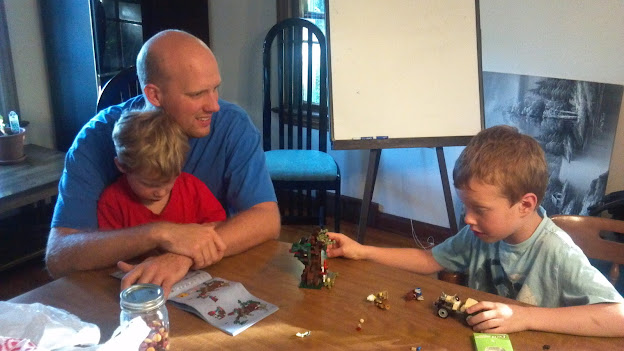
At some point, as a parent, you come to realize in a non-abstract manner that your multiple children are, in fact, siblings to each other. This seems obvious. If you and your partner have two sons, then those sons are brothers. This is how it works, right? But there comes a moment when you watch the children you bore and love interacting with each other, and you realize… they are BROTHERS. What a fraught, laden word that is. How powerful. How overlaid with history, legend, tradition, meaning and poetry.

We few, we happy few, we band of brothers;
For he to-day that sheds his blood with me
Shall be my brother; be he ne’er so vile,
This day shall gentle his condition:

Shakespeare – Henry V

My sons are both old enough now, at 7 and 4, to be real people, and to have real personalities and real relationships. Perhaps the most remarkable of those relationships is the one they have with each other. Thane, at four, is still little enough to sort of take things as they come. Grey is a fixture in his life: the unfairly-good trader of Legos, the master of comic-drawings, the owner of the right-hand-seat in the car, the bossy one. Grey is the person who is always in his day and in his life, and without whom life would not be complete. Thane has never gone so much as a day without his brother. But you don’t think too much about that, if you are four. Grey is a fixture, an assumption in Thane’s life.

Boys with ponies. Both of them had very sticky-upy hair the next day.

Grey, on the other hand, sees his brother clearly, and understands what it is to be a brother. The other day Grey was over the heat-vent in the kitchen working on his homework, I was at the dining room table and Thane was in the living room playing with Legos. Grey, oh so old, raised his head from his 1st grade papers and said to me, “I love listening to Thane play. He’s so cute. He has a great imagination.”

Grey gives thane a “Good boy noogie” for eating a bite of his sandwich. This actually motivated Thane to keep eating.

Grey has, this year, discovered the truth about Santa Claus. I watched him as he listened to his brother talking about Santa, and what he hoped Santa would do this year. And I saw, writ plain on my son’s face, his sudden determination that nothing should take the mythos of Santa away from his brother. That night, he prayed that Santa would bring Thane all the things he wanted. Since then, he’s been an (over) zealous guardian – shooting me dagger-like glances and not-so-whispered rebukes for any remark that might lead to the unveiling of the mystery.
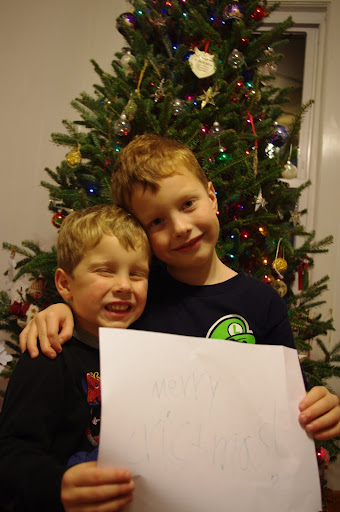
Thane and Grey wish you a very Merry Christmas!

My eldest son loves and needs his younger brother greatly. Grey hates, HATES to be alone. Despises it. It was always the worst punishment I could unleash upon him – to send him from the crowd into a quiet room by himself. Thane provides his brother a tremendous service by being another person. Grey is wily about talking his brother into coming upstairs with him when he needs to go up. Grey wakes Thane up in the morning to come down to breakfast with him. Thane prevents Grey from experiencing the horrors of solitude.

They teamed up to demolish this popcorn

For a few months now, Grey’s been waking up in the middle of the night, scared. For months, I’ve woken up with him sleeping at the side of our bed – having snuck in at some point over the night. But the other day I went to kiss Grey good night and found his door wide open and his music blasting. He was entirely missing from his bed. He wasn’t in my room. I couldn’t find him. I went in to see where he was, and found him cuddled next to Thane. (Grey has the side next to the wall and away from the door. He assured me later that it wasn’t so that monsters would eat Thane first. Really mom!) And for the last few weeks, this has been how they have been. Grey goes to sleep much easier when he’s not by himself, with his imagination in his room. There’s no nightlight. There’s no finding him falling asleep on his Calvin and Hobbes. And the boys look so happy together.

Remind me why these kids have two bedrooms and two beds?

God willing, these two boys will have each other for the rest of their lives. In the order of the world, they will fight, slip information to each other, back each other up, stand up for each other at weddings, godparent each other’s children, complain about us at Thanksgivings, and finally stand next to each other – again – at our funerals, recounting their funny memories of their crazy parents. I hope they always have this friendship.
Love that will not

In August, I packed my boys into a car an went on a road trip to Middletown, New York. My husband was off killing orcs and aliens at Gencon in Indianapolis. My mouth felt dry as I belted the kids in the car. I felt tired and very grownup and a bit alone as I drove across I90 through thunderstorms in the dark.

Legos with Unka Matt

I’d been meaning to visit my brother for months. He was installed as a part time pastor in a small congregation in January. For the first time, my brother and I were both out of school, both professionals, both grownups. (Although I will never confess that to him! Tragically, he reads my blog.) Saturday, we schlepped the boys around. I felt bone-weary, the way it’s only safe to do around family. We watched tv, went out for lunch, watched JourneyQuest, ate at the Texas Roadhouse. Thane fell asleep in the booth to the dulcet tones of “Boot Scootin’ Boogie” with the Yankees on the overhead tvs.

When the night was finally quiet, my brother and I talked. There is an ease that comes to talking with one of the few people who grew up in the same strange world you did: this is the great consolation of family. I never have to consider my words or my references. I have this narrow set of humans who also grew up in a town of 400, know the legends of Tuffy Suter, sang the old old hymns that even the elderly have forgotten in the mountain church we attended, consider Georgette Heyer, DE Stevenson and Patrick McManus to be canon, know the winding paths and theatrical finer points of the Oregon Shakespeare festival, and think of “Head Smashed in Buffalo Jump” Alberta as a top-tourist-destination. This is what it means to be family.

At some point, we started talking about music. I have an odd relationship with music. I love it, of course. I’m particularly fond of classical music, but I rarely listen to it. (I like to listen to radio with voice, in truth.) I do end up listening to a lot of folk/celtic music, but have no reliable sources of new introductions to music. I have always considered myself not a person who listens to popular music. You can have a lot of fun plumbing the depths of my ignorance, if you choose.

So my brother said, “You have to listen to Mumford and Sons” and he put on “Sigh No More”.

I was hooked. In return, I turned him on to Maddy Prior and Steeleye Span.

I immediately loaded “Sigh No More” onto my various devices of digital distribution and have not stopped listening since. The voice, the banjo, the lyrics have embedded themselves into the warp and woof of this time of my life, and I shall likely never hear them without being once again at this time of my life when my sons were young, my parents healthy and my love strong. The title song, in particular, speaks to me.

Love that will not betray you, dismay or enslave you. It will set you free to be more like the man that you were made to be.

“Yes” I think. “That is the standard to which we should hold anything we call love.” I find myself wondering, is that God’s love? Is that my love for my sons? Is that my love with my husband? Does the love I give conform to this high calling?

May I confess that I was shocked _SHOCKED_ when their next album beat out Bieber in popularity? I hadn’t intended to be listening to music that was actually popular. Ah well – so were Simon and Gurfunkel in their time.

I’m looking forward to delving the depths of their music. So far, I have what shows on the surface of the songs, and questions they raise. Are they Christian? Use to be Christian? Using Christian language? They are certainly not priggish. (Hey mom, that’s a warning that you might not totally like them. Let’s just say some of their songs cannot be played on radio.) There are allusions running through their music to Shakespeare. When you tie those allusions out, how do they change the meaning of what I hear?

I deeply appreciate this new music. It makes me aware how well I know the music I listen to, and how my ears seek out new songs. So… have you heard these guys? What questions do they raise in your mind? Do songs tie you to place-in-time, like they do me? Do you ever try to manipulate that, by introducing new music to something you’d really like to remember? And critically – who else should I be listening to?

Great Justice

Justice
Justice

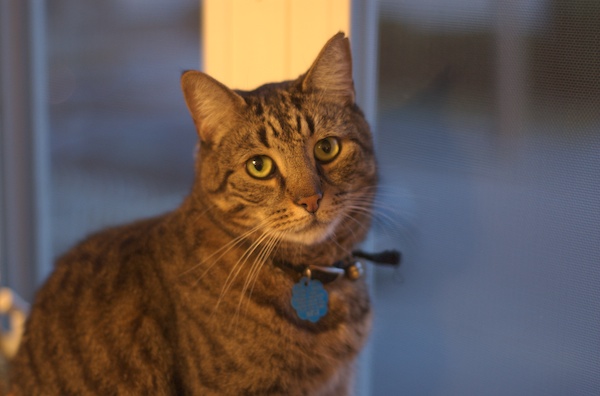
Back when dinosaurs roamed the earth and I was a newly-wed, I talked my husband into getting a cat. A friend of ours had a connection to a woman in Connecticut who ran an informal shelter, and we went there to select the animal that would be our companion. It turned out not to be much of a selection process: Justice hopped up on the counter and went to lay down in the cat carrier. The message was clear: stop yapping and take me home with you.

We did.

A young Justice
A young Justice

I am oh so tremendously sorry to tell you that Justice died today, and the universe is a bleaker place for it.

Justice was a remarkable cat. Many of you knew him well. He was rescued and neutered a little late in life, so he had quite a bit of the rakish Tom left in him. He was without exception the most gregarious cat I’ve ever met. During parties with 30 or more people, while his sister was hiding under the bed, he would be in the middle of the crowd, hamming it up and demanding scritches from whomever in the room had the worst allergies. He was impossible to ignore, and would drape himself over you, your keyboard, your book or whatever triviality you were attempting.

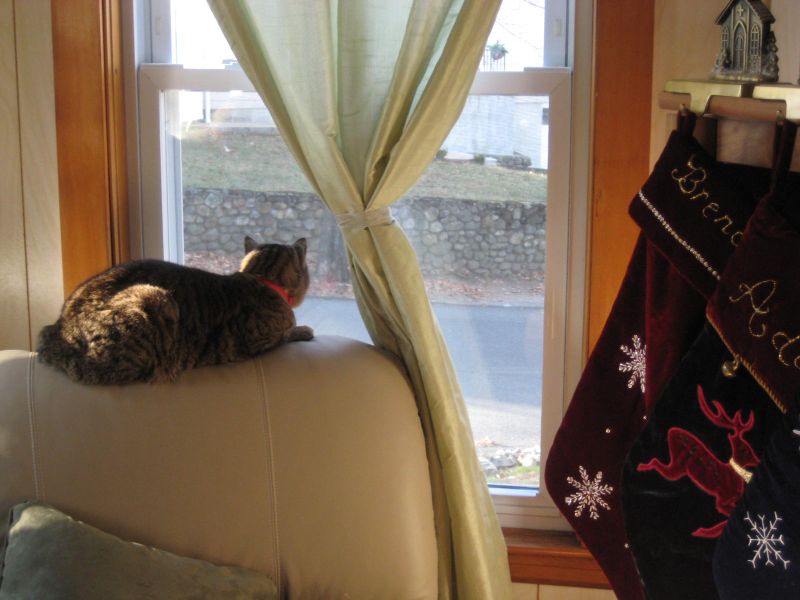
Justice was always in on the action

Justice was a very adventurous soul. When we originally got him, he started going crazy in the confines of our apartment. We got Magic to help burn off some of his kittish energy. It didn’t work. He was very unhappy as an indoor cat – always trying to escape and looking longingly out windows. When we finally accepted that our grief tonight was a price we would be willing to pay for him to have the life he wanted to live and let him outdoors, he was much, much happier. He followed us on walks around the neighborhood. People would stop us and ask if we had him on a leash – but we didn’t. He just followed us non-chalantly, as though we happened to be going the direction he was headed anyway.

Do you like my snuggly Justice-scarf?

Justice excelled in all catlike arts. He was an excellent hunter – often expecting us to be impressed by the rabbits and squirrels he offered to us. He spent many an hour napping in a finely cat-like way. But oh, he was so gentle and patient with people. He excellence with children was unsurpassed. He never offered violence at any but the most outrageous treatment. He liked to sniff the heads of babies to see if they were tasty. He was incredibly patient with kids, and their attempts to play with him.

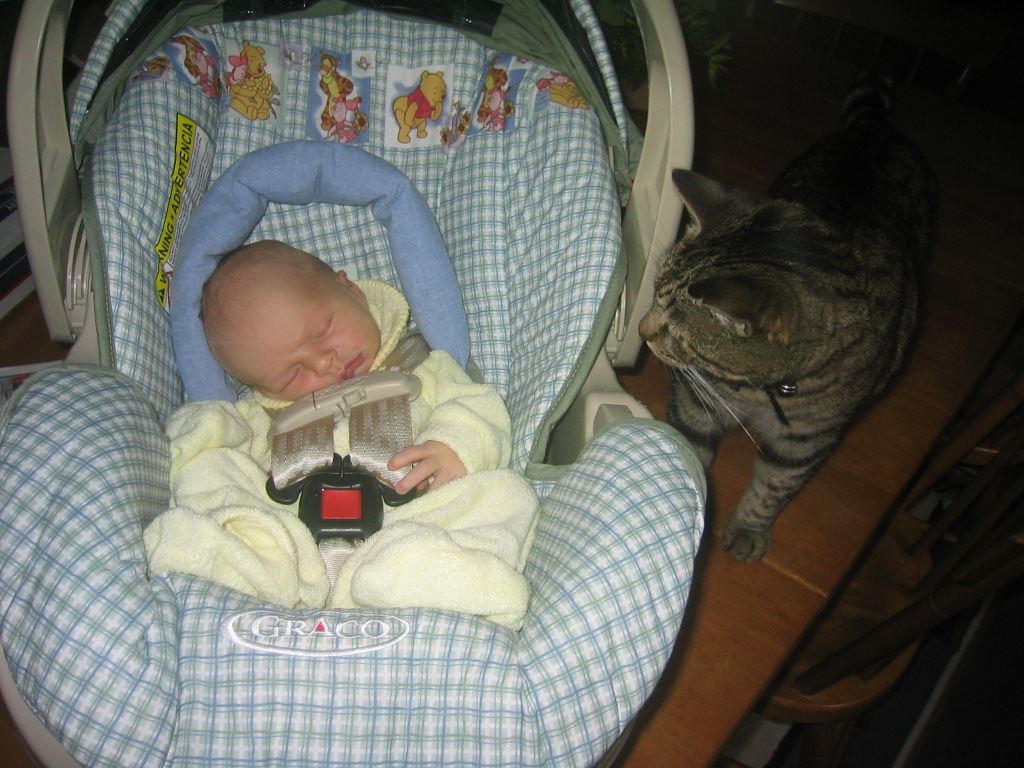
Justice welcomes an infant Grey home from the hospital

Justice had his trials of course. There was the long bout with urine crystals that ended up with a full abdominal surgery and ignominious shaving. There was the broken leg. The tattered ear predated our acquaintance, but bespoke a more than passing familiarity with pugilism. He bore them all with great dignity and pride: charming the staff of the veterinary clinic, and making friends wherever he went.

He was well loved throughout the neighborhood. When we left our last place, the neighbors brought over the toys they’d kept for him, and the treats. He invited himself into many a home, assumed his place on the guest list at many a gathering and was a well known local figure.

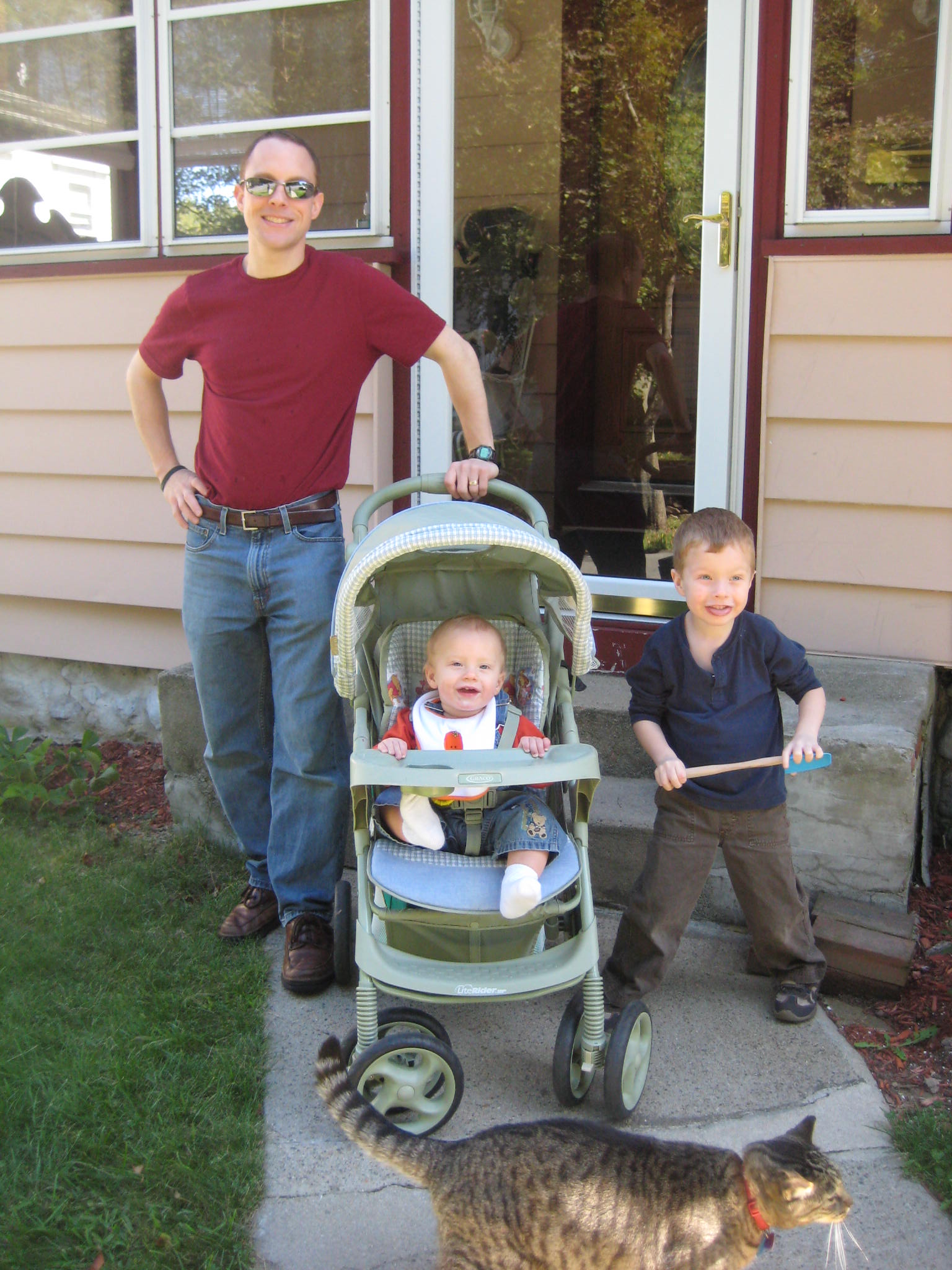
Justice joins the family for a walk

Last night he slept at my feet – crowding me so that I had to contort myself in bed. The night before, I’d cuddled him as I put him on the porch so he wouldn’t follow me on a longer walk that would take him outside his territory. Tonight, he has left us and is gone. I confess myself completely bereft.

Last night, I went to Grey’s back to school night. In one drawing hung on the wall, Grey drew four things: one thing he liked to do (read), one thing he liked to eat, I forget the third. But the fourth was one thing he loved. And he drew a picture of his beloved cat Justice. When I sat the brothers on the couch and told them their cat was dead, Thane did not really understand. But Grey did, and he burst into tears. “He was my best friend,” he said. “I loved him so much.”

I know child. I did too.

May you never be forgotten, beloved friend

Roller Coaster Ride

It’s taken me years to finally figure out the rhythm and the schedule of the grownup me. It’s hard when you leave behind the beginning and conclusions, the milestones, the counting down of your school life. All of a sudden, there are no logical breaks. You do not get a fresh start every fall. You do not matriculate, commence or otherwise change. It feels as though life is now a blur of barely differentiated days: a gradient instead of an ordinal scale.

But finally, after more than a decade of careful attention, I think I have it figured out. Beginning in January is a long, slow slog up the tracks of the year. We go seven or eight months with only a handful of three day weekends. There’s a particularly appalling stretch from mid-February to the end of May when every single week has five workdays in it. Before I had kids I resented this time of year as boring, undifferentiated, tedious. Now I find it enjoyable in its own right. That slog-uphill time is the time of year when not every weekend is claimed, when I have time to read novels or play video games, when yes-I-can-get-together-this-Friday happens. You spend a weekend doing something that doesn’t Make Great Memories and somehow it doesn’t matter as much. I mean, it’s not like you wasted great weather this weekend.

As the weather warms, the snow melts and May arrives, things start heating up. Suddenly, “it seems like a pity to waste” re-enters the vocabulary on Saturdays. I realize that the next three weekends are fully committed. Whole blocks of the calendar disappear under markings like “Camp Gramp”, “Gen Con” or (this year) “London”. These are, of course, completely awesome things. Summer is the high season for adventures. The pictures pile up on the memory cards, the laundry is carefully calibrated around how many bathing suits my eldest son has (and his !$@#$ summer camp t-shirts that must be worn twice a week) and take-out menus get a good workout. But still, there’s that feeling of space in life. It’s summer. Vacation is coming. This is going to be great!

Sitting in Ashland, sipping my 93rd cup of coffee at Dragonfly while reading “A Civil Campaign” (again), I had this sensation of being on a roller coaster. All winter and spring it had chugged its way up the mountain of tracks as I gazed around at the altitude-revealed scenery. That moment in Asland we were at the very top of the tracks, and only the weight of the cars behind us kept us from our full plummeting speed.

So today… wheeeeee!!!!!

From here to 2013 is a crazy ride. I’m conducting a wedding on Saturday. Adam goes to Gencon soon. I have approximately 93 batches of jam to make. We’re camping again. School starts. My MIL arrives. My birthday happens. I get started on the labor of love that is my Christmas cards (yes! In September!). Then Grey’s birthday. Somewhere in here we go apple picking and then make at least two batches of apple butter. Two weeks later, Adam’s birthday. A week after that, Thane’s birthday. Three days after that, Halloween. Two weeks after that, Mocksgiving. Two more weeks to Thanksgiving. (Ironically, the only breather in this schedule. Unless I get inspired to go somewhere … which knowing me I probably will.) Then holy-cow-how-is-it-Advent-already? Then Adam’s gone for a week for a work conference. Then Christmas, followed by New Years. And all that stuff? That’s the EVERY YEAR stuff. (Well, except the wedding this weekend.) There are always exceptional and unusual events added into that mix. Zoom! No wonder I feel like my schedule is picking up speed.

I find it funny that this month, of all months, I would decide to start a big new project (http://technicallypretty.com) that requires consistent attention. I think I do this every year. It takes me a few months after that ride to get my breath – and my courage back. But then my lizard-brain notices a pattern of several months of under utilization! Obviously circumstances have changed and I now have more disposable time! Let’s come up with some new ideas we want to try, ok? Great idea. My lizard brain has not figured out the pattern that my mammal brain lays out here.

Still, maybe this is the year that, uh, somehow that schedule is not jam packed? Maybe my new writing time plan (on the bus on the way home on a teeny netbook) will somehow mean I actually DO have more disposable time for my new blog? Even if not, in the most hectic days of October I will be able to remind myself that come January it won’t be quite so crazy.

Does your adult life have a consistent seasonal pattern? How much does it line up – or do you make it line up – with that old academic calendar? When are your busy times and your free times, or is it more consistent for you?

The second age of firsts

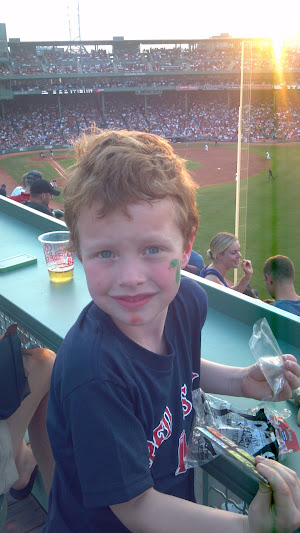
Grey at Fenway
Grey at Fenway

Grey is now entering his second great age of firsts. The first, of course, is that period from birth to about two when you get first smiles, first steps, first solids, etc. Then you have the long steep curve of learning until, a scant four years after all the first milestones are met, you start with the second milestones. First day of school, first crush, first real secret, first overnight trip without a relative, etc.

Grey had two big firsts this week, from my point of view. Last night was my husband’s company’s annual summer outing to Fenway park. It transpired that – perhaps – an extra ticket was available. So with a babysitter lined up, we left him to Thane’s tender mercies and brought Grey to his first adventure in Fenway Park. We were in the right field roof, in a terrace. I’d never been up there, but on a very hot and humid solstice, it was breezy and open and lovely. I bought Grey a new t-shirt and he arrived – face-painted with serpents – and I showed him the park and the history and explained the game and the players to him. With intense concentration he learned how to say “Saltalamacchia”. His father, on the other hand, taught him “We want a pitcher, not a belly-itcher” and “We want a catcher, not a belly-scratcher.”

The Sox played the Marlins. Papi hit a grand slam into the bleachers. The Sox trounced the Marlins 15 to 5 with booming hits to all corners and long leisurely innings. The air was warm and fragranced with peanuts, beer, people and the softer fragrances from the not so distant fens.

We stayed through Sweet Caroline – sacred tradition – and turned tired feet home, only crossing our threshold around midnight to find a Wide-Awake Thane. It was a weary household this morning, I assure you.


Grey asks questions during the intermission

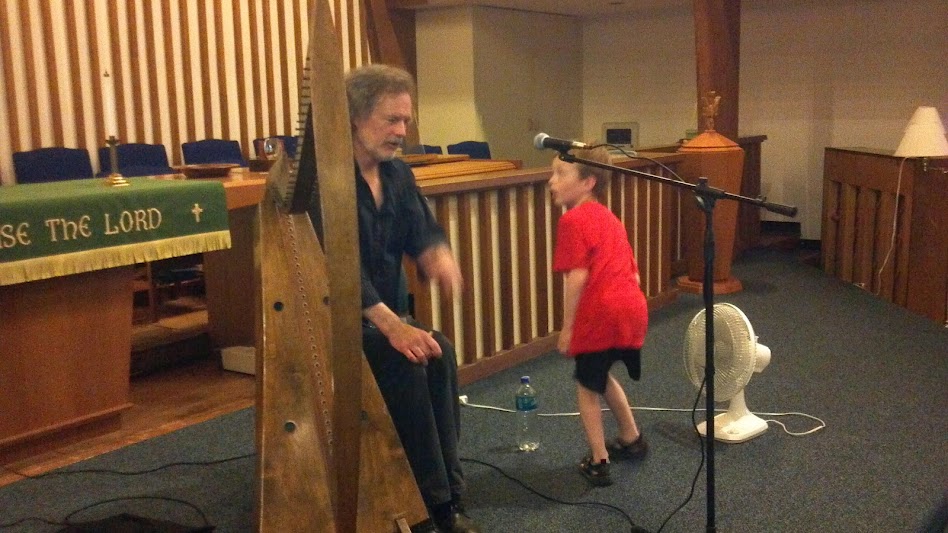
But my church was hosting a concert this evening, and I wanted to go. The performer was Patrick Ball, a gracious and funny man. (If you ever have the chance to see him perform – go!) I wanted to go, and I wanted to take my son with me. So I wrested myself off a gossiping front porch and news of babies to head to my church on a sultry Thursday night. Grey picked our seats in the very front. The wise child had figured out where the fan blew hardest.

He had a notebook with him (our church provides them at the front door for kids), so I listened to the stories and the harp while I watched him draw. As an aside, he is already a far more accomplished artist than I am. Not than I was at that age – than I am now. Anyway, he would lay his pencil down for the stories and pick them back up for the songs. He would drape my arms around him like a scarf, still young enough to not be ashamed of my touch, or to lean his back against me as the night drew long.

The harper’s last story had the weight of bronze, of meaning, of power to it and settled heavy on us in the audience. Patrick turned his hand to the twinkling brass harp strings one last time. As he glid through an arpeggio, close to the end of the song, one of his harp-strings sprung and snapped in the heat of the night – springing up in curliques. With impeccable timing, he declared that he was now done. He stepped down and gave Grey his broken brass harp string.

There are moments that you hope are prophetic, that point to a future you would like to see. I watched my son, transfixed by words and music and meaning, take a glimmering bronze harp string from a bard directly under the cross – at the spot where my child had himself been baptized. Your breath catches and you wonder if, maybe, perhaps, there is still some magic left within the world after all.

Grey tugged at his shirt. Patrick leaned his head down kindly to listen. Then says, “Sure, go ahead.”

In a loud and ringing voice, my first-born announced, “I have a joke!”

I am caught between mortification and pride. I have no idea where this joke is going. To infinity and beyond? Terrible punch line? Actually funny? No clue. But standing in front of the unmoving audience that just paid to come listen to a professional storyteller, my son bravely stood, remembered his lines, lifted his voice and told a truly Kindergardeneresque joke. You really have to be under the age of 8 to think it’s funny. But with courage, conviction and timing, he delivers it to the (extremely patient) crowd.

So I don’t know? Portent? Talent? What does it all mean? On the way home, he discussed at length that final story, asking questions about it that showed he had thought about every word. He wondered if maybe he could try something different with music? (I will give him this – the guitar teacher is really tough. I struggle with the lessons – I don’t think someone learning how to learn was going to be successful in that context.) What does it all mean? Should I sign him up and help him pursue these interests? Should I step back and let him blaze his path, watching in fascination (and periodic mortification)?

What remarkable people they are, these children of ours. They come from our love, eat at our tables and judge the world based on a normal we define for them. But such paths they walk are mysteries to us all, and every winding step an adventure and a delight to watch.

Thank you, Patrick, for your brazen harp string and stories, and for firing the imagination of my son.

The Bard
The Bard

If you are going to San Francisco

Veterans of the 60s
Veterans of the 60s

The other day I created a new Pandora station. It goes back to the guitar lessons, you see. There’s this Simon and Garfunkel song (Kathy’s Song) that I want to learn how to play. I then discovered that somehow my Simon and Garfunkel hadn’t made it to my new computer, and thus not to my phone. Let’s just put some ellipses in here that cover the fact that 4 interventions later, I still do not have Kathy’s Song on my phone to play for my teacher nor my oldest favoritest CDs onto my new laptop which is synced with my iPod.

But in the long journey towards getting my music in a place I can listen to it, I realized I hadn’t heard much Simon and Garfunkel lately, and that cannot stand. Enter the Pandora station.

And people, this is the best Pandora station ever. It’s basically the singer song-writers of the 60s, with these great voices, acoustic guitars and fantastic lyrics. This year for Valentine’s day one of us got tickets to the ballet and one of us got an awesome sound system for the tv. Adam has a blast with him mom at the ballet, and with the Roku I can stream my music and it sounds great. So I’ve been listening to Pandora through this sound system with this rocking new station. Now, back in the old days, before they invented NPR (or more accurately, before any sort of talk radio actually made its way to the boonies where we lived – and yes I am older than talk radio) my family listened to the Oldies station. This was like the 80s, so oldies meant the 60s, as opposed to now when oldies mean the 80s. These are songs I actually recognize!

The other day, I stayed up way too late with some friends playing a game that had been popular in my youth. This game is basically, “Just how out of touch is Brenda with everything pop culture”. In the modern edition it involved a playlist of Songs I Should Really know and then gales of laughter as I guessed Completely Inappropriate Bands. Let’s be honest… while I stand a decent chance of correctly pairing a aria with its composer, if not its opera, I can’t tell Aerosmith from Lynrd Skynr.

Anyway, I’ve been listening to these old songs, new songs, lovely songs. I’ve been hearing the words far more clearly than I did in the back seat of the station wagon, waving in and out through distant FM waves. Some of the songs I completely misinterpreted. For example, I was listening to My Sweet Lord. At first I thought, ‘What a beautiful Christian anthem! Wonder why I haven’t heard it sung at a church service?’ All the “alle”s heading up to an “alleluia”. Yeah, I hear you laughing now. It’s not “alle” like “alleluia”. It’s “Hare” like “Hare Krishna”. Oops!

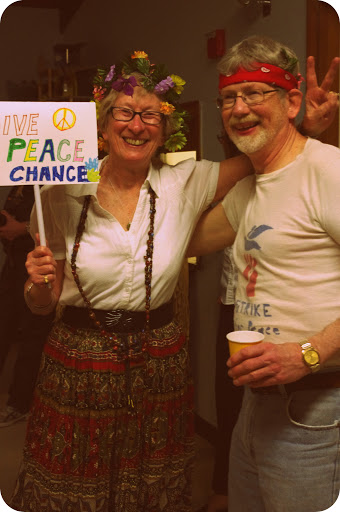
Some of the other songs from the 60s break my heart and make me want to cry. Long on that list have been Last Night I Had the Strangest Dream and Imagine. This particular playlist is fond of If You Are Going to San Francisco. I’m increasingly struck by the hopefulness, the belief they had that this time it could really be different – the world could really be new. There was a spirit of joy that is so compelling, so lovely. The song simply promises that if you come to San Francisco, you should wear some flowers in your hair, and you will meet gentle people there. Gentle people. How often today are we offered gentle people? When is the last time you heard someone called gentle, or were called gentle yourself. We do not aspire to gentleness, we do not claim to desire gentleness.

The flower children of the 60s were younger then than I am now, and their childhood seems lovely to me. My parents were of that generation (although decidedly not flower children). The persuasive hope and gentleness and optimism of a generation were erased, assassinated, worn down, made illegal, caricatured and faded. There are not unironic people in San Francisco – gentle – with flowers in their hair. We would say that John Lennon was a dreamer – and he died a violent death. He might not have been the only one when he sang, but I hear many fewer dreamers on Kiss 108.

I get tired of irony, cynicism and self-consciousness. Our artists cannot afford sincerity. The internet, the media channels… they stand ready to mock the slightest weakness. Hope seems impossibly naive. The Boomers couldn’t change the world – what chance do the Millennials have, or those of us whose generation comes at the end of the alphabet? I look back to the childhood of my parents, the thrill of change, and I wish I had gone to San Francisco with flowers in my hair.

I leave you with some thoughts from Bob Dylan:

Come gather ’round people
Wherever you roam
And admit that the waters
Around you have grown
And accept it that soon
You’ll be drenched to the bone
If your time to you
Is worth savin’
Then you better start swimmin’
Or you’ll sink like a stone
For the times they are a-changin’.

Come writers and critics
Who prophesize with your pen
And keep your eyes wide
The chance won’t come again
And don’t speak too soon
For the wheel’s still in spin
And there’s no tellin’ who
That it’s namin’
For the loser now
Will be later to win
For the times they are a-changin’.

Come senators, congressmen
Please heed the call
Don’t stand in the doorway
Don’t block up the hall
For he that gets hurt
Will be he who has stalled
There’s a battle outside
And it is ragin’
It’ll soon shake your windows
And rattle your walls
For the times they are a-changin’.

Come mothers and fathers
Throughout the land
And don’t criticize
What you can’t understand
Your sons and your daughters
Are beyond your command
Your old road is
Rapidly agin’
Please get out of the new one
If you can’t lend your hand
For the times they are a-changin’.

The line it is drawn
The curse it is cast
The slow one now
Will later be fast
As the present now
Will later be past
The order is
Rapidly fadin’
And the first one now
Will later be last
For the times they are a-changin’.

Fog’s rollin’ in. Like a shroud it covers Congress Street.

Klapatche Park – Mt. Rainier: from http://www.desertmarmot.com/trips/rainier05/

Today I stepped out of my old brick building consumed with the problems and challenges of an office-worker with cubicle and projects to bring in on budget. I turned the corner to cross the Fort Point Channel and watched the low-riding wave of a cloud break across the sky-scrapers of the financial district in the Hub of the Universe. For a moment, foot-fast and bustled on every side, I was transported to Klapatche Park on Mt. Rainier. One trip, as we ascended the vast mountain, we arrived at this long sought and often missed site at the same time a determined cloud did. Although some of the finest scenery in the world was being covered by that cloud, I was struck motionless watching the vast wave of cloud crash over the banks of the mountain, swarming the walls like determined soldiers heedless of survival. The motion, the energy of those clouds stayed with me still.

Today I watched those self-same clouds, or their sisters, break across the monoliths of capitalism in the storied ancient city on the Atlantic. I thought, for a moment, how proud, how special those drops of water must be to touch those soaring buildings. Of all the water in the world, THEY were the ones dancing around the marble-dewed palaces of One International Place and the State Street Financial Center.

But then I realized, in a dizzying turnabout, where else those water molecules might have been in their journey.

They came to us, those dancing particles of mist, through fire and ice. Some were born as the molten core of the new world cooled. Others journeyed through distance stars and long milennia of darkness in the hearts of comets – only to smash against a planet, water droplets like the broken pieces of chandeliers scattering on impact. Those fog banks nurtured the first complex compounds. They supported the first gasping explorers on land with pools and puddles. In the hot ages of the earth, they steamed around the swirling feet of animals unwitnessed by human eye. Those droplets were locked up for a thousand thousand years in a timeless icebank. They explored the depths of the ocean, marvels in the dark pressure that will forever escape our knowing. They were trapped quietly under continents, rolling through limestone caves. They have lived a million lives, passing ten million times through the beating hearts of creatures from the humblest to the mightiest. Perhaps that water ran through the channels of civilizations unknown, who did not build in rock for us to remember. Perhaps that cloud, there, witnessed the rising up of the silent sentinels of Easter Island. Perhaps that water was lifted by a hyssop branch on a sponge to a parched and dying man. Perhaps it was an iceburg, unseen, calved in the North Atlantic in the path of the maiden voyage of a mighty ship. A thousand moments in history, known and unknown, this water has coursed through. Or perhaps, over its long voyage, this is its first encounter with any human history at all.

It is not the water that should be proud to writhe around our mighty buildings, our great civilization, our high towers. It is we who should be humble before this water which has come from the beginnings of our time, passed through our ancestors and and ancestor’s ancestors, and yet is unchanged in its tendrils, habits and majesty. It endures and persists. It may be in constant motion, or content to stand still for uncounted ages. Witnessed, unwitnessed. Noticed, unnoticed. Remarked or unremarked.

Today that water danced in the city, swooping low above the heads of the distracted, the busy, the self-important. And we did not attend it. It did not care, because it does not exist for our approbation.

The white gulls are crying

I was, perhaps, unduly influenced by Tolkien in my youth. And by “unduly influenced” I really mean “secretly spent Junior High living in Middle Earth” and “can still recite Elvish poetry”. I was raised in tall and wild mountains with tall and wild trees and short and prosaic people, (Ah, Tuffy Suter!) although one or two of them might have passed as Bjoernings.

My first love – you would dream dreams too if you read Tolkien in this place

In one scene in “The Fellowship of the Ring” (skipped over in the movies) Legolas is warned by Galadriel of the lure of the sea – that once he hears the gulls cry he will never again know peace. Of course, Legolas does not then say, “Right ho! I’ll just head back through the Mines of Moria and forget this whole Fellowship business.” He travels the Paths of the Dead and in the course of commandeering some slave ships hears those fated gulls.

I always thought this bit was lame because pffft. The sea. Lamesauce. I was all about the mountains: high, majestic, completely familiar and yet unknowable, omnipresent and unscalable with volcanic secrets buried deep in their hearts and an aspect of icy glory overlooking millennia of maudlin human history. Give me the mountains, the forests, the deep glades and rushing streams and I will be content. I lift my eyes unto the hills. Living between the mighty Mt. Rainier and the sliver of the Pacific Ocean known as Puget Sound, my heart could have been swayed either way. But I turned my back on the sea and gave my heart to the hills.

This has remained true even as my coastal allegiance has switched. I spent four years of college in New London – gazing out of Long Island Sound – and only ventured to the shore a handful of times. I live now within 10 miles of the Atlantic Coast in an old and storied land, and over the past few years – again – I have only ventured to the seltzered strand a handful of times. When I drag my complaining menfolk to wilderness, I drag them to the lakes and “mountains” of New England. (I spent several years rather disdaining the label mountains for the worn down nubs of granite in New England, but closer proximity has given me rather a more grudging admiration.)

But then this new job, and this new commute that have driven so much of my wordcount in 2012. And as part of this urban 2 mile adventure I undertake every day, I pass over a tiny slip of the sea – the shivered remnants of the once great Fort Point Channel. It is the ocean in its most bounded – a sliver of barren water bounded on either side of my commute by iron bridges, commuters and noisy trucks.

My seducer

And yet that sliver of water is to me as the gulls were to my dear Legolas. It commands my attention when I pass it. Is it high tide, low tide or some in between state? I gaze at the mussels and barnacles encrusting the stations on the bridge. On dark dull mornings, the water is a choppy gray. On bright cheerful afternoons, a sparkling blue. The waters carry with the mysteries of the ocean, unbounded, unknown, unplumbed and it lures my imagination. As I once gazed out my window and imagined myself trekking on dusty trails through quiet groves, now I imagine myself the intimate of those vast waters. I see a slowly growing friendship between myself and the mysteries of the deep – or at least of the New England coast.

This summer I’ve managed already to cadge an invitation with a friend to spend at least a weekend close enough to hear crashing waves in your sleep. Gloucester and its beaches are a quick jaunt away, when the heat of summer weighs down the suburbs. Perhaps some chance will come to gaze on Maine’s rocky coast and investigate tide pools. And my summer plans tentatively include a few days on the other coast – the mists and rocks of the Oregon coast.

To the Sea, to the Sea! The white gulls are crying,
The wind is blowing and the white foam is flying.
West, west away, the round sun is falling.
Grey ship, grey ship, do you hear them calling,
The voice of my people that have gone before me?
I will leave, I will leave the woods that bore me;
For our days are ending and our years are failing.
I will pass the wide waters lonely sailing.
Long are the waves on the Last Shore falling,
Sweet are the voices of the Lost Isle calling,
In Eressea, in Elvenhome that no man can discover,
Where the leaves fall not: land of my people forever!

Holy Saturday

Holy Week – the week leading up to Easter – is full of named days and church services. It starts with Palm Sunday, with loud Hosannas and praises and donkey-riding-reeactments. Then there’s Maundy Thursday – the day we celebrate the Last Supper. This is followed by the ironically named Good Friday, the day on which Jesus died. Then everyone comes out in their finery to celebrate the resurrection on Sunday, even those who only come to church once or twice a year.

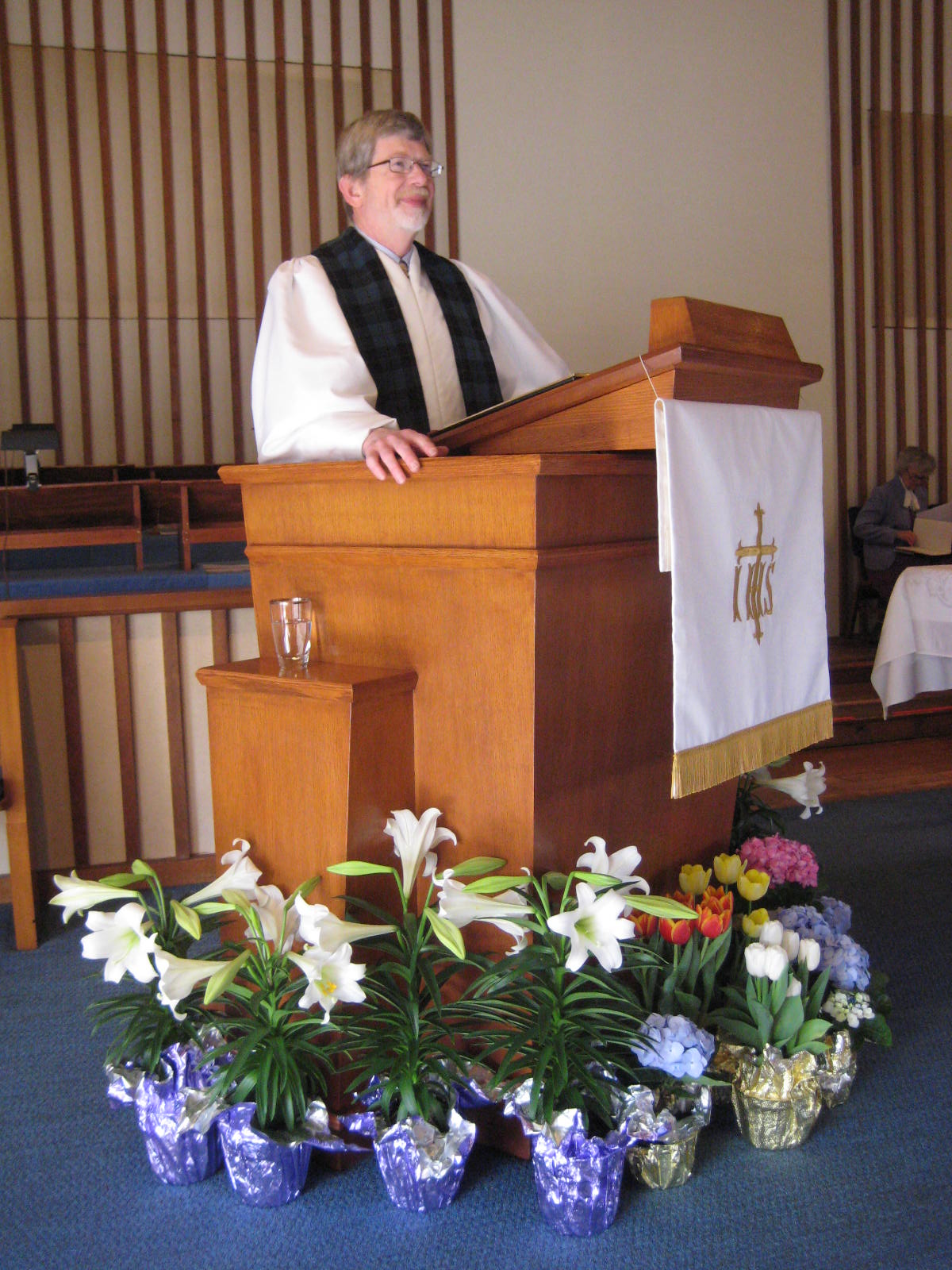
The pastor prepares for Easter

If you know a church musician or a pastor, this week is something of a marathon. There’s usually a huge push… Palm Sunday has big spectacle, then there’s a service on Thursday (with communion), on Friday (in the dark and quiet), and on Sunday with the biggest party of the year in the sanctuary. For many, there’s also a Sunrise Service in the wee sma’s of Easter morning. If you’re a pastor, that’s five big sermons (or meditations, or whatever) in 7 days. If you’re an organist or pianist, not only is it a lot of music you have to put together but it’s some of your hardest and most important of the whole year. Most of the liturgical professionals I know are completely wiped out after this week.

The Good Friday service is my favorite of the year. In our church, it’s the same down to the word, year after year. The only thing that changes is the name of the president and the UN Secretary General. We read through six scripture sets, extinguishing a light after each is read until the sanctuary is in total darkness. (Or rather, lit only by the extremely bright light that illuminates our parking lot. The year that it cycled on and off during the service was memorable to me.) Between those readings is only music and your own thoughts and prayers.

I have gotten better at this, over time. The first few years, I could hardly sit still and think, looking over and again for stimulation or change – unused and uncomfortable with the silence of my mind. This year, I sat heavy in my pew and was surprised when the time came to read again.

The other surprise is that, in those few words read over and over, I can still hear new things. This year on Good Friday, I heard something I’ve never heard before. It was in the voice of those many people who ask Jesus, “Are you the Messiah? Are you the Son of God? Are you the King of the Jews?” Before, I only heard the leading, lying question trying to get him to implicate himself in front of the Romans in order to remove a nuisance. But this time, I heard another thing.

They really wanted to know. Moreover, some of those asking really, really wanted him to answer yes. This was the moment so many of those followers had been waiting for. This man whom they had watched work miracles – who a short time before had met with Elijah and Moses – would declare himself! He would be a second Moses, liberating the people from the domination of the Romans! He would show not just the hungry multitudes but the halls of power who he really was and what he could really do.

And it wasn’t just those Pharisees and soldiers asking and half hoping to hear a yes, nor only his disciples. Jesus is sent to Herod, who is totally excited because he’d been hearing about this guy and really wanted to see it for himself. If Jesus had given Herod anything to hold on to, he wouldn’t have been sent back to Pilate to die. Even if Jesus had just told a good story or two, or a minor miracle, maybe he would’ve gone on to great things within the Roman Empire!

All these people wanted Jesus for all these different things: for entertainment, for political need expediency, for rebellion, for leadership. Many of these people who looked to Jesus for deliverance were good people, who were asking for needed things. None of them were looking for Jesus to, oh, conquer death and provide atonement for sin. It just wasn’t on the agenda. Overthrowing the Romans: plausible. Dying and coming back from the dead: not plausible. (In this my reading of the Greek and Roman classics has been edifying. Virgil talks about Prometheus (Tityus), and the vast torment of being immortal while your liver gets ripped out and eaten every day. In their immortality the very power of those ancient gods is limited because – do what they will – they cannot die.)

After a few hundred years of this happening every day, immortality might stop looking so good.

I have heard before how unexpected the path of Jesus was to his followers: how this was not the outcome they expected. This is not in the stories. You’d don’t lose all the way, and end up winning. You don’t quietly accept shame and ignominy. (I promise you now that silence is not how Odysseus or Aeneis or Xerxes would have dealt with being mocked and abused.) But I had never before heard that note in the voice of his accusers, betrayers and killers. They were hoping he would prove them wrong.

“Look at you now!” they yelled at him. “You said you were going to destroy the Temple and rebuild it in three days. Well then, if you are the Son of God, save yourself and come down from the cross!” Matthew 27:40

I had heard the mockery in it before. I had never before heard the half-hope that he would.


This is Holy Saturday. It deserves a cooler, more depressing name, like “Black Saturday” or “Golgotha Saturday” or “Despair Saturday” or “Holy crap he actually died, what do we do now?” Saturday. It’s the only full day that Jesus was actually dead. It always seemed to me like a day where were should just stop – like a day where we should rend our hair and mourn and walk around in a shocked trance.

Of course, I did nothing of the sort today. In fact, I had a lovely day that included a nice lie-in, breakfast in bed, a spring-flower walk, an Easter egg hunt in a local part (which was a dud), followed by an impromptu Easter egg hunt in my backyard with the neighbors (which was not) and a family movie. Great day, in fact.

But there in the back of my mind was the set-apartness of this day. If you go from Palm Sunday to Easter, or from Christmas to Easter, or from Easter to Easter… you miss the best part. On Easter, Jesus does something that humans could not do: to be raised from the dead. But on this Saturday, he was doing something the little “g” gods of mythology could not do: be human enough to die and be dead.

Tonight is dark with the grim settling reality for those who loved Jesus. That really happened. He really died. When we thought he would wage his mysterious eloquence against the powers of the world, he shut up and went silent and the fickle crowds abandoned him – including us, to our everlasting shame and horror. We sold him out. We fell asleep. We lied about knowing him. We shouted “crucify him” from the crowds and threatened a riot. We gambled for his clothes and put sour wine on a stick for him. We made fun of him. We did little to be proud of this week.

But tomorrow will come with the vast surprise of resurrection (as it has every year for almost 2000 now), and a confusion of pancakes and chocolate and bunnies and preludes and trumpets and ham dinners and nice dresses and really tired clergypeople with adrenaline highs. We will take the purple off our communion tables, welcome back whatever we gave up for Lent, and catch the baseball game in the afternoon.

But – hopefully – we will remember that the miracles we look for are not always the miracles we get. The miracles we get may be far bigger, far more profound, and far less predictable, and less comfortable, than we ever dreamed.

Sacrificial Offerings Part II

We now interrupt this epic for some sporting news....

In my last post, I talked about how our long-suffering grandparents (and great-grandparents) dug deep to offer comfort and hope to their erstwhile WWII enemies. But the second part of my reading that really made me pause were the words “sacrificial offering”.

I’m currently reading Virgil’s Aeneid, and have recently read Homer, Herodotus & Thucydides. Basically: I’m up on my ancient Greek history right now. These ancient texts offer a different context for some of the more contemporarily mysterious passages of the Bible, especially around sacrifices. Throughout the Aeneid, offerings are made or promised. The very best of livestock are repeatedly sacrificed on alters to various gods. (My favorite was a lily white sow suckling 30 lily white piglets which he sacrifices to Juno, which was totally a waste because she has it in for him. The sow was a combination augury-fulfillment and offering.) Somehow these seafaring travellers find the ability, time after time, to come up with appropriate livestock to offer to Apollo or Venus or their ancestors.

For us, today, sacrifices and offerings are both very abstract. I, for example, have sacrificed my consumption of candy this Lent. I sacrifice three hours a Sunday to worship the Lord (and hang out at coffee hour). An offering is a slip of paper with a few numbers written on it slid into a tasteful envelope with a scripture on it. These are my sacrifices and offerings.

The sacrifices and offerings of Jesus’ world, of that Mediterranean civilization, are far more concrete. When Jesus comes of age, his parents (poor folks, not like Aeneas), sacrifice two doves (Luke 2:24). These offerings are killed and eaten by others. Hard enough. But consider that livestock were not only today’s food, but tomorrow’s hope of food. Those 30 piglets killed with their mother represent forgone bacon and ham and pork tenderloin to people who were probably constantly hungry, and for whom meat was a profound experience. They are a waste – the finest of herd stock cut short and killed simultaneously in an age with limited ability to preserve meat. Their sacrifices consume capital – like us withdrawing from our 401K and paying the penalty.

I can’t help but think this idea of sacrificial offering carries over to that early “One Great Hour of Sharing”. Those folks were rebuilding a country and economy. They were finding capital to start businesses and families, to buy houses and maybe radios, tvs and cars. Their sacrificial offering, in the spirit of the ancient Mediterranean offerings, came at the cost of some prudence.

I look around and see a society where, increasingly, capital is the way to win and being labor is the way to lose. The work of your hands can earn little compared to the work of well-managed liquid assets. In that context, the sacrifice of capital is even harder than when you could just work to make it up.

In the Aeniad, the offerings and promises of offerings often swayed the gods to listen. They did remember them in their conferences together, and when deciding whether to interfere. They did listen when someone REALLY needed to make a spear-throw count. Without this context, and with 2000 years of cultural expectation behind me, it would be hard for me to hear and understand how radical my desert God and his carpenter son really are:

The sacrifices of God are a broken spirit; a broken and contrite heart, O God, you will not despise. (Psalm 51:17)

But Samuel replied: “Does the LORD delight in burnt offerings and sacrifices as much as in obeying the voice of the LORD? To obey is better than sacrifice, and to heed is better than the fat of rams. (1 Samuel 15:22)