Culinary heritage

Many people talk about how amazing their culinary heritage is. Nana made the best home made pasta. Or no one makes dumplings like my great-aunt. Or childhood memories are full of groaning tables full of latkes and love. If your childhood memories of food include things like “colors” or “vegetables” or “texture” – well, bully for you. ‘Cause I’m of Scottish heritage, and the one dish that always made an appearance when the Johnstone Clan got together was corned beef hash.
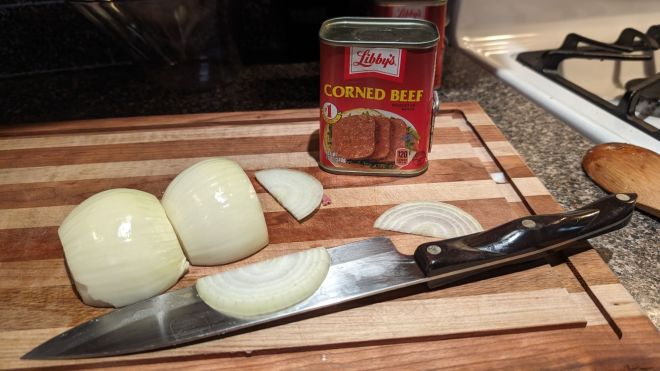
The recipe for corned beef hash is as follows:
– Half a pound of bacon
– Two onions
– Two cans of corned beef (the ones you open with a “key”)
– 5 lbs of russet potatoes (boil the hell out of these first in their skins)
– 2 to 3 cups water
– 1 tablespoon garlic salt

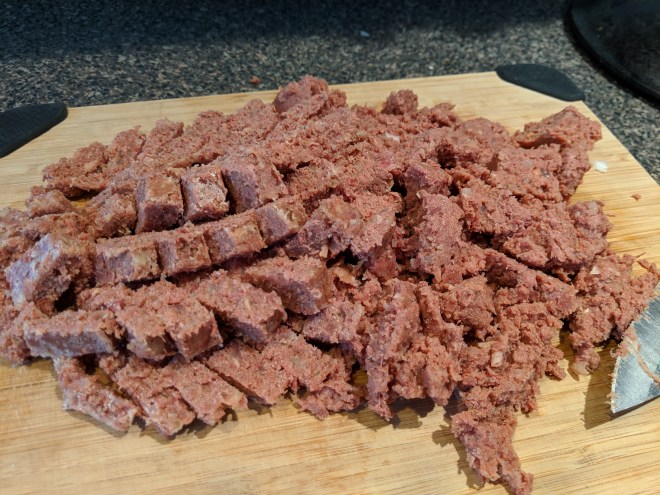
In a large dutch oven, cook the bacon. Add the onions. Chop up the corned beef (not slicing any fingers on the weird pot things that exist in no other food type than potted meats). Add the water, and then pull the skins off the potatoes (burning fingers in the process optional) and chop into large cubes. Add to pot with garlic salt, and then cook for a long time. Maybe a week.

Serve with (I am NOT kidding) store bought Italian bread and large curd cottage cheese. Proceed to die of scurvy. There is no part of this meal that has any color whatsoever (unless you put jam on the bread). It is also – and I am still not kidding – delicious. Even better as leftovers the next day. And hey, um, high in protein?

I loathed corned beef hash when I was a young girl, but I can hardly remember a family gathering where it wasn’t served. (I do not remember any of the other meals that may or may not have happened. I’m sure there was turkey and burgers etc. etc. but the corned beef hash is burned into my memory.) My grandmother became paralyzed when I was in high school, and following that my mother (who married into the Scottishness) took on the mantle of making the dish. Apparently, remembering the garlic salt was a challenge, and my grandmother never failed to point this out to my mother. I always think of her when I add the garlic salt.

Burns Night is just around the corner. The Scots may be somewhat culinarily deficient, but make up for it with their poetry and song and the power of their booze. I’ll put on some bagpipe music (also endemic in my childhood, and I also actually like it), and contemplate Rabbie and his works, and miss my grandparents. And heck, maybe I’ll have some leftover delicious corned beef hash for lunch.

Scottish Haut Cuisine

Ye Pow’rs, wha mak mankind your care,
And dish them out their bill o fare,
Auld Scotland wants nae skinking ware
That jaups in luggies:
But, if ye wish her gratefu prayer,
Gie her a Haggis

Address to a Haggis – Robert Burns

My grandfather’s father came from Scotland to the mountain west just over a hundred years ago. My grandfather never stopped being a Scotsman. He was active in the local Highland Games. At my cousin’s wedding, there was a picture of all four of my father & uncles wearing clan kilts. And in his 80s, after decades of never traveling by plane, he decided to go back to the old sod and spent a month or so wandering around Scotland reintroducing himself to various long-severed branches of the family and being welcomed in with open arms.

As with so many cultures, cuisine plays a critical role in the transmission of this culture. Instead of curries or empanadas or stir fries, we had corned beef hash.

My mother is a midwestern girl, raised in California. But it was another century, so when she married my father she took over responsibility for making the corned beef hash. I think fondly on her tendency to forget the garlic salt, which only my grandmother could spot in omission. Often when we got together as a family, dinner would be corned beef hash (with accouterments) and a pie or two from my mother’s hands.

I HATED corned beef hash. It looked disgusting. It tasted disgusting. No sane person would eat it. But it was served to me over and over again in an era where there were no alternative food options and as a person under ten you ate the dinner that was served or you did not eat dinner. And so despite my dislike, I ate the stuff. By the time I was ready to head off to college and leave the familial fold, I liked it quite a lot. It was tasty (if you closed your eyes). And it tasted like family times and traditions.

Sometime in this century, I made friends with a man of Hungarian descent who (logically) hosts a Burns Night. It’s one of my favorite things – poetry, song, deep meaning and good company. And to accompany the beverages available, I often bring a batch of corned beef hash to share.

I was making the meal yesterday (it actually is better on the second day, so I make it on Saturday and freeze it on the porch. Then I carry it frozen to the celebration and heat it up there. I’ve been doing a lot of Blue Apron and Hello Fresh lately, which produces these lovely, colorful meals that are in many ways designed for Instagram. The contrast with Corned Beef hash was… stark. I also realized that 100% of the ingredients fall into two categories: preserved meats & roots.

So with no further ado, here is how to make your very own, highly Instagrammable Corned Beef Hash.

I recommend dusty cans – they taste better

Scottish Corned Beef Hash
From the kitchen of Carolyn Johnstone – long may her memory endure!
Serves ~12 hearty rustics
Prep time: 30 minutes – Cook time: 1 hr minimum (3 is better)

1) Boil 5 lbs russett potatoes, whole, with skins on
2) Chop 1/2 lb bacon (or a whole pound if you’re getting into the spirit)
3) Chop 2 large yellow onions
4) In a large dutch oven on the stove, cook together bacon and onions
5) Open and cube 2 cans of “corned beef”. Make sure not to break the key or your life will be full of pain.
6) Once bacon is rendered and onions are soft, add corned beef.
7) Add 1 teaspoon garlic salt (optional if you’re my mom)
8) Once potatoes are cooked through, drain and let sit for a few minutes. Then by hand peel off the skins and cube the potatoes into the dutch oven.
9) Start by adding two cups of water (see note before)

The best way to cook this is to leave it simmering on your stove over the course of several hours. If you do this, you’ll need to add more water in as it gets thick, since this often leads to the dish getting burned. If you do burn it, just stir above the burned line and you’ll be fine.

Serve with:
Large curd cottage cheese
White Italian bread slices

What am I, chopped meat?
Potato skin residue
At the beginning of simmer