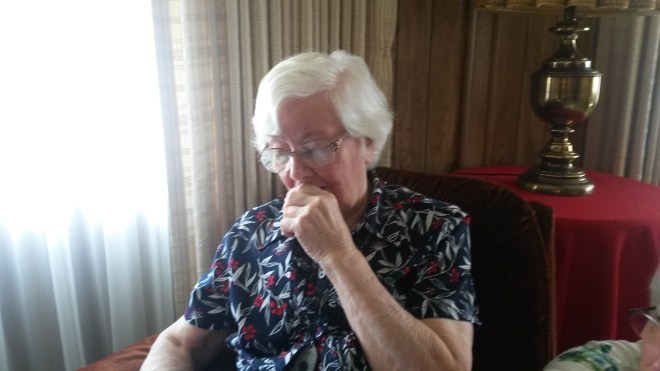
Ruth Evelyn Jones, 1923 – 2016

The last time I saw my grandmother

In the years of the roaring 20s, Chester Finley and his sharp-eyed, capable wife Frances Finley were married. They had two young, bright sons – close in age – followed by a daughter Ruth. As young boys her brothers Russell and Richard started acting strangely. At the ages of about five and three (I think?), they stopped walking, stopped talking. They died not long after. I remember Grandma Finley showing me the pictures of them, dressed in their Sunday best, lying still in their coffins. She wept, sixty years later, for their lost beauty. What peace there might have been in that midwestern home was shattered. Frances – so strong and capable – could not bear the death of her sons and left her husband and quiet young daughter while she stayed with her parents. When I think about my grandmother, I think about this formative time. She rarely – never – talked about it. But I imagine that little girl with her patient, grieving father, and her lost brothers, and her missing mother.

I was told this story because there was a chance that the sudden lost of those two boys was a genetic flaw (four trouble free generations later, we suspect it was some sort of environmental poison they got into). Indeed, my great-grandparents never bore another child. They adopted Walter to help with the farm. Walter was mischief personified (from what I could tell) – a happy go lucky child in a serious family and it was my grandmother’s job to keep him out of trouble. Some jobs are impossible.
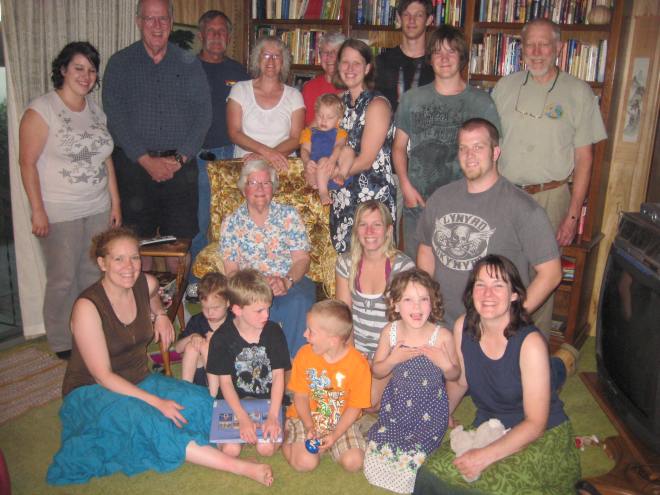
We gathered together for her 90th birthday

When the second world war put lie to the hope that the first had been the “war to end all wars”, Ruth was a young woman in a small midwestern town. The story here is shrouded, but my grandfather Virgil left for the war (he was a baker on the European front – but even the bakers saw some things that marred memories) with an understanding with one young woman. During the war, he and my grandmother (from the same small town) exchanged letters. After the war was over, the two of them got married. We have a beautiful hand-colored photo of them beneath a grape arbor, him in a dark suit and her wearing a simple white dress.

I have a story from her in a letter I cannot find (I probably put it somewhere “safe” – curse my bones!), where she talks of the post-WWII housing shortage. They lived those first year in a house that had been custom built for what she called a “midget couple” who had made their living in the circus. Grandma said she could cook dinner while sitting on the bed. I really wish I could find that letter.

In her own words… “Grandpa and I were not Christians when we were married. In our hearts we knew we would always feel unfulfilled as we were living. Then in January of 1948 our Wesleyan Church had a revival and we recommitted our lives to Jesus. Larry was born two months later – into a Godly home! We never looked back.” (April 11, 2006)

Larry Marcus was followed by Kathy Frances, who was followed by Renee. Each child was given the middle name of a grandparent, until they got to Renee. My grandmother could not stomach “Blanche” as a young girl’s name, even in the middle! (The result being that I don’t know Renee’s middle name! Edited: My mom says it is Evelyn, which was Blanche’s middle name!)

In 1954, the whole extended family moved to California in “Grapes of Wrath” type moment. (Well, everyone but Walter as far as I can tell.) They lived in a little house in Turlock California, with a big family and big garden. Brian Chester – the last of the children – joined them. My grandfather worked at an asphalt/construction company in accounting, and in 1963 my grandmother went to work, first at Farmer’s Insurance and then in the Merced Schools library.

At my parent's home
At my parent’s home

My grandmother described the home in Turlock, “Your Grandpa and I loved fixing the house on Locust Lane in Turlock (My mom says the house in Turlock was actually on Mitchell St, but we may need a family conference to get this all right). Grandpa hired a carpenter to put in metal liners in two deep drawers. One drawer held 25 lbs of flour, the smaller one, 10 lbs of sugar. He put lazy susans in the corner. Grandpa bought a big electric stove – the oven held 6 loaves of bread. Oh, did I bake in those days. We had an acre of land with lovely walnut trees and two apricot trees. My folks, the Finleys, lived in a trailer next door. Grandpa Finley irrigated the whole acre as it was needed. What a wonderful place for the children.”

The young family years are filled with tales of camping trips to Yosemite, grape arbors, camping cookies and gardens. My grandparents were, from that revival in 1948 until their dying breaths, extremely faithful and devoted Christians, following a Nazarene theology. They supported the building of a new church, and my grandfather was the church treasurer. (He actually had an office in the church, which I remember being very impressed by.) It was a very strict practice (no movies, no rock music, no face cards, no dancing – certainly no alcohol or smoking or indecency). This made for quite a culture clash with the ’60s, when the older children were teenagers. If there was a saving grace in that conflict, from what I can understand, it is that my grandparents were willing to live by the strictures they preached. There’s an old joke that you should always invite two Nazarenes fishing with you. If you invite only one, he’ll drink all your beer. Your beer would have been more than safe with my grandparents, I think.
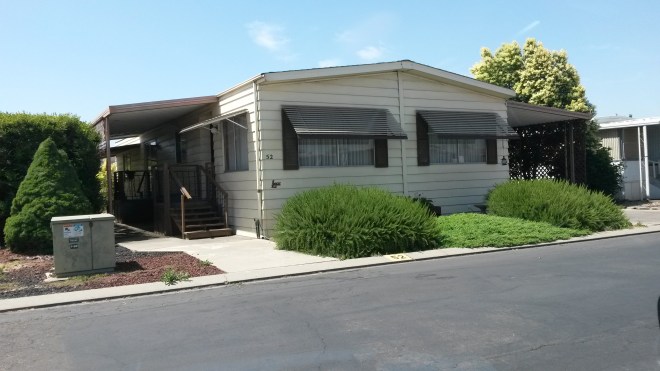
My grandparent's home
My grandparent’s home

Around the time I was born, they moved as a family to a trailer park just off the freeway in Merced – my grandparents and their parents in trailers in the same park. My grandmother describes meeting me, “For some reason, I often think of you the very first time I saw you – at 6 months of age – at the airport. I as holding you while your mother and Grandpa collected luggage. Several people came up to us and commented on how pretty you were. You had such a dear perky way about you!”

We lived with my grandparents for a year, after we came back from Zaire. I turned four in their home, and remember it well. It gave me a familiarity with my grandparents I was lucky to have. I remember sitting for lunch at the long dining table, with the cold cuts and breads beautifully presented. Dessert was often sliced nectarines, or cottage cheese and jam mixed together.

My grandmother was very interested in people, and in their stories. Her letters to me are full of updates about the family, her neighbors, and friends of friends. (I always tried to write really newsy letters back so her letters to OTHER people could be about me.) She was very a very good cook, and preserved food. I remember an abandoned apple tree in a neighbor’s yard. She spent hours and hours laboring over a hot stove turning bushels of apples into applesauce.

BLTs for lunch - I remember this from my childhood!
BLTs for lunch – I remember this from my childhood!

She lived a life tending to others. I remember her as a caretaker to her mother, her mother-in-law, her great-aunt, her husband. When they left, she tended to the only-slightly-older folks around her.

When your grandmother dies, even at age 93, people often express their sympathy. I have often replied that in her death, my grandmother realizes one of her fondest hopes. One of her last letters to me, written in a hand turned shaky and short by neuropathy, ended with this joyful anticipation “I often think of heaven. It seems so close, so real. I often think of the loved ones who are already there. So if I don’t see you all again, let’s make a promise to meet in Heaven. Eternal joy! No more separation or pain! Bliss! I like that word. Much love, Grandma Jones”

—————————————-

I have created a shared album of pictures of grandma here. I’m pretty sure I’ve got some details that are missing – I’d love to hear the family stories!

Quilts and connections

On Monday, there was a package on my doorstep. It was a box and it was (astonishingly) NOT from Amazon. (The Fedex driver must have been mightily confused by that!) It was from my beloved sister. I knew it was coming. I had an inkling of what was in it, and opened the box with the expectation of seeing an old friend.

Our wedding quilt
Our wedding quilt

This quilt is just about fifteen years old. It was my sister’s first quilt, and is made with my favorite colors. The white around the edge is done with the silhouette of Mt. Rainier. In the corner, the dates and our initials are embroidered – the last time my initials would be BJJ instead of BJF. (Which, side note… changing your initials might be harder than changing your name!) The reason it was sent back to me is because quilt backs are not as durable as quilt fronts and sometimes when it spends a decade on your bed it can get torn. Maybe. (Maybe this is kind of a regular thing with all our quilts. Maybe.)

BJJ & ARF August 5, 2000

There was also Thane’s baby blanket. He was old enough to vote on his colors. (Grey’s was ready for his arrival, and was themed with dragonflies. He was also lucky enough to get dragonfly curtains which still hang sparkling in his room.) He opted for the Pigeon theme. PIGEON! He was – is – absolutely entranced by it. In this cold winter, where bundling up in blankets against drafts and chills is a necessary comfort, he has been delighted to wrap himself up in Pigeon. (I have dreams, you know!)

Don't let the pigeon hog the heat ven
Don’t let the pigeon hog the heat vent

Grey dug out his quilt from his room and demanded we all cuddle up on the couch in our Aunt Heidi quilts. Well, if you insist Grey! (I’m not cuddled up because I was photographing the situation, obviously.)

Couch snuggles
Couch snuggles

I had this idea, when I was young, that it was impossible to do anything my sister was good at. This was for the obvious reason that I might not be as good at it as she was, and this was completely unacceptable. Things this ruled out for me as a youth included: photography, poetry, cooking, fabric arts and Georgette Heyer novels. Some of these we’ve clearly swapped places on. My niece asked – looking at our senior pictures – why her mother was holding the camera instead of me. I became a half-decent cook. Poetry I love to read but never wrote. And I’m the only one of my family who hasn’t read Georgette Heyer. (I KNOW!) But fabric arts were, and have remained hers. (Well, other than a very unfortunate encounter with a bright neon-striped apron in the year of Home Ec I was forced to endure before I absconded over to shop with the boys.)

The tradition of quilting, and of giving a baby a quilt, is one my sister comes by honestly. My mother can sew well – I have a cloak of her making in the closet. But she was of the age where women were taught to sew because it had previously been practical… but where it ceased to be a survival skill for a well equipped woman. I’m sure my grandmother can sew too. But it was my great grandmother whose sewing I remember.

I don’t remember when I got my quilt. It must have been after we got back from Africa – I doubt it crossed those oceans. Perhaps it was given to me when I lived in Merced. I can’t remember life without it. My great grandmother (Grandma Finley – my mother’s mother’s mother) made all three of us crazy quilts – my brother’s being made when she was north of 84 years old.

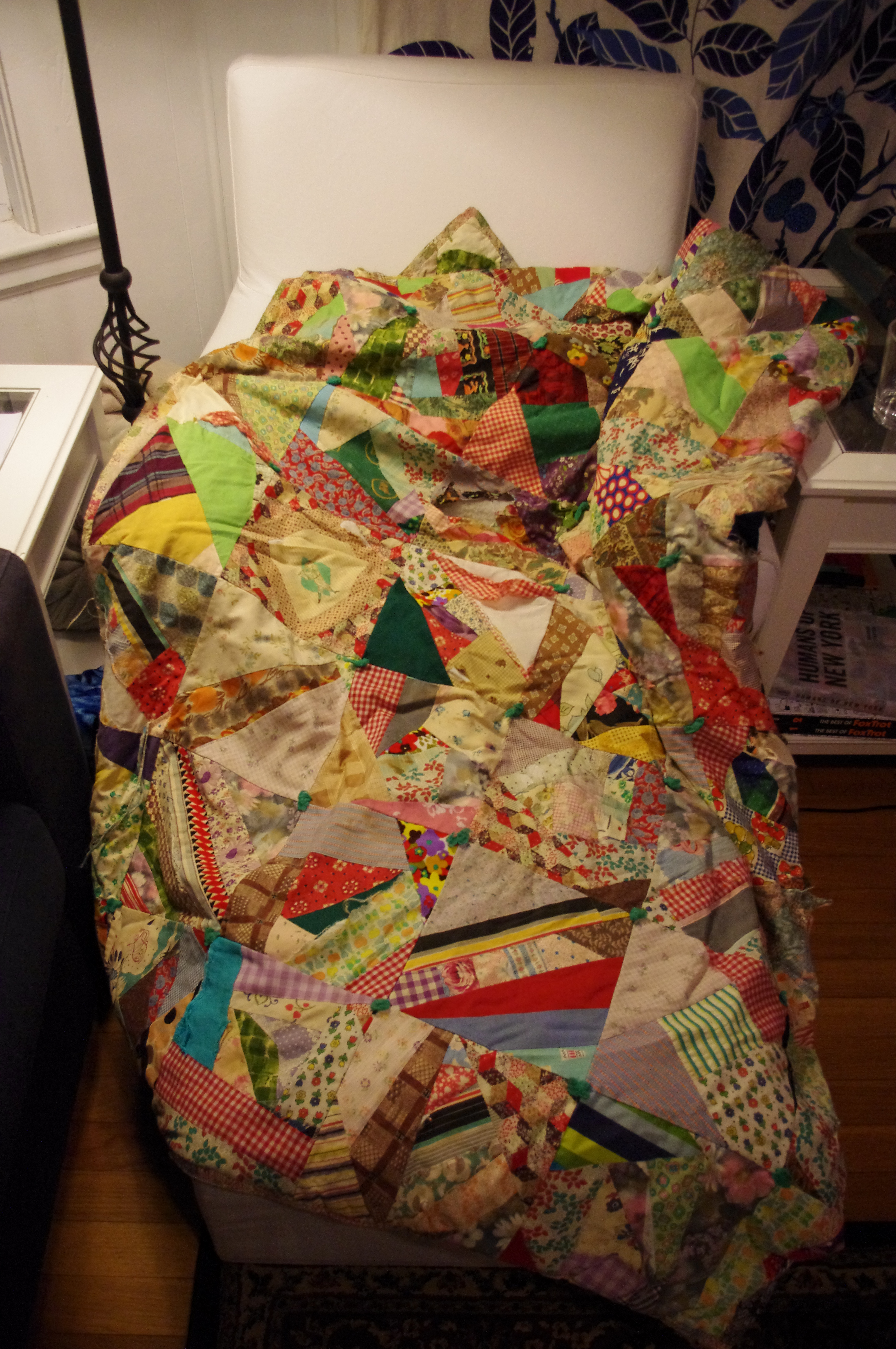
What is a crazy quilt? The most practical of all quilts. The depression quilt. Here’s mine:

My crazy quilt
My crazy quilt

My sister’s quilts are made with cotton fabric of a consistent weight. The fabrics are selected for color and pattern, and cut to create the design – then sewed back together. It’s an art form – a lovely one. But creating a quilt like that is certainly a cost. Fabric costs almost more in a fabric store than clothes do in a clothing store.

But the fabric on my crazy quilt was not purchased for its loveliness or pattern. What you see on my quilt are the dress shirts, worn out skirts, curtains, blouses, dresses, slacks and tablecloths all worn out past repair or reworking. My grandmother collected the fabric from worn out garments (and buttons – we had her button box for a long time and it was super fun to play with!) and then when a child was born she reached into that treasure trove and put together a quilt. I’m quite sure a few of those squares come from my mother’s childhood dresses. I have cuddled myself in the castoffs of my ancestors, put together to warm me by the thriftiest of them all.

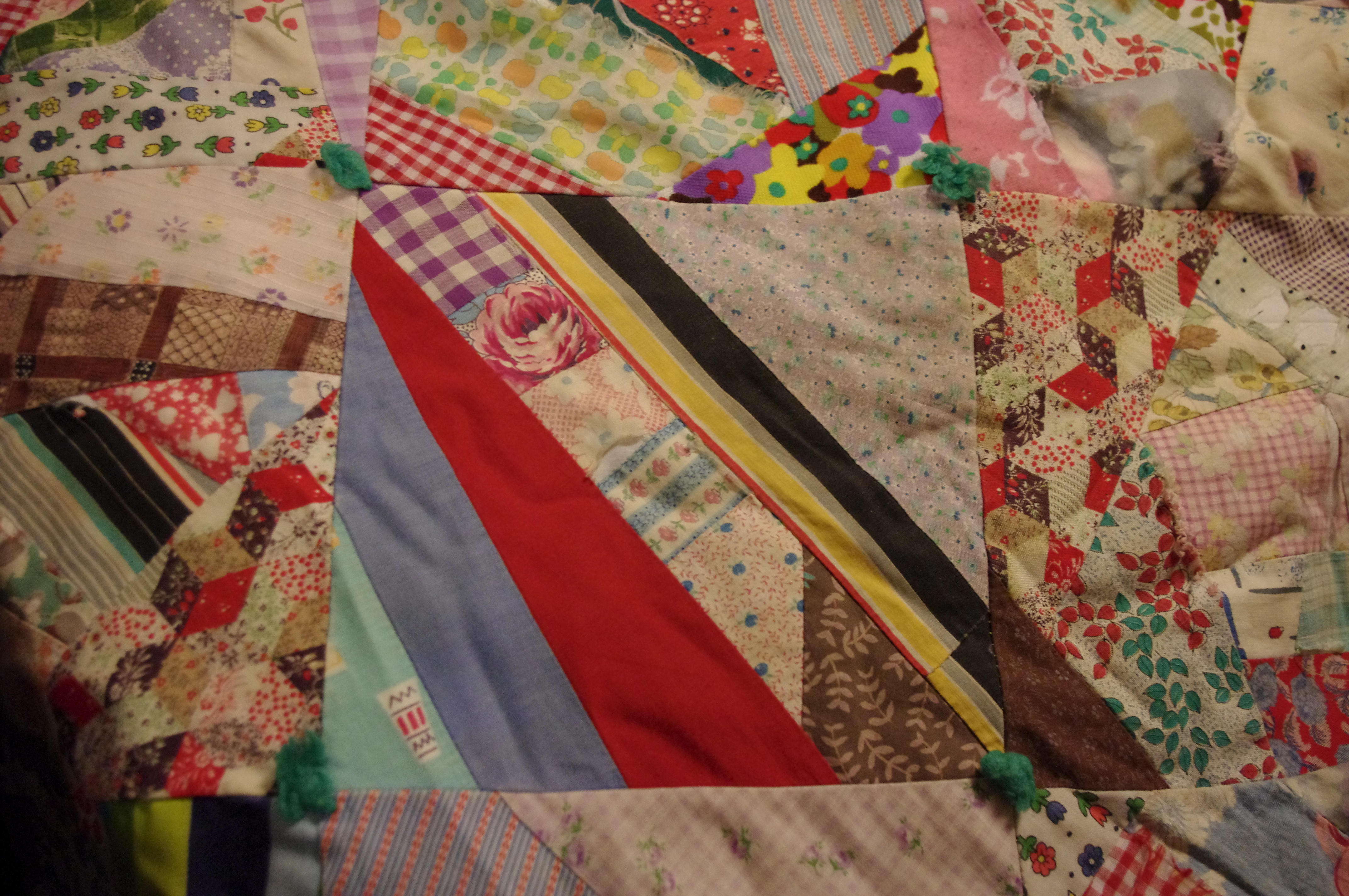
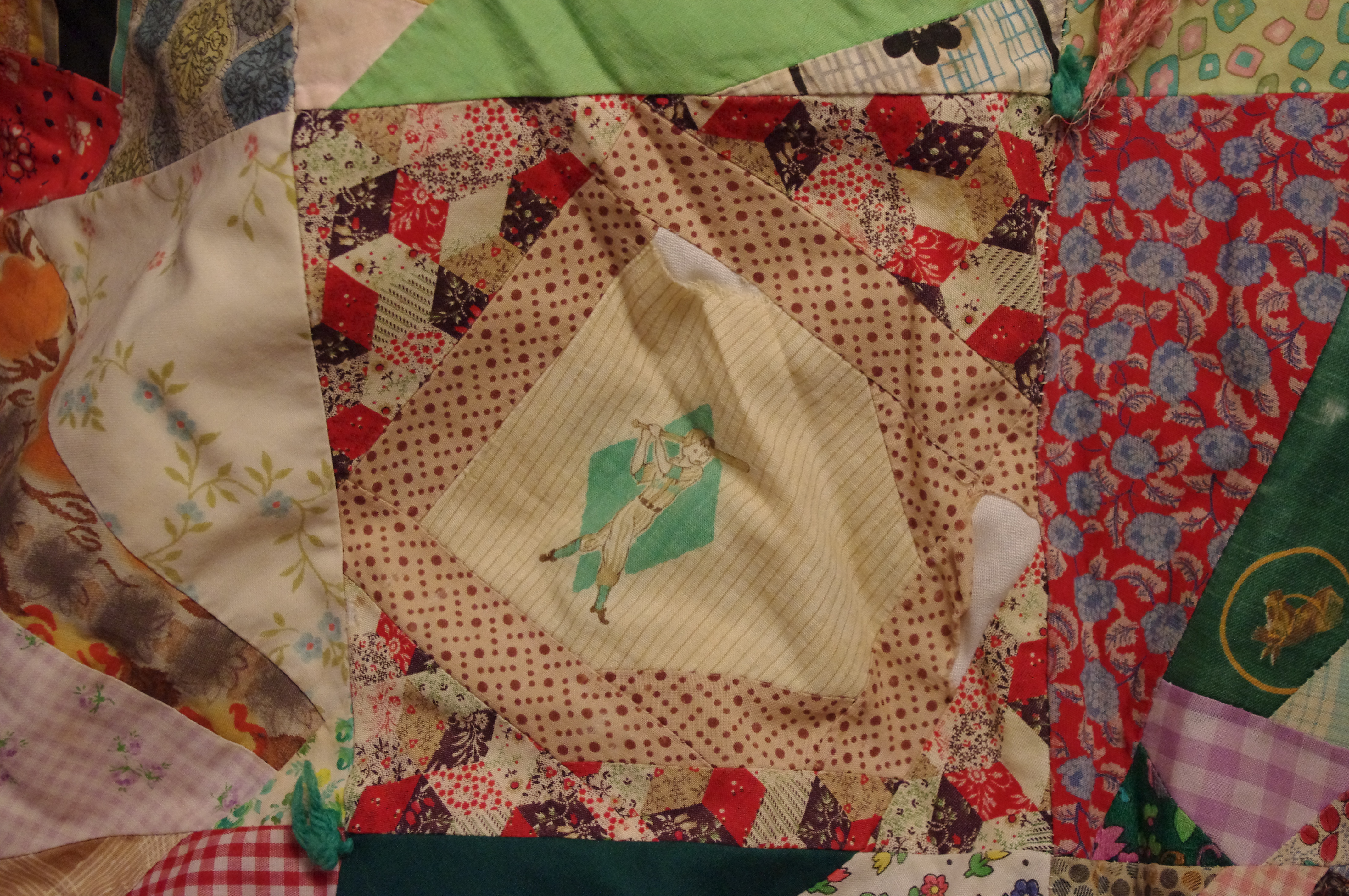
You can see how each quilt square was put together by different pieces of fabric – whatever would fit. There are no squares on my quilt made of a whole piece of fabric, although the same fabric will show up in multiple squares.

This block has no fewer than 12 different fabrics
This block has no fewer than 12 different fabric pieces

Each of those tiny, tiny squares of fabric is sewn to its partners to create the block. What a labor of love. How long did she spend composing the squares – piecing them together like a puzzle? I can see the thoughtful look in her eyes – rimmed by old-fashioned golden spectacles – as she contemplated the pieces. (She had a tremendous sense of spatial reasoning. She was famous for being able to pick the perfect size tupperware for leftovers at a glance. She also cleaned our clocks regularly at Chinese Checkers. She died when I was in my late teens, so I knew her well.) And each of those seams is TINY. Not an 1/8th of an inch more fabric than was absolutely required for those seams was spent.

My favorite block
My favorite block

The differences in the kinds of fabric (there are thick cotton fabrics, thin gingham pieces worn almost to the woof, synthetic fabrics – all manner of clothes) mean that those unforgiving seams have pulled apart in many places – unrepairable because there isn’t enough material to bridge the gaps. The different squares were then sewed each to the other. The actual quilting portion of the quilt was incredibly simple. She sewed the filling and the back on at the edges, and then tied each quilt-square corner with a green yarn knot. I think this all meant that she could put together the entire quilt on her regular, workaday sewing machine – without any specialized machinery. Practical to the utmost.

There’s a lesson in that crazy quilt. My great grandmother was born in 1900. She was coming of age in World War I, and was a young mother when the Great Depression ravaged a generation. She watched all the young men of her daughter’s age go off to war when World War II hit. I can imagine her as a ruthlessly effective Rosie the Riveter. (She actually was a switchboard operator.) She learned – and she taught – that waste was not only morally unacceptable, but that the ability to make the best things with the least waste was a skill to be proud of. (Well, modestly proud of. She wasn’t a big fan of pride.)

My home and my life overflow with good things. I have bags of perfectly good clothes and toys I’ll summon some charity to haul away for me. I never know what to do with the spare buttons that come with my clothes – my memories of her keep me from just throwing them away, but I might as well since I never repair any clothing. But perhaps, in her memory, wrapped in two generations worth of love-wrought quilts, I could consider myself pleased with what I have that is durable, of great value, and be content.