
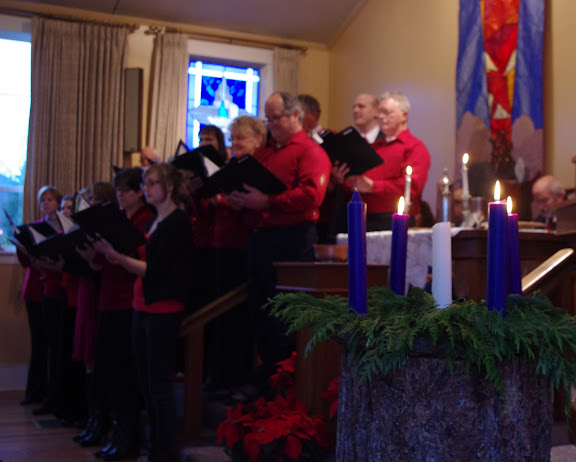
While I was home on my whirlwind watch-my-brother-get-ordinated trip this December, I said something about how I could take 700 pictures at the ceremony, knowing I’d keep perhaps 70 and print probably 10 (20 if you count the fact that I send my grandmother prints regularly).
Now, my father is a historian. A bona-fide, written a book and has a contract for another one signed historian. He specializes in historical photos and runs a business taking people’s old black and white photographs and digitizing/archiving them. As I was lauding the convenience of the digital age, he lamented how I was making the job of future historians harder by destroying this original evidence.
I thought about that for a while. (Well, if you’re counting, I thought about that for three months.) And Dad, I understand where you’re coming from, but I think you may be wrong.
I’m increasingly convinced that the historians of the future will not need to wrest a compelling narrative from charred wooden sticks and a few hieroglyphs carved on a rock. They won’t even be putting it together from a shoebox full of black and white pictures with light pencil notes on the back, like my father does. The key skill of the historian of the future will be finding some way, some algorithm, some method of sorting through the vast and vaster amounts of information we throw off. It will not be finding the needle in the stratus, it will be finding the needle in the haystack.
Consider just my blog. In this WordPress blog I have 562 posts. And I’m missing about 3 years of posts from Livejournal. I also have about 8 paper journals that I wrote as a young girl. And several boxes of letters written and received. Oh letters! I’m using 8.3 gigs of space on Google’s servers, between my letters and my pictures. 8 gigs. Do you know how many 3 1/4 in floppy disks that is? Do you know how vast we thought those floppies back in 1992? We said things like, “All the literature in the world can fit into one bookcase with these floppies.” (Just a back of the envelope calculation… those floppies help 1.44 mb. So my email and pictures would require 8000 of them. Give or take. I should mention Wikipedia has quite a long discussion on just how much they held.) I’m a one woman content creation machine! Oh, and then there are Facebook posts. And Tweets. And text messages. And – let’s be honest – I’m doing well if only 95% of my material is completely worthless.
I imagine the poor historian of the future, who sits down to write a story on some recent event – the Arab Spring perhaps. First this historian starts with the summaries of the summaries – the writings on it that have been proved by the test of time. Then this historian reads the contemporary published writings (many of which were done too quickly and too poorly edited in order to take advantage of “the market”). The historian then moves on the famous non-published writings and pictures. She must be nearly through her PhD by now… only to begin looking at the non-famous sources. Perhaps she picks a person or two. Then, for her period of interest, she reads through the gigs and gigs of material, pictures, posts, updates, emails and LOL-cat forwards for those people. How impossibly daunting.
Our historical anonymity is almost as guaranteed by our vast hordes of information as by the paucity of prior millenia… with one exception. If, for some reason, people WANT to know about you in the future they will be able to. They’ll know it all. When you were sick, and how. (Perhaps they’ll be able to access your medical records and xrays?) Who you contacted. Where you were. What you saw. Everything. But that will happen for so few of us – only the Elvises and Kennedys of the next generation (whose mothers are cheerfully documenting everything from their birth story to their potty training to what kind of trouble they’re having in school).
So what do you think? Are you careful to archive your own history? Or do you prefer to curate, and keep an edited summarized version of your life somewhere that might actually be readable? Or do you think that, as we continue to grow as a people, our descendants will have an even wider range of interest and no previous historical person will be uninteresting and banal? Do you think we might do our children’s children favors in their PhD theses not by saving everything, but by deleting most things?

 My Truant Pen