
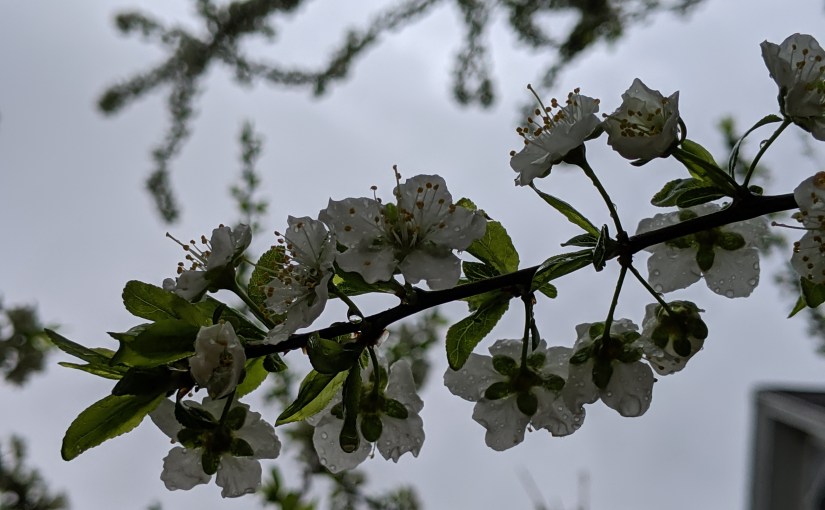
Though much is taken, much abides; and though
We are not now that strength which in old days
Moved earth and heaven, that which we are, we are,
One equal temper of heroic hearts,
Made weak by time and fate, but strong in will
To strive, to seek, to find, and not to yield.
Ulysses, by Alfred Lord Tennyson
I was running when my watch buzzed with a message from my brother, “Y’all seeing the fire at Notre Dame?”. At first I thought of the Fighting Irish. But the link, which I did not stop my pace to read, was from the BBC in Europe. So the other Notre Dame. I’ve been heart-sore lately.Good exercise on a day when the world was contemplating renouncing the despair of winter for the hopeful enthusiasm of spring was meant to be a brief panacea. I tried to put the fire out of mind (hoping it was minor) and focus on the daffodils.
Running through the well-kept houses and lawns of wealthy Winchester, I reminded myself how amazing our civilization is. It is so much easier to destroy than build. But there is so much more built than not. What a great weight of effort lay behind every vista. And to the pounding rhythm of my slow pace, the words came back to me: Though much is taken, much abides
I find myself greatly consoled by remembered poetry. You’d think that this would mean I spend more time reading and memorizing poetry, but humans are not so sensible. We do not always invest in the things that offer us the greatest returns. We do not avoid the things that bring us harm. But this poem is not one I’ve read. It is, instead, a poem that a friend has memorized. I remember one bright night, when we were all younger than we are now, when we went together to see a play – a musical. We all agreed that it was quite possibly the worst performance any of us had ever seen. But walking back together through the streets of Boston, through swirling mist and halogen light, he recited all of Ulysses to the city sky. I’ve likely heard him say this poem 20 times in our years of friendship. So it is unsurprising for me to hear it in his voice. My friend’s voice assures me, much abides.
When I returned from my run and saw the pictures of the flames, I thought nothing could survive. What was built over centuries and endured for longer centuries would be wiped out in the slow course of my 5k jog. I was comforted only by the memory of that poetry. “Much abides” I reminded myself. And indeed, from the implausible wall of flames much more was recovered – largely because of human planning, care and expertise – than I dared hope for. The windows remain. The bees remain. The gothic walls and buttresses were designed independent of the roof, so the one could fall while the others held. I read an amazing response (which I cannot now find) by a medievalist who long studied the cathedral at Reims. The scholar talked with great hope about how the Medieval architects had learned so much (from hard experience) about how cathedrals burned that they had built new ones to withstand conflagration. The churches were designed to burn, but yet abide. And looking at what remains in the rubble in Paris, that seems true. How clever we are, we humans, when we put our minds to resilience and preservation. How foresightful we can be, and have been. Much abides.
Today, as I write, it is Holy Saturday. Last night, I went to Good Friday services – my favorite of the year. There’s no sugar coating harsh truths on Friday night. We put ourselves in the place of the false accusers, the cowardly arresters, the sleepy and scared friends who fail at the first test. We speak of beatings and mockery and spears and nails in the flesh. We listen to a dying man make fun of another dying man. There’s no place on Good Friday for looking away or softening. I think it’s no coincidence that rarely are children present that night. (Although I was very, very glad that my youngest son joined me, for the first time. I’m not sure my children will be able to understand my faith if they never worship with me on Good Friday.) On this Friday night – and on the long Saturday that follows – we live in a reality where God himself has died and we cannot see how anything can ever be okay again. Hope is lost, and all that remains is cleaning up and moving on.
Of course, there’s always the rest of that story. I usually practice my Easter hymns on Good Friday (which feels like cheating, but practice you must!) Beyond hope, hope arrives. There is redemption for the failed and weak. There is forgiveness. Although there is also real loss – Judas is never forgiven. I sometimes wonder if he would have been, if he’d chosen repentance over despair.
As we look to rebuild Notre Dame, and the black southern churches destroyed by a hateful arsonist, I am reminded of another phrase caught in my mind lately, from Isaiah:
Your people will rebuild the ancient ruins
and will raise up the age-old foundations;
you will be called Repairer of Broken Walls,
Restorer of Streets with Dwellings.
Isaiah 58:12
As I looked for the right words to close my thoughts, my pastor posted a poem by her favorite poet, whose title caught my eye. I leave you friends, with a new poem. May it be a consolation. For much abides.

 My Truant Pen