

I’ve been thinking a lot lately about the physical object of books, as opposed to the content of the books themselves. The generous allotment of bookshelves in our home is full to bursting, which makes it difficult to buy more books – an unacceptable status to remain in. These shelves were made by my husband, and designed to accommodate our collection – the awkward height books, the comic books, the mass market paperbacks. It’s easy to get rid of a book you don’t like, or a forgettable book you can’t remember only hours after shutting the pages. We give our extras to the Book Oasis which has led on several occasions to me seeing a book in the window and being all like “How odd, I think I’d love that if I didn’t already have it!” only to be reminded that I HAD previously had it and had donated it. But the last few weeks, with the towering stacks of unread books next to the bed taking on menacing proportions, I had to admit it was time to get rid of some books.
Here’s how I figured it. I would clear out a book if all the following were true:
1) The physical object was not uniquely special to me. (Eg, a meaningful gift given to me, inscribed)
2) The physical object was not beautiful and delightful in a way that made me want to read it instead of it’s ephemeral kind
3) The books was easily replaceable (not out of print, etc.)
4) The physical form of the book was not particularly useful (for example, cookbooks are best in actual paper)
What this really meant, was most of the mass market paperbacks went into the donate pile. I mean, I really do love Tamora Pierce, and Brother Cadfael, and Dorothy Gilman. But truthfully many of the physical copies of the books of theirs I have will not survive a multiday reading. The yellowed and cracking pages of an 80s paperback that was never meant to last make me think of the Waldenbooks in which it was so likely purchased – of another fading era. I also donated one or two of my (cough) SEVERAL copies of books like The Lord of the Rings books. I’ve read several versions of those physical books into pulp, but I have some really nice and sturdy ones that can withstand a reread.
The question of the durability and survivability of books was highlighted due to one of the most delightful gifts I got this Christmas. An actual physical copy of Silas Dean’s book “A Brief History of the Town of Stoneham“, which I have read as a digital book and of which I have a very bad reprint.
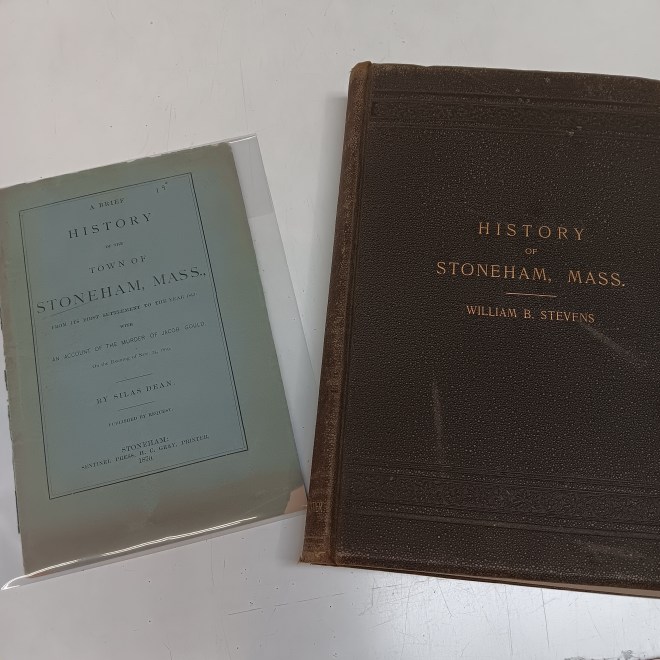
It’s shocking, in person, how delicate and destroyable this venerable book is. The front cover makes it clear that it was the 19th century version of a vanity publication. The paper itself – though in very good condition in my book – is thinner than newsprint. The cover is barely thicker cardstock. There can’t have been that many copies made. A few hundred? A thousand? And given that it was printed 140 years ago, I wonder how few have survived to the modern day. I know of three or four – perhaps more – and obviously some libraries had them (that’s where the reprints come from). But fewer than 100 seems almost certain. The object itself is both delicate and precious.
This trip we’ve made to the UK has ended up being very book centric. The reading room at the British Museum felt like a museum exhibition to a kind of reading that once happened and does no more. What a glorious space, now the home to tourist selfies. The British Library was much better – the books are still there in their fleshed embodiment. Getting my reader’s card was the most thrilling souvenir I could have obtained. In my brief hour in the reading room there, I encountered the thick multi-volume set “The Bibliography of Prohibited Books”.
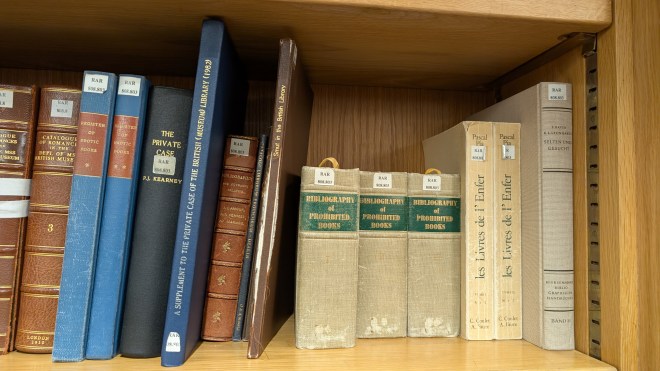
I read as much of the forward as time allowed, and the author vehemently made the point that the smut and erotica of former eras is much rarer, less known, and harder to obtain than the first folios of Shakespeare. “Any fool with money can buy one of those”. They were rarely listed in estate sales, often not even summarized in wills, not included in the lists of belongings, not documented anywhere. Even the libraries refused to catalog them. It gave me pause – that these “shameful” books should be sought after, collected, enjoyed and then lost or stolen. We forget how much the internet has changed what is known and knowable. I didn’t finish the forward, but the three volume set of thick books tells me the author was at least somewhat successful in his aim of naming what was, and perhaps what was also lost.
In Edinburgh, one of our first stops was Blackwell’s Bookshop which had an astonishing collection of beautiful books across three levels. It is amazing so many books have been published. We all came away heavy laden (see what I mean about needing more shelf space?). I think my favorite part was how invitingly curated it was – little cards recommended WHY you might like a particular book, and the tables with attractive displays were well themed. I particularly liked the “Romantasy” section. It was spacious, comfortable, brightly lit and wherever my eye fell was a book I wanted to read. There was an art section of the store, and in it were these notebooks. The innards of old books had been removed and replaced with blank paper – giving an old object new life. I’ve always been reverential in how I treat books (never underlining or highlighting), and horrified at the idea of destroying or damaging a book, never mind throwing it away. But looking at the titles on the shelves – these books were never going to be read again. It’s a strange inverse of the ebook. The contents of the book have been removed, but the physical object is retained.
I’ve decided, as my New Year’s Resolution, to try to read an average of a book a week for a year – where “read” can mean physical book, audio book or ebook. I’ll be tracking my journey on Storygraph. (So far I’ve learned that I’m “currently reading” a rather unreasonable number of books.)
What are you reading? How do you prefer to read? What books can you not part with?


