
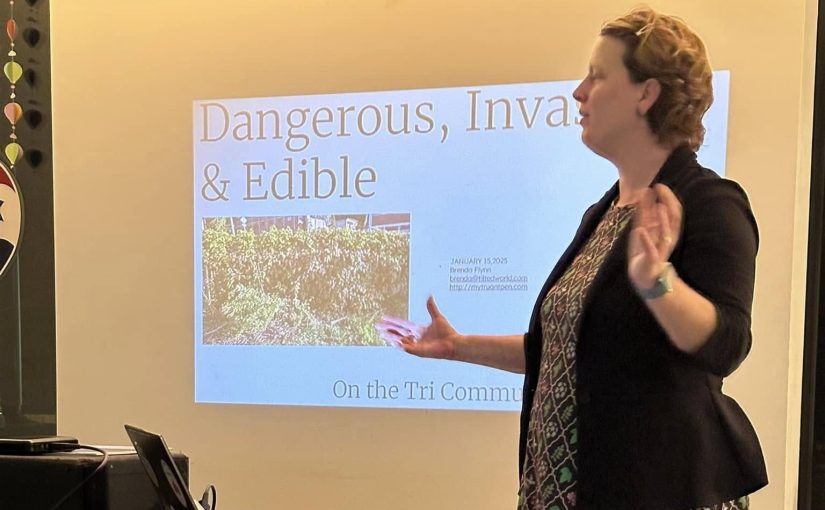
View my presentation: Dangerous, Invasive and Edible: Plants of the Tri-Community Greenway
It can be a mistake to volunteer. For several years on my company’s paid volunteering day, I’ve opted to do invasive species removal. Mostly it gets me outside and is light and satisfying physical labor. But it has the nasty side effect of teaching me to clearly identify local invasive species. And every time I take a walk along the Greenway – particularly fertile ground for those – I just can’t stop noticing the invasives (as well as the noxious and edible plants I’ve trained myself to notice). In October, in a burst of civic enthusiasm, I noted a Keep Stoneham Beautiful meeting, figured I had two hours to spare, quickly snapped a picture and description of the plants in question (easy to do since that particular narrative runs through my head every walk), and tossed it like a glitter bomb in their unsuspecting open meeting.

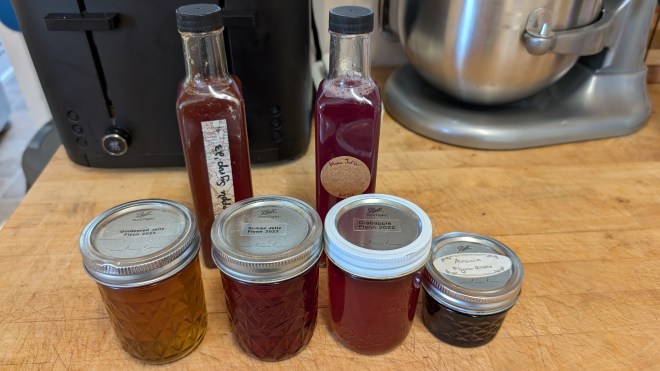
They were EXTREMELY gracious about it. And then, in a move I really should have anticipated, they then wanted me to DO something about it. We settled on a community education talk. So this last week, I added baking some homemade bread into a busy work day (I admit it’s somehow a jarring role shift to go between the highest high tech and baking bread back to back). And then I brought my slides, several books, two syrups I use for flavoring seltzer, three loaves of warm bread and four jams to the Common House in Stoneham. It ended up being a packed house. It’s a small space, so packed was probably only 20 people, but we had a lively discussion with a lot more talking about goats than you might expect. (Renting goats probably our only non-herbicidal solution to the poison ivy problem.)
My presentation really focuses on an extremely small section of trail. It’s probably 2/10ths of a mile. Everyone in the crowd knew exactly what I meant when I said things like “it’s where the Montvale Plaza used to be” or “it’s on the downhill side near the Y”. It can be easy to forget how, in a physical community, we have this shared context of places we (mostly) all know. It allowed this conversation to be incredibly specific, in a deeply satisfying way. It wasn’t about invasive species in general: it was about that stand of knotweed right where the new housing is going up, but on the other side of the trail.
I had a really fun time. I loved watching people try out my jellies. People especially enjoyed the chokecherry (aronia) and crabapple. The sumac was good but wasn’t anyone’s favorite. And only a few holdouts though that the goldenrod jelly was enjoyable to eat (although heaven knows it’s a complex flavor). I foreshadowed the coming of the pawpaws. And the bread was very popular!
One of the things I like about this kind of community work is that it is something we can DO. Most of my suggestions don’t require approval or collaboration or fundraising or even other people. Or if so – only small groups are really needed. It shouldn’t be a divisive issue to find a way to get rid of the poison ivy where our kids play. Sometimes, there’s so much in the world I feel like I can’t fix, that I have to remind myself to ask the question what CAN I do? And this is something I can do.
Next on the schedule: walks of the area this spring, with narration! And maybe goats.
Thanks to Jeannie Craigie for the pictures!

 My Truant Pen