
We are in this wonderful phase in life, where our caretaking responsibilities are small, our financial resources are just about peak, and our bodies are still capable of doing intense athletic feats. And so in our adventures, we’re taking full advantage of it.
Our most recent journey was destined to Patagonia. If you ask most Americans (in my small sample size) what they know about Patagonia, most of it has to do with moderately expensive clothing. A few will recall the quick line from the Princess Bride about the Dread Pirate Roberts “living like a king in Patagonia”. There are a few hints and trickles of the region in our lore, but not many. So when we decided to go to Patagonia, it was only with the haziest of ideas of mountains and hiking and wild rivers. So we reached out to Jane, and it turns out she lived in Patagonia for 2 years, so knew all sorts of secret gems.
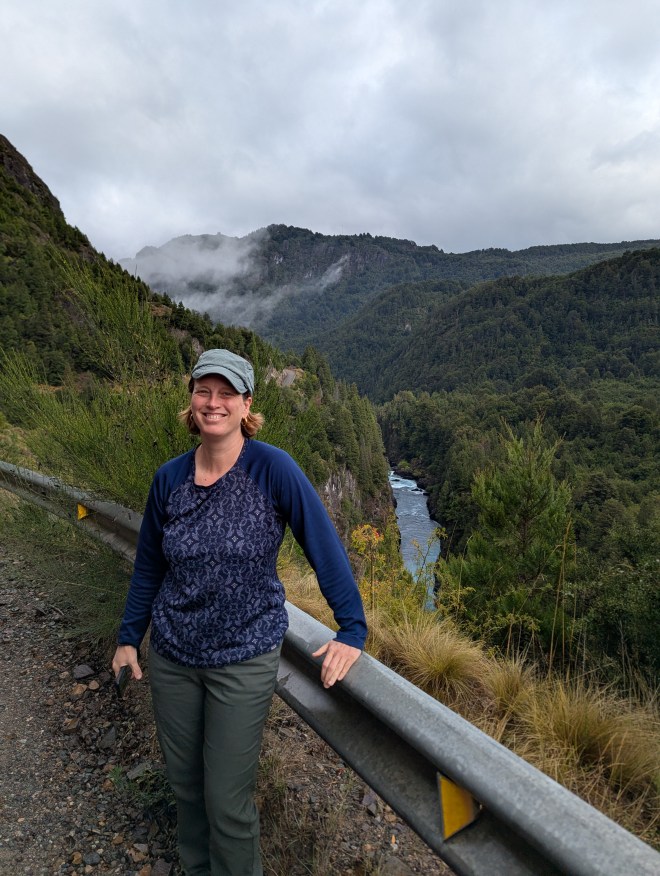
We came in through Buenos Aires and spent a few happy days in the warmth of the city before boarding a local plane for adventure. We were picked up at the tiny airport in Esquel by Chris Spelius, our gracious host, and a truly legendary kayaker. After a quiet but lovely night in Trevelin, we crossed from Argentina to Chile on a dirt road in an incredibly scenic valley. Not to long after that, we turned off the “main” road to a forest-service type track next to this incredibly blue river where we’d spend the next week, the Futaleafu (which means “Big River”).
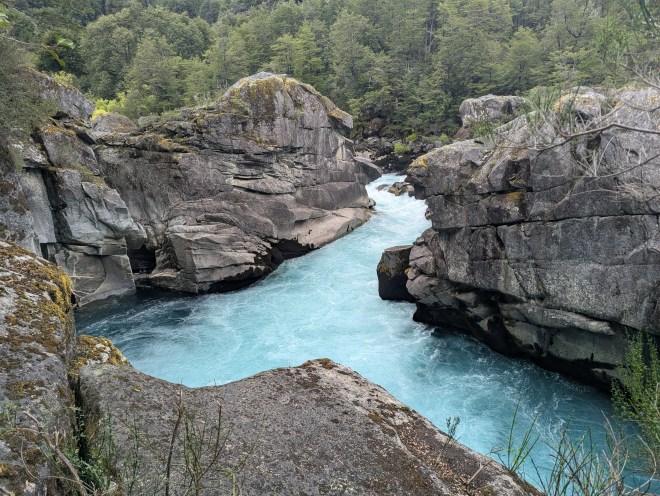
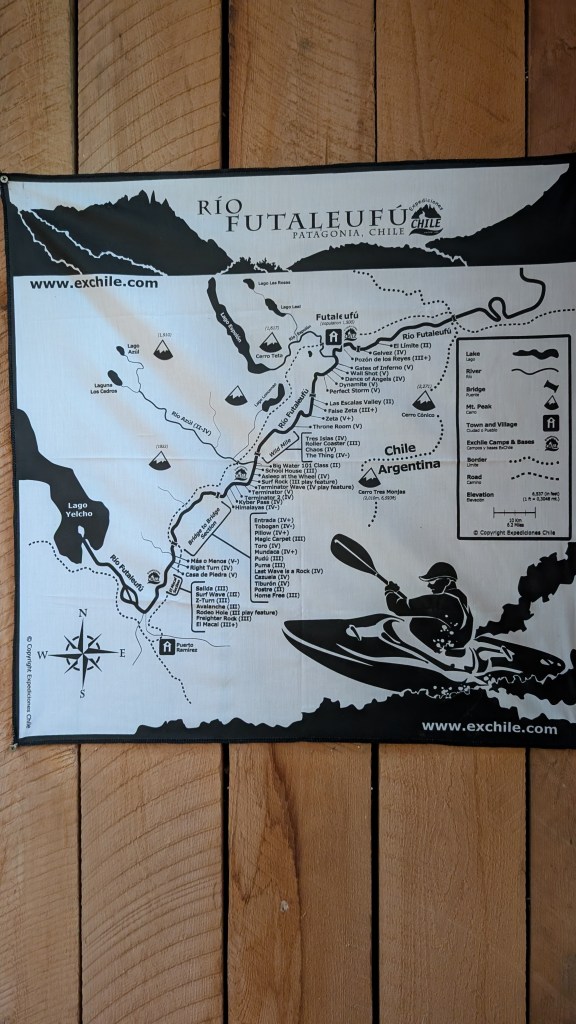
At the banks of the river we swapped our civvies for wetsuits (and a wool layer underneath), and met our phalanx of guides. It was just the two of us in the whitewater raft, but we had a deeply skilled guide manning the big sweeping oars (Pedro) and three rescue kayakers (Chiloe, Kris and Juan). This seemed a little like overkill, but we soon learned why. The whitewater was super fun to run, and the scenery we passed through stole my breath with its rugged beauty. But down the river we disembarked for some lunch and a portage. I am a mountain girl. I can talk about every peak in my world. My friends and I can and do discuss specific trails at great length and specificity. But here I was living in a river world, and we had run Las Escalas and Son of Zeta, but Zeta is a class v+. If there was such a thing as a VI, it would be a VI. It has been run (by Chris among others). But it was very tricky. The rocks were slippery and a fall would be catastrophic so we stayed low and safe, enjoying our hot cocoa and incredible fresh tortilla wraps while the four guides the walked the kayaks across the trails and laid all the complex ropes to portage the raft down the river. It was fascinating and slightly terrifying to watch the process that required them to clip into harnesses just to place the ropes. The degree of their expertise and problem solving was immediately clear. There were a few exciting moments, but the raft made it down the river. We portaged the Throne Room and ran the rapids on the Wild Mile: Tres Islas, Roller Coaster, Chaos and “The Thing”. (The rapids names are super fun – I think my favorites for the river were “Asleep at the Wheel” and “Last Wave is a Rock”.)
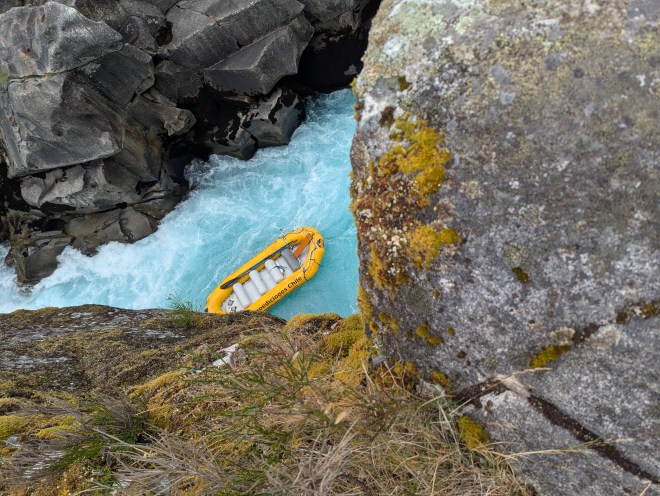
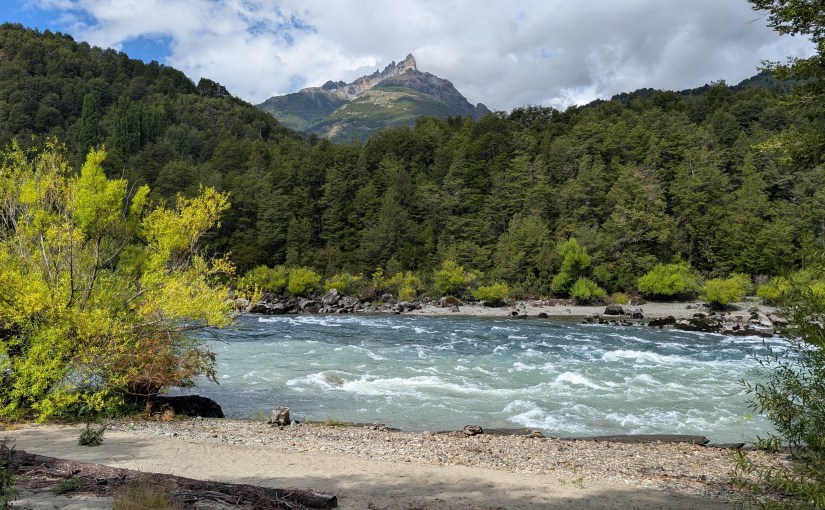
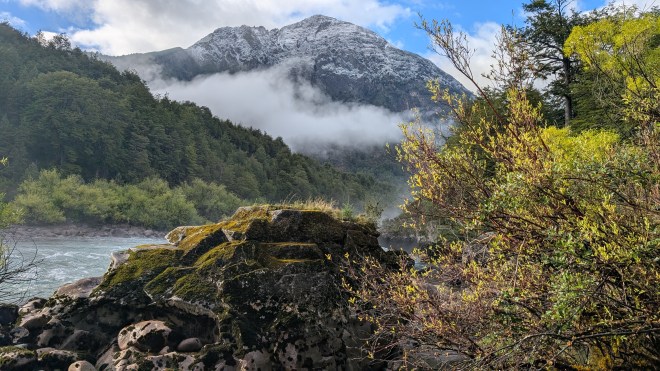
We stepped directly off the rafts onto the isthmus where we’d be living for the next week, at the confluence of the Futaleafu and Azul rivers, where the sound and presence of the waters is the heartbeat of life.
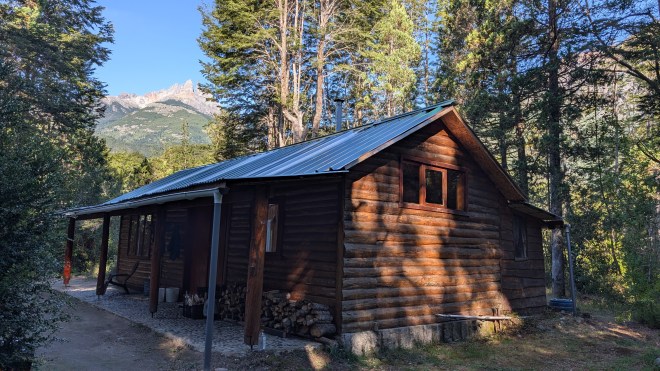
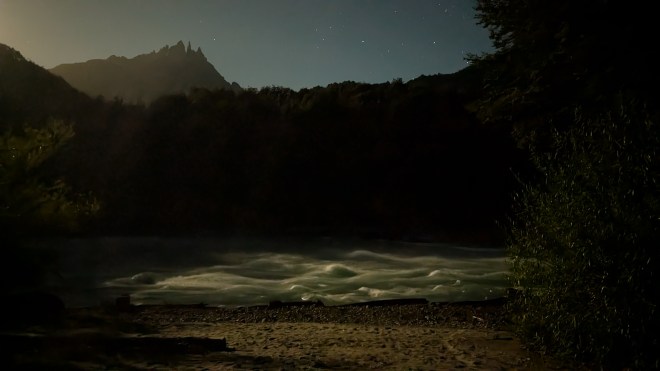
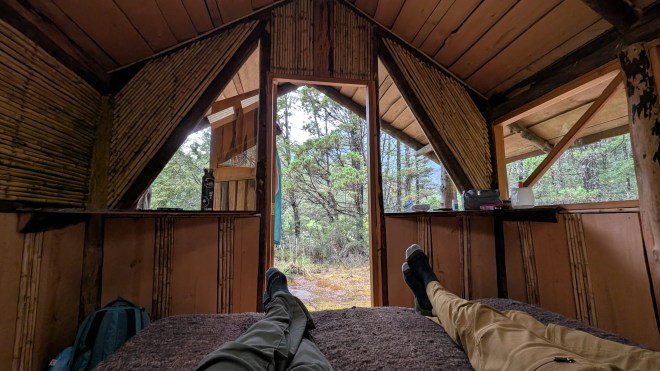
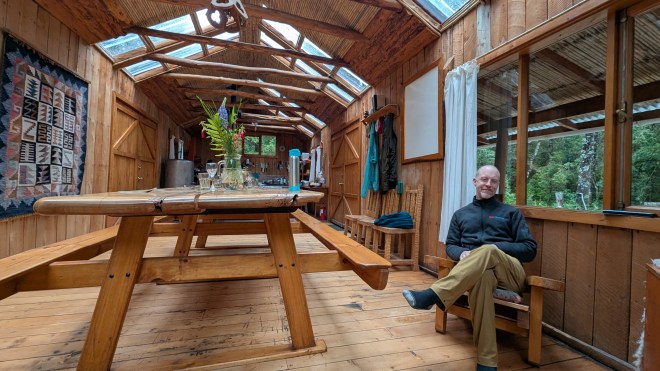
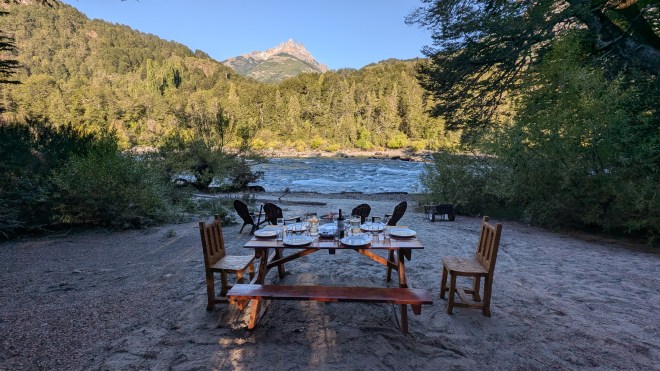
The camp – Tres Monjas or “the Three Nuns” for the overseeing peak – feels like a fantasy come true. My fantasy specifically. There’s a great house with the kitchen and a big table, surrounded by big windows. It’s home to one of the two wood stoves, which prepared all of our food and also heated the water for one set of showers. There’s the wood sauna, dark and warm, that provided heat for the outdoor shower that was everyone’s favorite (and the next-door massage room). The bathrooms were in the middle of camp, with spectacular unencumbered views on all sides. And then there were cabins all dotted privately through the isthmus, in sound of the river. They were unheated, but the thick woolen blankets meant that even when it dropped to freezing we were toasty and comfortable. There was exactly one place where electricity intruded – a charger for phones in the great room and a single lightbulb above the kitchen to allow cleanup in the gathering dark. There are few places in the world further “away” than this confluence below the Southern Cross where the waters of the Andes sprint towards the sea. Towards the middle of the camp is a sandy white beach on the Futaleafu where the Tres Monjas spin their spires above the blue waters. There’s a lovely table there, some chairs, and an ever-changing view of the mountains. Every time I passed, I had to pause and see how many of the spires were out.
We all ate together at night, with a pair of taper candles on the table lighting the conversation. Usually the main topic was “what are you going to do tomorrow”, with a good amount of top-quality story-telling and raconteur added in. (You are offered the choice of eating by yourself or joining in the group – so if that sounds horrible to you for your vacation it’s not required. But it was truly one of the high points for me. These people have STORIES.) We were the only guests at the close of the season, so it was really what we wanted to do.
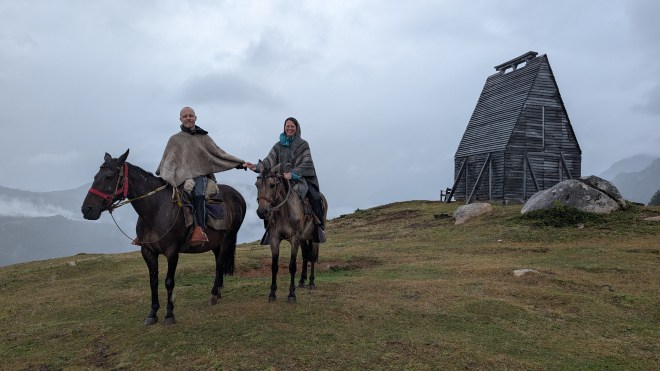
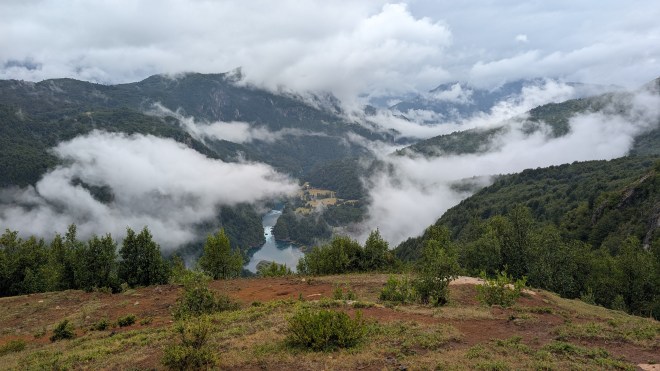
Our first full day was horses. We crossed the Futa on the Catamaraft and walked up a hidden trail to the Condor’s Nest, where we were met by a quiet woman with four horses. If the Sahara was fast stallions across the flat desert in the heat, these were mountain mares and well equipped for the mud and rain of our path up the mountain. One of my great takeaways from this trip is how freaking amazing wool is. Wool under wetsuits meant wet but not cold. Wool in the rain is astonishing. Jacinda had two woolen ponchos for us to wear. I was like “I’m fine I’m wearing layers and rain gear” but as I went up, I realized that actually that sounded great. We emerged through forests and fields to this medieval-feeling fairy tale of a meadow with a steep wooden building “The Indulgence” and overlooked the Throne Room rapids we’d portaged the day before.
Weather in Patagonia is similar to Alaska – not all that reliable or warm even in summer. The second day was unsettled, so we decided to go to the Escolon River (which is significantly less white-water) to learn how to handle kayaks under the tutelage of two terrific kayakers (shoutout to Pablo and Kris!). We were on “duckies” which are inflatable kayaks that are pretty tough to overturn (and don’t trap you if you do turn over – you just fall off). We learned basic skills – how to ferry, how to cross, how to use the current to turn you, how to move back and forth between still and moving water. The weather held, and we had a beautiful day down the river. When we hit the sandy beach we were going to take out on, in calm waters, we got promoted to the hard-shell kayaks and spent a happy half hour half-drowning ourselves to learn how to right ourselves if needed. The next day would be all rain, and all whitewater kayaking.
My husband and I both really love learning new skills. This probably doesn’t sound like vacating to some people, but the refreshingness of learning something totally new under extremely skilled instruction. So when we headed back to the Escolon (in one of the kayaks that Chris helped design) in the pouring rain, our pickup driver thought we’d be out an hour… but we stayed four in the pouring rain in the river tackling a Class 1 over and over again, learning how to make our way to the eddies, keep our noses pointed to 11 or 1 as the direction warranted, to turn fast, to lean in, to read the water. It was exhilarating, although at some point my arms let me know that I’m mostly a LOW BODY athlete and they are not USED to this kind of exertion. We dunked ourselves a few more practice times before piling towards the in-town bunkhouse to warm up with more excellent hot cocoa and lunch.
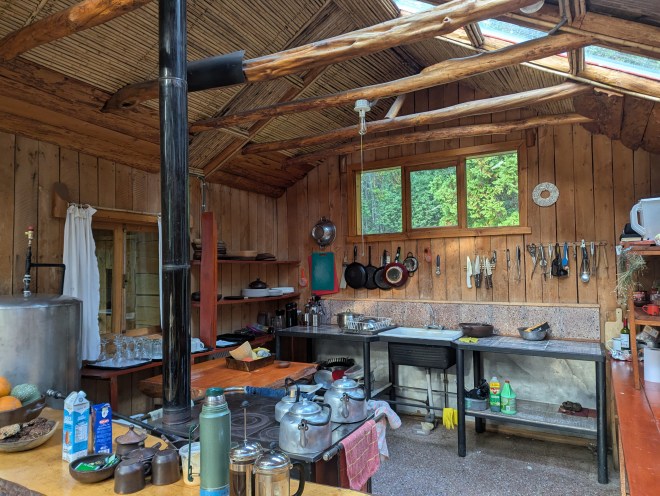
Let me take a moment to talk about the food. I’m hard to impress. I like to eat out, I like to cook, I’ve had a farm share for years, Boston has a fantastic restaurant scene. I’m not picky though, and I can keep body and soul together with almost anything. So I didn’t have high expectations for a cabin in the middle of the woods where the cooking was done over a wood stove. OH MY GOSH. People. This chef, Evelina and her helper Sophie, would put many top ranked Boston restaurants to shame. My husband has lactose intolerance, and she made sure that every single dish was no problem for him. All of the food, gnocchi, steak, breakfasts with pancakes and oatmeal and eggs, lunches … all of it was spectacular. It was incredibly high quality, made from super fresh ingredients. Folks, she turned out tiramisu for dessert on a wood stove. What sort of wonder-working is that? I’m not saying you should go here just for the food. But dang, it would almost be worth the trip.
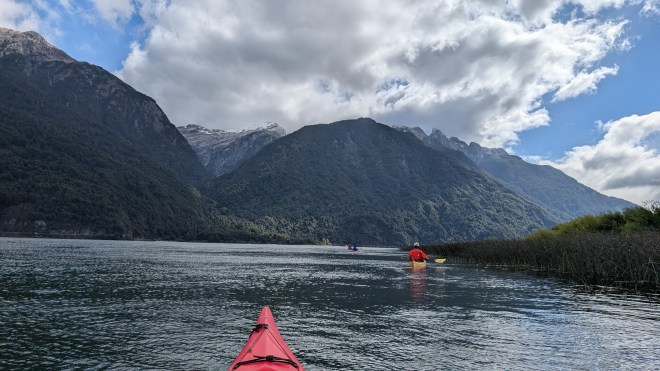
After our waterlogged day of whitewater rafting, we were ready for some sea kayaking down the still, broad portions of the Futa to Lake Yelcho. I figured this would be easy – the current would take us where we needed to go and a nice placid lake sounded great. We got into our third kayak configuration in as many days, and set off down the river. The views on either side were utterly spectacularly distracting. The joke had become that I would always go wherever I was looking (which was bad when I was, say, trying to avoid overhanging trees). If that were true, I would have been high up in the mountains, poking at the toes of glaciers in carved-out cirques. But I started to notice that, um, there was a bit of wind. A lot of wind actually. I was moving backwards if I wasn’t paddling in fact. This might have been the best abs and arms workout of my whole life people. We battled the winds all the way to the island where the waters of the Futa divided. To our right, it was as though a herd of horses stampeded across the lake, the whitecaps were so high and daunting. We went left, and just before we emerged from the protective estuarial reeds, Kris and Pablo gathered round. “We can use a tow rope. But once we get into the lake, it’s going to be important that you keep going, keep your nose at 11, and then we’ll turn at the shore and come down. We’re headed for that beach over there.” It didn’t look far. But we couldn’t go straight – we had to go up up up and edge our way across before letting the wind swing us around. Going broadside would invite waves to crash into us, and this was going to be inconvenient to be rescued in. I gathered all the strength of the soggy noodles that had replaced my arms, lamented a minute that I would not be able to stop to capture any of it, and started my fight across the lake.
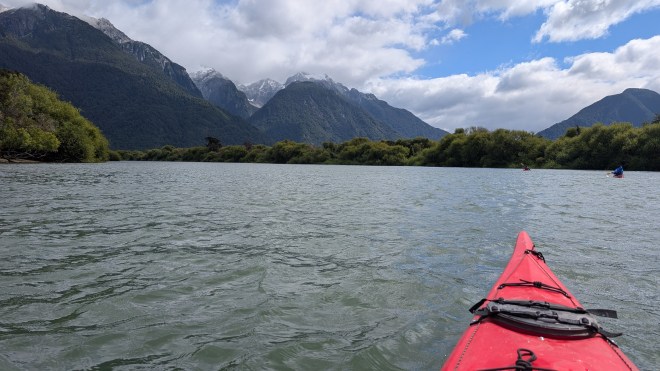
FYI it’s generally considered poor form to kiss the ground when you land. I was never in any peril, but I certainly tested myself against the waters and found that their strength was greater than mine.
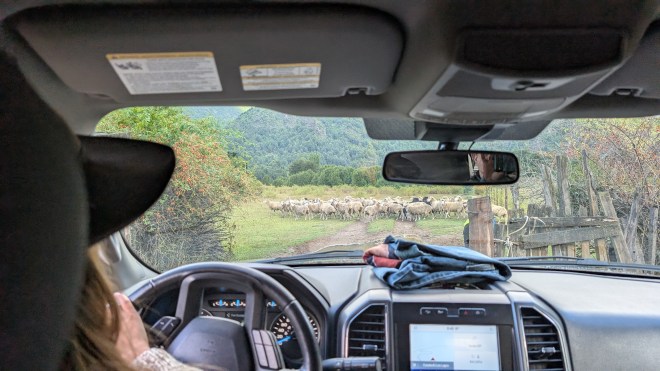
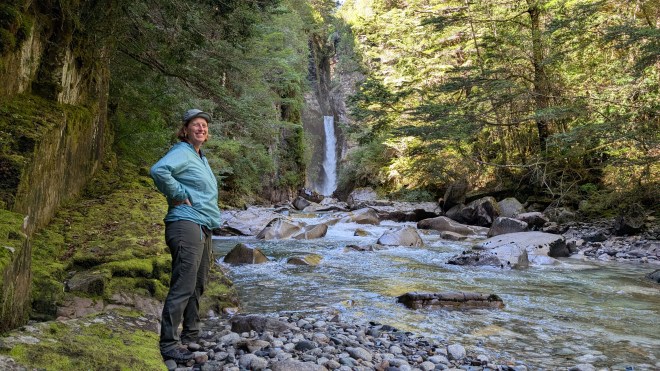
Our last full day we decided to dry out. The sun came out in full glory, and the whole place just hummed with beauty. My husband decided to spend the day in camp, trying out the hammock, exploring and generally actually relaxing. Six of us headed across the river to meet up again with Jacinda (and her 8 year old daughter) – including Sophie out for a bit of a holiday. Rumor was there was a waterfall that had been recently discovered with a new trail cleared for it. Patagonia has not been settled all that long, and it’s sparsely settled. As I understand it, even before the coming of Europeans this area had few inhabitants. They called it the Green Desert. So I took a mare until the trail got narrow, and then we hiked in a few miles to a waterfall that almost no one has ever seen. There were two actually, a small cascade that reminded me of nothing so much as the old Herbal Essences shampoo bottle and a 30 foot brilliant waterfall, crashing into crystal clear waters below. We had a picnic there in hidden canyon, carefully supervised by two very good puppies.
The last night, we all ate on the beach with a fire in the clement weather. The folks at Expediciones Chile were not any longer “the staff at the resort we stayed at”. They were friends, humans, people whose stories I know and care about. I have come to know them, and be known. It’s actually hard, wondering how they’re doing and missing them. (And the food. And the mountains and rivers of course, but really the food.)
After a long return flight, I’m back once again in the world of cold and snow and politics and cell phones and AI and all the things. But a part of my heart is still on the Futeleafu.

 My Truant Pen