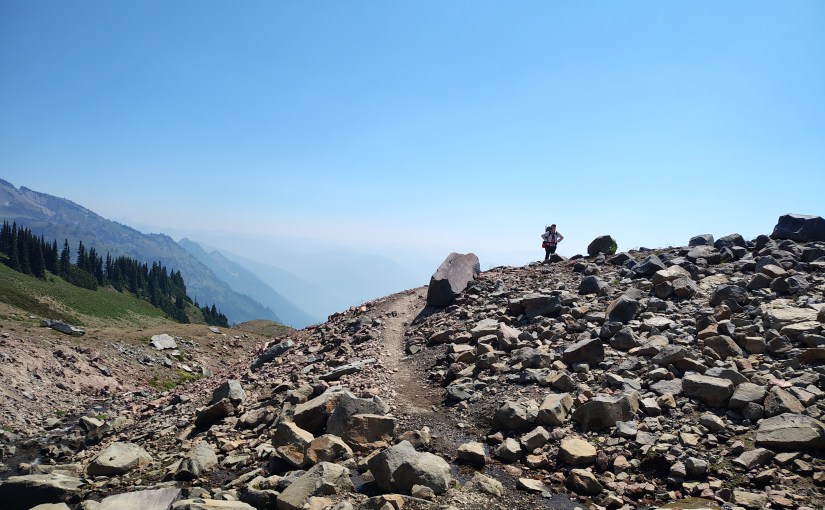
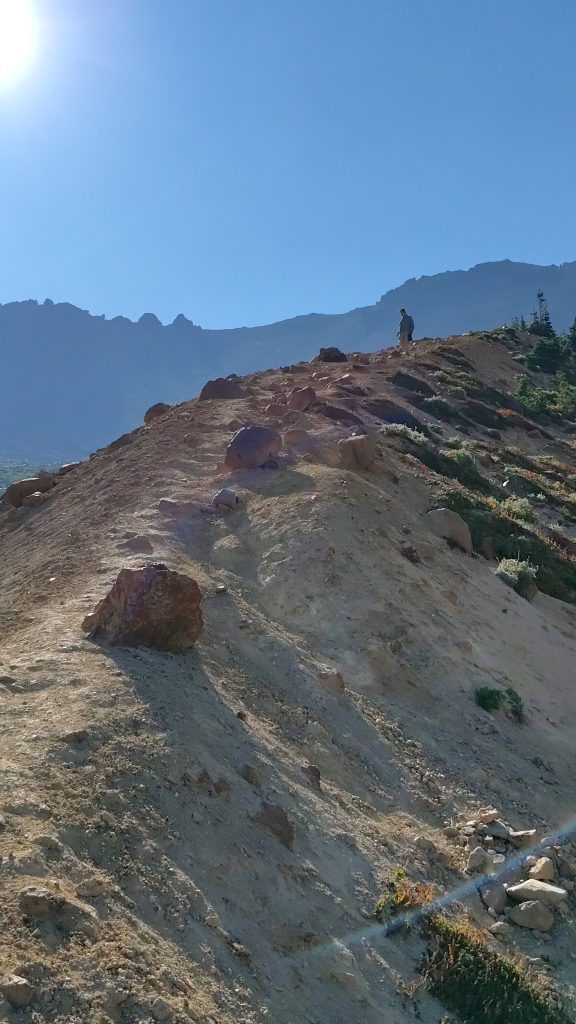
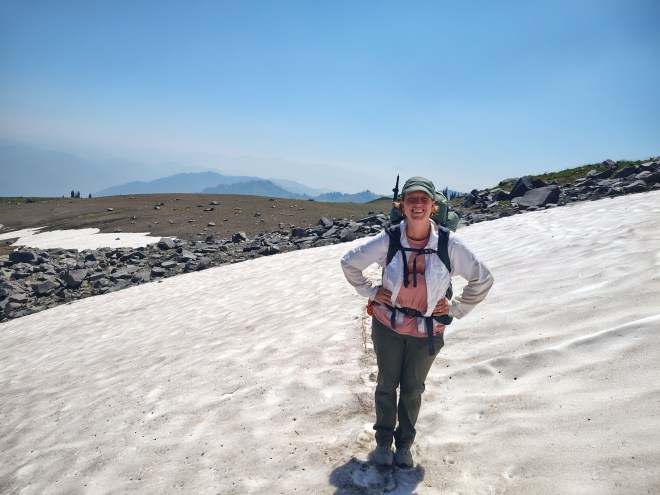
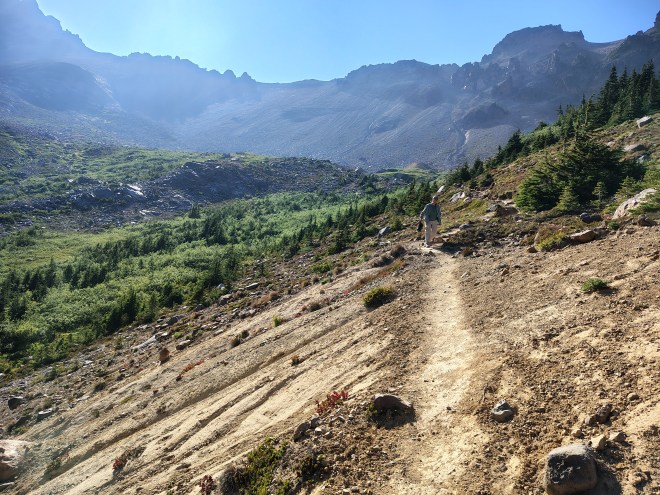
I’m an avid hiker – loving nothing more than to follow my legs to a place you can’t get to any other way and stand overlooking vistas you can only achieve with effort. Over the years, I’ve gotten a lot of comments and concerns about hiking. Is it safe to hike alone? What about bears? Did I hear about that person who died in the White Mountains last week? We spend a lot of time thinking about the risks of this hobby. I’ve taken Wilderness First Aid. We go out prepared with the ten essentials – and another 20 more “super usefuls”. We carefully review the weather, have at least two maps of the trail (and one in our head) and generally do everything we can to mitigate the risks of tackling remote, ankle-breaking trails for fun. Every time I go hiking, I take a big risk.
But one of the things I think a lot about is the difference between a big, active risk you take, and the kinds of risks that exist without a decision. If I don’t go hiking – what are the risks of NOT hiking? According to a 2018 study, “Overall, 8.3% of deaths were attributed to inadequate levels of physical activity.” [https://www.cdc.gov/Pcd/issues/2018/17_0354.htm]. A lifetime of not hiking, or not running on roads where you might get attacked, or not riding bikes where you might get hit by a car leads to a situation where you might instead die of heart disease, diabetes or the other curses of the inactive body.
Going outside and getting exercise are two absolutely proven mental health interventions. Sunshine, nature and exercise (which I get on those trails) have measurable positive impacts on mental health. “3% of deaths, equating to around 8 million annually, are attributable to mental health conditions.” [https://themaplesrehab.com/how-many-people-died-as-a-result-of-mental-illness.html]. So that trip to the mountains instead of staying home doomscrolling also reduces mental health related risks.
You might argue that a lot of these benefits could be obtained by going for a run around a nice, safe track without the risks. But there are aspects to the very risks of the rocky trails that also create protections. If you’ve ever scrambled up a rocky slope for a few hours, you feel it in the tiny little muscles in your ankles and feet – the little stabilizers that never get called upon on a flat road. Your balance gets better. You become more resilient to uneven terrain. Given that falls are a top injurer and killer of older folks [https://www.cdc.gov/falls/data-research/index.html] and hiking can help you stay steady-footed later, it seems clear that the upsides might outweigh the downsides.
Do people die hiking? Absolutely. But far fewer than a thousand people a year [https://imalive.co/data/hiking-fatality-statistics]. When someone does die that way, it makes the news. It doesn’t make the news when someone dies of congestive heart failure, alcohol poisoning, or the effects of a fall on a sidewalk. Put another way: hiking is safer for you than NOT hiking.
We don’t look at risks that way though. We look at the things you DO as creating a risk, not the things you don’t do. I worked at a place that had a risk log where decisions were written down with who accepted the risk of them. Did you update some software? Into the risk log. Adopt a new technology? Open a new facility? Take on a new kind of project? Risk log for you. But no one writes down “we didn’t innovate today” in the risk log or “we didn’t kick off a project to update our authentication system” or “we aren’t listening to our customers well” in the risk log. Action has an owner who takes responsibility. Inaction belongs to everyone and no one.
So I’ve started to think hard and long about the risks of NOT doing something, in both my personal and work life. What is the risk of NOT going for a promotion, taking on a big project, or looking for a better-fitting role? I thought about this a lot in the context of leaving Google. I’d been there 11 years. I knew how things worked. I had friends and habits and I had been continually employed there for over a decade. Of course it would be “safer” in this really tough economy to just stay there and hunker down, right? The counterpoint was the steady erosion by layoff that is endemic across the high tech industry. It felt like a week didn’t go by without some layoff, some friend gone, some email suddenly bouncing back. The frenetic pace of project changes made it feel like a huge game of musical chairs. So far I’d always been in a seat when the music stopped playing – but I couldn’t guarantee my luck there would hold. There was always the chance I’d wake up some morning to an email letting me know it was my turn.
I truly believe that it was safer – for my long term and short term career – to find a company whose mission and leadership I’m really excited about. It’s safer to work for a company that not only needs me, it KNOWS it needs me, as opposed to the anonymity of a role inside a behemoth. The freshness of the new business and expanded role help invigorate me for the next chapter in my career.
How much do you think about the risks of “not”? When you’re contemplating something that feels dangerous – either a perilous mountain trail or career change – how much time to you spend imagining what the risks are if you don’t change anything?
We are in this wonderful phase in life, where our caretaking responsibilities are small, our financial resources are just about peak, and our bodies are still capable of doing intense athletic feats. And so in our adventures, we’re taking full advantage of it.
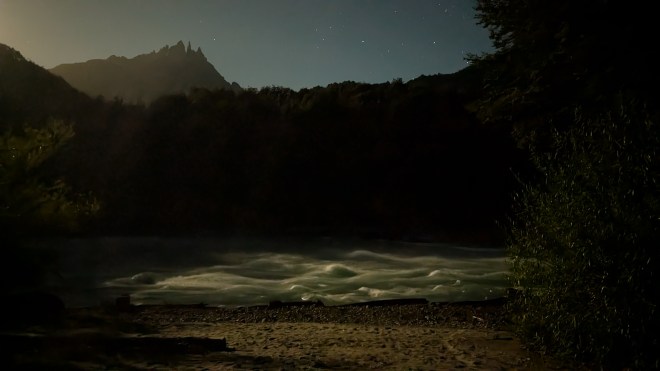
The Futaleafu by moonlight
Our most recent journey was destined to Patagonia. If you ask most Americans (in my small sample size) what they know about Patagonia, most of it has to do with moderately expensive clothing. A few will recall the quick line from the Princess Bride about the Dread Pirate Roberts “living like a king in Patagonia”. There are a few hints and trickles of the region in our lore, but not many. So when we decided to go to Patagonia, it was only with the haziest of ideas of mountains and hiking and wild rivers. So we reached out to Jane, and it turns out she lived in Patagonia for 2 years, so knew all sorts of secret gems.
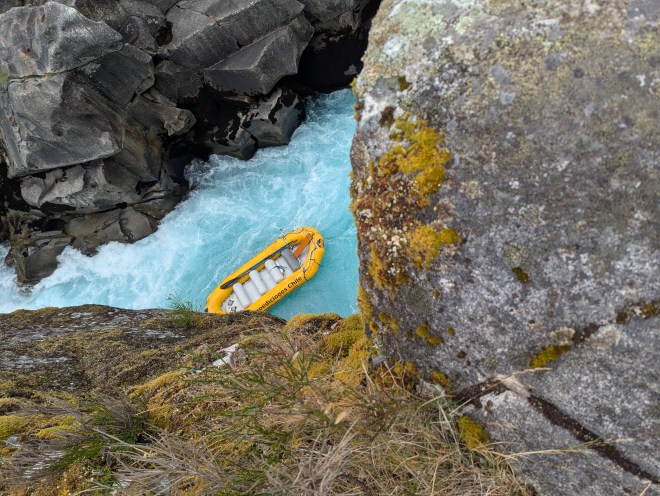
Wait, we’re rafting that thing down there??
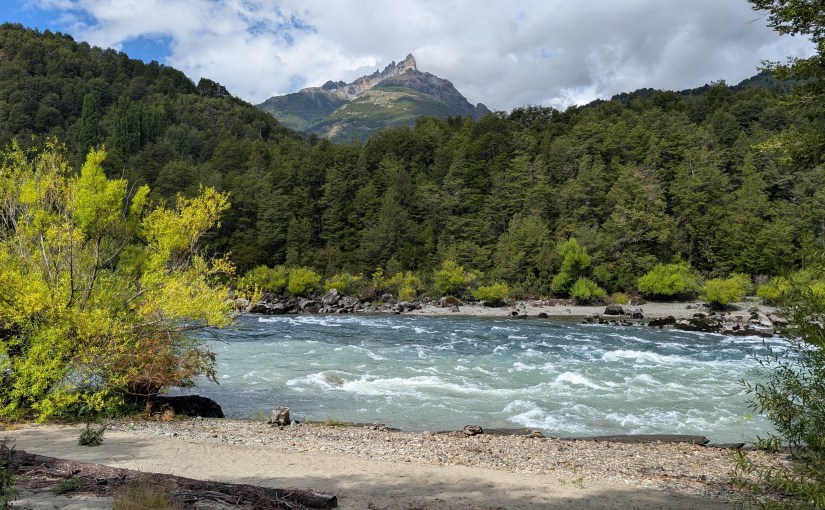
We came in through Buenos Aires and spent a few happy days in the warmth of the city before boarding a local plane for adventure. We were picked up at the tiny airport in Esquel by Chris Spelius, our gracious host, and a truly legendary kayaker. After a quiet but lovely night in Trevelin, we crossed from Argentina to Chile on a dirt road in an incredibly scenic valley. Not to long after that, we turned off the “main” road to a forest-service type track next to this incredibly blue river where we’d spend the next week, the Futaleafu (which means “Big River”).
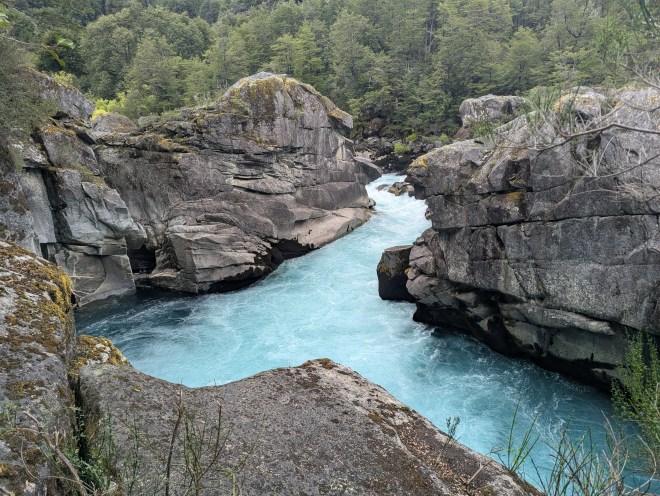
The bottom half of the “Z” of Zeta
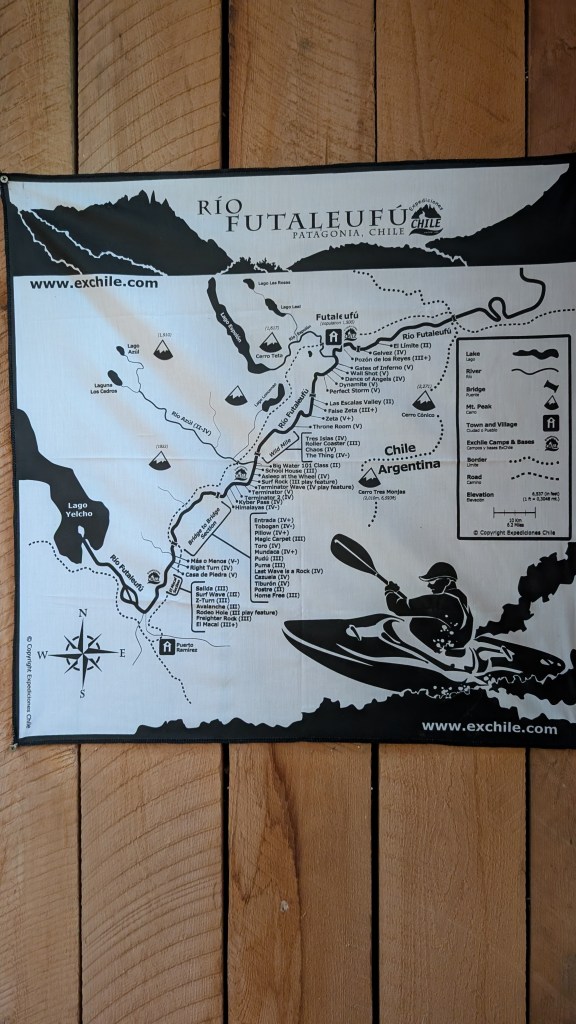
At the banks of the river we swapped our civvies for wetsuits (and a wool layer underneath), and met our phalanx of guides. It was just the two of us in the whitewater raft, but we had a deeply skilled guide manning the big sweeping oars (Pedro) and three rescue kayakers (Chiloe, Kris and Juan). This seemed a little like overkill, but we soon learned why. The whitewater was super fun to run, and the scenery we passed through stole my breath with its rugged beauty. But down the river we disembarked for some lunch and a portage. I am a mountain girl. I can talk about every peak in my world. My friends and I can and do discuss specific trails at great length and specificity. But here I was living in a river world, and we had run Las Escalas and Son of Zeta, but Zeta is a class v+. If there was such a thing as a VI, it would be a VI. It has been run (by Chris among others). But it was very tricky. The rocks were slippery and a fall would be catastrophic so we stayed low and safe, enjoying our hot cocoa and incredible fresh tortilla wraps while the four guides the walked the kayaks across the trails and laid all the complex ropes to portage the raft down the river. It was fascinating and slightly terrifying to watch the process that required them to clip into harnesses just to place the ropes. The degree of their expertise and problem solving was immediately clear. There were a few exciting moments, but the raft made it down the river. We portaged the Throne Room and ran the rapids on the Wild Mile: Tres Islas, Roller Coaster, Chaos and “The Thing”. (The rapids names are super fun – I think my favorites for the river were “Asleep at the Wheel” and “Last Wave is a Rock”.)
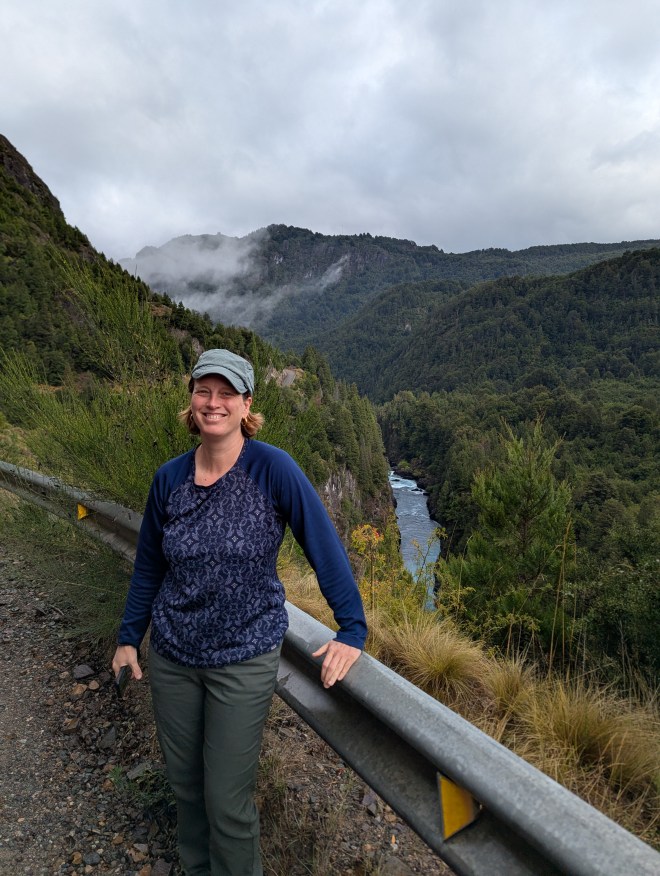
It was a looong way down and hard to even get close enough to see the waters below.
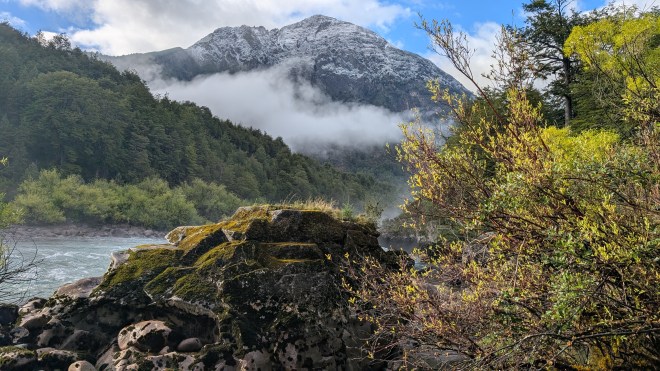
We stepped directly off the rafts onto the isthmus where we’d be living for the next week, at the confluence of the Futaleafu and Azul rivers, where the sound and presence of the waters is the heartbeat of life.
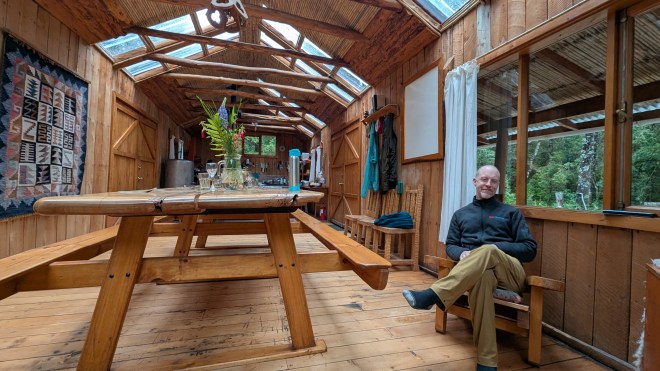
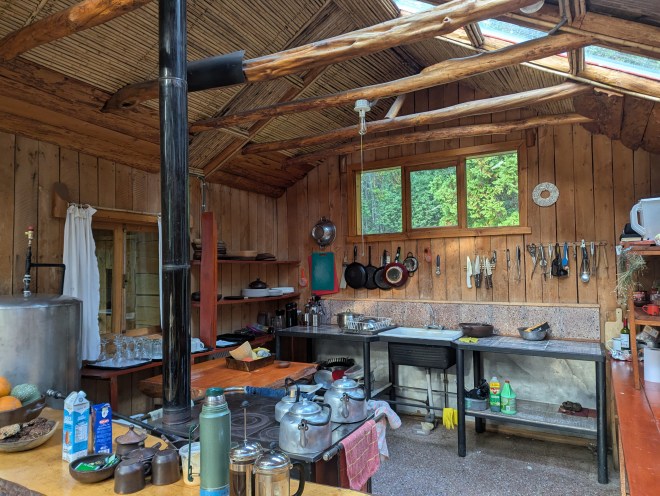
The great room, looking all scenic and rustic. It was the heart of the camp.
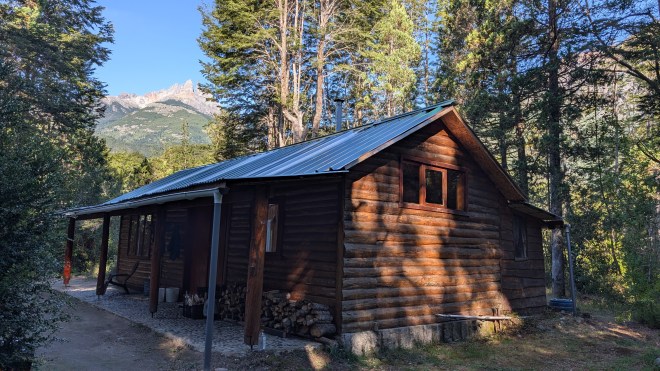
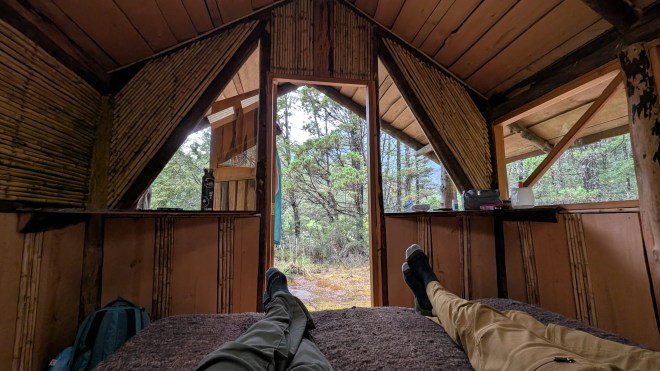
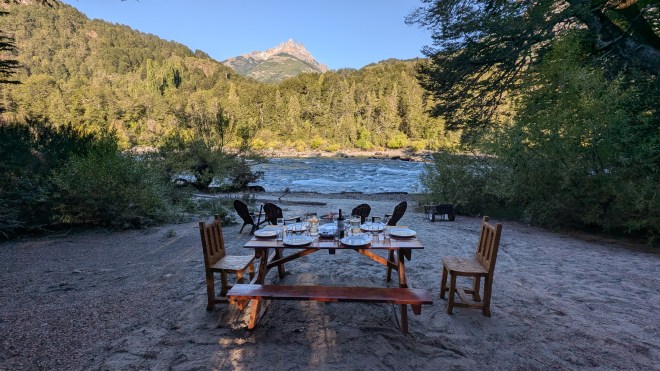
The camp – Tres Monjas or “the Three Nuns” for the overseeing peak – feels like a fantasy come true. My fantasy specifically. There’s a great house with the kitchen and a big table, surrounded by big windows. It’s home to one of the two wood stoves, which prepared all of our food and also heated the water for one set of showers. There’s the wood sauna, dark and warm, that provided heat for the outdoor shower that was everyone’s favorite (and the next-door massage room). The bathrooms were in the middle of camp, with spectacular unencumbered views on all sides. And then there were cabins all dotted privately through the isthmus, in sound of the river. They were unheated, but the thick woolen blankets meant that even when it dropped to freezing we were toasty and comfortable. There was exactly one place where electricity intruded – a charger for phones in the great room and a single lightbulb above the kitchen to allow cleanup in the gathering dark. There are few places in the world further “away” than this confluence below the Southern Cross where the waters of the Andes sprint towards the sea. Towards the middle of the camp is a sandy white beach on the Futaleafu where the Tres Monjas spin their spires above the blue waters. There’s a lovely table there, some chairs, and an ever-changing view of the mountains. Every time I passed, I had to pause and see how many of the spires were out.
Putting up your feet. Weirdly, there were NO bugs.
We all ate together at night, with a pair of taper candles on the table lighting the conversation. Usually the main topic was “what are you going to do tomorrow”, with a good amount of top-quality story-telling and raconteur added in. (You are offered the choice of eating by yourself or joining in the group – so if that sounds horrible to you for your vacation it’s not required. But it was truly one of the high points for me. These people have STORIES.) We were the only guests at the close of the season, so it was really what we wanted to do.
The great room is where all the gathering happened
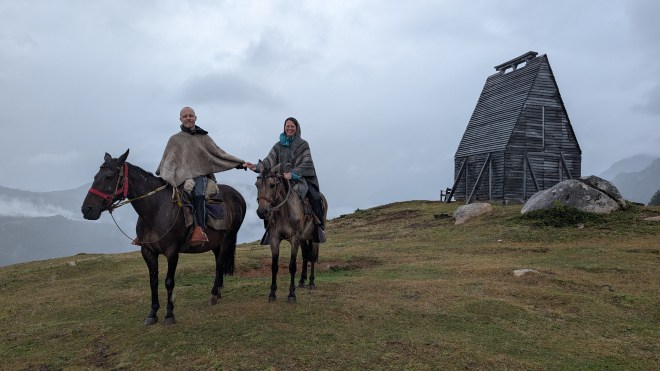
Our first full day was horses. We crossed the Futa on the Catamaraft and walked up a hidden trail to the Condor’s Nest, where we were met by a quiet woman with four horses. If the Sahara was fast stallions across the flat desert in the heat, these were mountain mares and well equipped for the mud and rain of our path up the mountain. One of my great takeaways from this trip is how freaking amazing wool is. Wool under wetsuits meant wet but not cold. Wool in the rain is astonishing. Jacinda had two woolen ponchos for us to wear. I was like “I’m fine I’m wearing layers and rain gear” but as I went up, I realized that actually that sounded great. We emerged through forests and fields to this medieval-feeling fairy tale of a meadow with a steep wooden building “The Indulgence” and overlooked the Throne Room rapids we’d portaged the day before.
Those ponchos are CLUTCH. Truly amazing.
Weather in Patagonia is similar to Alaska – not all that reliable or warm even in summer. The second day was unsettled, so we decided to go to the Escolon River (which is significantly less white-water) to learn how to handle kayaks under the tutelage of two terrific kayakers (shoutout to Pablo and Kris!). We were on “duckies” which are inflatable kayaks that are pretty tough to overturn (and don’t trap you if you do turn over – you just fall off). We learned basic skills – how to ferry, how to cross, how to use the current to turn you, how to move back and forth between still and moving water. The weather held, and we had a beautiful day down the river. When we hit the sandy beach we were going to take out on, in calm waters, we got promoted to the hard-shell kayaks and spent a happy half hour half-drowning ourselves to learn how to right ourselves if needed. The next day would be all rain, and all whitewater kayaking.
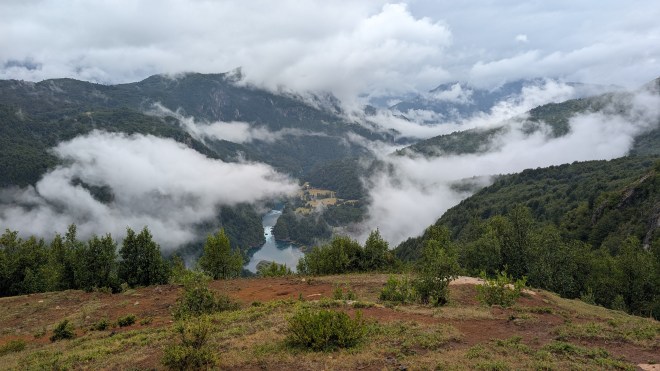
Looking down at the Throne Room rapids
My husband and I both really love learning new skills. This probably doesn’t sound like vacating to some people, but the refreshingness of learning something totally new under extremely skilled instruction. So when we headed back to the Escolon (in one of the kayaks that Chris helped design) in the pouring rain, our pickup driver thought we’d be out an hour… but we stayed four in the pouring rain in the river tackling a Class 1 over and over again, learning how to make our way to the eddies, keep our noses pointed to 11 or 1 as the direction warranted, to turn fast, to lean in, to read the water. It was exhilarating, although at some point my arms let me know that I’m mostly a LOW BODY athlete and they are not USED to this kind of exertion. We dunked ourselves a few more practice times before piling towards the in-town bunkhouse to warm up with more excellent hot cocoa and lunch.
I consulted this often
Let me take a moment to talk about the food. I’m hard to impress. I like to eat out, I like to cook, I’ve had a farm share for years, Boston has a fantastic restaurant scene. I’m not picky though, and I can keep body and soul together with almost anything. So I didn’t have high expectations for a cabin in the middle of the woods where the cooking was done over a wood stove. OH MY GOSH. People. This chef, Evelina and her helper Sophie, would put many top ranked Boston restaurants to shame. My husband has lactose intolerance, and she made sure that every single dish was no problem for him. All of the food, gnocchi, steak, breakfasts with pancakes and oatmeal and eggs, lunches … all of it was spectacular. It was incredibly high quality, made from super fresh ingredients. Folks, she turned out tiramisu for dessert on a wood stove. What sort of wonder-working is that? I’m not saying you should go here just for the food. But dang, it would almost be worth the trip.
Where the magic happened
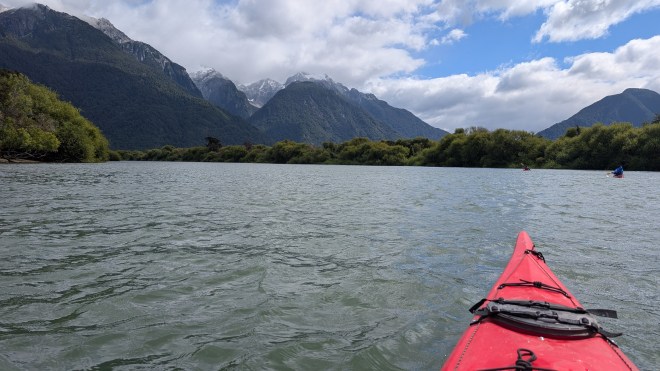
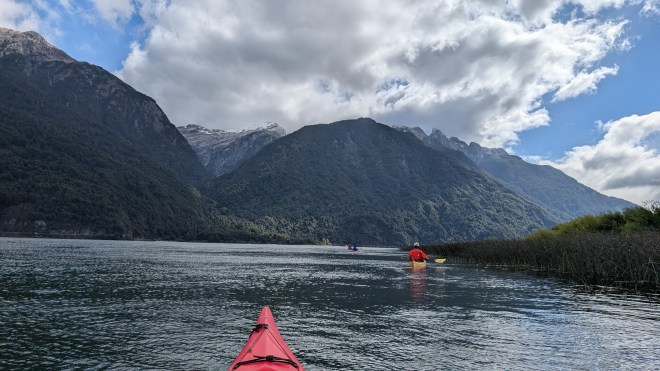
After our waterlogged day of whitewater rafting, we were ready for some sea kayaking down the still, broad portions of the Futa to Lake Yelcho. I figured this would be easy – the current would take us where we needed to go and a nice placid lake sounded great. We got into our third kayak configuration in as many days, and set off down the river. The views on either side were utterly spectacularly distracting. The joke had become that I would always go wherever I was looking (which was bad when I was, say, trying to avoid overhanging trees). If that were true, I would have been high up in the mountains, poking at the toes of glaciers in carved-out cirques. But I started to notice that, um, there was a bit of wind. A lot of wind actually. I was moving backwards if I wasn’t paddling in fact. This might have been the best abs and arms workout of my whole life people. We battled the winds all the way to the island where the waters of the Futa divided. To our right, it was as though a herd of horses stampeded across the lake, the whitecaps were so high and daunting. We went left, and just before we emerged from the protective estuarial reeds, Kris and Pablo gathered round. “We can use a tow rope. But once we get into the lake, it’s going to be important that you keep going, keep your nose at 11, and then we’ll turn at the shore and come down. We’re headed for that beach over there.” It didn’t look far. But we couldn’t go straight – we had to go up up up and edge our way across before letting the wind swing us around. Going broadside would invite waves to crash into us, and this was going to be inconvenient to be rescued in. I gathered all the strength of the soggy noodles that had replaced my arms, lamented a minute that I would not be able to stop to capture any of it, and started my fight across the lake.
It was not as still as it looked
FYI it’s generally considered poor form to kiss the ground when you land. I was never in any peril, but I certainly tested myself against the waters and found that their strength was greater than mine.
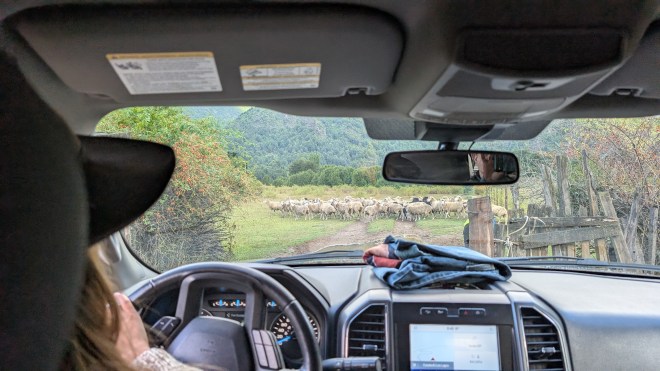
When I stopped to take pictures I started going backwardsTraffic problems like this were common in the region
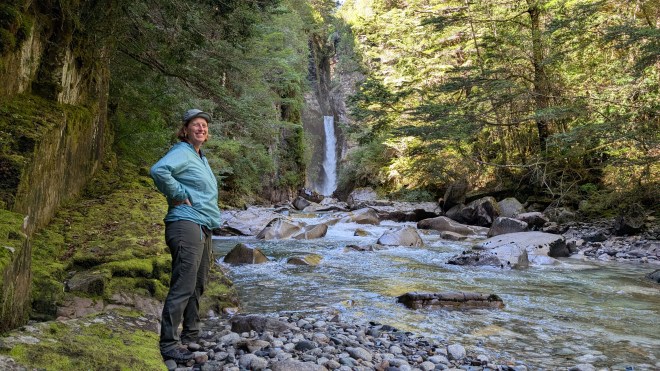
Our last full day we decided to dry out. The sun came out in full glory, and the whole place just hummed with beauty. My husband decided to spend the day in camp, trying out the hammock, exploring and generally actually relaxing. Six of us headed across the river to meet up again with Jacinda (and her 8 year old daughter) – including Sophie out for a bit of a holiday. Rumor was there was a waterfall that had been recently discovered with a new trail cleared for it. Patagonia has not been settled all that long, and it’s sparsely settled. As I understand it, even before the coming of Europeans this area had few inhabitants. They called it the Green Desert. So I took a mare until the trail got narrow, and then we hiked in a few miles to a waterfall that almost no one has ever seen. There were two actually, a small cascade that reminded me of nothing so much as the old Herbal Essences shampoo bottle and a 30 foot brilliant waterfall, crashing into crystal clear waters below. We had a picnic there in hidden canyon, carefully supervised by two very good puppies.
It was really tall, but I’d gotten wet enough and didn’t care to do what it took to get closer.
The last night, we all ate on the beach with a fire in the clement weather. The folks at Expediciones Chile were not any longer “the staff at the resort we stayed at”. They were friends, humans, people whose stories I know and care about. I have come to know them, and be known. It’s actually hard, wondering how they’re doing and missing them. (And the food. And the mountains and rivers of course, but really the food.)
Kris spent like an hour with a level getting the table perfect. He and my husband also spent a happy hour working on knots for the pull in the light in the great room.
After a long return flight, I’m back once again in the world of cold and snow and politics and cell phones and AI and all the things. But a part of my heart is still on the Futeleafu.
We have entered the time of year when I want to listen to Christmas music 24/7. I love the classics – give me a Deck the Halls or Joy to the World any time. I particularly love early music in all forms, but the medieval Christmas classics are favorites. I love a good Personet Hodie or Boar’s Head Carol. In fact, I once went and looked through all the albums with a Boar’s Head Carol in it to try and find some new music. I love Vince Guaraldi doing Charlie Brown’s Christmas Carol. But my favorite albums are the indie, fully original ones.
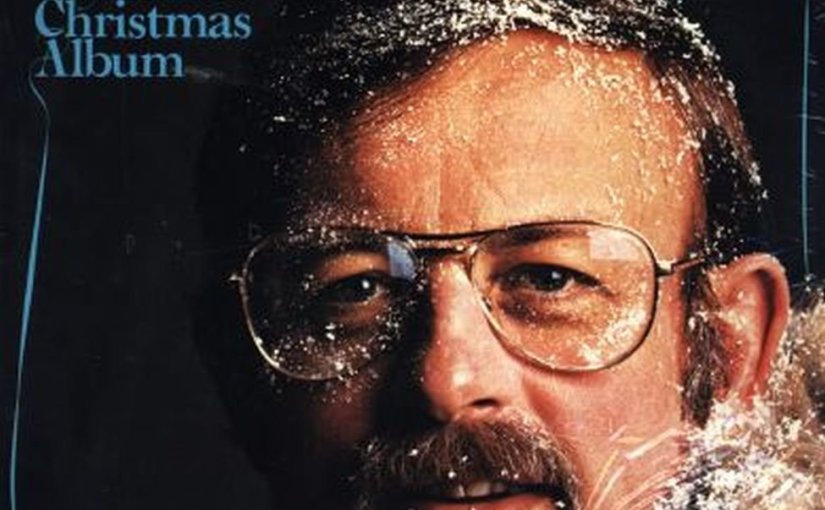
You know the genre. The one hit wonders. The guy who used to be big 50 years ago but only his Christmas albums is still listened to. The artist who never made it big but has the cult following – including me. My favorite Christmas album is the Roger Whittaker Christmas Album with the fake snow on his beard. I have deep and meaningful thoughts about “Darcy the Dragon”. My husband’s is the Kingston Trio’s “Last Month of the Year”. Neither of these are just covers of the same 50 songs – they include some historic ones but also some really deep discoveries and some new songs. In recent years I’ve added to this pantheon Sting’s “If on a Christmas Night” and Maddy Prior’s “Gold, Frankincense and Myrrh“. Sting’s hearkens back to the middle ages. Maddy’s is all original.
But I want more.
I don’t have enough Christmas music to listen to it 24/7 for a month without getting bored. And I don’t want just another cover of Santa Baby or I’ll Be Home for Christmas. I’ve been harassing Bombadil (very politely!) begging them for a Christmas album. I really want one of theirs. But I also want one by Brandy Clark, and the Mountain Goats, and Belle and Sebastian. How has Taylor Swift not taken a crack at this? When Kendrick Lamar drops a mid November album, I want at least one song on there talking about Christmas Eve. I want Shaboozey to overtake his own #1 spot with the banger of the summer by making a banger of the winter we can pull out every year for the next 50, getting all nostalgic about those 2020s and what a time that was. I want some songs that talk about the now – the ever expanding Black Friday, the traffic on the way to the holiday, the wishlists that tell you exactly what to buy, the difficult conversations with family members you only see twice a year. I know it all seems prosaic and boring now, but so were the songs that now seem quaint and atmospheric. I want today’s artists to be poets of our era and pass along the flavor of it to our future selves and our children and the grandchildren who will ask us, confused, what Cyber Monday really was. Or to expand our holiday music – add in the Diwali can’t-stop-singing, the atheists song, the Kwanzaa carol. Bring in the Australian tunes (I do love “Six White Boomers” and “The Longest Day“) talking about the Christmas heat.
Of the twelve months of the year, only one of them does not throw away what is old but pulls out the ancient and brushes it off year after year. I think that to truly pursue artistic immortality, to speak further than the hour, the artists should turn their eyes to the holidays and give us a full month’s worth of music worth listening to.
If I’m missing a great album that understands the assignment, drop it in the comments for me!
Two towns there were, that with one sea were wall’d.
Built near, and opposite; this Sestus call’d,
Abydus that ; the Love his bow bent high,
And at both Cities let one arrow fly,
That two (a Virgin and a Youth) inflam’d:
The youth was sweetly-grac’d Leander nam’d,
The virgin Hero ; Sestus she renowns,
Abydus he, in birth; of both which towns
Both were the beauty-circled stars ; and both
Grac’d with like looks, as with one love and troth.
– Musaeus Grammaticus
First meeting
The last twelve months has seen us bid farewell to our feline companions of the last decade, renowned Tiberius of doughty strength, ineffable charm and unquenchable mischief and lovely Data, the sweetest cat ever to be worn as a scarf. Thus ended our second generation of cats – the first being Justice and Magic. But for us, a house without cats is only a house. It is the tread of paws which transforms it into a home. We gave Data a due period of mourning. We completed our adventures and camping – brainstorming cat names as we drove the sylvan road from Frankfurt to Strasbourg.
We had many pairs of names for boys: Rosencrantz and Guildenstern, Gilgamesh and Enkidu. Two girls were much harder, perhaps Tigris and Euphrates? Boy/girl we were spoiled for options: Tristan and Isolde? Abelard and Heloise?
Driving back from camping for Labor Day, Adam spent the entire trip filling out online profiles for adopting cats. When we adopted Data and Tiberius, there were probably 40+ adoptable cats in the shelter. But we were finding that there was no “stock” of cats, and they were getting adopted wildly quickly. We got a call on a way to the adoption appointment on Sunday night not to bother – there were no adoptable animals. But there were, she gave us insight, a bunch of them going through the process of being checked, neutered, etc. And we should watch the listings. On Monday late night, 10 adoptable cats were added. I fretted – Tuesday we had soccer and bass lessons and I didn’t know how we could go. But then the rains came and the field was flooded and the bass instructor got food poisoning and all of a sudden signs pointed to cat. By the time we got to the shelter at 6:15, there were only five of those ten cats remaining, and only three within the criteria we were looking for. Sterling, now known as Leander
The first cat we met was a handsome long-haired tuxedo called Sterling. He fearlessly permitted himself to be picked up and handled, and purred under adoring fingers giving him pets and scritches. He was five months old, and just a wee little kitten. Data was a tiny light cat at the end, and this little critter was half his weight. Sterling had extremely long and dramatic whiskers, ridiculously hirsute (or firsute?) and hairy ears and the most adorable socks – the ones on his back legs being extremely decorative. We learned that he was out of Virginia – and just a baby with no history. We pretended not to have decided that we were adopting him when we put him back, but it was all pretense.
Violet, aka Hero
The second cat was a tortie – mostly black with orange highlights except for the very tip of her five-month-old tail which is vibrant orange. Violet, as she was called, was lithe and powerful like a tigress, and ardent in her affections to the hands which stroked chin and shoulders. She’d been returned along with another cat after a week, with no reason given, so we don’t even know where she hailed from. She is DEFINITELY trouble, but that is the nature of a cat. She’s also sweet and affectionate and snuggly and has cat ADHD (in my very professional diagnosis).
Feline mischief, right here
They were not bonded, nor did they come from the same place. (Massachusetts usually imports stray animals from parts of the country with lower spay/neuter rates.) But they were both charming, friendly, affectionate and definitely coming home with us.
Very Dignified Cat
We’ve had them for a few days (each in a different attic room, slowly getting used to each other and each other’s smells). And so far they are very much kittens with so much kitten energy. They’re affectionate and funny and noisy and all over the place. They do have some epic zoomies. We’re totally in love, and can’t wait until we can unleash them on the house, and looking forward to many fine years of their soft and silly company.
Nine years ago, we brought home a pair of 8 year old cats from a shelter. Older cats are hard to adopt, but this particular pair was the most engaging, sweetest and most fun set of cats we’d ever met. I thought at the time that we would have them for a shorter period than if we got young cats. I remember thinking that they’d be coming to the end of their predicted life spans when my eldest son was in high school. This is unimaginable when you have a little kid – an impossibly distant future. But…. Grey is a rising junior. Here we are.
Data actually liked to be worn like a scarf. He’d jump on your shoulder.
Tiberius left us in October of last year. We learned, in that moment, just who was responsible for 99.9% of all the cat related hijinks in the house. We THOUGHT with two cats we probably had two culprits, but noooo. It was entirely Tiberius. With only Data, butter could be safely left on the counter, we never were startled by a cat leaping out of an unsecured trash can, and you could plate dinner without leaving an armed guard or two and still find it on your plate.
Kitty snuggle piles
But Data, like Tiberius, was approaching 17 – quite an advanced age for a cat. Despite being teeny to start with, he was losing weight every vet visit. His kidney numbers weren’t great. He had to have a thyroid cream put on his ear. But for the last year, no lap went unclaimed. I started calling him “Fur and purr” – so insubstantial but omnipresent and loving.
This last week, though, he started refusing food. Including tuna. I may not be a vet, but I know that a cat who will not eat tuna is a cat who is done living. I took Data in to the vet who said that he basically had no more kidneys whatsoever, and that his numbers were literally higher than the test could measure. He also looked very uncomfortable – hunched up. He started hiding, and could only endure about 10 minutes of lap-petting before he went back into a hidey hole. He was telling us in clear terms that it was time. I asked the vet to take some palliative measures (rehydration, anti-nausea meds) and called Lap of Love to see when they could come. Data purred past his last breath.
Watch cat
His parting was easy and painless, if not quite as funny as Tiberius’ (who literally died with a Dorito in his mouth). Unfortunately, both boys were away, so it was just Adam and I saying goodbye. Data was the sweetest, snuggliest, softest cat it has ever been my privilege to live with. He had a kind heart, and was very simple: he just wanted to love and be loved.
Take us with you!
With no children and no cats, the house is very quiet. I find for myself, cats are what transforms a house into a home. My nest is not yet empty, but my children are fledglings. We are unanimous on one thing: we definitely want more cats. I’m not really even sure how long we’ll hold out before we welcome new furry friends into our house. I can only hope and wish that we may again experience the joy and pleasure like Data and Tiberius brought to us.
Farewell, Fur and Purr. You are already deeply missed.
On this Small Business Saturday, if you find yourself struggling for a gift for that new married couple, matriarch/patriarch or person who has zero storage space, consider a generational gift like a family crest (which also gives you personalized gift ideas from local artisans for years to come!).
We have now arrived at one of my favorite times of year: Christmas card time! I love every part of it (except the bit where I send about 150 of them): finding the perfect picture, picking the ink for the envelopes, spending a few moments thinking of the friends I love as I address their cards and write them a note with my thoughts and wishes for them. But my very favorite moment is the sealing of the card, when I take my family crest embossed on a gold notary seal and put a benediction on my prayer to and for them.
The cards haven’t been sent yet, so I can’t spoil the surprise!
The seal is one of the three places on my Christmas cards that my family crest appears this year, and it’s similarly salted through my house. The crest was designed by Fealty Design – the brainchild of my creative friend Julie. (Actually, so were the Christmas Cards and Mocksgiving Cards, but that’s a secret between you and me, right?) She’s a creative director and brand designer, and her favorite part of the design process is taking the time to understand what’s important, and show that in a design. She founded Fealty Design as a way to do more of that creation process she delights in!
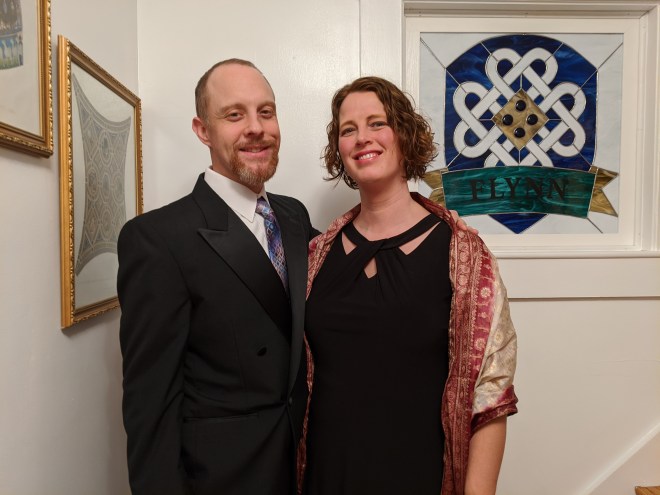
I’ve had my crest for about three years, and taken particular delight in finding new ways to use it, especially ones that make opportunities to work with small artisans and artists. One of favorites in that regard is the stained glass window we had custom made to fit our picture window by Barbara Conners. She executed Fealty’s design superbly – and came to our house to fit it in the window. (Unfortunately, the window is now a new size, but that’s a problem for another day.) This window would have originally had stained glass, but it burned in 1947. Putting this window back to the way it should be – only for us – was a deeply satisfying result. And it wouldn’t have been possible or as meaningful without our family design!
Glorious day and night
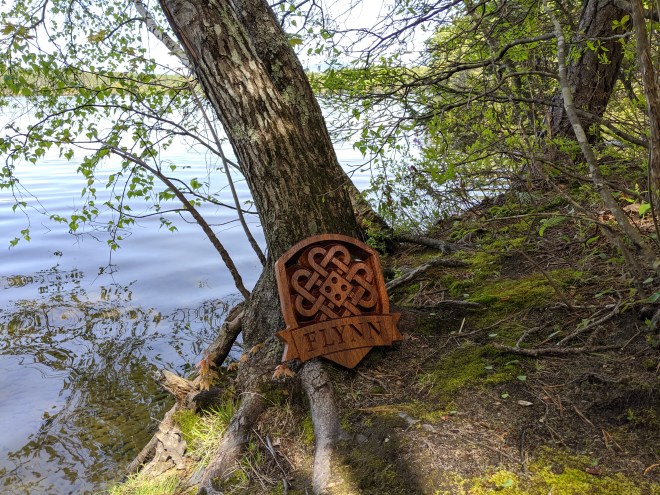
My other favorite craftsman job is this Camping Sign. These kinds of family markers are common among the family campgrounds in the White Mountains. They include cast iron pans with paint, gifts from grandkids made in shop, or the work of master craftsman now retired. I have wanted a camping sign for some time, and Adam came through with a version done in our crest. To our surprise and delight, the best qualified craftsman for this custom project was just down the street: SignMeUpCustomSigns.com He actually dropped the sign off in person, and showed off the marine grade lacquer and craftsmanship. He said his homemade CNC machine is big enough to do a standard sized door.
So I took it out to do a photo shoot….
In the lowest budget version of this, it turns out the vinyl stickers are amazing for … everything. Every thermos and water bottle in our house is marked with a shockingly dishwasher safe sticker, ensuring that anyone who finds the lost objects enjoys their lovely decor and personalization. (OK, and there’s a very outside chance we get it back.) My kids often ask for a Flynn sticker for a device, book or thing they don’t want to share. It feels surprisingly spiffy to have your own stickers!
From back when we used to send kids into school….
Tell me – what gifts have you gotten that still bring you joy years later? Which ones lead themselves to ongoing themes and years of additional simplified and meaningful gifts? What especially marks you and your family?
In 2012, back when I was young and the world was a different place, I planted a plum tree in my back yard. I had a dream – a vision – of finally making damson plum jam. This after years of scouring farmer’s markets and orchards for the rare English plum. It was audacious, to decide to commit to a mini-orchard in my plucky and not super bright tenth of an acre of land, but I try not to be limited by common sense too often. The story of my plum tree is familiar to many of you, since it might be just about the most written about topic in my desultory blog. There was one memorable year when the lectionary had the story of Jesus and the fig tree and no fewer than three pastors of my acquaintance asked my permission to use my bitter, hopeless plum journey as a sermon inspiration. Oh pastors, consider this permission to use anything I put on my blog in your sermons.
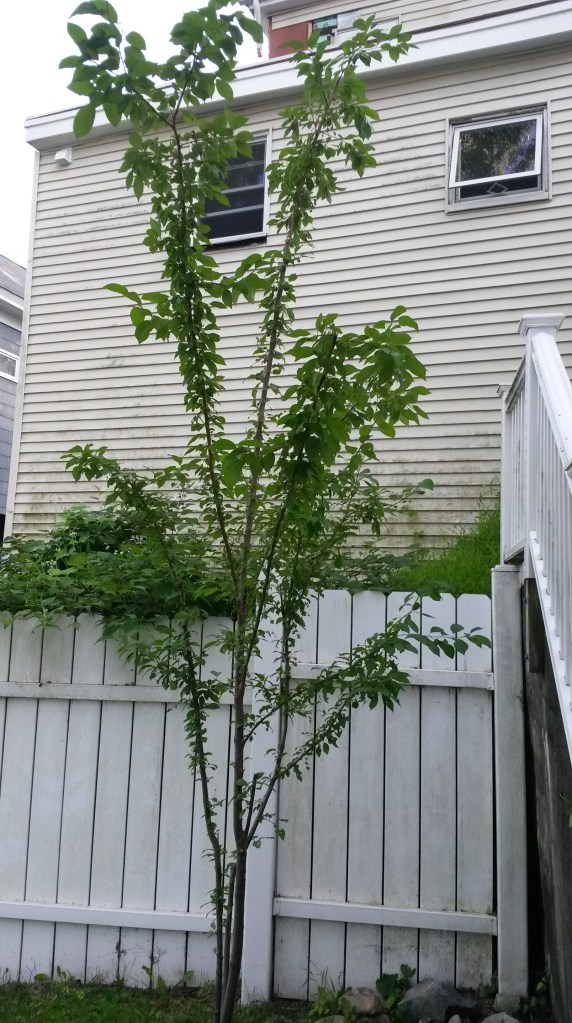
Wee small tree
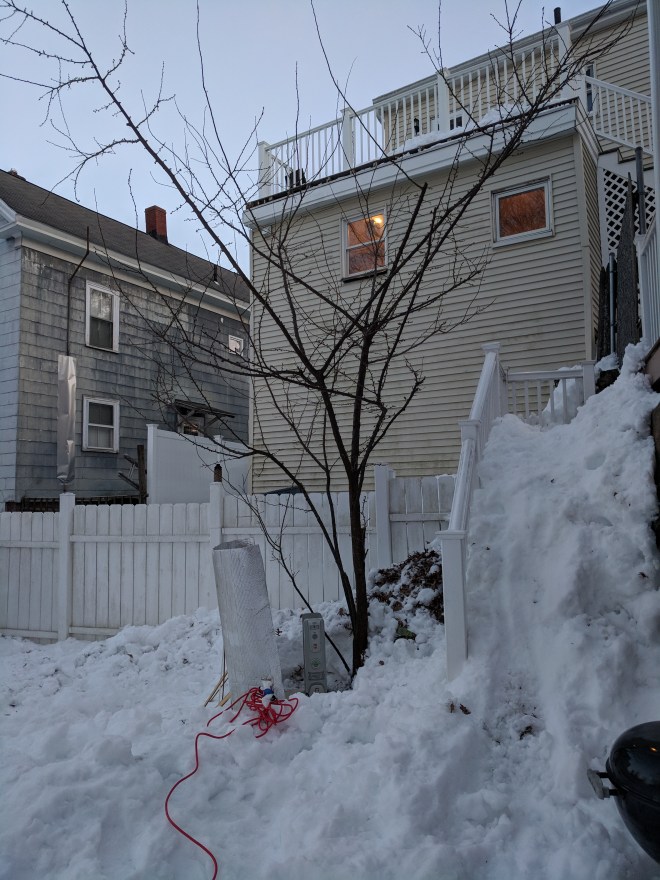
And then I waited, while the tree grew. I discovered a saying “You plant a plum tree for your children, but a damson tree for your grandchildren.”* For years it flowered abundantly and never fruited once. It was lovely, but so far barren. I upped my game, my fertilizer use, and on one memorable night even rigged up a space heater as a suburban smudge pot to prevent a die-off when winter had one last late fusillade for us.
Yankee ingenuity – or possibly insanityHope in plum form
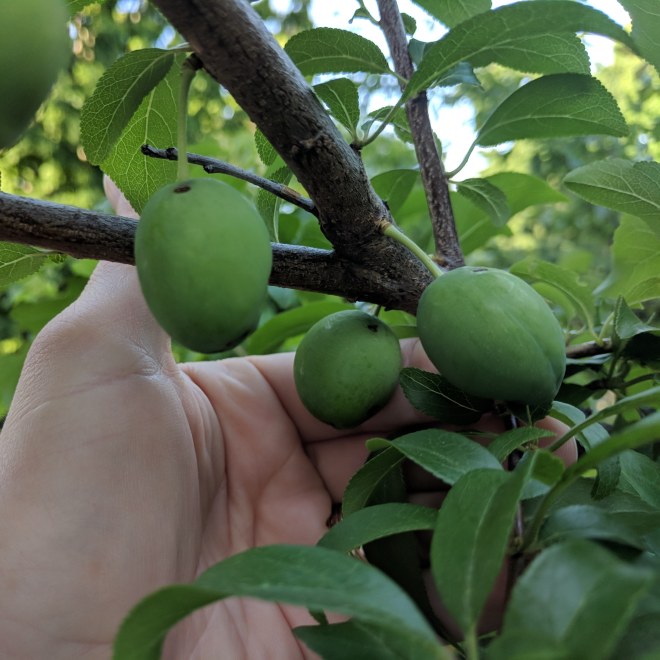
In 2018, I got really excited. There were all these little plumlets! Thousands! Tens of thousands! Even a 5 or 10% survival rate, and I’d be swimming in plums. I began looking up recipes for plum wine, plum sauce and plum puddings. But when we walk through a forest of acorns, it is a warning to us about how rare the success of life is in the face of the cruelty of nature and chance. By ones, and in great bunches, through every stage of life, I watched my plums fail. In the year of my greatest harvest, I had many hopes, but only in the end three plums, which I ate late – not understanding that my tree ripened to gold instead of purple plums. (Dammit, I’d bought a purple plum tree!)
The lone fruit
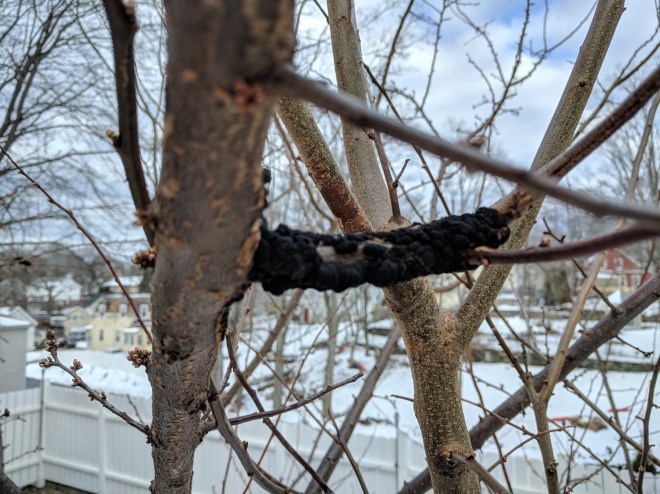
Then, that winter, I discovered the first knot of the blight that will kill my tree. Instead of having planting a gracious tree that will bring fruit to the world for the rest of my life, and for many years thereafter, I have planted this tree and I will watch it die. And worse, I will never get a single batch of jam out of the damn thing. I fought it of course, as we do mortality. I pruned and I fertilized and I read up on it. On the afternoon we learned a friend had two weeks to live, my husband couldn’t understand why I had to cut off the blackened cancerous growths RIGHT THEN. But from this vantage, both you and I can see it. This tree is not a garden object. It is a metaphor for life, for longing, for generations, and for mortality.
Black mark of deathly doom
I have come to a point, now, where I have passed through the phases of denial and bargaining in my grief for this tree – this metaphor for mortality. I no longer expect to eat a fruit from its branches. I do not believe I will be able to pull it through, or that miraculous healing is possible. I did not cut away the black places this summer – there are too many and they are too high to reach. I let the tree be, and only cut away the branches that made it hard to sit around it.
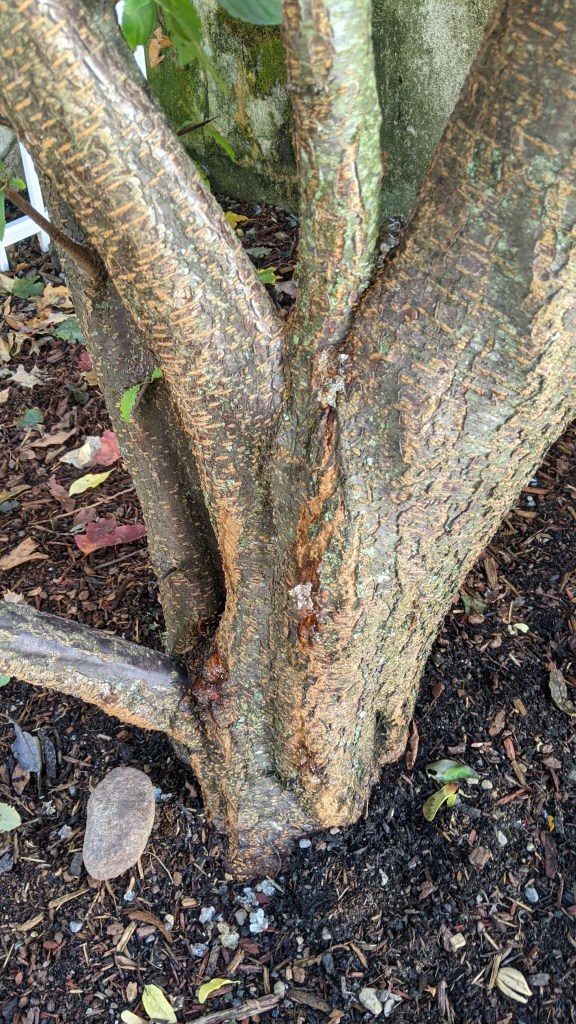
The main trunk has begun to weep sap. It will not be much longer now.
This moment of acceptance has in some ways freed me. While I planted the tree for fruit, in this long hot summer, when we spent so much time in the back yard, I came to love the tree for the shade it gave. I spent days sitting below its branches, sheltered under gracious leaves. The tree is home to an entire ecosystem of ants and bees and aphids and ladybugs. I admire its enormous elasticity, as when weighted by snow it will bend halfway to the ground and then spring back to the sky once it has dried off. I love the glorious puffy white blossoms it still bravely throws against new-blue skies in spring. Now that I have stopped expecting more, I can love it for what it is, for as long as I still have my friend.
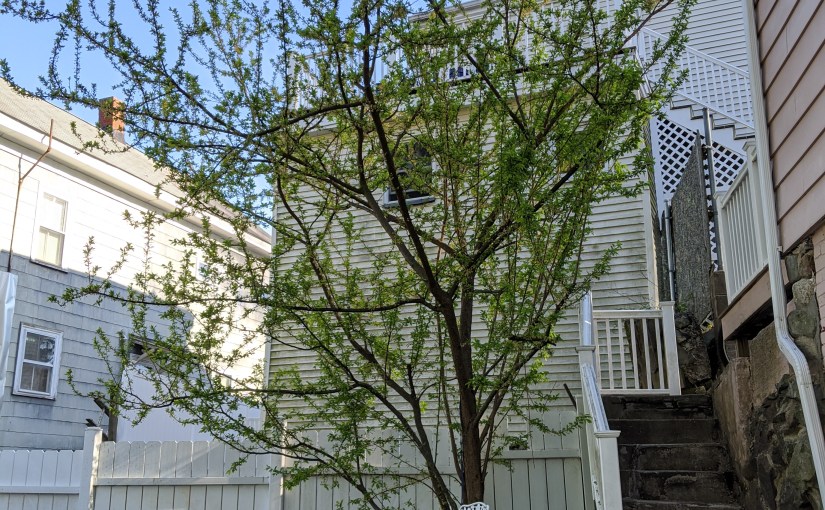
The tree has become a frequent backdrop for our pictures and life
I will not, however, have this tree much longer. It is hard to watch it blacken and wither. And our yard is small to be home to a dying tree for very long.
So I had a choice. I could give up on a foolish, childish dream of fruit. This is tempting. There is no argument that my attachment to this tree and this hope is a sensible one. I know that any other plum I plant would likely suffer a similar fate – this blight will likely linger in soil and suckered-sprout for years yet. Our land is not appropriate for orchards. I have no skills or abilities to raise a healthy tree. I should just go buy my fruit like a normal American. I can feel the weight of the pressure to just be normal already. To not care so much about things that are so stupid. To pretend to myself and the world that this is just a tree like any other, and use it as an opportunity to teach my kids how to use a chain saw. Maybe put in a nice patio or something, with a sun umbrella.
Or. I could double down on crazypants dreams. I could pull out the core of my desires and longing, and find another way to express them. Maybe buy a tract of land without this problem? What if there’s a saleable set of orchard already growing? Do you think Farmer Dave would let me, like, sponsor a tree? Could I plant one at Camp Wilmot? Guerilla gardening along the greenway?
Then, there came a moment when I suddenly knew exactly what to do. I myself do not understand the genesis of this idea – the germination or pieces that went into its creation. I do not know how I knew these things. But I knew … I had to plant a pawpaw tree. I’m working on my patter for “What the heck is a pawpaw?” The pawpaw is the largest native north American fruit. You possibly might vaguely remember having heard of it through songs like “The Pawpaw Patch“. It is slightly larger than apple sized, has a thick skin and a few big seeds, and the fruit is described as a citrusy custard – like a cross between a banana and a mango. It’s been grown in America since before we colonists arrived. Although Massachusetts would have been traditionally too far north for its zone, with the change in our climate we are now warm enough to host it. The reason you’ve never heard of it isn’t because it isn’t delicious. It’s because there aren’t any varietals of pawpaw that are durable enough and last long enough to survive the American Corporate Food Chain. It doesn’t ripen once picked, is very fragile, and only lasts about 5 days after it ripens. So you just can’t pick it, pack it, ship it, stock it and eat it in time. It is an unbuyable, historic fruit. In other words, absolutely perfect for me.
There are two practical considerations. The first is that TWO pawpaws in the area are required in order to get any live fruit. I can’t find any self-pollinating varietals. This is a challenge since I have a paucity of pawpaw space. I have a plan, but if any of my neighbors would be willing to plant a tree, I’d happily buy it, plant it and tend it for you! (JAY THIS MEANS YOU. YOU ALREADY TOLD ME YOU READ THIS SO HA HA YOU CAN’T PRETEND YOU DIDN’T SEE!)
Pawpaw and plum: the old and the new
The second is that the tree, in its early years, really requires shade to grow. It’s best planted underneath a mature tree, until it gets its feet under it and begins to shoot up. So the best place for it is in the shade of my dying plum tree. And here we return again to our mortality allegory. To be dying is not to be dead. There are still gifts that we can give and receive, after any hope of fruit is past. I will ask my beloved plum for another year or two of shade, blossoms and the gracious hosting of life. I will give it fertilizer, water, and compost for its nourishment, as well as my unabated love. And in in return, I hope that it holds on to strength and life long enough to give the live-giving gift of shade to the next generation.
It seems like every few months we’re broken-hearted by the treatment of our black brothers and sisters. I am thinking about George Floyd today, and I think about Ahmaud Arbery every time I lace up my running shoes. I’m still haunted by Tamir Rice’s death, as I look at my own boy stalk through the neighborhood with his NERF armaments.
It’s so hard not to wish these were aberrations – rare and unexpected events. But they’re not. There is no reason or excuse other than that we have created a system that does not value human lives as equal.
The only, small hope in this is that human systems are created by humans, and can be changed by humans.
Keep working, friends, until all people are as valued by the systems and habits of our society as you are.
“To be sane in a mad time
is bad for the brain, worse
for the heart. The world
is a holy vision, had we clarity
to see it – a clarity that men
depend on men to make.”
– The Mad Farmer Manifesto: The First Amendment
Wendell Berry
Right now, I should be in Terminal A in Logan. Perhaps I would be traversing that long tunnel, lit by colored lights and sped by moving walkways, with man’s triumph over gravity taking off and landing overhead – the sky a checkerboard of contrails. Maybe I’d be stopping at the Starbucks at the end of the long staircase up to the gates. I’d be with Adam. Grey and Thane would be in flight already, headed to Atlanta. It was to be the first time that Grey counted as “accompaniment” and I wouldn’t have to pay extra to fling them into the loving arms of a grandparent. Adam and I would be looking towards an ancient land. Tomorrow morning, bleary eyed, we would land in Rome to celebrate the twenty years we have been married.
But. I will not stand in the Forum Sunday, drinking in espresso and diesel fumes in equal measure. We will not explore the catacombs or marvel at the rococo splendor of the Vatican. We will not see works by Michelangelo and eat pasta made by strong-armed old women, decanting wine and prayers with equal familiarity. Instead, we mark a time increasingly trackless, as we enter our fifth week spent in our homes, morally isolated, masked, in a world we would not have recognized even two months ago. We’re growing weary of gazing at the world through the windows – of our homes, our computers, our televisions. Every vista is framed in by the constraints of the virus.
This all has started to feel almost…. normal. There are mornings I wake up, and don’t think I’m late for the bus. There are days I do not leave the house, and do not mark that I have not left. There are even cheerful days and hours now, where within the inscribed circle of my life I am pleased and even energetic. But every time I find my feet, an aftershock ripples through and reminds me how uncertain and unstable everything really is right now. Layoffs among my friends. Plans for returns two years out. Closings. Deaths. Intubations. Work shifted, changed, urgent or deprioritized. Rumor of pending shortages, as the people who make things and grow food also look through their windows at untended fields and idle factories. My daily ritual is looking at the numbers and ages of those who have died today in Massachusetts from the virus. Yesterday there was an entire page of deaths of people in their 80s, and a second almost as long of people in their 90s.
I’ve tried not to mark what I’ve missed. I delete the calendar entries, trying to forget what has been lost. Del’s funeral, and the beer I planned with my surviving cousins to remember the one who died this fall. Piemas. I have so many pie fillings in the freezer, marked for that date. My children do not like pie. And we were going to remember BJ there. My husband did a “virtual gaming convention” last week, and I kept thinking I heard him over the speaker – where he most assuredly would have been had his heart not given out. I had finagled traveling to Dublin for training. I’d never been to Dublin. Two concerts: Brandy Clark and the Wailin’ Jenny’s. My son had shown astonishing proactivity in signing up for an MIT educational course, which made me proud and hopeful. His 8th grade graduation and dance are added to the pile of “unknown but unlikely”. And we are the lucky ones – we don’t have a senior, or a wedding, or a once-in-a-lifetime trip. Or worse, a farewell and funeral denied and delayed.
Last week, I was talking to my sister and telling her my idea for one of those online quizzes, of your “lasts”. Last in person concert. Last flight. Last conference. Last meal in a restaurant. Last hike. Last night in a hotel. Last road trip. Last in person church service. I’ve held these lasts in my head. Some of them I knew were lasts – the last hike and last meal. But most were unmarked, and felt like part of the relentless pressure of life, piling on event after event and journey upon journey. I did wish that I could step off that relentless track – just for a little bit. I’m trying to be grateful for what is, at very least, a break.
And there are some consolations. I think few of us would prefer this life to our prior one. But I have spent more time with my husband and children than I ever would have, in any other circumstance. There has been more space for thoughts, despite work which swells to eat my extra hours. I’ve had breakfast in bed every morning for a month. I have cleaned things that I always meant to get to “someday soon”. I have watched every single slight move of spring with the hungry eyes of a hawk looking for their prey to clear cover. Have the forsythia and daffodils and hyacinths ever had so appreciative an audience? Have they ever lingered so long? And I am taking great comfort in art – old and new. My gaze has lingered over the watercolors on my walls, painting detail and adventures into their broad strokes. My mind has lingered on poetry, with the extra space resonating words and phrases with unusual meaning. My ears have sought new songs and new singers. And although I am not with my friends, we talk. Via group chats, 1:1s, video calls, yelling from windows – even as we are distanced we still reach out to each other.
There is no chance that we will emerge from this time unchanged. It is not an option. We cannot go back to being who we were, or living the way we did. Even if the world were miraculously the same, we are inexorably changed. What will we be, when we have been transfigured? How will we grow, with the snow on our blossoms? Will we be destroyed, or made stronger? Will we ever be so busy again we cannot see the spring around us? Will we be able to take thing so for granted? We are in a crucible, and our civilization is being melted. We can only hope – and work – to make sure that when we are recast, we are recast to be the best version of humanity we can possibly be.
Seven years ago, I took the bus to work. Both kids were little. I remember picking them up at the Y, rushing to get there before 6 pm. I’m guessing Adam dropped them off, since I don’t remember it. I drove to the tiny lot near the bus stop for that reason, and stressed about parking every day. Over time, I made friends with the people at my stop. I got to know the folks on the bus by sight, if not name. I read a whole lot of frivolous novels. I was kind of sad when that commute came to an end.
Then the word came that my office was moving from Cambridge to Boston for a little while – about 9 months. I’d been very tired of driving anyway, so driving into Boston was a no.
Now there are no daycare pickups (thank heavens!) And there is a beautiful new Greenway almost directly connecting my home and that bus stop with a brisk 20 minute walk. So here I am again, sitting in the 354, headed to work!