Tanque Verde with Shari Blaukopf: or MISE West magnificence

Last year, I decided three days before the start of the workshop that I wanted to be in Tucson, painting. My watercolors were not dry in the palette before I was on a plane to Arizona (and in point of fact I finally got the last of the gold-green explosion off getting ready for THIS year). But I’d fallen in love with Tanque Verde Ranch last year, and thoroughly enjoyed my first foray into urban sketching with Shari Blaukopf as part of the extremely well-run Madeline Island School of the Arts (MISE). So this November, as things started to darken, I figured that it would be the perfect time to spend a week with the only distraction from watercolors being the superb food dished out three times a day by the friendly and talented staff at the ranch.

In 2024, I’d been four weeks post-op from knee surgery, which somewhat reduced my hiking aspirations but not at all reduced my hiking longings. So this year I gave myself some extra time before and after to hit the iceless mountains of the Sonoran Desert. If I’m all praise for the actual workshop, I have nothing but calumny to pour on the heads of Payless Car Rentals – which kept me and dozens of others waiting for 3+ hours for the rental cars we’d reserved, or the Hilton resort I stayed at which sneeringly told me that if I wanted to charge the EV rental car which had been my only option I was welcome to spend several hours hanging out in the parking lot of town hall to do so… but I’d find no welcome in their facility.

I still managed to get in a good hike, but these shenanigans probably took 3 miles off my intended course with their time suck. I digress. I had a great hike, and managed to see THREE big horn sheep which was really cool and also they are extremely hard to pick out.
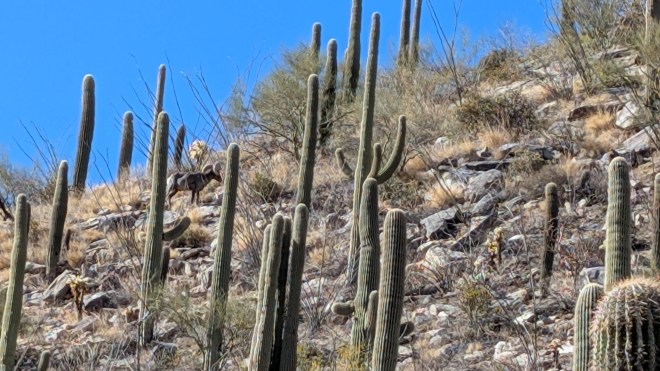
A rather pixelated photo of a hillside covered with saguaro cactus. You can just barely make out the shape of a big horn sheep on the hill.
It’s not AI, I just had the digital zoom cranked up all the way so you could see this bad boy.

My usual self is a lot of things to a lot of people: mother, wife, friend, daughter, employee, boss, mentor, board member, volunteer… the list is long. I love all these things and wouldn’t set them down. But the allure of going somewhere where no one knows me and I don’t have to live up to anyone’s expectations of me is strong. My mother has a hilarious schtick about her belief about going to college, and how she’d finally be the lay-dy (you should hear her say the words) she knew she was in her heart of hearts. I went in with the same idea. I’d be reserved. Quiet. A mysterious presence who spoke only with her brush and astonishingly beautiful selection of 37 colors (none of which was Prussian Blue, to the astonishment of all assembled). For once in my life I’d be quiet. Fade to the background. Unobtrusive.

As my mother discovered when she went to college and was still herself, I found myself not two days later (successfully) attempting to convey “Scheherazade” in charades with some of the world’s greatest color geniuses. Oh well.

Day 1: Into the fire

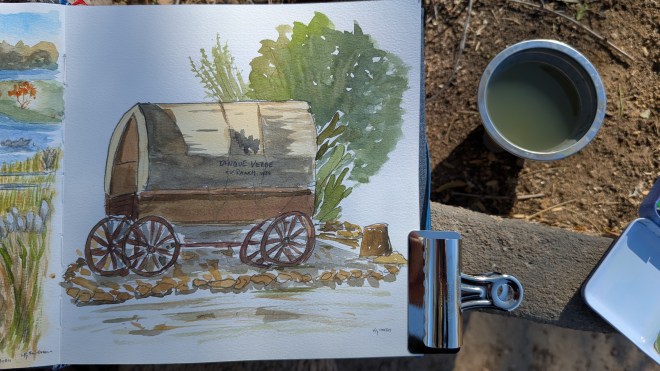
Little can strike terror into the heart of a bad drawer like wheels. Many of our bold number quailed when our first assignment was a covered wagon with an excess of spokes and shadows. There’s nothing like watching an expert wave a brush across a page and a brilliant, colorful, characterful painting just appears, and then tackling it yourself. This was a warmup effort – my shadows are particularly disappointing. But they can’t all be winners.

A covered wagon in bright sunlight
Please notice how there are a bajillion spokes

A watercolor of the covered wagon
There are more things wrong with this than are right with it. The shadow on the canvas is extra not great, and my foliage is a consistent weak point.

Day 2: Paints up!

A two page watercolor spread, with an agave plant and barrell cactus on the left page, and a desert scene on the right
Days 1 & 2: A spread of cacti and a desert scene

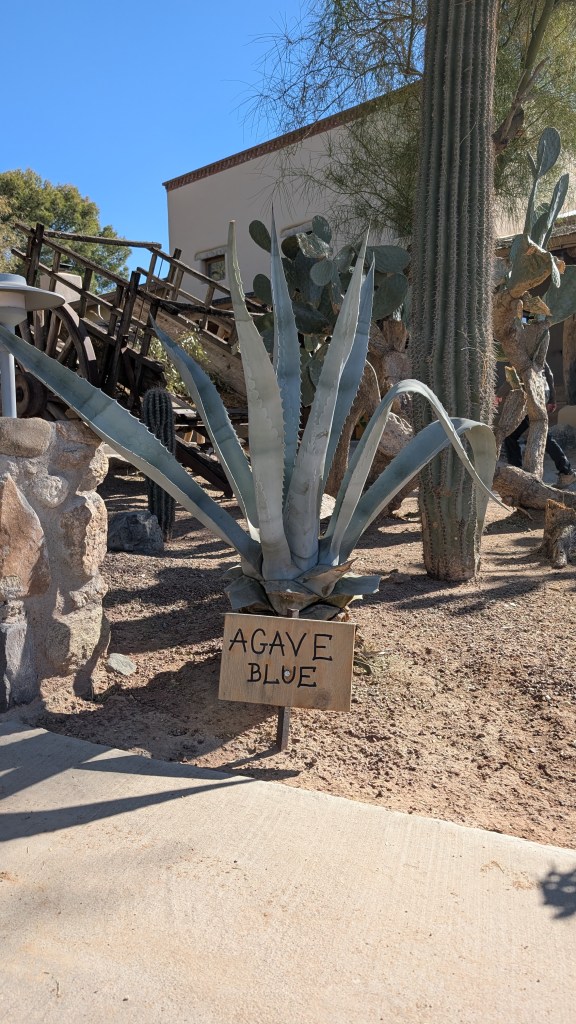
A blue agave plant with a wooden label in front of it
Sure it looks easy to draw, but how do you do that fold on the right side?

After I finished my wagon, I turned around and painted two of the cacti – one on either side of the walkway. I’d done some swatching ahead of time and had a brilliant idea for the color of the agave (which I was quite pleased with). Drawing the agave was haaaard. The barrel cactus might be one of my strongest paintings to that point. I keep finding myself looking at it. I didn’t fill all the space with paint (an error I’m particularly susceptible to), and left some glints to keep it interesting.

This was my second time painting nearly this exact desert scene (I’d tried last year too). Both of them were rather disappointing. I love love love mountains and want to paint them beautifully, but this scene didn’t convey the feeling I was going for.

Day 3: Tucson Botanical Gardens
You have no idea how exhausting painting can be. Also, it was _cold_ out there. There was ice that didn’t melt during the day, which is practically unprecedented in Tucson. I seriously questioned whether I shouldn’t just stay in the incredibly soft and cozy bed all day and maybe come out for a bit of a hike and call off the botanical garden. But I’m glad I didn’t.
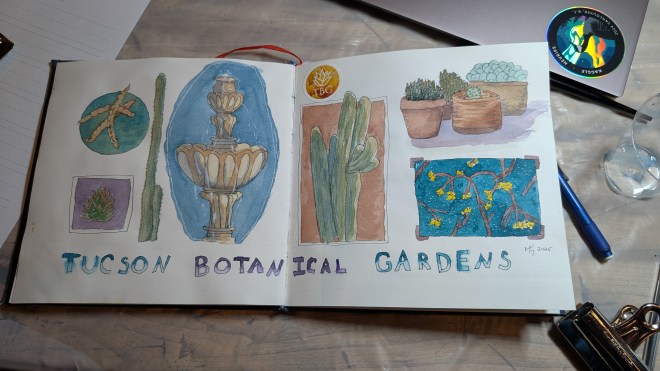
A two page spread of watercolor and ink vignettes from the Botanical Gardens, including a fountain, some cacti, and a small set of pots.
7 small paintings in one day

I was mostly pleased with this. The fountain was very difficult drawing for me. My ink drawings end up sort of cartoony like the fountain, and I think I need a new strategy. Or to embrace that as my style. I particularly like the cluster of pots in the top right – I was captivated by the real thing. The red cholla with the yellow blossoms on the teal background created a problem. Everyone likes it, but the value was all wrong for the rest of the vignettes. I tried to fix it with the lettering, but I’m not really sure I did.

A collection of pots with succulents and cacti in them.
I now want a shelf of these succulents and cacti in my house. I’m sure it would be just like this.
A picture of a terra cotta fountain with a woman behind painting
My fellow sketchers are in many of my reference photos

Day 4: The Old Homestead
The old homestead on the top of the hill had been the spot of some of my more successful paintings last year, so this year I decided to skip it and take another crack at the disappointing panorama. I’m not saying this is my best painting ever. But … it very well might be. I’m half-sad it’s in a sketch book and I really can’t frame it or display it. It’s not perfect (my foliage continues to bedevil me) but the mountains are right. And I really GOT the rocks for the first time.
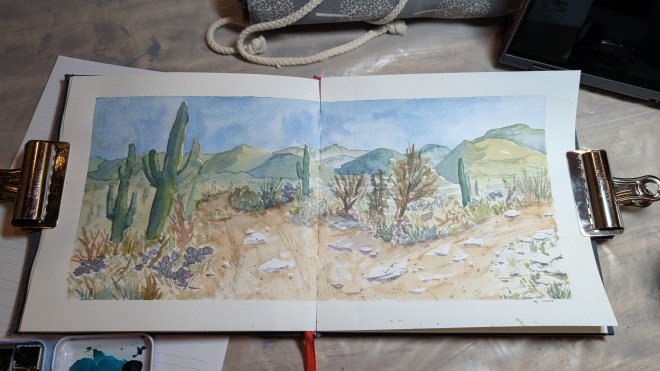
A two page spread of a desert panorama done in watercolor
Now this one I’m very pleased with
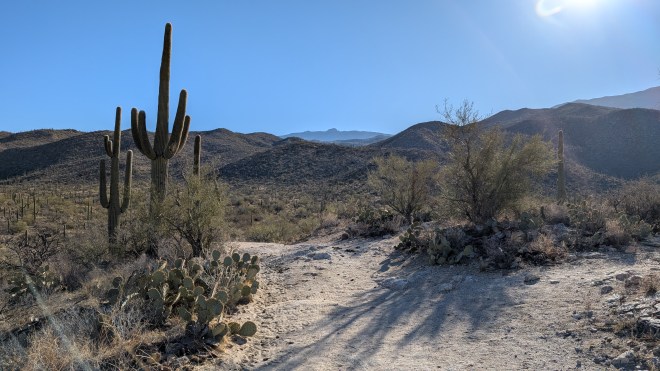
A dusty trail in the Sonoran desert with clear blue skies, saguaro and creosote bushes.
I think the trail is the key to my problem: I needed to lead the viewer INTO the picture instead of having this horizon barrier between you and the desert.

Day 5: Farewell to Tanque Verde
After a week of the subdued hues of the desert, my eye kept being caught by the bright colors of the US and Arizona flags. I decided to practice my foliage (definitely a work in progress), attempt a human figure (this guy ended up somehow being a figure in many of the classes paintings – maybe because he took a contrarian viewpoint?), and use some bright colors. It’s not a great painting – the values are too close, the tree on the right is weird. But reps count.
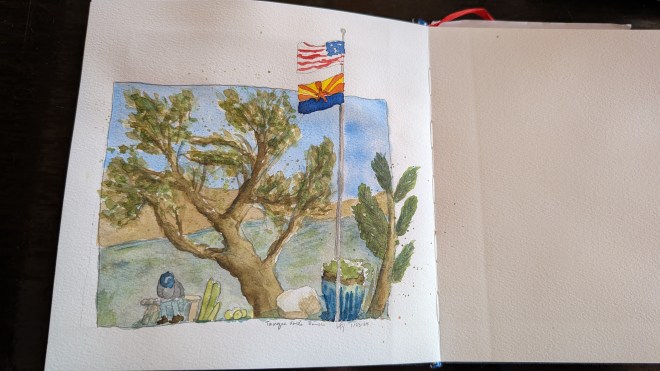
A watercolor of a figure under a tree with a flag breaking through the frame
Those colors are still flying. I do really like the Arizona flag.
A picture of a man sitting below a tree, with a flagpole to his side.
I had to go back later and take another photo of the flags to get the colors right, but the second photo doesn’t have the figure

My last full painting of the class (I started a third one) is one that I don’t think I could have done at the beginning of the week. I’d admired this pot and its flowers all week (one of the fun things about a class like this is how much it sharpens your noticing muscles). I had finished my first painting and there was still time left, so I plopped down after lunch and did a super simple sketch and then just enjoyed non-desert colors. This is loose and fast and fun and I think you can feel that when you look at it. It shows a lot more fluency than I started the week with.
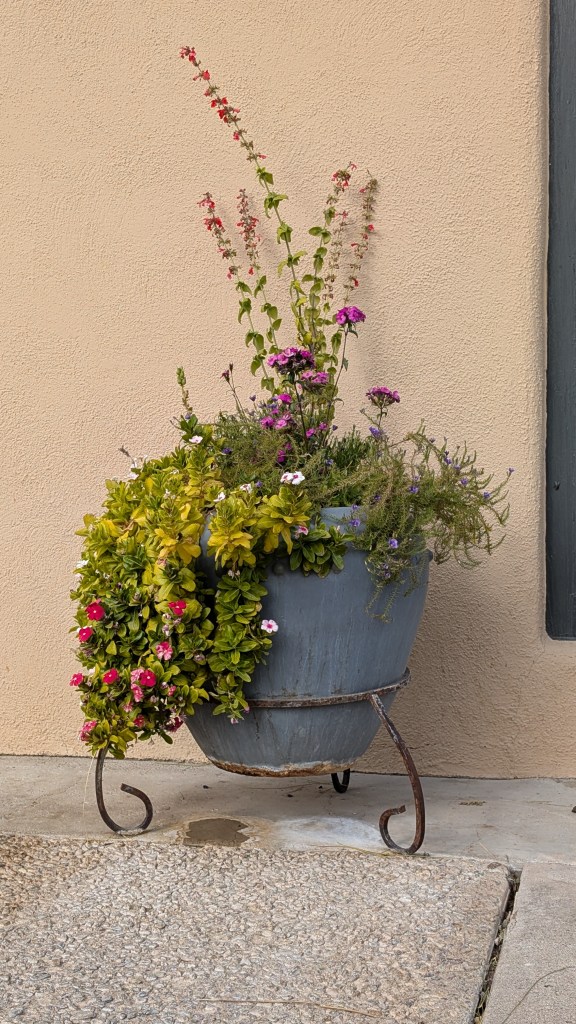
A beautiful pot on an iron stand full of greenery and flowers, against a warm beige wall
I mean, how can you be in a painting class and walk past this every day and not paint it?
A watercolor painting of a large blue flower pot overflowing with greenery and flowers against a beige wall
It’s not fussy. It was fast. And the shape and shadow are good. I’m especially proud of how … organic the edges of the painting are.

I would 100% recommend the teacher, class and location to anyone interested (if not the rental car company). I’m now ready to collapse into an exhausted heap (seriously how is painting that tiring). And tomorrow I’ve got a hike planned before I fly back to frigid New England on Sunday.


Just a quick reminder for folks that you can catch my shorter form work on Bluesky.
Make the color my own

What if you could possess a color? Own it, understand it, live with it through the moods and vagaries of light and paper? It’s been about three and a half years I’ve been painting with watercolors. The very first time I tried, the book instructed me to mix the blues and yellows in proportion. I squeezed out from a tube blue and yellow in the approximate proportions. It took me the better part of two tubes before I gave up and called it good enough. It seemed like a pity to throw away the rest, but what could you do?

Yeah, for those who don’t know like me? You can “resurrect” watercolor indefinitely by adding um, water. And when they recommend you mix it, they’re talking about the released watery watercolor you would paint with. A tiny dab of watercolor in a palette can last you months and many paintings.

Good thing it was the cheap student watercolors.

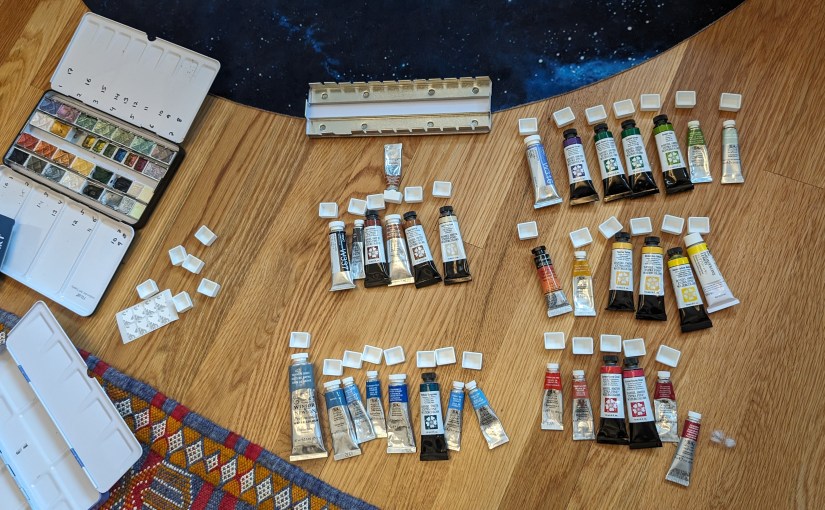
When I loaded up my palette yesterday, with a number of new colors, the watercolors were not the cheap ones. I try to tell myself that the hobby is inexpensive by comparison to, say, golf. Or bass fishing. But the contents of my paintbox are truly a treasure. Loading a palette is a labor of love – equal parts tedious and delightful. My left hand got sore from the threaded tops of the tubes, stuck on by paint. There was the planning and the labeling and the decision making … can I live without Bordeaux? Which yellows will I want for the desert? But the best part of all is the swatching, where you dip a tip of your brush into the thick virgin paint and then release it with water onto the paper. Will it be creamy? Transparent? Will it granulate? Will the color of the paint and the color of the watered paint be the same or wildly different? Will the water reveal one pure color, or a prism of many? And most critically – did you guess right about the variety and value and hue in your ordering of the swatch?

The desert palette

In light, I love all colors. Perhaps green most, since it’s the garment of my beloved nature in the places I have lived. But in paint, my heart belongs to indigo. Students of history know how important indigo was to the commerce of the colonized Caribbean. Blue pigment was always a problem in the history of paints. There’s the fantastically expensive lapis lazuli pigments. There’s the ecology destroying but fugitive woad of the Picts. Blues are hard to find. And indigo is not just blue, it’s exceptional. The indigo paint is so creamy and consistent, versatile, kind, assertive, trustworthy. When I have indigo on my brush, I have no fear. If I were limited to one paint for the rest of my life, it would be indigo. I remember the first time I tried to use Cerulean blue. It’s a pretty blue – like a robin egg or a spring sky. But it came across my page chalky, inconsistent. I thought it must be a defective batch but no. Granulating is the technical term. A wash with it is like rolling the dice on paint coverage. Per instructions, I loaded Cerulean into my palette, but we will never be on dear terms, Cerulean and me.

A thousand faces of indigo. All indigo, all the time. If you’ve ever seen me paint a night sky, it was almost certainly indigo.

The last year or two I’ve been reading my way through the histories of pigments and paints. My palette covers a hundred thousand years. I have the yellow ochre that neolithic priests painted in flickering firelight on deep cavern walls in the airless belly of the earth. I have the Venetian Red that colored so many lions and trousers and buildings in medieval and renaissance paintings. I do NOT have mummy brown, alas, since we no longer find the best use of mummies to be loading them onto our paint brushes (or burning them as fuel for locomotives). But I also have a whole palette of the unspellable quinacridones: gold, coral, magenta, rose, red, violet. Those paints “break” in this astonishing way where the thick paint and the watered paint are entirely different colors. The poisonous arsenic has been removed from the greens, and replaced with the perylene and the pthalos. What color does not come in cadmium? All these minerals and chemicals and discoveries (the history of mauve is a real page-turner – Wikipedia doesn’t do it justice) come with their own characteristics and traits – the personalities of the paint. Some of my paints I hardly ever use (Potters Pink, Terra Verte) but love for their connection to the earth and artists before me.

I have put together a number of palettes in my short history of painting: for a particular book, for a particular season, as I learn which ones I love and those with whom I will maintain a polite distance. But this palette has an entirely different slant than my White Mountain or Northwest art. I need the yellows, the purples, the red earths, the subdued depth of the desert greens to capture Arizona.

I can hear the confusion now … Arizona? Do you not live in New England in January (which, btw, is mostly a hundred variations on blue and blacks palette wise). Well. Here’s how it is. I’m switching functions at work from one to another, and it was taking a while and I didn’t have all that much to do while we made the switch. And it was a quiet week on the ol’ calendar. And last weekend I started looking at watercolor retreats I might be able to do this winter/spring, since with graduation etc. we are not likely to travel as much as a family this year. And the best one that didn’t conflict with anything was … this week. I feel wildly impulsive and out of character! Who flies to Arizona at the last minute? Surely this is irresponsible of me. But yet, here I am.

Look! Proof! Definitely Arizona.

I’ve never been to Arizona (well, I may have driven through when I was 13 but that really doesn’t count). I’ve never seen a saguaro. I’ve spent far too little time in the desert of any ilk. I do not object to 80 degree instead of 18 degree weather. But in two hours I’ll land in Phoenix and wend my way to Tucson, for this workshop. I brought my hiking shoes (and yes, extra water bottles) in the hopes of hitting Saguaro National Park on the way. I have no idea what to expect: I haven’t done something like this before.

But that’s really more than half the point. In these middle chapters of life, we face the choice on whether to invest and focus on continuing to grow and change and learn new things – or whether to hone our existing expertise and enjoy the mastery we have worked for our entire lives. Of course, it’s a nuanced choice: we all have to figure out how to use the new way to watch movies, and every skill we once had comes on the journey with us. I find myself hungry for curiosity, and enthralled by the worlds out there I never knew existed. Who knew that paints had such personality and history? A child of the magenta/cyan/yellow screens would never guess such a truth. What other wonders await out there, just asking for me to ask the right set of questions to unlock them? I’m itching to find out. And see a few new sights in the process.

Edited to add:
I wrote that on the plane. Then I got here, spent an annoying amount of time in the airport and drove down I10 to Tucson feeling depressed at the nature of the billboards (casinos and personal injury lawyers mostly). But Saguaro National Park made up for all of it. The watercolors start tomorrow!

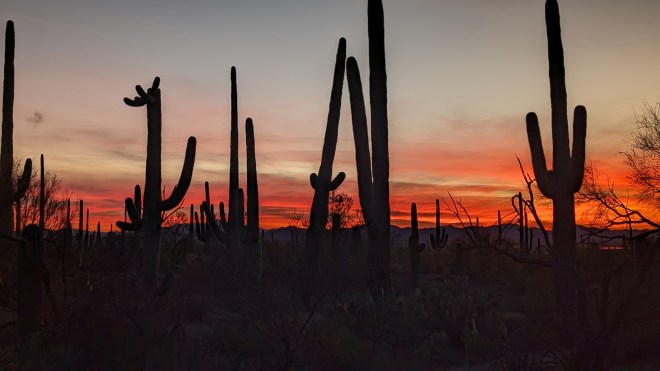
Golden hour among the cactus
Can you make out the sundog here? (Parhelion for the pedantic.)
If I told you that the sunset was far more vivid than the camera saw, you’d call me a liar.

Slow River Studios: Creative Kickstart

I’m at about the 18 month mark of my artistic journey, from my very first drawings in my very first sketchbook. I’ve really enjoyed the discovery: I love watercolors, like drawing, and lack the exactitude and patience needed to do lettering arts (I have bought like 10 books and every time I try to do it I’m like … this is boring. Let’s watercolor instead.) But I felt like I was getting to the edge of what I could learn by myself, from books and via Skillshare online classes. It was a wonderful stroke of luck when one of my friends sent me a gift certificate to Slow River Studio. Browsing through the classes was a little like that feeling you got when the college released the course catalog for the next year, and you found yourself dreaming of that Thursday night “Death, Dying and the Dead” seminar and the sticky noting the fascinating classes (before you realized that you a) didn’t have the prereq and b) they all conflicted with your required courses … pretty sure I ignored at least a) when I did sign up for DD&D). I finally settled on spending Wednesday evenings in Essex doing “Creative Kickstart”.

It was a six week class, and I both really enjoyed it and feel like I learned a few things. I also feel like I did my first ever piece of art that had a thing to say (other than “mountains mountains mountains mountains TREE!”). Here’s what we did (click on each for a bigger version and page through):

(I’m trying a new format with the gallery!)

Here’s the 98355 poem:
9 Mineral Lake: Old Mill Pond, Loggers Long Gone, Farm Bred Trout
8 Mt. Rainier: Active volcano, Ancient Ice, New-born Stone, Dangerous beauty
3 Sky: Cerulean, Above Clouds
5 Hill Road: The winding road to civilization
5 Towards Round Top: Gateway to the Wild Lands

When your soul knows what it needs

A year ago was a dark time. The pandemic was just settling in for the long haul and we were all coming to terms with the fact that the promised return to normal would not be days or weeks or months. I’m not sure any of us really believed years, but we sure as heck didn’t know what was coming. The bright days of summer, with their brief abeyance of death and loss, only served to highlight that darkness ahead loomed uncertain and fearful. There were also some things in my personal life – not for sharing on a public forum (reach out if you really want to know – we’re all hanging in there) that left me devastated, fearful and feeling broken.

My first drawings in July

The great crashing of my personal life happened just before we spent a week at Camp Wilmot, trying to drag some fun and normal out of this hard hard summer. I remember going on a run, knowing that I needed to practice meticulous self-care to make it through all this mostly intact, and the thought suddenly popping into my head that I wished I could draw. And in the gift of time the pandemic reluctantly gave us, maybe this was the right time to learn. I don’t even know where this inspiration arose – was it the slanting of the evening light? A mix of form and beauty that caught my eye? Was I going through a catalog of things I would wish I had done when I looked back on my life? This moment is lost to recall. But I came back and I ordered a book: Learn To Draw in 30 Days.

Draw what you see

And I did. I worked my way through the book methodically, gradually convincing myself that basic art was indeed a skill which could be learned by interested (if likely untalented) practitioners. And it was fun. It was so different. Especially early on, I was constantly astonished by what I could do instead of frustrated by what I couldn’t. There were new tools and techniques. My eyes saw things in different ways. And at the end I, previously a creator of the ephemeral, had this lovely *thing* that existed in this world, outside of the binary memory of the cloud or the listening ear of another human. I persisted without me in a way words and music did not.

White Lake study

As I pushed on the edges to discover what about it I liked (shading) and what I hated (erasing), I realized that what I really wanted to do was to capture the majesty of the mountains, the wild things, the natural world which has so long been my great consolation. I bought about a thousand books on how to draw wild things with your pencil, but they missed the color and light – especially the light – that turns a leaf into a graceful flicker. And so in the vastness of my ignorance I thought maybe watercolors would be a good way to draw, but with light. I have always liked to color (my collection of coloring books was extensive BEFORE that was, uh, “cool”), and I had watercolor pens, so that was like the same thing, right?

White Lake in watercolor pens – my first watercolor

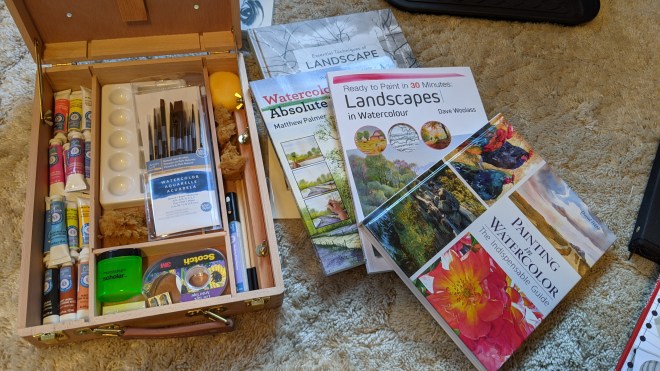
Once again a vast vista opened in front of me, of what watercolors might be and do and how I might feel if I could capture the light with a brush. Art supplies being expensive, but much cheaper than therapy, I walked tight-masked into art stores, armed with lists from the stack of books I began acquiring, and began the delightful acquisition of color and paper (two long time favorites of mine.)

My starter set: of these, I only still use the easel and the pencil sharpener.

There were so many things I didn’t understand. For example, every book on watercolors has a color mixing section – eg. two parts Prussian Blue and one part Indian Yellow to make a dark green. But I tried to do it by squeezing the tubes to be 2:1. No one explained that part. (FYI, I am pretty darn sure that’s not how you do it – you take the color on your brush and mix a smaller amount usually, but I’m still not sure.). I didn’t understand that once watercolors in your easel dried, you just rewet them and used them again. I thought the whole thing was rather wildly wasteful in that context (good thing I started with cheap paints!). I still struggle to admit how much of watercolor is water, and how little is color. I learned about masking fluid (and how it can take off sizing). I learned about sizing. I learned about blocking with masking tape. I came to understand why the weight and quality of paper mattered so much.

Learning from online teachers

I learned what gouache is, when and how to use it, how to pronounce and aspire some day to be able to spell it without looking it up. At nights, when my thoughts ran dark and fearful, I’d turn my thoughts to the names of colors – glorious names like Indanthrene Blue, Alizarin Crimson, Veridian and Aureolin. I’d think about Caput Mortuum violet and Venetian Red and how those tubes, innocuous on my particle-board desk, stretched back in time hundreds of years and tied me to a far older tradition. I’d plot out paintings I would do some day when I had the skills. And I would fall asleep in the fearful still dark of the night, instead of spinning over and over.

A collection

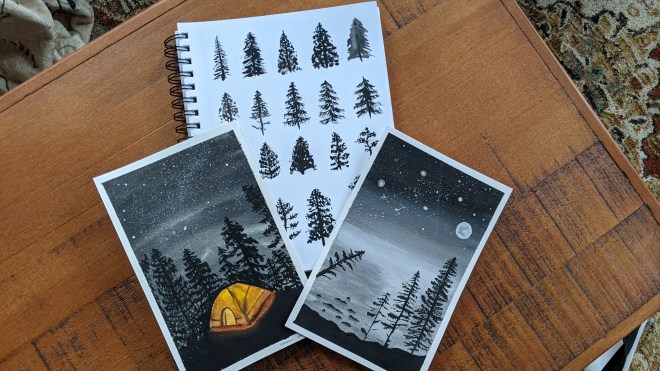
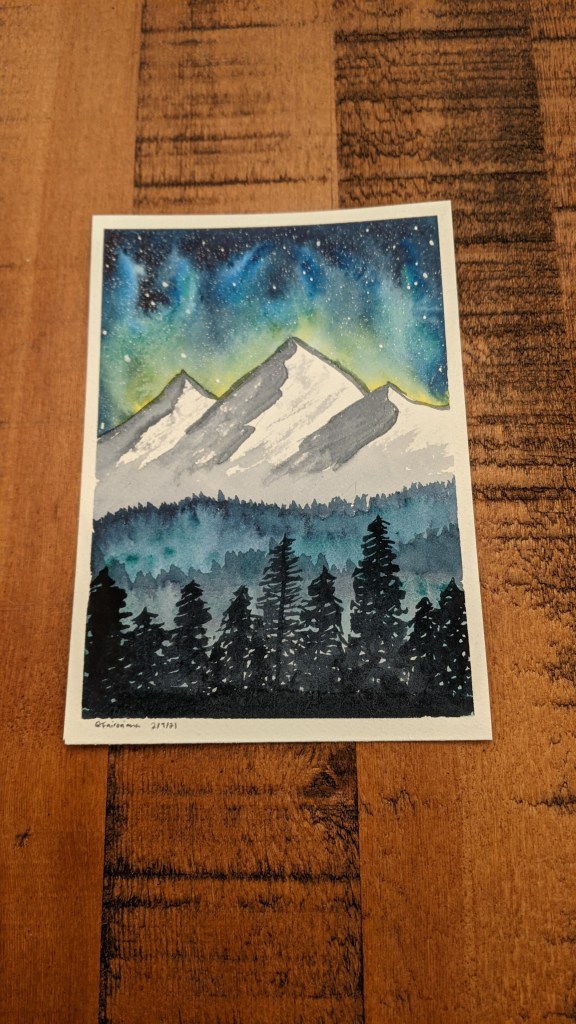
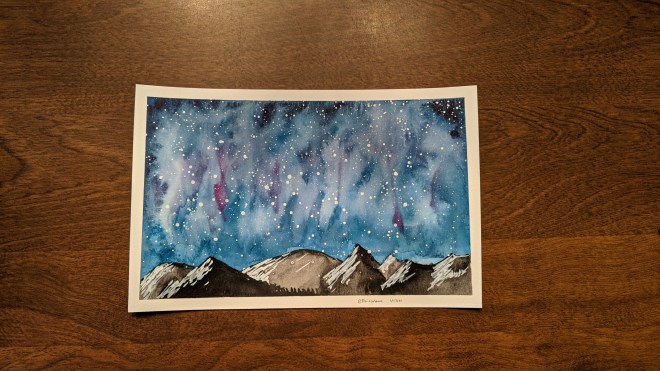
And I got better. I painted mountains. I painted the northern lights (also a bit of a pandemic obsession). I drew things that I painted. I made terrible paintings. I made bookmarks. I slid paintings into the hundreds of letters I also wrote during this time. I was taught by books (I have learned I like to learn by book). I was taught by online videos. I set up my Instagram feed to be all the amazing art of people who were way better than me. I attempted to compose and create my own scenes.

Increasing artistic independence on display

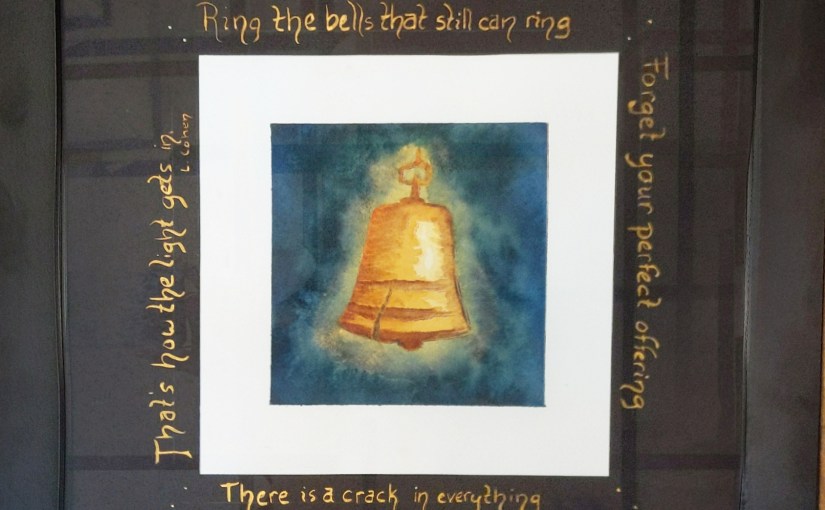
Perhaps my magnum opus was a painting I did for a friend of her favorite quote. I felt gloriously vindicated and complete in that through a LOT of iterations, I had accomplished something that I was proud of, and that I hoped would speak to her.

The journey: the one where the masking fluid pulled away the painting nearly broke my heart
The final product

And it was such a solace to me. To turn away from words, which felt caught in my throat and dangerous, to this way of speaking to which one could hardly be held accountable, was beautiful. The freedom to be terrible is a glorious liberation. The fierce joy of creating a thing of beauty, or the bubbly humor of creating a disaster, were both panaceas to me. My failures all had a back side that I could use instead. Or they could be cut into bookmarks. Or saved as glorious evidence later of how far I had come.

My teachers

Things are better now. I am in less desperate need of consolation. The world is spinning back up, and the gaps of time are evaporating, and I don’t think I’ll be on my periodic “one a day” track of watercolors. But I am so, so, so grateful for this time and the gift of this light, and color, and lightness of being.


I actually have an album of many of the paintings and drawings I’ve done. You can see them here!

Zodiacal light

And now for something totally different. I have a tendency to accumulate small and obscure interests. I don’t talk a lot about them, since I have long since learned that few people are interested in going in depth on things like Wagner’s Ring Cycle and it’s mythical connections to Tolkien. If you try, you can get me going on some of these at a party, when we have parties again.

Anyway, one of my small obsessions is solar phenomenon. At least, specific solar phenomenon. For the last five or so years I’ve been totally obsessed with the Carrington Event, a Coronal Mass Ejection at the beginning of the industrial age that lit up and partially destroyed the telegraph wires (as well as painting skies across the world with vibrant auroras). I sort of fail to understand why this isn’t a bigger deal. It’s one of the most likely civilization disrupting events (right next to, uh, pandemics). Events of that size hit earth every couple hundred years, depending on a solar cycle much more complex than I realized. (We’re in solar cycle 25 right now, although it seems clear there is also a meta-cycle that lasts longer than our scientific observations and is hard to map to any permanent stuff here on earth.)

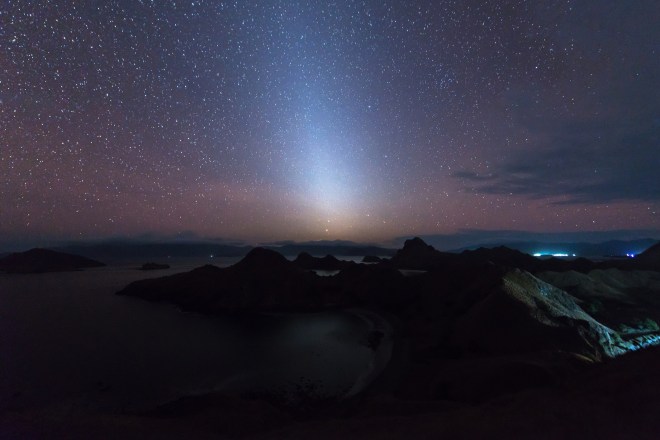
Anyway, I decided this summer to dig deeper into the aurora and the coronal mass ejection (and also Northwest Lookout towers) and read this great book called “The Sun Kings: The Unexpected Tragedy of Richard Carrington and the Tale of How Modern Astronomy Began” by Stuart Clark. Towards the end of it, after the unseemly death of the title character (Clark seemed to hate telling that part, but dutifully dished up the promised salaciousness), you get some lovelorn English gents wandering to Egypt with the expected malaria, ill health, and bad neighborliness. They go to investigate the Zodiacal light. Given my obsession with all the other weird phenomenon, I couldn’t believe I had missed one. The Zodiacal lights are a pyramid shaped column of light seen at dawn and dusk roughly between the tropics. And those ill-fated Englishmen (did they die of dysentery/malaria? I don’t recall, but it seems right) couldn’t figure it out. In fact, the mystery stretched down to my reading of the book.

There was a pyramid of light in the sky, and no one knew why.

Until last week.

We launched a probe, Juno, a decade ago. And with it’s vast solar panels, it discovered something in space – a vast section of dust fiercely pinged and pitted the light-catchers. And that dust lined up perfectly with both the trajectory of Mars, and the Zodiacal lights. That pillar in the sky? Mars dust. So cool. Of course, in the manner of all scientific discoveries the answer to one question simply raises another: how did all that dust get into space in the first place? Interesting, but not quite as cool as the mysterious pillar of light in the sky.
Anyway, Zodiacal light has been on my mind this week, so I decided to make this, ahem, artist’s rendition of it. It’s SO CLOSE to what I wanted, without quite being perfect. Ah, the life of a person attempting to make art. Anyway, this picture is definitely an exaggeration. But I got these pearlescent watercolors, and they seemed just right for this dim and misty light. And pyramids are fun. If I’d had skills I would’ve added a camel. But I don’t have skills. I did add two zodiacal signs to either side of the pillar – can you spot or identify them?

What bizarre stuff are you interested in?

Actual image of the zodiacal light

Color in a monochrome world

If you follow me at all on social media, you know that I’ve fallen hard for watercolors. I’m posting pictures several times a week: some I’m proud of and some I’m frustrated by. I dream about watercolors, when I am not having that dream where you go to a party and realize halfway through that no one is wearing masks. My art adventure started in July with basic of learning how to draw, and then in September I tried a watercolor of White Lake. I’m saving the before/after until I’ve been doing this for a year, assuming I’m still interested this summer. But I’ve made a lot of progress.

A recent (uninstructed) attempt

I’ve been waiting for two weeks breathlessly for a shipment from an art store. (Shockingly Amazon isn’t a good source for the stuff I’m trying to buy.) I’ve been whining a lot about how it’s taken TWO WEEKS to get me these paints. I, unlike most Americans, like STUFF. When I was a kid, the best part of going to school was that sweet, sweet 64 crayon box with all the sharp, unblemished colors. I’m not alone in having learned the names of every crayon Crayola produced for years. But my art education never advanced past the Crayola and Coloring phase, although my love for colors shows in my extensive pen selection.

My favorite genre of painting

For years, the closest I’ve come to artistic expression has been stamping cards. This is also a pleasure with color and paper – the sharpness of a crease, the perfect match of pattern, image and words. My favorite was always coloring in the stain glass window stamps with watercolor pencils – a bare step above coloring book and crayola. But with the water colors, all the joy of the 64 box has come flooding back, but with even more complex and multilayered joys.

Remarkable how much the mind fills in

One of the first books I read advised me to buy about 8 colors of paint. So I went to Michael’s and bought 8 tubes of cheap student’s paint (appropriate, given my skill level). The book had instructions on how to mix the colors to make other colors, but neglected to understand just how inexperienced a student might be. I struggled mightily squeezing out gobs of paint trying to get proportions right and cleaning huge amounts of paint off my little plastic palette after every picture. It felt… wrong and wasteful. Because it was wrong and wasteful.

I did this one twice, so you can see the amount of my skill vs. the skill of the instructor

I’ve been doing a lot of classes from a teacher online, and my new strategy has been to have blick.com up for the materials section of every class and buy everything I don’t already have. NORMALLY they’re here by the next weekend’s painting time. I’ve learned quite a bit about the tools and my preferences. For example, the right brush is absolutely transformational – at least at my skill level. I adore indigo with a deep and enduring passion, but cerulean is just meh. And it’s not just the one color, it’s the colors as you move from pure paint to nearly-water with the same paint. It’s the richness of the paint, and how the paint loves the water. Whether it longs for or disdains the paper. Is it smooth? Is is translucent? Does it haunt your dreams? But it’s hard to guess by paint names. I mean, cerulean is a great color name. Indigo is boringer. But I love indigo so much.

So much potential

So this last order I got a dot sheet, which allows you to paint from a tiny dot of watercolor all 109 colors that Winsor & Newton make. 109 times you introduce the paint to the water, and share both with the paper. It’s a deeply contemplative activity (how can a person be bad at painting swatches? But yet I am.) It took me almost two quiet hours. And in that time I delved into a world previously unseen to me. Each color is coded with the permanence, series number, staining, granulation, transparency and light-fastness. These are realms I have not considered.

From a recent class

As the time spread like water on the paper, I also started contemplating the color names – so different from their Crayola predecessors. I think of myself as having a pretty good vocabulary, but have never heard of perylene or quinacridone or gamboge or indanthrene. Mysterious patterns lay themselves out: there are cadmiums of every color, and then a non-cadmium option. Why? What makes the cadmiums both so prized and so flawed that they cannot be left out but also need some alternative? What does it mean that there is one Winsor in every color. Does that harken to the manufacturer? Does it mean the base color, like a box of 8 crayons? Then we go a step farther. One of the colors is caput mortuum violet. I know that once they made a paint called mummy brown, made of mummies. Is this … latin for mummy brown? There is a tale to this color, likely over a century old. And every color in this swatch. And then there is also the science to it. Intrigued, I looked it up and caput mortuum is made from hematite and the name stretches further back than the 19th century to the alchemical experiments of the enlightenment and yes. Is related to mummy brown.

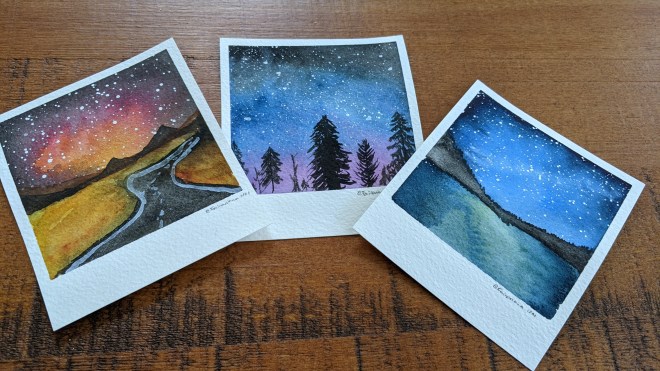
I like the polaroid size

I stand on the banks of the river of my ignorance and am only now seeing just how deep and wide those waters run. Truly, I have known nothing and come to this as a babe. It’s been so long since I have approached something so innocently. I mean, this is just paint colors that have my heart running fast with excitement tonight. There are other paint manufacturers, who have other storied colors. There are other kinds of watercolors, like the unpronounceable and unspellable gouache. There are brushes. I know they matter, but I do not know what they MEAN. The papers, sold with so many languages on their covers, hint at sacred mysteries like cold pressing and rough grain. (Are these mutually exclusive? How do they change the dance with the paints and the brush?) There are techniques, and trick and things everyone knows (did Picasso have one shade of blue he used in his blue period?). There’s the difference between pigment and hue. There’s how to see, and how to communicate what you see, and which tools you need to pick for what you’re trying to do. And that’s before we get to acrylics or oils.

In this pandemic time, I feel like all my horizons are room-sized: small and constrained and maybe just a little worn. Watching this world of painting unfold in my own mind is like braving a winter hike to stand on a summit and gaze beyond purpling horizons lined with mountains. When I first started hiking, those mountains were unnamed and undifferentiated too. And now I know them with the intimacy born of sweat and suffering.

My love and longing

There is no telling how long this phase of exploration lasts. Do I quit when progress is no longer immediate? Is my time swallowed by the return of the world? Does it lose its charm? Do I develop a near-fatal allergy to cadmium? Even here I have no path, and simply walk ahead, seeing what vistas may yet await me the next time I pick up a brush.

Indigo mountains

How I wish I were in Sherbrooke now!

It’s hard to move as fast as the internet. For a glorious few days last week, the internet was taken by storm by a revival of sea shanties and the subsequent public bemusement and pedantic corrections (eg. the Wellerman isn’t a shanty per se because it’s not intended as a work song). As I listened to the familiar lines, I was full of various and conflicting emotions. My first one was a prideful possessiveness: here were all these “Leave Her Johnny Leave Her”-come-latelies. Did they even Stan Rogers? But then I realized that was the absolute worst, and not who I wanted to be. What I want is for everyone to enjoy these great old songs like I do, and for people to discover and recover just how much fun it is to sing singable songs: alone, in the car, on Tik-Tok and some day (God willing) together again.

Monday is Robert Burns birthday. In other years, that would mean tonight would be spent in my kilt and tam, dragging my plaid-covered Scottish song book and preparing to endite poetry memorized 30 years ago, when memorization came easily. We’d usually start the night with Burns (“My Love is Like a Red Red Rose” and “Address to a Haggis”) before going to vaguely Celtic (“The Parting Glass” and “Early One Morning”) and then moving on to whatever we could sing or recite (a capella renditions of “Some Nights” by Fun). But the absolute highlight of the night, often sung two or three times (which I also snuck into my host-friends wedding) was “Barrett’s Privateers“. Not a shanty, but a sea song like Wellerman – sung by the same dude. This is also one of the few songs my sons have learned to sing.

The great joy of the singalong is the verse/chorus format. The more interplay there is between them, the more the crowd can join in after the first round or two. Barrett’s Privateers is particularly fun because there is a lot of interjection and plenty of verses. Plus fewer things are more cathartic than belting out “God damn them all, I was told…..!!!” at the top of your voice.

So in case you would like to join in the sea shanty*, fun to sing along songs, here are a few of my favorites:

1) Barrett’s Privateers: Stan Rogers
The very best of the singalongs for large, rowdy groups. Try to have at least one person who has the verses written out for a call and response. And never look at a bowl of eggs the same way again. Just what ARE the staggers and jags?

2) Mary Ellen Carter: Stan Rogers
On the same album, this song about the resurrection of of a sunken ship, given up on by the owners. It’s a triumph of the little guy over the heedless, soulless bosses, and the relationship between a worker and the tools, which is so much more than a simple cost benefit. To my deep surprise, this song was one my pastor chose to have sung at his retirement celebration.

3) The Wild Rover: The High Kings
There are a bunch of good version of this song, but I like the harmonies on the High Kings version. The funnest part is by far the clap in the chorus. Makes you feel like you’re part of the in-crew when you can totally nail the claps, and gives you a chance to good naturedly laugh at the new person who adds the extra clap!

4) The Scotsman: Seamus Kennedy
Another classic with many versions. It’s a tremendous accomplishment to roll off a ringdingdiddlio or two. This version is nice and clear so you can hear exactly what he’s saying, which was incredibly scandalous to 12 year old Brenda when I first heard it at a party after the Highland Games sung by a man named Sterling.

5) The Tarriers Song: Chad Mitchell Trio
Another fun, fast chorus on this one, with gorgeous three part harmony by the Chad Mitchell Trio. Like so many of the songs in this genre, it makes you grateful for a desk job. It’s short, but a fun chorus.

6) Greenback Dollar: Kingston Trio
In the version of this song we had on tape when I was a girl, they’d only strum on the word “damn”. I didn’t discover what I was missing until we acquired a CD version, and was appropriately scandalized by the language. I apparently spent a good amount of time as a girl being scandalized.

7) Long Black Veil: Columbia Country Classics Volume 3
This entire album is a freaking national treasure, and memorization of all the songs should be mandatory for high school graduation. Also, I only figured out last year that Lefty sold out Pancho, and I’m starting to have doubts about Carmela. This is a great song for later at night, when you’re feeling maudlin and sentimental.

8) The Wreck of the Edmund Fitzgerald: Gordon Lightfoot
This one has no chorus, and is more the kind of song you should memorize (even if you can’t sing a lick) in order to impress everyone with your authentic credentials. This is an excellent choice for someone who can’t sing to sing, since it has like a 5 note range and super simple melody. The strength is the lyrics.

9) The Downeaster Alexa: Billy Joel
Required singing for any beachside fire-pit sing-along from New London to Newburyport. Billy Joel has a straight-up fishing song, tinged with the grit of New Jersey and the smell of diesel. For contemplation: does he die in this song?

10) Hard Times Come Again No More
Another song sung by so many, this is a great theme for all of us as we persist through these dark days, held hard by pandemic in the right hand and squeezed by the icy grip of winter in the left. We can all sing together on the chorus “Hard Time Come Again No More” and get misty-eyed at the plaintive hope in this song.

‘Tis the song, the sigh of the weary
Hard times, hard times, come again no more
Many a days you have lingered all around my cabin door
Oh, hard times, come again no more

So there you have it. When we get together again, let’s sing these songs together. I’ll take the verses – join me for the chorus.

And while we’re on the topic, ahead of any future improbable resurrections of unlikely music, I’ve also long been a huge fan of:

  • Opera, especially Wagnerian opera
  • 1970s folks rock with electric background (see also: Maddy Prior & Steeleye Span)
  • All the great folk trios of the 60s
  • Early music, inclusive, but especially focused on motets and madrigals, the works of Giovanni Gabrieli, and the repertoire of the pifarri.
  • Old school hymns
    Congrats! You got to the end. Have a haggis.

    *None of them are actually sea shanties. Pedantry isn’t the point.

  • Though much is taken, much abides

    Though much is taken, much abides; and though
    We are not now that strength which in old days
    Moved earth and heaven, that which we are, we are,
    One equal temper of heroic hearts,
    Made weak by time and fate, but strong in will
    To strive, to seek, to find, and not to yield.

    Ulysses, by Alfred Lord Tennyson

    I was running when my watch buzzed with a message from my brother, “Y’all seeing the fire at Notre Dame?”. At first I thought of the Fighting Irish. But the link, which I did not stop my pace to read, was from the BBC in Europe. So the other Notre Dame. I’ve been heart-sore lately.Good exercise on a day when the world was contemplating renouncing the despair of winter for the hopeful enthusiasm of spring was meant to be a brief panacea. I tried to put the fire out of mind (hoping it was minor) and focus on the daffodils.

    Running through the well-kept houses and lawns of wealthy Winchester, I reminded myself how amazing our civilization is. It is so much easier to destroy than build. But there is so much more built than not. What a great weight of effort lay behind every vista. And to the pounding rhythm of my slow pace, the words came back to me: Though much is taken, much abides

    I find myself greatly consoled by remembered poetry. You’d think that this would mean I spend more time reading and memorizing poetry, but humans are not so sensible. We do not always invest in the things that offer us the greatest returns. We do not avoid the things that bring us harm. But this poem is not one I’ve read. It is, instead, a poem that a friend has memorized. I remember one bright night, when we were all younger than we are now, when we went together to see a play – a musical. We all agreed that it was quite possibly the worst performance any of us had ever seen. But walking back together through the streets of Boston, through swirling mist and halogen light, he recited all of Ulysses to the city sky. I’ve likely heard him say this poem 20 times in our years of friendship. So it is unsurprising for me to hear it in his voice. My friend’s voice assures me, much abides.

    When I returned from my run and saw the pictures of the flames, I thought nothing could survive. What was built over centuries and endured for longer centuries would be wiped out in the slow course of my 5k jog. I was comforted only by the memory of that poetry. “Much abides” I reminded myself. And indeed, from the implausible wall of flames much more was recovered – largely because of human planning, care and expertise – than I dared hope for. The windows remain. The bees remain. The gothic walls and buttresses were designed independent of the roof, so the one could fall while the others held. I read an amazing response (which I cannot now find) by a medievalist who long studied the cathedral at Reims. The scholar talked with great hope about how the Medieval architects had learned so much (from hard experience) about how cathedrals burned that they had built new ones to withstand conflagration. The churches were designed to burn, but yet abide. And looking at what remains in the rubble in Paris, that seems true. How clever we are, we humans, when we put our minds to resilience and preservation. How foresightful we can be, and have been. Much abides.

    Today, as I write, it is Holy Saturday. Last night, I went to Good Friday services – my favorite of the year. There’s no sugar coating harsh truths on Friday night. We put ourselves in the place of the false accusers, the cowardly arresters, the sleepy and scared friends who fail at the first test. We speak of beatings and mockery and spears and nails in the flesh. We listen to a dying man make fun of another dying man. There’s no place on Good Friday for looking away or softening. I think it’s no coincidence that rarely are children present that night. (Although I was very, very glad that my youngest son joined me, for the first time. I’m not sure my children will be able to understand my faith if they never worship with me on Good Friday.) On this Friday night – and on the long Saturday that follows – we live in a reality where God himself has died and we cannot see how anything can ever be okay again. Hope is lost, and all that remains is cleaning up and moving on.

    Of course, there’s always the rest of that story. I usually practice my Easter hymns on Good Friday (which feels like cheating, but practice you must!) Beyond hope, hope arrives. There is redemption for the failed and weak. There is forgiveness. Although there is also real loss – Judas is never forgiven. I sometimes wonder if he would have been, if he’d chosen repentance over despair.

    As we look to rebuild Notre Dame, and the black southern churches destroyed by a hateful arsonist, I am reminded of another phrase caught in my mind lately, from Isaiah:

    Your people will rebuild the ancient ruins
    and will raise up the age-old foundations;
    you will be called Repairer of Broken Walls,
    Restorer of Streets with Dwellings.

    Isaiah 58:12

    As I looked for the right words to close my thoughts, my pastor posted a poem by her favorite poet, whose title caught my eye. I leave you friends, with a new poem. May it be a consolation. For much abides.

    What Abides, What Returns

    Readying for Spring

    March is a cruel month in New England. It is the time of dirty snow, when winter is old and grey and has entirely worn out it’s welcome, but clings to our shaded areas with a stubborn tenacity. Even today, the second nearly-70 degree spring day this weekend, I gaze over at my nearly-budding plum tree and see a malicious pile of snow in the corner.

    But still – the fighter jets just flew past in tight formation, rumbling against blue-and-white sky, readying for the opening day in Fenway Park. The daffodils and hyacinths have pushed past winter’s hoar and into a friendlier light. The forsythias are golden in longer, stronger light and the spring peepers have begun a cacophony as loud as any fighter jet. Not even March can hold on forever.

    I pruned the plum tree yesterday. That’s such hard work. You know you have to cut it down, for it’s own good. But you don’t want to. You’ve been cheering for every branch. I severely hacked back one of the branches that overhung the stairs (although I fear it’s going to inspire riotous new growth). There were also two fungally infected spots – one of which was a minor branch and one which was a medium one. I made more cuts based on health and my convenience than based on a proper pruning. But there are a good many incipient blossoms, and this year I have the fertilizer stakes in. I will ensure it gets well watered (I think my biggest mistake from last year). This year, you just watch, will be the year of plum jam.

    I feel more than a touch repetitive when I tell you that life has been busy. On the spider-plot of the areas in which my life is usually busy, right now it’s dominated by work – of which there is much, and what I’m doing requires tremendous energy and leaves me tired at the cessation of my labors. I’ve been having headaches often lately. I think I may have cracked that one, though. I had a cold and sinus involvement which led to me taking a lot of cold medicine that included Tylenol. (Transcontinental flights with colds = All The Meds.) Then I kept getting headaches (and taking Tylenol) sometimes even from the moment I got up. I read through the internets (I was pretty sure it wasn’t one of the more serious causes) and discovered the concept of a rebound headache. I lowered my coffee, stopped taking all pain meds despite pounding headaches, and tried to get a bit more exercise. And it seems to have worked! No headaches for a week now!


    Spring’s most perfect day

    In other news, Grey has signed up for travel soccer. He had a great season doing indoor soccer this winter, during which time he enjoyed playing with his teammates, brought his skills up to a new level, got in good shape, and lost pretty much every single game. Builds character. For those of you who are not soccer moms, the hierarchy of soccer excellence goes like this:

    Town soccer: 1 practice, 1 game a week. Entirely for fun. Don’t have to travel anywhere. Low pressure.
    Travel soccer: 2 practices, 1 game a week. Have to do tryouts to get in. Increasingly competitive based on which team you make.
    Club soccer: Soccer is now your life.

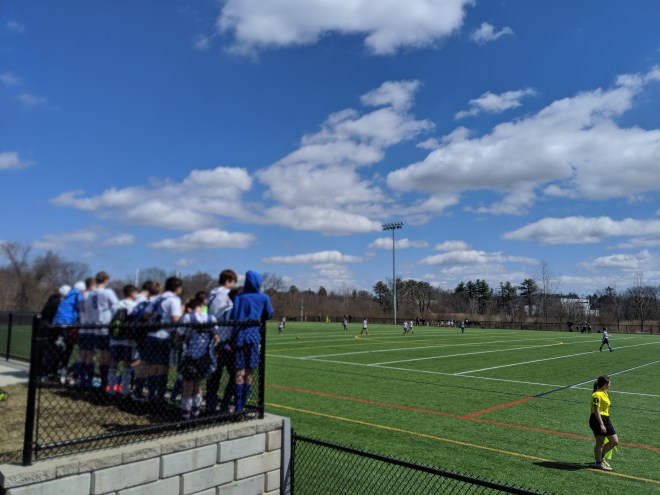
    We’ve always been in the Town Soccer zone, and our sons have shown no interest in travel – until now. I often miss Grey’s games, but I got to go see him this Saturday on Spring’s most glorious day. I loved watching him run – the way his long legs effortlessly ate up the field as he moved. I loved watching him attack the ball, and how he’d position himself on the field, constantly adjusting to where the ball and other players were. He looked very right and in his element out there, which is not what I had expected based on his early years playing.

    Does anyone with a background in physics know what happened next?

    But we just added together 1 & 2 (it’s an and, not an or). So for the remainder of the year he’ll be playing games both days of the weekend, and will have three practices a week.


    Yesterday, Facebook showed me an “On this day” update from a year ago. This was when we started the demolition for our attic project. Every night when I get to go up to that beautiful, bright, clean, airy space I can’t believe my good fortune. I think it will take a long time for it to get old.

    Dare I say my favorite spot?

    We went up to Conway in January, and spent some time looking at art galleries with an eye to the perfect pieces for our pristinely white walls. We found one superb piece that I enjoy every time I see it. It’s this beautiful, very New England scene (very wintery, really). It’s this lovely circle picture, done with photosensitive paper. It seems like a real place, lovingly remembered.

    I especially love the stars

    So what’s new with you lately? Have you seen any art? Spent any glorious spring days outside? Read any good books? Tell me!

    Land of Ashes

    [Written Friday morning 8/17]

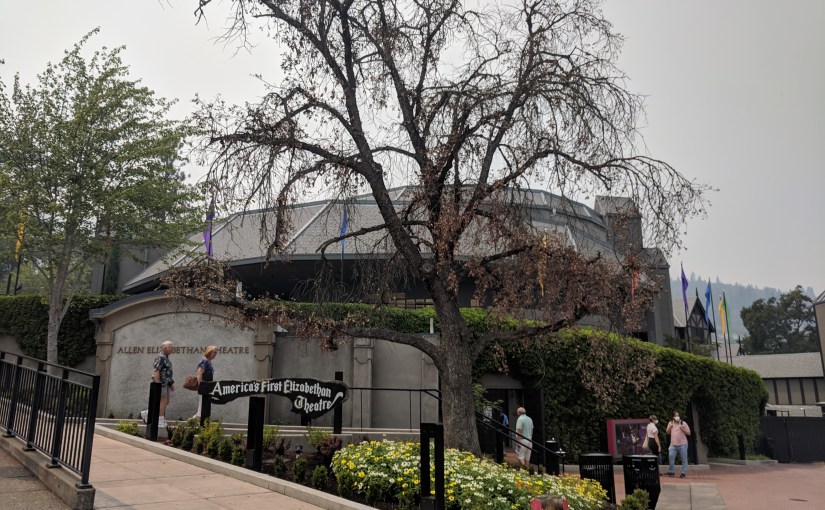
    It’s cool this morning in Ashland – 70 dry degrees under the shade of the old ponderosa pines whose roots reach deep into the cheerfully burbling Lithia Creek. I’ve loved Lithia Park, and it’s eponymous creek, since I was a girl in the first flush of my coming of age (perhaps 15?), and thought the college boys here were very grown indeed. I fell head over heels in love in 1992 with the romantic lead of “As You Like It” (the ever dreamy Ted Deasy), and have returned often enough to watch him begin taking the elder’s parts, as I have begun paying for my own tickets. (It’s a sorrow to me that he is not here this season!)

    Ashland has lived up to it’s name in this week, with the sun blood red at noon with the smoke from a hundred encircling fires. As the air thickens, the theater goers are shifted from the grand outdoor Elizabethan theater to the surprisingly nice for a high school Ashland high school theater. But you cannot watch the stars rise above the flags for comedy, tragedy and history from the high school. Walking down uncommonly empty streets, faces are obscured by masks. It’s been nearly a month of unhealthy air here, and the stitch-ladies have begun turning their handicraft to N95 masks. I see more and more of them that appear attractive, artistic… permanent. Even the bright waters of Lithia seems murky with ash and fire-trace.

    We saw no plays here

    But while the very air we breathe may be turning against us, the actual art of Ashland is as superb as I have ever seen. I’m extraordinarily fortunate in finding a mate who likes theater as much as I do (I swear I don’t drag him – I proposed we go backpacking). So in the four days we are here, we will be seeing seven plays. We’re through five of them on this cool Friday morning, and my belief in the importance of art to show what it is you would rather not see has been swollen, like my heart.

    Sense & Sensibility
    I’ve never been a great lover of the Austin era romances. I’ve read a few of them, and enjoyed them, but never with the passionate ferver others express. My favorite version of Sense and Sensibility was actually a sci-fi sendup when the unsuitability of the young ladies had to do with their telekenetic and other powers. But this play was masterfully frenetic. It was almost tiring to watch the energy and enthusiasms of the young ladies and young men and gossips – the still patience of that eldest Miss Dashwood stood in most abrupt counterpoint to the chaos around her. It was a costume drama and a continual joy to the eyes. And at the end, when all the wheel of fortune ends it’s turning for the afternoon, there were tears standing in our eyes.

    Book of Will
    This was our first shift from the grand Elizabethan theater to the tiled halls of Ashland High, but as soon as the actor took the long trumpet in hand to herald the coming play, I was drawn completely in. This may be one of the most loving plays I have ever seen – showing long and happy marriages. It was a story of how it came to be that we still have the words of the Bard, against all odds and habit of the era. It was a good reminder of how much we owe to our forebears for their preservation of what is good and lovely. It was also very much a story of loss, and of the meaning of life. Will himself was years dead at the time of the telling, and the King’s Men (who knew his words) were also dying. The characters wrestled with questions of living now versus creating legacy, of what is owed to the honored dead, and of how to claim the very value of our days, especially when those days grow scarcer. It’s hard to say, but this might be my favorite of the plays.

    Snow in Midsummer
    There’s nothing quite like a good ghost story, and this one was very fine. It was a very modern retelling of an ancient Chinese story. What would happen if the honorable dead had the ability to demand justice from those who have killed them, and those who benefited from that killing? It was a very keen play, cutting to the heart of expectations, first impressions, and questions of justice versus love. It also spoke to the great modern themes of the changing climate of the world, the inequality of resources and justice, and the Chinese practice of harvesting organs from executed criminals. This is the sort of story that stays with you, and haunts your quiet thoughts.

    Love’s Labors Lost
    After dining with a long-lost college friend, we once again negotiated the process of getting and claiming our tickets for the Elizabethan in the high school instead. It was easier once we remembered we had a car. I’m very fond of Shakespeare’s comedies. Love’s Labors Lost seemed to echo the last two plays, with it’s sudden turn towards sorrow which questions the meaning and worth of all the drollery that makes the early acts such a frolic. In this one, I particularly noticed the costumes, going from white innocent frills throught the red of charming, lustful deceipts to the black of full mourning. The play is both a laugh at and a lamentation for youth. How very very young and innocent those kings and princesses are in the beginning. How sorrowful it is to see such folly vanish as it’s brought of age – and yet how hopeful at the same time.

    Manahatta
    Thursday was our light day, with only one play (and that one only 90 minutes long!). But it was a remarkable 90 minutes. Our culture is full of the trope of cowboys and indians, the winning of the west, the conquering of savagery by civilization. But from the eyes of the conquered, killed and often-displaced the story looks very different. This play was a heart-piercing dual story of the theft of the homes and lives of the Lenape people to claim the island of Manahatta for the Dutch. The wall for which Wall Street was named was built to keep them from their own homes. The second layer of the story, seamlessly interwoven, tells the tale of a Lenape woman with the highest credentials returning to Wall Street as part of the derivatives group in Lehman brothers. We watch again, in eerie echoes, as home foreclosures chase out native folks from their homes as inexorably as did colonists a few centuries before. It was devastating. It is also strange to see presented as historic remembrance things that I easily remember as they were happening. I was no child in 2008, and I remember how it felt to wonder just how far the normal order of the world would slip (as I do now).

    Before each performance, for the first time ever, the company has remembered that these theaters sit on grounds once belonging to the Shasta and Takelma people. I understood better why a company that has memorized the lines from this remarkable production would be conscience-bound to confess this.

    The Way the Mountains Moved
    Not every play can be the best you’ve ever seen, although the OSF sure tries. This one was well acted and well executed but perhaps overly ambitious. In telling too many stories, it failed to tell any enough. It threw together the wild mix of manifest destiny Utah with Mormons, escaped slaves, 19th century naturalists, Mexican war veterans, Native Americans and pioneers. I had high hopes, but this one was not my favorite.

    Henry V
    This is my favorite Shakespeare play, and this was a masterful performance. I’ve never seen a Henry so vulnerable and human. His night-before fire visits, when he talks about how the King is also just a man, really resonated with the sound of truth. It made his Crispin Crispian speech all the better, when you know that he’s fighting his own feelings, doubts and fears in order to make such a bold stand. I wish I’d gotten to see the full cycle of Hal plays with this lead actor – he was superb!

    Taken all together, my heart, mind & conscience have been moved by my time here. We’ve been debating the role of art for a few hundred years now (if not longer). I find as most precious this kind of art – that makes me see things I cannot myself see from where I stand. It teaches me something of what I do not know. I have never found another place that does such art as well (or even nearly as well) as Ashland does it. I wish you could all be here, and watch these plays with me, and be moved.