The news is always depressing, but it seems like it’s been even worse lately. On CNN yesterday, there were five stories above the fold about children who had been hurt, bodies found… horrible things. It makes me want to turn my eyes away from humanity.
Yesterday, a viral video of David Foster Wallace talking about the implacability of adult life crossed into my digital awareness. It is a good video, and it has some good insights about our choices, and the patterns of thought we fall into. But you can hear in it the overarching despair of someone struggling to see the good – even the made-up good – in humanity. It is hard to listen to this without remembering that David Foster Wallace died at his own hand, struggling to the end with a depression as implacable as a ninja assassin. He fought that suicide so long and so hard, and you can hear the fight in his words.
I watched that yesterday. Then I sat back and said to myself, “This is not my reality.” None of this incredibly depressing stuff is. Now, the bad parts of reality have gotten awfully close. The marathon bombings scattered pain to my right and to my left. There’s a guy who used to go to my son’s grade school who is fighting to keep one of his two legs. I’ve shared the story of my friend who ran towards the bombs. (In a surreal moment, she texted the other day asking if I wanted to go to the movies since she got some free tickets for being a first responder. Sadly, I couldn’t.)
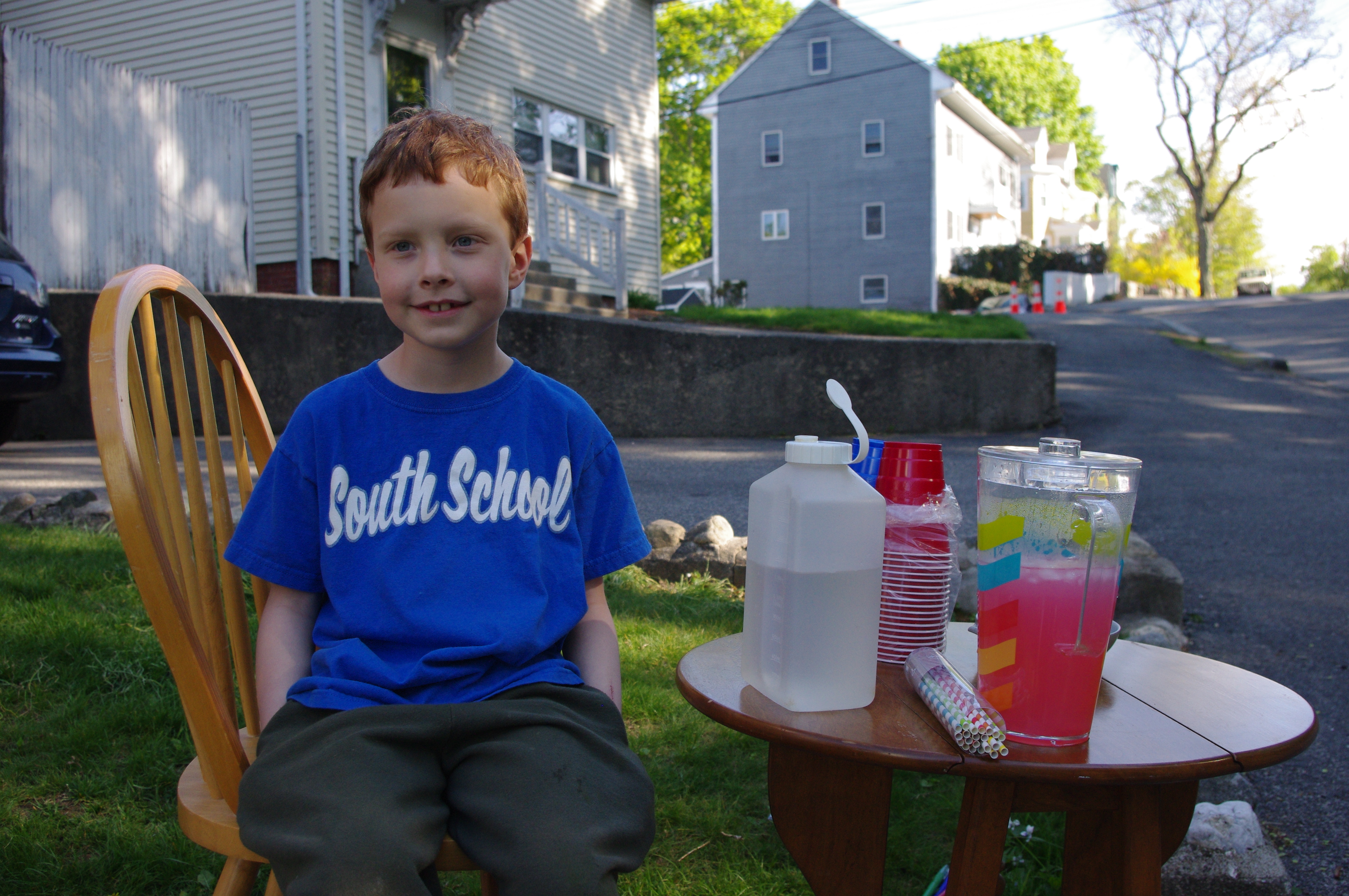
But 98% of my life – perhaps more – is full of neat people who are nice, kind and friendly. That part of my reality crystallized for me the other day. Grey had a tough day at school, and I was working from home, so when I got a call saying that he had a tummy ache… well, I picked him up to let him have a quiet afternoon. The quiet bit lasted an hour or two, but then around 4:30 on a beautiful spring day, he decided he wanted to make a lemonade stand. He had done this last year, with varying degrees of success, but came back to the idea. He set up the table, made the signs, priced his offering (reasonably, as opposed to last year).
And they came. The mom in the van who said, “We have set up lemonade stands too, but we live on a cul-de-sac so they don’t usually go very well.” The older woman with lots of makeup and a nice car who talked to him with the yearning of a grandma who doesn’t see her grandkids often, and overpaid. The dad with his two boys in the car, on their way to go fishing. The neighbors, who see our sons as extensions of their own children. The young, tattooed couple walking by who were enthusiastically accosted, and who walked uphill two blocks to make a little kid’s day.
The kid netted $15 and grossed $10
This random suburban sampling of humanity was kind and friendly. Almost all gave what was in their pocket, even if it was rather more than the price of a cup. Moreover, they gave encouragement, a smile and their support. No one stops at a lemonade stand because they are thirsty and pining for a cup of lemonade (although in point of fact, the best lemonade I’ve ever had was at a lemonade stand in Seattle). But lemonade stands do well because people are kind, and interested in each other, and generous. That is just as much “reality” – likely more so – than anything CNN is covering today.
It is one of my more pleasant chores to go through the pictures on my camera to upload them. I usually notify that vast cadre of people (all four of them!) that may be interested in such things here. To that effect, hey guys! I got the April pictures up! And it’s only May!
There comes a point in your thirties where you start answering survey questions, and you realize that you are (more or less) telling marketers to ignore your feedback. When you have to pick the “34 – 45” option instead of the “25 – 33” option… your preferences and ideas have just become a whole lot less interesting.
One of the great moments in one of the great video games of all time
I was having dinner with a friend who helps create computer games the other day. This is a guy who actually has some decision making ability about which video games get made. I was telling him what computer games I loved, and what I desperately wished his company would make. And over the lobster mac and cheese at Lucky’s he looked at me and said, “Yeah, those were great games. But you’re just not our target demographic. To be successful, a game has to be a hit with 15 – 25 year old males. We can’t afford to make games they don’t like.” So not only am I not a video game designer’s target demographic, I never was one. If they made a game (I’m thinking of YOU “Black and White”) that I loved… well it was practically by accident. Later versions of games I loved almost always emphasized my less favorite parts of the game and entirely scrapped the cheerful world building I loved.
That got me thinking about how often I am not the target demographic. The truth is that in most media, I’m not the target demographic. I don’t like violence. Right there, I’ve made myself not the target demographic for 80% of movies. I don’t like meanness. That rules out all the remainder but a handful of Pixar films. Although there are definitely movies I could like, I’m not the target demographic. The movies I would enjoy are rarely being made. And if they are, I’ve already tuned out and don’t watch them.
They don’t want to impress me
Or when you’re standing on the street, and a guy drives by who is *so selling his image*. He’s in a low-riding car with a custom exhaust and a sound system that can deafen you at 20 feet. He’s got tinted windows (rolled down) and is slouching in a seat, not wearing a seatbelt and looking at the world with a jaded eye. My thirty-four year old Protestant-white self clucks and tongue and thinks, “Who are you impressing? You’re not impressing me!” Then I remember: I’m not his target demographic.
I used to work in the same building as Cambridge College
I’m not the target demographic for most bus ads (I already have a degree, thanks.) I’m not the target demographic of our local Red Sox radio station, which seems to find it impossible to avoid misogyny with even ONE of its talk show hosts. I’m not the target demographic for the salons that dot my town offering increasingly esoteric forms of hair removal and supplementation. I’m not who they’re talking to, or who they’re trying to reach.
It can almost be depressing sometimes. So few things – or people – are really designed to please and entice me. How can you be important if no one is even trying to sell you something?
When I get it that mood (usually after a trip to Gamestop trying to find something I want to play – where I am also NOT THE TARGET DEMOGRAPHIC) I remind myself of the delightful flip side.
They’re not MY target demographic, either.
These handsome guys are MY target demographic!
That guy in the car? He doesn’t impress me, but I don’t feel the need to impress him either. No platform shoes or tight dresses for me, thanks! That judgmental person I run into who has something bad to say about everyone? They’re not my target demographic. Those beauty magazines that tell me that I need an expensive and time consuming regime in order to be acceptable? I’m not their target demographic either. My husband loves me the way I am. I look better than I “have” to in order to be promotable at work. My church family will not look down on me if I wear last season’s styles. My neighbors will invite me over after bedtime to hang out even if I have a mis-allocation of hair, according to the latest trends.
So although it can be sad that so little is made to suit me, I am more than compensated by my liberation from having to impress those elements of society that are most oppressive!
Who is your target demographic? And which group do you wish would pander just a little more to what you want?
During Monday’s Marathon bombings, my friend Caitlin Rivet was working as a volunteer EMT at the Boston Marathon. I’ve known Caitlin since she was about 12. I taught her and her churchmates in Sunday School, youth group and confirmation. We’ve been close ever since, even as she moved into adulthood.
At church this morning, Caitlin was there. Her face has a strip of abrasions from shattered glass from the explosion, and she shies away from talking about her Monday. It’s too close, and too hard to put in words. But she wrote this narrative about her day, and gave me permission to share it.
When the marathon was just a fun sports event.
4.15.13 – A Reflection
The Boston Marathon is one of the world’s premier sporting events. This year it was marred by two bombs that were detonated close to the finish line. During a time when most marathoners are finishing, the first bomb was set off in
front of a sports store along the spectator sidewalk. While hundreds of people were cheering on family and friends to the finish, they experienced a horrible act of terror. The first bomb went off feet from the finish line and only about 12 seconds later, the second went off less than one block away.
This is my reflection and memories of my day there.
It was a cool morning starting in the dark at 5am, my first major marathon volunteering experience about to begin. Despite having worked until 11pm the night before, I was a giddy person excited to see what the day would entail. With my clothes on that I had laid out the day before, I set off to the train station. Surprisingly, I could see my breath and I was happy to have my hot chocolate. As I waited for the commuter rail to pull in, I began to think how this marathon might be run compared to the Bay State Marathon, which had been my only experience in major sporting events. I was eager to get my directions, I was volunteering as medical staff, as an EMT. So as the train rolled into North Station, I followed my plan to the green line, ending at Arlington Station. From there I found my way to the Back Bay Event Center and my group meeting area. I was assigned to transport bus #5. I was the only EMT on my bus and surprised, it being my first time and all, but nonetheless, off I went. I gathered my volunteer jacket (score!) and supplies for the day, boarded the bus and so it began.
As the morning went on a few runners were unable to complete the race and we picked them up, making the trip to the finish line to drop them off. On our second run into the finish line, I realized I needed additional supplies. So after all the runners had made their way off the bus, I headed down the street to re-stock. On my way, things took a complete u-turn.
I was walking by the stands packed with friends and family cheering on their runners, when the first explosion occurred. It was a loud pop, suddenly my ears were ringing and I was off balance. As I re-gained my balance, saw the smoke and debris flying through the air, I knew instantaneously this was not normal. What I didn’t know was that it was a bomb not an accidental explosion of some sort. I later found that I had been scraped in the face by some of the glass flying- nothing major. As I began to run to the sidewalk, the second explosion occurred less than a block away. I stopped, saw it was similar and proceeded to the injured people.
From flying glass – she’s not included in the count of injured.
As I looked around, people were running with me towards the smokey, debris- filled sidewalk to assist those injured. What we found was beyond imagination. Blood stained the sidewalk, ran down the curb and sprayed against store windows. Glass flew through the air from windows blown out. In an attempt to gain access to the injured, everyone began to rip the staging apart; through metal scaffolding, marathon tape, the nation’s flags, wooden fencing: all with haste to reach those in critical condition. Suddenly, those of us who began the day volunteering to help with hypothermia and dehydration found ourselves making tourniquets of belts, tablecloths, clothes from the stores and marathon tape. Using clothes to cover wounds and many other makeshift items we found solutions. We entered a scene of horror, trepidation, mangled bodies and cries for help. Moving as quickly as possible for fear of additional attacks, we evacuated the injured over our shoulders, carried them by the extremities that were still intact and eventually stretchers and wheelchairs. As the police cleared the scene, the remnants of a nightmare were visible: an event of great personal achievement turned into a mission of many.
I found a few moments to txt people close to me and post on facebook that I was ok since cell towers were shut down.
This was such a relief to hear
The medical tents quickly filled, the grassy areas used for the less critical and ambulances began lining up to take patients to every available hospital. Police and volunteers began to stop runners, asking if they were medical staff and worked in Boston area hospitals; those who answered yes were quickly transported to begin the hard work extending the need to use their previously exhausted bodies.
We continued clearing the area, treating and transporting people until 7:30pm, only a total of 4 ½ hours after the explosion. Around 170 people were treated and transported, in the biggest MCI (mass casualty incident) Boston and
most medical staff had ever seen.
Around 8pm, it began to wind down. I gathered my belongings once I had been cleared to leave and took a look at the medical tent, the scene was one of peace and serenity. There was plenty of proof of the day’s events, but instead of chaos, screams and debris, it was filled with used supplies, sweat poured out from everyone’s best efforts and hope.
A great sense of accomplishment preceded a large feeling of the unknown. What’s next? Is there anything else I can do? Has everyone gotten what he or she needed? Did I miss someone? Did everything we do work? Do I go home now? Can I get home?- the MBTA had been shut down. What do I do when I go home? I’m exhausted – will I sleep? As much of the unknown crowded my mind, a sense of disbelief and numbness settled in. I proceeded to the nearest open station guided by troopers since most of Boston was still shut down. I took the train home, calling my Aunt on the way home and stopping for a burger – my first meal since breakfast.
I sat on the train and couldn’t think about what happened, how does one process an event of such magnitude? I am very good at compartmentalizing and focusing on the job, will that carry over to today? I texted a few friends who had been trying to get my status, knowing I lived in the area but not that I was actually at the marathon. As I responded to them, I was in awe of how many people had heard and thought of me- some people I hadn’t heard from in a while. Then a thought crept in: what will I tell people when they ask? Do I give details? Can my friends and family handle the details of my experience? What does my Mom know/think- she’s in Spain? Should I give a summary, if you will? Will I be ok talking about it? How will I be at work now? And what the heck will I say to my Dad? In conclusion: I needed space to see how this will play out.
The next day I woke up feeling well rested, then my memory was jogged and I remembered what had happened. Should this effect my day? Let’s see how it goes. I got more info, though I felt no need to look at the pictures since I had plenty in my head. I heard the number of official fatalities and injured. Amazingly much to the tribute of a city’s teamwork, the fatalities were extremely low for an attack of this caliber and most survivors will have the opportunity to overcome their injuries and flourish in spite of the attackers intentions.
I did go to work the next day; things went fairly well. Besides being a bit jumpy and nervous at doors shutting, sirens blaring, basically any loud noise, I was able to do my job and finish my shift. When I brought patients to the hospital, my friends offered their support and checked to see how I was. Staff that had never really interacted with me, suddenly knew me and were interested in my well-being. I was shocked at the span of knowledge that I was there. Wednesday, work went well, somber and numb still, but well. Thursday I had a non-violence interventions training, I attended with a few friends and the class was better than expected. Somewhere in the first portion of the training, we were instructed to shut our eyes and picture our happy place- I did not do this, then out of nowhere, the instructor
screamed. I was overwhelmed and had to leave the class to gather myself. This was really my first time not able to keep it in control. I realized that things were starting to become less numb. My boss asked me to take the evening off, though I did not want to and call the crisis team. I did and got a counselor, basically my thinking was – dude, this is normal, it’s going to take a little while to re-adjust and comprehend. I got a few good tips and went to work Friday. Friday the hospital chaplain approached me also, and the rest of the shift went well.
What I have realized is, the effects are probably going to take a while to subside. I am sleeping through the night, I wake up sweaty in the morning, but it’s a complete night sleep. I get startled easily by noises such as car doors, things being dropped and the lock on the hospital stretchers. When I know they are coming, I can brace myself. I keep cough drops in my pocket because the crisis counselor suggested that when I get trapped in a moment, sucking on a strong flavor stimulates the senses and brings you back to the present. Very true, whoever figured that out is genius!
I cry occasionally without warning. I am not totally in my usual easygoing personality, but it peeks through sometimes.
The only thing that has truly saddened me is that while thinking of those I needed to notify immediately that I was ok, I thought of my grandparents. My grandparents passed this fall. I feel it speaks to our strong connection and the love that still exists. I know that they would have been so proud and enjoyed my story.
Time will go on, people will ask, things will scare me: flashbacks or whatever you want to call them; will occur, but overall, I am comforted by the fact that I did everything in my power to improve the circumstances for many. I will most likely never have the opportunity to make such a large difference/ impact in my lifetime. I am grateful that I was there. Although I struggle at this time, it is nothing compared to others and my struggle is warranted by the actions I took.
It has been a truly profound experience and when I have trouble, I picture the tent at 8pm; quiet, serene and peaceful: the perfect ending to a tragedy and the best display of humanity in its essence.
It was a nice day here in the Boston suburbs. It wasn’t quite as lovely as a certain memorable day in September, but it was warm and clear after a cold and cloudy winter. Today is a Massachusetts holiday – celebrated only in a small area around the Hub. We call it Patriot’s Day, and it starts before dawn with battle reenactments in Concord and Lexington. It moves from that to the earliest baseball game in Major League Baseball, with the first pitch thrown at about 11 am. The game is supposed to let out just in time for the spectators to watch the racers from the Boston Marathon cross the finish line. It’s a day of revelry in Boston.
I didn’t have today off, sadly. My husband took the boys to a museum far away from the Boston crowds, since both school and daycare were closed. I had started work a little early (and worked a little late) so I could go volunteer to play taps for a WWII Navy vet. As the sun was at the zenith, with forsythia and narcissus early harbingers of spring to the Wildwood Cemetery, I traded off with a bagpiper as we laid a brave lady to rest. I watched her family’s face as the strains of Amazing Grace wound away and the piper turned his back, and I’d be lying if I didn’t admit to being a bit weepy myself.
After the last note was sounded, I was home in time to catch the 9th inning of the game. It was a great game today, with a walk off wall-ball double in the bottom of the 9th. I was deep into functional specifications when a one-liner came across Twitter, “US media report two explosions near finish line of Boston Marathon”. It was right after the tweet of a friend whose ultrasound was not showing good news, and right before a notification that Deadliest Catch starts tomorrow.
In this inured age, such early reports often tend to be not that big a deal after all. A firecracker. A backfire. A prank on social media. But this one, with a sick feeling, grew across the feeds. There were pictures. Videos of scenes that were definitely not backfires. Images that had not been approved for general viewing of a national tv audience. I was heartsick. And then I remembered. One of my Sunday School kids (not a kid anymore, of course) was there, working as an EMT. She posted this picture this morning:
Back when it was exciting instead of ominous
I posted hoping to hear back from her. It was a very long hour before she found time to respond to anyone that she was ok, but very very busy.
On a bright, sunny, sorrowful day a lot of folks have reached back to the wise words of Mr. Rogers, advising us to look for the helpers. Before I knew she was ok, I thought that if my friend – who babysits my kids, to whom I taught confirmation and Sunday School classes – was there, it was to the advantage of the world. I know her, and she is one of the helpers. I have yet to hear her story of the day, but I have no doubt she was – is still, probably – helping the hurt, treating the injured, calming the scared and lost, comforting the afflicted.
I have other friends there too – a law enforcement official who won’t be coming home tonight because he’ll be working on finding any unexploded ordinance, on catching the bad guys, on keeping us safe. There’s the fellow mom whose hospital was in a lock down, and who spent tonight a long way away from her kids, taking care of the very sick in a fearsome atmosphere. When you look at the race grounds for those helpers, you will find my friends standing there.
I am so very proud, and so very grateful, for those who help on a dark Patriot’s Day. Thank you, my friends.
I just finished reading Sheryl Sandburg’s “Lean In: Women, Work and the Will to Lead”. If you have been living under a rock for the last two weeks, the COO of Facebook has written about what she’s learned in the course of becoming a leader of a Fortune 500 company; specifically, regarding what she’s learned about gender in that journey. For her troubles, she’s been roundly criticized and excoriated in the media. However, I found this book extremely useful, tactical and eye opening.
One of the key criticisms waged against the book is that it is written from a too-privileged position. Sheryl went to Harvard. She studied under Tim Geithner in grad school. Oprah was a cheerleader for her as she wrote the book. It’s soooooo a book written from the point of view of a woman who started with all the advantages (although she is definitely aware and explicit that she knows she’s in the minority of women).
The point is this: if Harvard-educated, brilliant, fully-advantaged women are still struggling to break through to leadership positions in corporate America, what chance does a Latina from the barrio have? And how COULD Sheryl really write about her experience as an under-privileged girl with the same accomplishments, when that’s not her story? It just wouldn’t be true, or authentic. Sheryl wrote the book she could, and did it well. And we don’t necessarily HAVE women in a fully privilege-neutral position to write a book about becoming a corporate success. If we don’t have women like Sheryl to help us negotiate through our stagnation in progress, we won’t ever get that Latina leader.
I learned a lot from this well-researched book. For instance, pointing to that trouble breaking through to leadership, “A 2007 study of Harvard Business School alumni found that while men’s rates of full-time employment never fell below 91 percent, only 81 percent of women who graduated in the early 2000s and 49 percent of women who graduated in the early 1990s were working full time.” (Leaning in, Loc. 1458)
You don’t go to Harvard Business School in order to not work, but yet a majority of the women who graduated from this elite school were not working full time 20 years later. These are not women who always wanted to stay at home with the kids – these are women who WANTED to be titans of industry, and who were qualified to be. But they’re not there. Sheryl’s book illustrated why they aren’t, and gives personal and systemic advice on what needs to change so that more of the men who might want to be home with their kids and more of the women who might want to make a run for leadership can do so.
Here are my key take-aways, from the many useful insights I got from reading this book:
Don’t borrow trouble.
The whole title of her book is about women looking waaaaay forward and thinking that maybe if they get that promotion and then if they have kids then maybe it will be too hard for them to balance it all. So they don’t ask for promotions when they’re in their 20s because they’re afraid they won’t be able to make it work if they succeed. I recognize this pattern. It plays into the fear and self-doubt that many women wrestle with. “What will I do if this works?” can be a terrifying question to ask – in part because we don’t see very many role models of professional, leading women who live a life we want to have. (Aside: my CEO in a recent article said that his secret interview question is “Who is your role model?” This made me awfully glad that he didn’t interview me, because I can’t think of a woman in history who offers me a role I’d want to follow. Many of the successful ones were unhappy or tragic. The best I can come up with is Sacajawea.)
Anyway, this fear that success will compromise our long term happiness, families and marriage causes many women to “lean back” in their careers instead of leaning in. That would be bad enough if happened when women actually WERE trying to balance kids and work, but it’s made worse because the young 20-something women who just WANT marriage and families are already curtailing their careers, in advance.
Put up your hand.
So last time I talked to my boss’s boss, I talked about my desire to get Java training and to stay strong technically. Why do I want to stay strong technically? Because I want to be in a position to be a highly-respected technical leader in my company. I deeply value coming up through engineering, instead of the traditionally female-oriented fields like marketing or HR. So I want the technical chops to lead a development team, or even become a CIO some day. Did I tell my boss’s boss that second part? No. I just told him that I wanted Java training. He probably thought I was leadership-phobic and wanted to stay in the code trenches. (Many programmers do.) But I was afraid that if I laid out my ambitions I would sound, well, ambitious.
Sheryl mentions over and over again that women’s strategies of being excellent and waiting to be noticed are not working. Often, men put themselves forward for positions, while women work hard and hope someone notices. This is – straight up – less effective. She doesn’t blame women for their reluctance, though. She cites several studies where equally qualified women who behave in exactly the same manner as men are viewed much more negatively. Women quickly discover that being assertive is unpopular, with both men and women audiences. So instead she offers tactical, negotiating advice for how women can do this while not evoking negative stereotypes.
Another element playing into this has to do with women’s “by the bookness”. We don’t think we’re qualified, so we don’t try. “An internal report at Hewlett-Packard revealed that women only apply for open jobs if they think they meet 100 percent of the criteria listed. Men apply if they think they meet 60 percent of the requirements.” So put your hand up even if you’re not sure you know the answer.
Ask for what you need.
This can be so hard. When you are the first lactating mother in the company and need room to pump, when you need to be home in time to pick up the kids every night, when you need to spend a week a month with your ailing parents… it can seem easier just to drop out or dial back than to assert that you are worth accommodation. I learned this one myself. My first pregnancy, I meekly accepted unpaid leave, and came back after two months, half-apologetic for having had a baby. I worked nearly two weeks after my due date, and only stopped coming into the office after my colleagues got too uncomfortable with my ticking-time-bombness. I felt like any weakness would be an excuse to disregard me. With my second baby, a few months before I was due I set up a 1:1 with the CEO. I told him that I was planning on taking three months this time, and that I would like for those three months to be paid. He said “Sure!” I didn’t even have to deploy the long list of reasons I had carefully outlined for why he should listen to me. I just had to ask him. But it is so terrifying to anticipate the “no”, that often we just skip the asking part and assume the “no”. Our bosses are not psychic. Often, they haven’t lived through the challenges we’re experiencing. If we don’t let them know what we need to be productive, we won’t get it.
A few things I didn’t have much trouble with…
I’m not pretending that I have a model career of supreme accomplishment, but I have made a ton of progress in the last three years. I’m now working in a very rewarding, stimulating environment where I’m respected, and where I provide significant value. I’m really happy at work – which has not always been the case – and it’s entirely possible that the key issues that I have inadvertently NOT had to deal with are a portion of the reason why.
Pick the right partner.
Sheryl says the #1 most important career choice women can make is in their partner. I think she may very well be right, and I think I picked very well indeed. My husband and I have always had a “we both win” competition to see who could earn more. This was probably more on my side than his but… we should earn about the same amount. We are in the same field, educated at the same institution to the same level, with similar work experiences, relatively similar skill sets (they’ve started diverging in the last three years), and similar work ethics. I was a year behind, so I did start at a disadvantage, but that should have evened out after a few years. Instead, it took me nearly 11 years to catch up to him. Then, in the 12th year, I passed him. There are men for whom this would be a threat to their identity, where in order to keep peace in the marriage a woman would have to earn less, or pretend she earned less, or … something. But because I picked the right partner, he was like, “Rock on! Does this mean I can stay at home now?” (Well, not really. He loves his job too.) But my husband would move for my job (if the opportunity was right), dial back on his schedule, pause his growth… in order to let me excel.
So far, we haven’t had to pick primary vs. secondary careers – we’ve been lucky. But I was able to interview for a promotion once because he said that he would do what was needed in his career to facilitate mine, even if that meant moving to Germany. (I didn’t end up getting it. But I think I was seen more positively because I tried for it!) If I am successful in my career, it will be in large part because my husband has my back.
Sit at the table
I think I missed the cultural gender education on this one. I’ve always sat at the table – preferably at the front. I’ve always been incapable of staying silent during a heated discussion. I’ve rarely been shut up because someone interrupted me. I think my life-long interest in male-dominated occupations has required me to give up this deferential attitude: you can’t hang back when you’re the solo trumpet player. I’ve experienced less of the negative side-effects that Sheryl says accompanies women who sit in the front. Or perhaps I just experienced them early (band and wood shop were not what you would call idyllic for me from a social perspective). I sit at the table every time. And perhaps that has helped – just a little – get me where I am today.
Be well-liked AND respected
There are lots of studies that say highly qualified, assertive women are considered unlikeable and hard to work with. I am highly qualified and assertive. So following this logic, I should be unpopular at work. But, well, I’m not. I just had my annual review, and it was called out explicitly that I get along well with others. I’m not entirely sure what to make of this. Maybe I work for an exceptionally progressive company? Maybe some element of my personality has mitigated this effect? Maybe my real interest in and enjoyment of other people makes it hard to not like me? (It’s harder to dislike someone who likes you!) Or maybe that qualified and ambitious part of me is well hidden. I don’t think I have any advice on this one; only a grateful shrug of the shoulders that this stereotype has so far passed me by.
To sum up:
Thanks, Sheryl, for writing this. Let’s lean together against the doors and open them wider so more of our sisters can join us in board rooms, and more of our brothers can join us in the PTA.
You should read this book. If you are a woman, you should read it to better understand the choices, motivations and precedents so that you can make informed decisions about your career and life. If you are a man, you should read it to better understand YOUR decisions as well, and to have more insight into the challenges that face the women you work with (and live with). If you do not work with women, you truly truly need to read it because you have a problem you need to fix. You are missing 50% of the talent you could have.
Sheryl’s goal, that I think most of us can get behind, is for all of us who HAVE choice because of our background and education, to truly be able to choose the route we want to take, instead of the route prescribed to us by our gender. It is worth calling out that we also need to ensure that a larger percentage of people HAVE a choice. For many people, there is no career and no “should I stay home or should I become a manager” decision, there is only unremitting labors to get food on the table every day. Wouldn’t it be fantastic if we ALL had choices, and could all pick the best path based on our skills, desires and aptitude?
I’m sitting on the wooden floor of a gym right now, listening to the distinctive percussion and squeaks of a basketball practice. The practicees in question are between 6 – 8 years of age. For many of them, it’s their first time with a basketball. Others can, with calm collection, make actual baskets on full height hoops. This is the tenth and final session – I’ve signed Msr. Grey up for another basketball session at the Y next session. But already I think he’s better than I was in Jr. High. He can dribble (kind of), pass (kind of) and shoot (kind of). He doesn’t know the rules of the game, but that will come.
Depending on why, how and when you know me, it may come as a vast surprise to you that I played basketball. In fact, not only did I play basketball, I played at the State level. (A Very Big Deal, in case you’re from a more urban or non-American childhood.) I started Jr. High as a three sport “athlete”. I played volleyball, basketball and track – in addition to my rather extensive musical activities. With volleyball, I only lasted through jr high, although I was a line judge through high school – respected enough they brought me along when they went to state. With track, I ran the mile, the 100 meter high hurdles, the long jump, the triple jump and the relay. I was terrible at the running, and middle of the pack at the jumping. I lasted to sophomore year of high school. I was part of a state relay team, and was part of the handoff that dropped the baton. I took full responsibility.
But I lasted longest in basketball, and liked it best.
Lest my litany of athletic accomplishment make you think you have misjudged me, I promise you haven’t. I was a TERRIBLE athlete. None of it came naturally. I had no prior exposure to sports. I didn’t know even the most basic rules of sports games. Things that were part of the culture and nature of my peers had passed me by. I recall in a certain little league game, I skipped third base on a good hit because it seemed more efficient to run straight home. And although I was healthy and somewhat active, I was not at all athletic. I still am not at all athletic.
But I think athletics taught me some of the most important lessons I learned in high school. First, it taught me how to be terrible at something I tried hard to do. I mostly did things that came easily to me. Academics were never my problem. Like most people I focused on things I was good at and convinced myself that things I was bad at were less important and less valuable. I think it’s very easy to put your head down, focus on your areas of competence and ignore your areas of weakness. It helped that a certain segment of society agreed that academics were more important than sports.
But because my school was so very small (There were fewer than 120 kids in the high school. My graduating class was HUGE with 42. Two years prior, we’d graduated 28.), and so very athletic, there was somehow enough peer pressure or something to convince me to attempt to challenge my weakness, and study an area in which I was not interested. But with basketball, I was terrible. I had no natural advantages and several significant disadvantages. I couldn’t shoot, had ball handling skills worse than several of these kids I’m watching now, got tired running and generally struggled.
But I practiced, and practiced. I played with the boys at lunch (to their vast chagrin). I ran the lines hard. I tried to force my uncompliant body shoot from the knees, follow-through, know the ball. I got playing time because the school was so small that everyone got playing time. I progressed from the worse player on the team to only the second worst player on the team. Despite my massive incompetence, there was a lot of pressure to sign up for the the team because – truly – we were on the edge of not having enough players to HAVE a JV team. My coaches went from annoyed to bemused to fondly affectionate as the years clocked by. Over six long years, I became a part of the team.
In my final basketball memory, we were in Spokane at State (where the Morton/White Pass girl’s and boy’s basketball teams are right now, as a matter of fact). It was our third game. After having won the first two, we were against a local team and I don’t mind admitting that the refs were horribly biased. It would have been a tight game anyway – they were good – but after our top scorers* fouled out we had no chance. You are allowed to bring 12 girls to the game. Our team only had 11. So I was there – at the bottom of the bench – living and dying with every pass up and down the court. My grandfather and dad were there – my grandfather actually put my paralyzed grandmother into respite care for a weekend so he could be there, for me, at the state tournament. And Mr. Henderson and Mr. Coleman – losing one of the biggest games they’d coached – grinned and looked at me and told me to get on the court. There were 1:47 seconds left, and in that time they ran all the plays around getting me a shot.
I missed one and committed a foul and am IN THE BOOKS at the state tournament. I had earned (and been given) a place where I was not gifted, capable, advanced or impressive. I had conquered my weakness, ignorance and inability with great effort in order to accomplish medoicrity. I would never be GOOD. But I was there, and it was good for me indeed.
It may be that I am taking that experience of being terrible away from my son with these early lessons. He’ll never feel quite as out of water as I did, and in his image of himself, he is athletic. But I can’t say enough about the importance of trying really hard to do things you’re terrible at – so that you can understand what can be accomplished by hard work, and what you were given as a gift. I had spent years feeling smug in classrooms as the kids next to me struggled with things that came easily to me. I needed the gift of humility that came with then going to practice and struggling with things that came easily to them.
*One of the very best – well top three – of the basketball players on that team was Brandy Clark. I remember her primarily as an astonishingly good 3 point shooter. She could get 7 of 10 from the three point line, even under pressure. She was an awesome weapon – with a thick ponytail and a big smile. I didn’t even know that she PLAYED guitar. To me, she was primarily a great athlete and nice person. Her song Better Dig Two just won a Country Music Award and is topping the Country Music Charts.
Another of the great players on that team – Sarah – was an astonishingly gifted all around player. She was fast, tall, had amazing hands, and could really shoot. I’ve since seen pictures of her on Facebook with another Morton Grad… at the White House Christmas party standing next to Michelle Obama. I remember Sarah thanking me, my senior year, for helping her see “brainiacs” in a more sympathetic light. She told me she respected me. It meant a lot.
I sometimes ponder how incredible and lucky it is that I have spent so much of my life surrounded by such incredible people, even if we didn’t know it that winter in Spokane when we were 15.
I’ve been very happily married – to the same man, no less! – for twelve and a half years now. If you count the time we dated before marriage, I’m perilously close to having been with my beloved husband for as much time as I was alive prior to meeting him. In that dozen plus years, we have developed something of a tradition that I have found extremely useful and – as it is topical – I thought I would share our “State of the Union” dinner with you.
Adam and I communicate well with each other. We both understand the other’s preferred form of communication and know how to adapt our language to reach each other. In addition to talking well when we’re together, we’ve developed a family toolset for managing the logistics of a two kid, two job family: the sacred Google calendar, the text messages and the emailed reminders. Basically – we have no problems with tactical communication. But just as in a company or a career, it’s not enough to be tactical in your relationship. You need to be strategic too. Otherwise, you drift and find five years later that both of you were doing something because you thought it was important to the other person… and neither of you actually wanted to be doing it at all. Drifting is no better in marriages than it is in other endeavors.
So every year, after Christmas is accomplished, we go out to a very fancy dinner at our favorite restaurant. We dress up. We hire a babysitter. And we have our State of the Union dinner. This started around the time our youngest was born, when the opportunities for casual deep conversation became more limited, and we found ourselves practically bullet-pointing conversations to get all the critical information out. We were in crunch, and it was very difficult to step back. There’s nothing like Melissa’s lamb shanks to help you take a long look at life.
Whether you have a fancy dinner together, take a long weekend, or just catch up over breakfast – the things we talk about are worth conversing with your partner with on a regular basis. You might find that even more often than annually is fruitful.
Finances:
I’m the keeper of the book in our family. I’ve made sure to document things so that if I was unable to advise Adam, he’d know where everything is. But as a family gets more busy and division of labor gets more critical, we can’t duplicate the job of bookkeeping. But it is critical for the health of a family to know how things stand in the moolah department. Some years I’ve actually generated a full report of where we stood: assets, liability, concerns, run rates etc. Other years, I just give him a high level overview. Some questions to discuss on finances are:
– Are we cashflow positive or negative (eg. are we getting into debt, getting out of debt or building on our savings)?
– If we are cashflow negative, why, and what can we do to stop it?
– If we are cashflow positive, how are we allocating our funds? Are they going to the things that are our top priorities?
– Do we anticipate any major changes in the money situation? Eg. do we think we might have a change in job, huge expenditure, inheritance or other looming event that is going to change the way things are?
That leads to the next conversation….
Jobs:
Does your boss know more about your career objectives than your spouse? Are you angling for a particular promotion? Are you becoming increasingly unhappy and daydreaming about a career change? Is your company facing shaky finances, or opening a new headquarters? We often talk to our spouses about day to day events, but it’s even more important to understand the larger context of your employment together. Adam and I talk about our relative happiness with our jobs and careers (two differently things, by the way), what we might need to do to fulfill our next-step ambitions, whether we need training, education or a new opportunity, etc. This has the advantage of causing us to pause for reflection about what it is we want – together – in our careers. It also means that shifts in employment are not the first you hear about a possible issue.
Kids:
We talk about our kids a lot. All the time, in fact. But this is a good chance to compare notes on how we think the boys are doing, whether they’re getting the things they need or if we need to adjust our parenting strategies. This year, I raised ideas like sending Grey to an overnight summer camp, to see what Adam thought. We probably need a check in less for kids than other topics, but it would be hard to imagine a serious discussion about our lives not including them.
This is also a great time to talk about whether your family has the desired number of children. You might discover that since your last heartfelt discussion, your partner has been taken with baby fever. Or it might be the impetus to schedule that surgery that indicates your family is complete as-is. Or, perhaps, you collectively decide not to make any decisions yet.
House:
By the time you’re cleaning your plate, it’s a good time to figure out whether you’re still living in the right place. Is your house still the right size, with the right number of rooms? Is your commute killing you? And assuming you’re not inclined to move, then what sort of home improvements – if any – would you want to prioritize for the coming year? How will you pay for them? What’s bothering you about your living situation?
Finally, you get to the dessert topic of the dinner…
Vacation:
It was at one of these dinners that we conceived the plan to go to Istanbul for our 10th anniversary. It was – obviously – the sort of thing that required months advanced planning. But it was a memory for a life time. Many of these kind of memories require advanced planning. If you sit around and wait for vacations to happen, well, you end the year with two weeks paid leave and a bad case of burnout. This is the time to figure out what you (collectively) want, and what it would take to make that thing happen. Bonus: I can usually send my boss my entire year’s vacation schedule in February.
Schedule review:
As we linger over the last cup of coffee, staring dreamily into each other’s eyes, we went through every single recurring event on our shared weekly calendar to make sure it still deserved its place. Is the weekly gaming just a habit, or is it a meaningful event in our life? Does Aikido still fill the need it was meant to fill? Does our worship life at church reflect our call to serve God? Are guitar lessons still gusting me? We didn’t end up changing any of our recurring events, but it was really liberating to consider our days as completely free – to be filled with the things we most value. This exercise affirmed our choices, and made them choice instead of tradition.
You might think this sounds incredibly unromatic. In fact, it might sound a bit like a running a family as a business. I mean, a meeting agenda for a romantic dinner? Really? Has it come to that?
In the history of marriage, the institution has never been JUST about love. Love plays a tremendous role as initiator, motivator and facilitator within marriage. But marriage has also been the way we organize the work of our days (especially for women), decide where to live, how to spend our time, organize our money, and raise our children. I think it’s much easier to enjoy your shared love when you also have a clear vision of what your spouse hopes for, what’s bothering them, and what they’re thinking about. When the participants in marriage have clear, shared goals for their lives, it cuts down tremendously on uncertainty and conflict and increases joy.
So that’s part of how my family deals with the complexities of being a family in the 21st century. (I must admit, I’m tempted by the Agile/Scrum family meeting concept in the article above!) How does your family make big decisions, and talk about big issues?
I am one of millions of Americans who love the Discovery Channel show Deadliest Catch. For those of you who are not familiar with it, it’s a show about Bering Sea Crab fishermen. It follows five boats over two fishing seasons a year (King Crab and Opies). It is a show about a grueling, heart-breaking, back-breaking, fraught and dangerous life perched on the icy deck of a lonely boat on the southern edges of the arctic.
On my bad days, I watch it to remind myself of how good I have it. Most of the time, though, I watch it to keep me company while I do the laundry. I did about 5 hours of laundry in the last four days, and finished up through season 7. Now, I work in software. You can hardly get farther from the Bering Sea than my comfy cube in Boston’s “Innovation District”. But I still think there are some true leadership secrets buried in the ice up there.
1) Find your Freddie and keep him forever
Freddie Maughtai of the FV Cornelia Marie (now on the Wizard)
Every group of people wishes they had a Freddie. He’s always early on deck. Once there, he moves with quickness, alacrity and skill. I’ve never seen him slip and fall, and I’ve never seen him dawdle. He knows his job, and he does it well. Just that much makes Freddie a good deck hand (and anyone who’s watched the show knows that being a good deck hand is really hard to do.) What makes Freddie a great deck hand is what he does for morale. He never complains, at all. He rarely makes a negative comment, even when it’s blowing ice and -10 degrees and he hasn’t slept in 23 hours. But best of all, he can and does turn the morale of an entire boat. Freddie never talks about *bad* luck, but after hauling a string of empty crab pots, he’ll pull out the ol’ clippers and give everyone a good-luck mohawk, or smear his face with cod blood (he’s Samoan) and convince the whole crew that the next string is going to be better. Most of the time it even works. Freddie not only is the best, he brings the best out in others.
Freddie was also a byword for loyalty… right up until he could no longer afford to stay on the Cornelia Marie. Even with his huge heart and deep love for the Harris family, he still needed to make a rational decision to earn more money on the Wizard. And of course, with his tremendous skills, practically every boat on the Bering Sea was open to him.
Leader Lesson: If you find a person who is not only great themselves, but makes the others around them work harder and better, consider them one of your greatest assets – and treat them like it. Make sure you never stomp on their optimism or cheer. Make sure you give them enough latitude to work their wonders. And make sure you never pit their loyalty to you against their good sense.
Worker Lesson: The difference between good and great isn’t how much you can accomplish. You can’t be great unless your team works better because of your participation in it. That means less whining, less following negative energy trends, and less doing-what-everyone else does. Instead, try to change the tenor of a negative team to be more positive (even if that means giving yourself a mohawk), and try to build on the energy of a positive team. Of course, none of that counts for squat if you can’t get the basics of your own job done.
2) Buy fireworks ahead of time
Fireworks for Captain Phil
In the Season 7 finale, the boys on the Time Bandit are coming into Dutch Harbor flush with victory – their ship totally crammed with fine-looking crabs. After they got Captain Sig Hanson “good” earlier (in a prank that involved having imported Chinese lanterns and sending them out over sea and turning out their lights – scaring the pants off our favorite wily Norwegian), Sig ambushed the boys with fireworks. (I must say, it’s kind of fun to watch people do something downright dangerous and inadvisable and not be told even once not to try this at home.) The Time Bandit returned fire. After a bit, both ships turned their fireworks skyward for an amazing display of pyrotechnics outside of Dutch Harbor.
Now, you could say this was a waste of money. Fireworks are expensive. And if the ship wasn’t full, what was there to celebrate? And if the ship was full, then surely just giving the guys wads of cash was enough celebration, right? But no. The very best of the fishing vessels on the Bering PLAN TO CELEBRATE SUCCESS. They buy those fireworks and bring them to the edge of Alaska at no small expense. The chance to earn tens of thousands of dollars are the reason that those fishermen work through injury, pain, cold, danger and sea-cooking… but adding a joyful celebration of success makes it about more than just the money. It creates a sense of pride, of joy, of celebration and of cameraderie that sets a boat apart. It makes the crew not folks employed in the fishing industry, but fishermen.
Leader Lesson: If you want your crew to treat their job as more than a financial transaction for cash, then don’t just reward your crew with cash. Plan on celebrating their successes in ways that are exhilarating, communal and right as they cross a finish line. If you can work in a method of celebration that would not be possible anywhere else in the world, it’s a bonus.
Worker Lesson: Life is much more rewarding when you work for a company that sees the works you are all engaged in as more than a financial transaction. Of course it is that (See Freddie above), but you spend too much of your life there to put up with a workplace that only has a paycheck to offer.
3) Pick a good captain
Captain Phil, the Hillstrand Brothers and Captain Sig Hanson
I’ve spent a lot of time thinking about the captains in Deadliest Catch. I think half of America still misses Phil Harris – his earthly, twinkle-in-the-eye wisdom, kindness, temper and vices. Sig Hanson is a manipulative, masochistic jerk… who still keeps his crew safe and his tanks stacked. Keith of the Wizard is a good Captain with good intentions, a gigantic chip on his shoulder and a completely out-of-control temper who gets his crew a full year’s salary in two months work. The Hillstrand brothers share a wheelhouse (although only one of them is ever captain in a particular season). There are a bevy of others: Wild Bill, Elliot…
And I’ve thought a lot about who I would want to work for, in the completely impossible outcome that I was forced to fish the Bering Sea.
Again – there’s that difference between sheer moolah and what it means to work. Those top captains will bring home similar paydays, between $30 and $70k for a fishing season. But if you work for Sig, you can expect to “grind” (work exceptionally long hours), be belittled and mocked, and to fear the anger of the captain. Although he offers a great payday, I don’t think I could handle working for Sig. (In the unlikely event that, you know, I could hack the other parts of the fishing.) Keith would drive me crazy – he’s too mercurial.
If I had to pick a boat, I would definitely pick the Time Bandit. In addition to being excellent fishermen who consistently earn greaty paydays for their crew, the Hillstrand brothers are smart about risking their crew’s well-being. They have a gift for morale, too. In situations where the other captains would explode at their crews, with yelling and puffing and pulling rank… the Hillstrand brothers will pull a prank or a joke that works 1000 times better. There’s nothing like throwing a string of firecrackers on deck to wake up a lethargic crew! They also do a great of job of celebrating their ship and their crew. And having two of them means that they have a backup plan and make better decisions.
Leader Lesson: It’s not JUST about the outcomes you create, it’s also about the experience your team has in their work. Given the same money, most people would rather work for a reasonable boss who solves problems in ways other than yelling.
4) Bring passion
The would-be captain
No one who has watched the show for more than an episode could doubt one thing: Jake Anderson has a fire in his belly to become a fisherman, and to some day captain his own boat. From the first episode, while he was still a greenhorn, he was angling to be driving the boat. He’s worked his rear end off every single episode to attempt to earn that right. His relations got him ON the boat, but he has no capital, no inheritance, no education…. nothing that would ever get him into that captain’s chair other than his own burning passion.
I believe that Jake will make it someday for one primary reason: he wants it so badly, and so clearly. He asks Sig practically every episode to push him further, to show him more, to teach him. He asked for the difficult task of steering a multi-million dollar boat into St. Paul Harbor, risking not just the ship but the lives of those on board if he messes up. How many of us would be brave enough to ask to do that? And Sig, after about 8 rethinks, lets him. And he does a fine job: showing himself as material for that chair eventually. Sig gets him up after only 2 hours sleep following a 30 hour shift. Instead of complaining bitterly (which is what I would do), Jake says happily, “It says a lot, that he thought of me.” If your bosses know how badly you want it, that helps. If you keep volunteering to do hard things in pursuit of a goal, that helps more. If you don’t complain about the hard work it takes to get your goal, that helps most.
Of course, it also helps that Jake knows so clearly what he wants.
Leader Lesson: If you have someone who brings this kind of passion to mastering their business, adopt them and make them like your own child. Give them hard tasks (but ones they can accomplish). And promote them for their excellence.
Worker Lesson: Figure out what it is you want. Let your bosses know what that thing is. Remind them regularly. Ask to do the things that role will require. Get any certifications you would require. And be persistent. When you do finally get the chance – even if it’s at 2 am after a 30 hour shift – feel proud. Don’t complain.
This is probably the one I have the most work to do on.
Twelve has always been my favorite number. I like the multiples of 6. Six itself, 12 as the favorite, 24 quite a lot. (18, 30, 36… I could take or leave the rest of them.) So during the 12 days of Christmas in the 12th month of 2012… the number 12 seems auspicious! I’m feeling quite cheerful and well-rested, and so I thought I’d share 12 things I really enjoyed.
1) My Neighbors
I don’t talk about them very much here for many reasons, especially preserving their privacy. But I have the most amazing neighbor/friends you could imagine. We spend a lot of time together with our kids whirling around our feet like chaos dervishes – all together or in subsets. But they are OUR chaos dervishes and we love them. One of the things that makes people happiest is the sense of community and friendship, and I have it in spades. It’s one of the things that makes me feel very richest, to have such good and joyful friends! Just as a “for example”, we are traveling today as six inches of snow fell on our driveway and sidewalk. Our friends have already shoveled us out. I feel incredibly lucky to have them in my life.
The Neighborhood kids gather for trick or treating
2) A Bus Commute that Leaves Room for Reading
During the last year, I’ve probably read more novels than in the two or three years prior. I’ve had the leisure to read all sort of great books: the Parasol Protectorates, the Church of England Series, Caesar’s Conquest of Gaul… and tons of other books. I have enough reading time to risk reading new books that may or may not be great – and lots of them are fantastic! Some days you find yourself hoping for bad traffic so you can read just a bit more before taking off on the bracing near-mile through the financial district.
3) Starbuck’s Reusable Straws
When using a travel mug (which is most of the time), I drink my coffee through a straw. I always have. Most of my idiosyncrasies are coffee-related, I swear! I reuse Starbuck’s thin plastic straws over and over until they crack. But this year, Starbucks came out with reusable straws. I have them in tall and grande sizes, and in green, metal and holiday-themed. I bought extra in case this is the only time they ever appear. They make me happy.
Of course, I use them for hot coffee
4) Legos
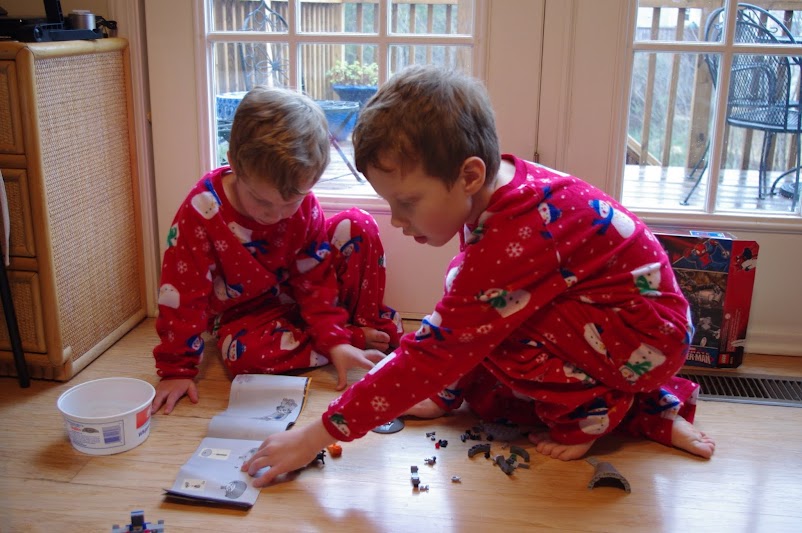
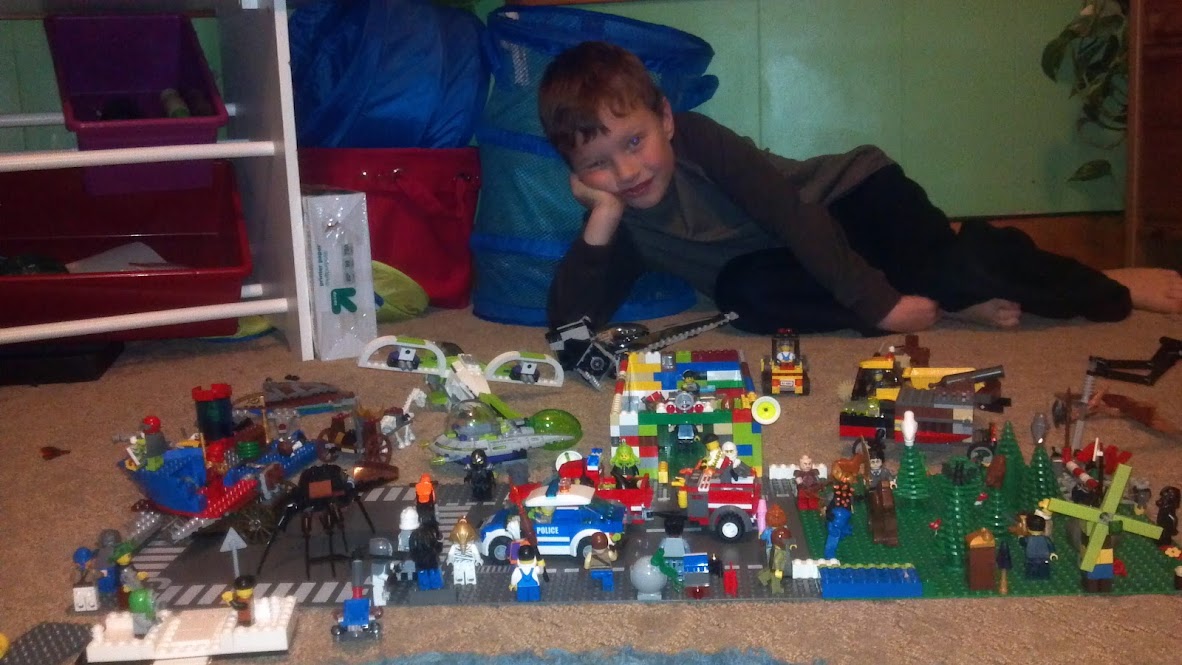
I can’t think of an obsession I would be happier with than Legos. The kids are imaginative, social, creative, totally immersed and completely happy in the throes of their Lego Play. They play together. They play by themselves. They learn the critical skill of following directions. Then they break apart the dictated shapes and use their free-form imagination to create things based on their fertile imaginations. Then they tell amazing stories to themselves using the figures, buildings, vehicles they’ve created. Does it get better than this for a kid AND a parent? (Well, except for the cleaning up.)
Collaborative Legos
5) New England Patriots
After a year where the Red Sox left me cold, I decided I was going to start liking the Patriots. I know you’re all like “You don’t just decide to like a sport!” to which I reply? Oh yeah? But I’ve caught most of the games this season (bumming about the fact I’ll miss tonight’s game!). And part of what made it was fun was catching those games on the couch with my neighbors. (See #1.)
Gronk’s failed spike was only second to Wilfork’s interception in my joy-ranking
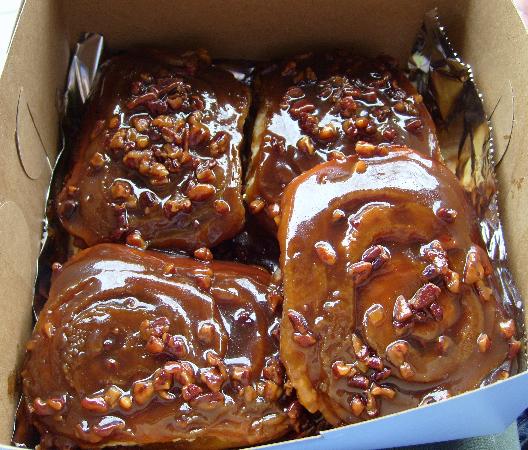
6) Flour’s Sticky Buns Flour Bakery in Boston is RIGHT across the street from my office. Usually I resist temptation. But on days when I’m having an unusually rough day, or good day, or stressful day, or, well, can find an excuse that holds water I’ll go across at 1:30 – 2 pm. That’s when the Sticky Buns are out of coming out of the oven. And I’ll get one and eat it warm with a tall glass of cold milk and bliss is mine. My colleagues have totally figured this out, and have begun bribing me with them. I’m ok with this.
Om nom nom nom
7) First grade and having a first grader
I’m loving this age for Grey. (I think I’ve said that for almost every age he’s ever gone through.) But I loved the Christmas concert, and the (easy) homework. I love the self-sufficiency. I love that his best friend is a kid I had not introduced him to, but that he picked for himself. (It helps that I like the kid, to be sure.) I love how he can do real chores that actually diminish the work I have to do, and how he can read and entertain himself, and I love hearing the thoughts and questions he has. Having a kid in school really ties you in to the community in which you live.
Grey and our neighbor on their first day of first grade
8) My New Dishwasher
It actually cleans dishes, including the dishes on the top rack. Isn’t that a phenomenal attribute in a dishwasher? I replaced three appliances this year: dishwasher, washer, dryer. And I’m delighted at the difference the dishwasher makes, I think the washer does a better job and I’m rather disappointed in the dryer. But hey, 2 for 3 isn’t so bad!
9) Vacating with my Husband
It turns out I really like my husband, and I really like spending time with him. Our trip to Ashland this summer is a source of joyful remembrance, from watching the big dipper setting over the stage at the Elizabethan to seeing the osprey’s dive as as shot rapids down the Rogue River. Adam and I are so often partners in the enterprise of family that I treasure the time we spend together being the dewy-eyed newlyweds we have so much capacity to be.
At Wellspring
10) Guitar
My intent this year was not to learn a new instrument. And if I had so picked, I likely would have selected cornetto or piano – instruments with which I have some experience. But I have had such a blast learning a completely new instrument with completely new skills. Practically none of my musical training has carried over, and I’ve gotten to start from scratch. It’s particularly lovely since none of my identity is tied up in being good at it. It is so LIBERATING to work on something when it’s ok with you that you’re terrible at it. I hadn’t realized. And better yet, I am bad enough to still hear my progress instead of my faults. I’m also starting to be able to really do things, which gives me a tremendous sense of satisfaction.
The guitar I got for my birthday
11) I really like my job
What a difference this makes, doesn’t it? I feel really well used in my current role. The people I work with value me as a person and as a contributor, and are not shy about telling me this. My job uses 100% of my brain and skills: interpersonal, technical, writing, organization, big-thinking. I have everything I need to be successful in my role: I only need to apply the skills I have and some concentration in order to do what I am asked to do. I get to do a wide variety of tasks, but I also don’t have sole responsibility. In everything, I have partners and colleagues with whom I work. My company is good about respecting the boundaries I set, but fun enough to tempt me across them every once in a while of my own volition. I get to travel just about once a quarter, which is enough to still be fun and make you feel like a Real Businessperson, but not enough to get tedious and tiring. Work sent me to London (for a week!), New York City, Atlanta, Detroit and San Francisco this year. I’m hopeful that the coming years may include opportunity to grow in my career, but so far I’m not complaining in the least about what I have going.
12) The Theater
The Globe in London
One of the great gifts of my upbringing was a love and appreciation for live performances. Since getting out on my own (and on my own resources) I have not seen nearly as much live theater as I want to. This year made a significant dent in that lack, however. I saw:
– Henry V at the Globe Theater in London (talk about a Bucket list item! This is my favorite Shakespeare play. Also, they had cornettists for the pre-music. And I had front-row, third balcony seats!)
– A concert at the Barbican including Carmina Burana, which I’d never heard before
– Patrick Ball concert
– As You Like It – at Ashland
– Henry V – at Ashland, completely opposite interpretation
– Merry Wives of Windsor, Iowa – at Ashland
– All the Way – at Ashland, the kind of play that makes you feel as though you lived through an era you certainly did not
– A Christmas Celtic Sojourn – at the Cutler Majestic
I might be missing one or two, but that’s more like it! Perhaps this year will be the year I introduce Grey to the theater and formal behavior!
So that’s a portion of my litany of joys. What were some of your favorite things in 2012? If you came up with a top 12 list, what would it include?
First, a few words about the unfolding horror in Sandy Hook Elementary. Like so many, I know about and deeply disapprove of many of other horrors: the mass rape and killing in the Congo, the drone strikes in Pakistan and Afghanistan, the ongoing scourge of inner city violence. But those all seem distant and abstract: chronic, unsolvable problems. But Sandy Hook comes very close to home.
My son is a first grader, seven years old. He was sitting in his first grade class on Friday morning with his first grade teacher and his young classmates. The kids who died were exactly like him. The same age. The same safe, suburban setting. Loving parents. Capable teachers. No enemies. The only difference between Grey and, say, Benjamin, is that Grey is still here and looking forward to Christmas. (Grey knows about the shooting, of course. His response was, “But mom, they didn’t even get to open their Christmas presents!”) There was absolutely nothing those parents or teachers could have done to prevent this from happening to their children – and there is nothing I can do to ensure it never happens to mine.
I am so, so, so sorry for the families that lost their loved ones. I hope that we can have sensible discussions about what weaponry should be available to civilians. I hope that we can improve access to mental health care, and support families raising mentally ill children more effectively. I hope we change our news coverage to de-glorify the commiters of these atrocities. I hope that this helps us work towards the safety and innocence of all children everywhere, including in war-torn Congo, “collateral damage” in our war on terror, and in our neglected communities. I can see myself in the weeping of those parents in Connecticut. I need to see myself in Syria, too.
Finally, we all are reminded that life is fragile, precious and never to be taken for granted.
So I shake myself off and make dinner. And as I’m making dinner, I contemplate my Most Successful New Years Resolution Ever. Two or three years ago – I forget now – I resolved to serve a vegetable with every meal. I also resolved to not be too picky about what the vegetable was. One brilliant piece of parenting advice I got when I was younger was that if I want my kids to eat vegetables I should not skimp on the cheesy sauce, ranch dressing, salt and butter. Trade the nutrition (and habit) for the calories. I can gradually reduce the sauces as the kids get accustomed to the taste of the veggies, but they’ll keep the habit of the vegetables for the rest of their life. I think, within reason, this is true.
And more or less every meal I’ve cooked since that resolution took effect, I’ve had a vegetable on the table. Grey now professes to like broccoli, carrots, corn, tomatoes, asparagus and brussel sprouts. He’ll eat the first four even when not asked to. Thane has been a harder sell. The kids are REQUIRED to eat one polite bite of the evening’s vegetables, and he’s slowly being overcome by repetition. And importantly, I’m eating a lot more vegetables too. When it’s right there on the table, I’ll have a serving or three.
A key to continuing this resolution has been ease. I have seasonal methods of making sure it happens:
Summer
We are part of a farm share, and during the summer my ‘fridge is full to overloaded with turnips, carrots, greens, peas, beans, squash and purslane. You start planning your meals for maximum produce consumption as you stare at the veggie crisper that ate Stoneham. Sheer abundance has required us to try veggies we’d never tried before (we’ve come to adore radishes, and discovered that brussel sprouts are excellent). It’s also dramatically reduced the cost of attempting to feed your kids veggies. I mean, produce can be expensive. Would you really buy a five or seven dollar bag of produce that you don’t think your kids will eat, especially if it only looks so/so fresh? Maybe not. But when that obscure produce is in your fridge and is going to go to waste unless you do something, you’ll prepare it and not care so much if your kids only have a bite or two – or even if none of you like it.
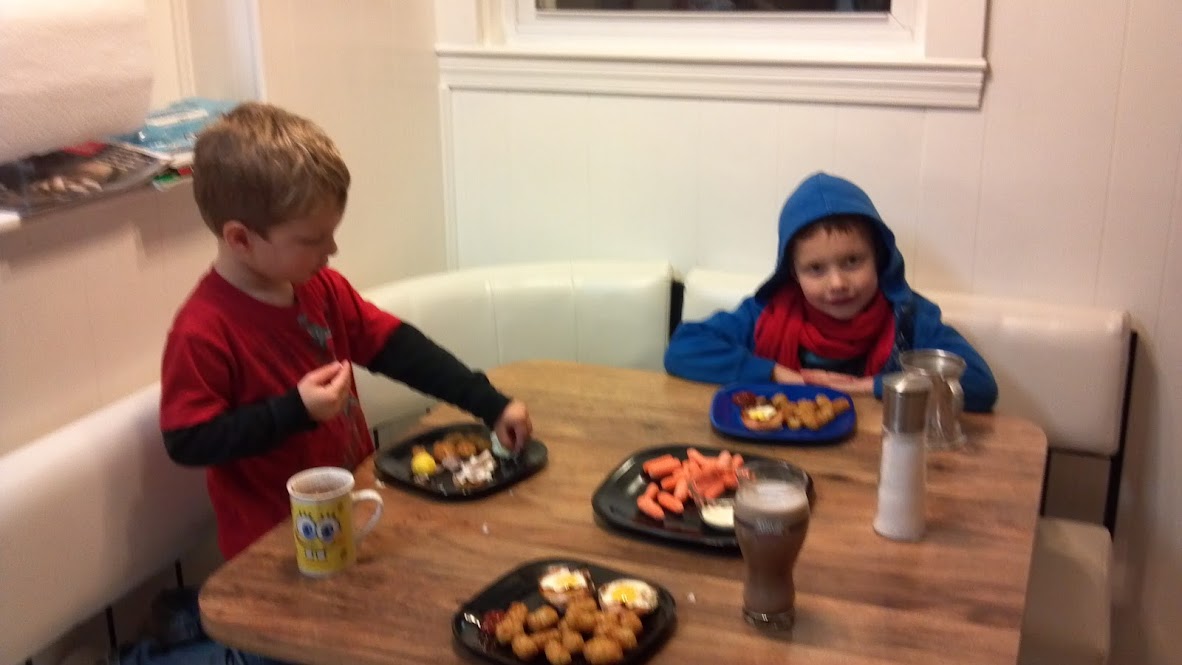
Blurry carrot eating kids. Grey picked out the veggie for this meal.
Winter
A magic bullet for veggie consumption
By the time the farm share season is over, I am _done_ being innovative. I do not want to try to think of recipes that require kale. I want something super easy. It turns out that – for once – marketers have heard my plea! There are massive selections of steam-in-bag veggies available in the supermarket. Many of these veggies are nutritionally excellent: frozen veggies and canned ones can actually be better than fresh ones in the Supermarket, because they can be less durable varieties and are packaged closer to prime. And you cannot beat the ease of use on these: buy, put in freezer, remove from freezer, nuke for 5 minutes, serve. You can get unseasoned and seasoned ones. And each bag of vegetables costs somewhere between one and two dollars: a pretty cheap slug of produce compared to fresh prices. Convenient, tasty and cheap TOTALLY works for me, and has made it pretty easy for me to keep up with my old resolutions.
So, how about you? How do you get your veggies? What prevents you from getting veggies? What’s your most successful New Year’s resolution ever?

















 My Truant Pen