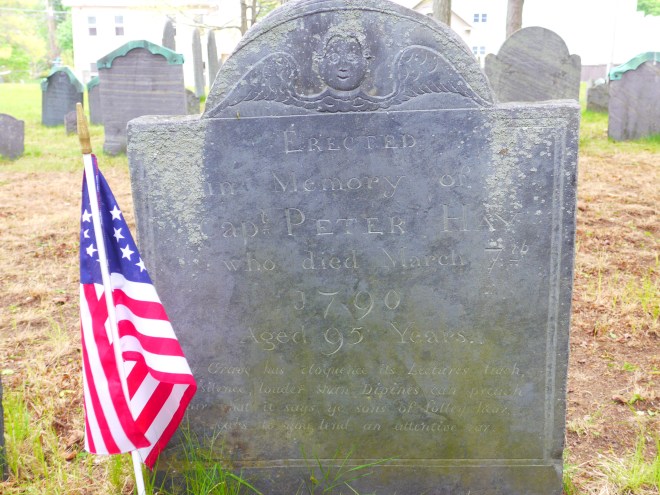
The Old Burying Ground in Stoneham was opened to visitors today. For years it’s been opened on Halloween weekend – at the exact same time as the town trick or treating. So I haven’t been able to go. But I’ve been falling in with the historical crowd lately, and they realized that we parents love history as much as our kids love candy and were awesome to set up this great second session this year.
Familiar faces
My trip to the Burying Ground this last Halloween kicked off an extremely fun month for me. I was doing Nanowrimo with a friend. I saw this amazing tombstone with its rich old story of Jacob Gould “barbarously murdered by ruffians in his own dwelling” and I looked it up on Google. Google books led me to more of the story in Silas Dean’s gossipy 1843 history of Stoneham (which is right there an argument on how awesome the internet can be!) and I went down a monthlong rabbit hole of local history and lore while I wrote a werewolf book about the strange misadventures. I had an absolute blast, although I sadly have not finished the book.
I did learn what they found when they opened the three crypts. New life goal: be there when they open one of the three crypts.
Rare to get a government tombstone for a nurse
They had three reenactors there, all of whom were excellent. One played the role of a Civil War nurse (who apparently had to be older than 30, of high moral standing, and rather plain). She told the story of how Hannah was buried in sight of the house she’d grown up with, across the alley on Oriental Avenue. And I stood there, in ground set aside at the turn of the 19th century where were buried Revolutionary War heroes, slaves, native Americans and pilgrim-folk and I thought about what it is to be at home.
He could have seen Shakespeare’s plays as a young man.
Many of the people lying there were not Stoneham born. They came from England, Wales, Africa… or as far as from Maine or Connecticut. They came to a frontier town, or a sleepy bywater. They came to a new place and built a place for themselves there. When they died they consigned their remembrances to the uneven soils of this burying ground. Hundreds of years later, we walk by twice a year to greet them. And where they were strangers to me last October, as May came I greeted them instead as friends.
Mt. Rainier
My heart has long lain in the rugged stark mountains of the West. It’s a land that feels as though history lies lightly upon it. The stories of the people who first lived there have never been told to me. The stories of my people are short – the town I grew up in is just over 100 years old. There are residents who remember the first people there. But for most of my life, I’ve been FROM Washington.
I think that may begin to be changing. I’ve lived in New England 20 years. Sixteen of those have been in Massachusetts, and eight of THOSE in Stoneham. How can I turn my back on Deacon Silas Dean, Jacob and Polly Gould, Benjamin Gerry, Elizur Wright, Parker G. Webber and the cast of folks – brave, strong, moral, funny and complicated who have also moved here from elsewhere, and made it their home? Fortunately, the question of home is not one you have to put exactly one answer to on a form. We may come from many places. But as I learn more here, meet more friends, run into more people at the store, and walk even the graveyards with familiarity, I find myself more and more at home.
I distinctly remember a moment a few years ago. I was talking with my mother-in-law about the stuff I was doing at church. (Honestly, I was probably whining about being too busy.) She sympathetically replied, “Well, tell them that they need to find someone else to do this. It’s not your problem if they can’t find someone else.”
It was at that moment that I came to the stunning conclusion that has followed me ever since. I AM “they”.
“They” have a lot of responsibility. “They” should really put a sidewalk on that busy section of road. “They” should get the word out about the local election. “They” should do something about global warming. “They” should change the sign at church to be more welcoming. I mean, if it was really important, “they” would tell us, right? We hear and say the words “They should” every single day. Maybe many times.
And when we’re kids, there are plenty of “them” to make this seem accurate. Classes are taught. Afterschool programs are organized. Special events (from Mother’s Day Tea to graduation) just seem to emerge as the normal order of things, and all we need to do is offer criticism on how “they” could have done it better. But at some point you take your own turn at being “them”. You organize an event (or help organize it). You get appointed to a committee or board (and are thrilled that people take you so seriously!). You have a responsibility at work, where something won’t happen if you don’t make it happen.
Suddenly, all that criticism of “them” takes on a whole new meaning. Don’t people know how hard you worked to make the event happen? The cooking the night before. Buying the decorations. Setting up the tables. Slaving over the serving. Cleaning up afterwards… and all people mention is that “they” should have made more coffee and “they” weren’t very organized with the presentation. Really? Knowing how much work goes into every event, I’m sometimes gobsmacked at how many events there are. It’s amazing! And so often, all that the organizers ask for is for people to come and appreciate the fruit of their hard labors.
I became one of “them” first at church. I was 22 years old when I joined the Board of Deacons. A few years later I was on the Christian Education committee, and co-lead the Youth Group. We set up the Sunday School classes, and organized youth activities. I had a more experienced partner, so the full weight of being “them” didn’t rest on my shoulders. But after Grey was born, when he became a mobile toddler, I just couldn’t lead the youth group anymore. That’s when my mother-in-law told me that “they” would need to figure it out. And that’s when I realized, I was “them”.
And most critically, it’s a great honor and opportunity. You see, my mother-in-law is Catholic. In the Catholic hierarchy, a woman like me might do critical and important work. She might make the important things happen. She might be organizing, communicating, setting up and cleaning up. But as I understand that hierarchy, the “they” who make the critical decisions and hold the final responsibility are the ordained men.
Last week, as everyone who is friends with me on Facebook knows, our town held an election for the Board of Them. I mean, the Board of Selectman. Four people competed for two roles to be the “them” that needs to put together and balance our budget, create a strategic plan for our downtown, preserve our historic locations, ensure sensible planning and comply with state regulations. In exchange for these labors – hours of work every week – we offer $3000 a year and constant complaints about how they do it. (Oh, and the campaign to get the job almost certainly costs more than $3k.) I’m astonished that people are not only willing to do this hard, thankless work of being “them”… they’re willing to compete for the job.
I am more than halfway through my allotted three-score and ten years. I sometimes feel like I’m in the heart of my powers. I have enough experience to know what I’m doing (most of the time) and enough energy and strength to do it. That’s why I’m so busy – I can do the things that need doing. When someone says, “They should”… I sometimes feel that as a personal call now. Because I know that I am “them”.
In what circumstances are you “them”? Why do you choose to do that service? Why do you think other people are willing to be “them”? That time in your life to thank “them” for all that “they” do.
In the years of the roaring 20s, Chester Finley and his sharp-eyed, capable wife Frances Finley were married. They had two young, bright sons – close in age – followed by a daughter Ruth. As young boys her brothers Russell and Richard started acting strangely. At the ages of about five and three (I think?), they stopped walking, stopped talking. They died not long after. I remember Grandma Finley showing me the pictures of them, dressed in their Sunday best, lying still in their coffins. She wept, sixty years later, for their lost beauty. What peace there might have been in that midwestern home was shattered. Frances – so strong and capable – could not bear the death of her sons and left her husband and quiet young daughter while she stayed with her parents. When I think about my grandmother, I think about this formative time. She rarely – never – talked about it. But I imagine that little girl with her patient, grieving father, and her lost brothers, and her missing mother.
I was told this story because there was a chance that the sudden lost of those two boys was a genetic flaw (four trouble free generations later, we suspect it was some sort of environmental poison they got into). Indeed, my great-grandparents never bore another child. They adopted Walter to help with the farm. Walter was mischief personified (from what I could tell) – a happy go lucky child in a serious family and it was my grandmother’s job to keep him out of trouble. Some jobs are impossible.
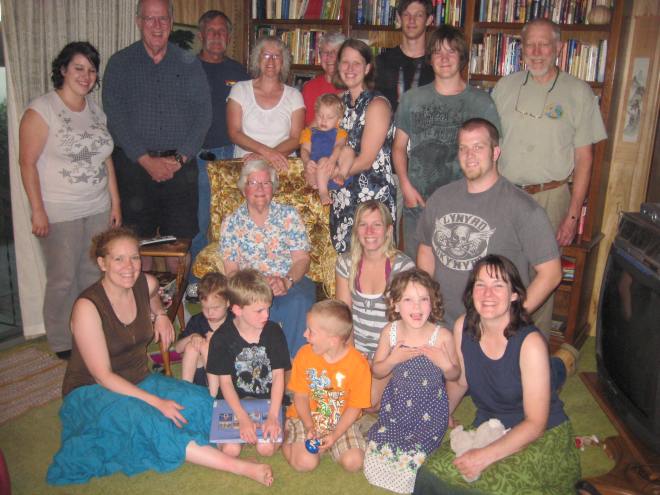
We gathered together for her 90th birthday
When the second world war put lie to the hope that the first had been the “war to end all wars”, Ruth was a young woman in a small midwestern town. The story here is shrouded, but my grandfather Virgil left for the war (he was a baker on the European front – but even the bakers saw some things that marred memories) with an understanding with one young woman. During the war, he and my grandmother (from the same small town) exchanged letters. After the war was over, the two of them got married. We have a beautiful hand-colored photo of them beneath a grape arbor, him in a dark suit and her wearing a simple white dress.
I have a story from her in a letter I cannot find (I probably put it somewhere “safe” – curse my bones!), where she talks of the post-WWII housing shortage. They lived those first year in a house that had been custom built for what she called a “midget couple” who had made their living in the circus. Grandma said she could cook dinner while sitting on the bed. I really wish I could find that letter.
In her own words… “Grandpa and I were not Christians when we were married. In our hearts we knew we would always feel unfulfilled as we were living. Then in January of 1948 our Wesleyan Church had a revival and we recommitted our lives to Jesus. Larry was born two months later – into a Godly home! We never looked back.” (April 11, 2006)
Larry Marcus was followed by Kathy Frances, who was followed by Renee. Each child was given the middle name of a grandparent, until they got to Renee. My grandmother could not stomach “Blanche” as a young girl’s name, even in the middle! (The result being that I don’t know Renee’s middle name! Edited: My mom says it is Evelyn, which was Blanche’s middle name!)
In 1954, the whole extended family moved to California in “Grapes of Wrath” type moment. (Well, everyone but Walter as far as I can tell.) They lived in a little house in Turlock California, with a big family and big garden. Brian Chester – the last of the children – joined them. My grandfather worked at an asphalt/construction company in accounting, and in 1963 my grandmother went to work, first at Farmer’s Insurance and then in the Merced Schools library.
At my parent’s home
My grandmother described the home in Turlock, “Your Grandpa and I loved fixing the house on Locust Lane in Turlock (My mom says the house in Turlock was actually on Mitchell St, but we may need a family conference to get this all right). Grandpa hired a carpenter to put in metal liners in two deep drawers. One drawer held 25 lbs of flour, the smaller one, 10 lbs of sugar. He put lazy susans in the corner. Grandpa bought a big electric stove – the oven held 6 loaves of bread. Oh, did I bake in those days. We had an acre of land with lovely walnut trees and two apricot trees. My folks, the Finleys, lived in a trailer next door. Grandpa Finley irrigated the whole acre as it was needed. What a wonderful place for the children.”
The young family years are filled with tales of camping trips to Yosemite, grape arbors, camping cookies and gardens. My grandparents were, from that revival in 1948 until their dying breaths, extremely faithful and devoted Christians, following a Nazarene theology. They supported the building of a new church, and my grandfather was the church treasurer. (He actually had an office in the church, which I remember being very impressed by.) It was a very strict practice (no movies, no rock music, no face cards, no dancing – certainly no alcohol or smoking or indecency). This made for quite a culture clash with the ’60s, when the older children were teenagers. If there was a saving grace in that conflict, from what I can understand, it is that my grandparents were willing to live by the strictures they preached. There’s an old joke that you should always invite two Nazarenes fishing with you. If you invite only one, he’ll drink all your beer. Your beer would have been more than safe with my grandparents, I think.
My grandparent’s home
Around the time I was born, they moved as a family to a trailer park just off the freeway in Merced – my grandparents and their parents in trailers in the same park. My grandmother describes meeting me, “For some reason, I often think of you the very first time I saw you – at 6 months of age – at the airport. I as holding you while your mother and Grandpa collected luggage. Several people came up to us and commented on how pretty you were. You had such a dear perky way about you!”
We lived with my grandparents for a year, after we came back from Zaire. I turned four in their home, and remember it well. It gave me a familiarity with my grandparents I was lucky to have. I remember sitting for lunch at the long dining table, with the cold cuts and breads beautifully presented. Dessert was often sliced nectarines, or cottage cheese and jam mixed together.
My grandmother was very interested in people, and in their stories. Her letters to me are full of updates about the family, her neighbors, and friends of friends. (I always tried to write really newsy letters back so her letters to OTHER people could be about me.) She was very a very good cook, and preserved food. I remember an abandoned apple tree in a neighbor’s yard. She spent hours and hours laboring over a hot stove turning bushels of apples into applesauce.
BLTs for lunch – I remember this from my childhood!
She lived a life tending to others. I remember her as a caretaker to her mother, her mother-in-law, her great-aunt, her husband. When they left, she tended to the only-slightly-older folks around her.
When your grandmother dies, even at age 93, people often express their sympathy. I have often replied that in her death, my grandmother realizes one of her fondest hopes. One of her last letters to me, written in a hand turned shaky and short by neuropathy, ended with this joyful anticipation “I often think of heaven. It seems so close, so real. I often think of the loved ones who are already there. So if I don’t see you all again, let’s make a promise to meet in Heaven. Eternal joy! No more separation or pain! Bliss! I like that word. Much love, Grandma Jones”
—————————————-
I have created a shared album of pictures of grandma here. I’m pretty sure I’ve got some details that are missing – I’d love to hear the family stories!
As any economist could tell you, there are a lot of ways to measure wealth. There’s your net worth (the value of the things you own compared to the amount of money you owe). There’s your current earnings. There are your projected earnings. (That’s probably a better way of evaluating someone graduating with with a law degree, for example, than net worth is.) I’m sure there are a bajillion other ways: months without income until bankruptcy, ability to survive layoff, projected age to retirement, etc.
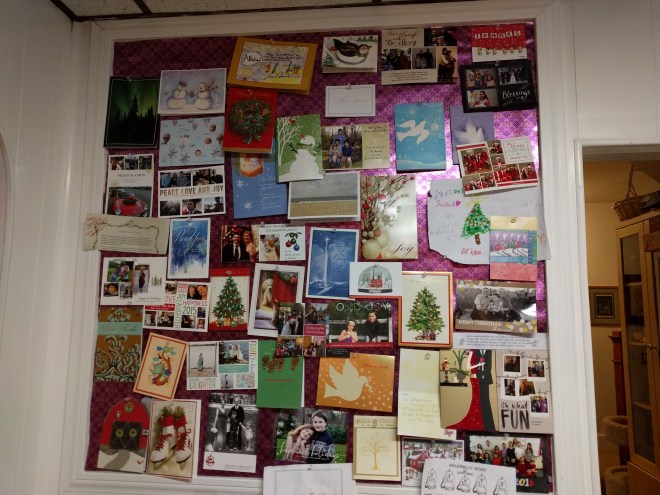
Another form of wealth
As the holidays draw to a close (even if you wait until epiphany, or count orthodox Christmas), I often find myself reflecting on my wall o’ friendship, and procrastinating from taking it down. I’ve noticed the cards seem to come later every year (I’m part of that trend – I think I mailed my last set on the 23rd!), and I get more New Years cards than I used to, but I love looking at them. Sometimes I take them down and read the notes inside them again. Every year I bundle them in a big bundle and save them. They’re in stacks in my attic, right next to the snapshots of my kids and school pictures.
The truth is that, quite unexpectedly, I find myself rich in friendships. I didn’t anticipate that, as a young girl. We moved a lot. I attended 6 schools by 6th grade. (I did that math when I was very young – I think I count church kindergarten in there.) I didn’t exactly have boatloads of friends waiting for my call. My best friend when I was Grey’s age wouldn’t acknowledge me at school. I, um, didn’t blame her. I wasn’t sure I’d admit to being friends with me either, if I was popular. I wasn’t a very easy kid to be friends with, I suspect. I reveled in being weird. It made me sad, sometimes, but there were books. My memories of childhood are mostly happy ones.
But then I stayed in one place for a while, and gradually learned how to not be quite so weird that people wouldn’t want to admit knowing me. (Or rather, how to keep the weirdness but lose the obnoxiousness of it? Maybe?) Then after learning how to be a friend, I got a fresh start. Man, college was the best.
The moon is hatching, and we’re earth’s last best hope.
And since I left college I’ve… accumulated friends. We’re still playing weekly (well, kind of weekly) role playing games with a friend whose name was picked off a bulletin board in a gaming store. (The gaming group has survived four children, and we’re delighted that a fifth has joined us. All boys.) I’ve made some relationships in church that are about ready to drive. The process accelerated vastly when I moved to this house, and there were a bunch of us the same age with kids the same age and we really got along. And then one of your friends introduces you to their friends. It’s been astonishing and wonderful.
I was thinking about what that flowering of friendship really means. Sometimes, when I’m staying out too late and consuming less-than-healthfoods with my friends, I wonder if friendship is bad for my health. But studies show that friends reduce your risk of dying prematurely, or that absence of friends increases it.
And then there are the more immediate advantages. I met a mom once or twice in a gathering of moms. In December, her husband was injured in a serious accident that killed the other driver and critically wounded one of his friends. This amazing group of moms banded together to deliver two week’s worth of dinners to her and her family.
A friendship catalyst
The funny thing about being rich in friendship is that the more of it you have, the more of it other people have too. It’s a lot like love that way. Spending it just creates more of it. The modern world seems poorly set up to create deep and lasting friendships (at least judging by the number of lonely people in the world), but the optimist in me thinks that with some sort of catalyst, friendship-creating-reactions can spread. It’s hard to see friendships (especially those tough ones that cross some boundary, like race or generation or political belief) as anything but a net good to society.
So, do you want more friends? Here are some of the ways I’ve seen people become close friends:
Strike up a conversation in a park. (Seriously.)
Invite someone you like to dinner. Give them a specific set of three different days, and ask if they need any accommodation (food preference, only drive during the day etc.) If they’re interested in being friends, they’ll either accept one of the three days or counter with a different date. (And don’t be too offended if they’re not willing to get closer. Sometimes people don’t have the energy to spend on new friendships.)
Throw a party and mix multiple different “sets” of your friends. One of my bestest friends became my friend because another friend begged an additional invite to a party I held. And this also helps your friends make more friends, which is a kindness.
Put your name on a gaming store wall as adventurer seeking game!
Bring your neighbors cookies. Knock on the door. When they’re on their front porch, strike up a conversation.
Throw a block party.
Get involved in a local project. (I made some great friends by being active regarding the Bikeway!)
Join a workout group. (OK, this one is just theoretical. I’m not a workout group kinda girl.)
Order more Christmas cards, and send them to people you wish you knew better.
Exchange contact information with those parents you end up chatting with when you pick your kids up. Then schedule something with them.
The internet. I made some dear, dear friends online. I still feel much more connected to people on Facebook than one might think!
How about you? What are some of the crazy ways you’ve met people? Are you overwhelmed by an over-full social docket, or is there room for a few more busy Friday nights?
I read an article in that beautiful late-December period when the media writes thoughtful, long-form articles about things that aren’t breaking news. The article described hygge. The word is a Danish one, pronounced “hoo-geh” (according to my Danish friend) and it means well-being, or maybe coziness. It’s a concept or value that the Danes consider a key part of their culture. In reading through what it means, I realized that it is both a value that I treasure and a place where I fall far short.
Cozy time by the Christmas tree
What is hygge to me? We don’t have a fireplace, which is tragic. Fireplaces are practically automatic hygge. Hygge is sitting on the couches and reading books together on library/pizza night. Hygge is a lit Christmas tree. Hygge is sitting on the front porch and working on my book. Hygge is hanging around someone’s kitchen with my neighbor-friends and catching each other up on our lives. Hygge is sitting with my son at Kushala Sip. Hygge is lighting the candles on either side as we sing “Silent Night” together on Christmas Eve. Hygge is when you can’t move because you have a cat on your lap. Hygge is when you’re in the kitchen, light on your feet, making food to feed your friends. I think that any time that is improved by lighting a candle is hyggeligt (rough translation: hygge-time!).
While I was working on my novel (update: still in progress, added a few thousand words this holiday), my beloved husband expressed that he missed spending time with me. Specifically – although he didn’t use this word – he missed the cozy time we might spend together watching a show or playing a game. I found writing to be a solitary, consuming task and my partner in life missed me when I was being solitary. He missed being hygge together.
There are of course precious moments in life that aren’t hygge. This weekend we went for a glorious hike along the turgid banks of the Saugus river, finding signs of beaver in the glazed snow. It as astonishingly lovely and refreshing… but not hygge. There are great adventures we pursue. I find, as I prepare to return to work, that the appeal of a difficult task to be well done with hard work is considerable. I like to work hard on things where my hard work leads to a great thing. That’s great – but not hygge. Most of camping is not hygge, but there’s that moment sitting around the fire when the entire world is about 10 feet in the radius of flickering orange tongues of flame, and the call of the loon wafting over the right shoulder that captures the very heart of the feeling.
Fire’s burning – gather round
In thinking about this, I’ve come to the conclusion that many of my most precious moments are these moments. They’re when I feel connected to my loved ones, myself… and even my God. They make my heart well over with joy. And yet I’ve taken them only as they come, taking them as a gift of chance. As I grow older, I look with greater skepticism on waiting for life to shower me with bounty. I prefer to create environments where the fruits I would grow can flourish.
So… I don’t have a SMART* New Year’s Resolution this year. Instead I have an atmospheric one. I would like to create more opportunities for hyggeligt with the people I like best. That will, ideally, show itself as more reading on the couch, more sitting together to watch the snow fall, more lying in bed next to my husband and listening to the rain fall.
What do you find hygge? And what are your plans for the new year?
*Specific, Measurable, Attainable, Realistic and Timely – if you really want to change something about yourself, finding an expression of your intention that matches those criteria significantly increases your odds of being successful.
The other night, I tucked a tired Grey into bed. It’s his most philosophical time, since every nine year old knows that the best way to get your parent to linger and not shut off your lights is to start talking about your rich internal life at 8:55 pm. As I returned to his bed with the water (and before I turned on his music and summoned the cats), he softly sang to the tune of “Oh Suzanna”:
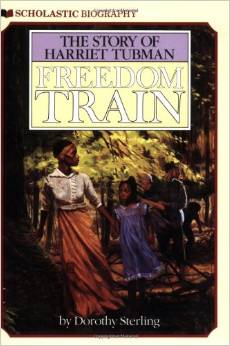
I was, shall we say, surprised. “Where did you hear that?” It being a way to extend bedtime, he freely answered. “From a book about the Underground Railroad.” “Was it about Harriet Tubman?” “Yeah.” We talked about race and equality. We talked about good people sticking up for other people against bad laws. I had that ever necessary conversation about how actually we don’t call our friends colored anymore. And after a successful ten minute delay, I kissed him goodnight.
But it brought me back. I haven’t explicitly thought about my encounter with the Underground Railroad in years. As so many important encounters do, this one started in a grade school library. I got to thinking about how the reading I did in that fourth grade corner of the library changed my life and outlook on race and gender. It helped me see a world outside the Inland Empire farming town, and to see that life from someone less blonde and blue eyed than I was. It wasn’t just Harriet Tubman who spoke to me, but a whole range of these strong, amazing, not-white female characters in this great set of books. I hadn’t intentionally set out to read minority feminist adventures. But I did. And I was – and am – greatly influenced. I’d never before realized what a great collection this is, or would be.
I have not read this book in over 25 years, but I remember this: Harriet had no advantages. She was black. A slave. Young. A woman. But she was gritty, determined and resourceful. This book did not sugar coat the hardship of slavery, or the dire danger of escaping. Harriet is gravely and permanently injured. But she risks snakes and dogs and slavers, overcoming so much, to escape. And then, once escaped, she goes back again and again to help others in the same journey. This is a book that inspired me by the capabilities even a young girl could have. It also helped me understand just how lucky my lot in life was. Harriet seemed very real to me, in the pages of this book. It made it clear that it wasn’t some intrinsic merit of mine that gave me a life of comfort and love, and her a life of persecution. But it did tell the horrible story of slavery in a way that didn’t condemn a white person to shame. I could choose to see myself in the helpers & conductors – the allies. I think I’d like to re-read it.
I’ve always had a fondness for survivalist stories. I devoured almost all of them in the genre I could find: Swiss Family Robinson, Robinson Crusoe, The Mysterious Island, My Side of the Mountains…. This is a slim but compelling volume in that larger lexicon. It was particularly important that instead of “White person trapped in savage environment” (See…. all the others above except My Side of the Mountain) it was the story of an Indian girl. And she was not left for a few weeks, or a few months. She created a whole life for herself, by herself. It’s a heart-song to independence and self-reliance.
A friend and I were talking about how you introduce your children to the horrors of man’s inhumanity against man. You can’t responsibly raise children who have never heard of the holocaust… but it can be tempting. I’m not sure I want my children to understand how evil we truly can be. This book was introduction. It’s an escape story from the point of view of a young Jewish girl who fights with her family (and alone) to escape from Nazi Germany – with her violin intact. It touches on the hard edges of the horrors, without delving into them. There’s a narrow shave, but a happy ending.
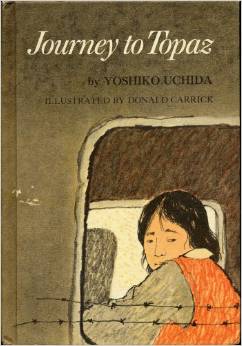
In counterpoint to that was this book. Of all of them, this might have been the hardest to deal with. It was geographically very close to me. And WWII is described as such a morally clear war from the US perspective. It would have been easy for me to get through childhood not knowing about the Japanese children uprooted from their homes and sent to internment camps in the US. Yoshiko Uchida’s descriptions were memorably evocative. I can still almost feel the grit and dirt in the barren and beautiless camps. Her life had started very similar to mine, and then had taken this left turn through no fault of her own. It hit very close to home.
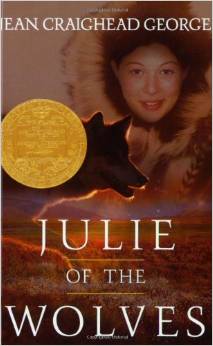
Leaving the WWII theme and returning to “awesome girls surviving in inhospitable circumstances”, we head up to Alaska for an Eskimo adventure. I don’t remember thinking about how appalling it is for a child to be literally safer with a pack of wolves in the arctic than with her family. I do remember how cool I thought it was to make friends with a pack of wolves. I believe I was cheering for her never to return to civilization. This one was again on the more mature side of the spectrum.
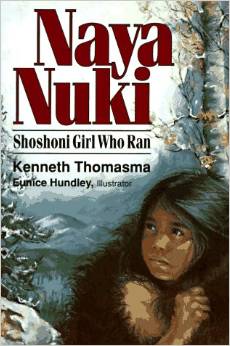
This is the book that started my obsession. Ken Thomasma came as an author to speak at my school when I was in second grade. We got a number of signed books from him in my grade school library. I read Naya Nuki over and over and over. I remember driving and looking for the places in the hills where Naya Nuki would hide out. The story is of a Shoshone girl captured by Nez Pierce slavers – who escaped and ran her way back over hundreds of miles and through countless dangers to be with her people. (Although she had to leave behind her friend – a much less important character named Sacajawea.) The countryside was my countryside. I mean, I had seen and touched the man who wrote the book! This was real! And it was a fantastic start to a reading life.
That was hardly all I read as a kid, of course. I had plenty of other books in the reread queue that were not about amazing non-white girls. But I’m in retrospect impressed with that list. I find myself wondering if some forward thinking youth librarian pulled these books out, made them attractive, brought them to my attention. I do not know. I kind of hope so.
Dear Librarian from Whitstran Elementary back in the ’80s – thank you.
On Monday, there was a package on my doorstep. It was a box and it was (astonishingly) NOT from Amazon. (The Fedex driver must have been mightily confused by that!) It was from my beloved sister. I knew it was coming. I had an inkling of what was in it, and opened the box with the expectation of seeing an old friend.
Our wedding quilt
This quilt is just about fifteen years old. It was my sister’s first quilt, and is made with my favorite colors. The white around the edge is done with the silhouette of Mt. Rainier. In the corner, the dates and our initials are embroidered – the last time my initials would be BJJ instead of BJF. (Which, side note… changing your initials might be harder than changing your name!) The reason it was sent back to me is because quilt backs are not as durable as quilt fronts and sometimes when it spends a decade on your bed it can get torn. Maybe. (Maybe this is kind of a regular thing with all our quilts. Maybe.)
BJJ & ARF August 5, 2000
There was also Thane’s baby blanket. He was old enough to vote on his colors. (Grey’s was ready for his arrival, and was themed with dragonflies. He was also lucky enough to get dragonfly curtains which still hang sparkling in his room.) He opted for the Pigeon theme. PIGEON! He was – is – absolutely entranced by it. In this cold winter, where bundling up in blankets against drafts and chills is a necessary comfort, he has been delighted to wrap himself up in Pigeon. (I have dreams, you know!)
Don’t let the pigeon hog the heat vent
Grey dug out his quilt from his room and demanded we all cuddle up on the couch in our Aunt Heidi quilts. Well, if you insist Grey! (I’m not cuddled up because I was photographing the situation, obviously.)
Couch snuggles
I had this idea, when I was young, that it was impossible to do anything my sister was good at. This was for the obvious reason that I might not be as good at it as she was, and this was completely unacceptable. Things this ruled out for me as a youth included: photography, poetry, cooking, fabric arts and Georgette Heyer novels. Some of these we’ve clearly swapped places on. My niece asked – looking at our senior pictures – why her mother was holding the camera instead of me. I became a half-decent cook. Poetry I love to read but never wrote. And I’m the only one of my family who hasn’t read Georgette Heyer. (I KNOW!) But fabric arts were, and have remained hers. (Well, other than a very unfortunate encounter with a bright neon-striped apron in the year of Home Ec I was forced to endure before I absconded over to shop with the boys.)
The tradition of quilting, and of giving a baby a quilt, is one my sister comes by honestly. My mother can sew well – I have a cloak of her making in the closet. But she was of the age where women were taught to sew because it had previously been practical… but where it ceased to be a survival skill for a well equipped woman. I’m sure my grandmother can sew too. But it was my great grandmother whose sewing I remember.
I don’t remember when I got my quilt. It must have been after we got back from Africa – I doubt it crossed those oceans. Perhaps it was given to me when I lived in Merced. I can’t remember life without it. My great grandmother (Grandma Finley – my mother’s mother’s mother) made all three of us crazy quilts – my brother’s being made when she was north of 84 years old.
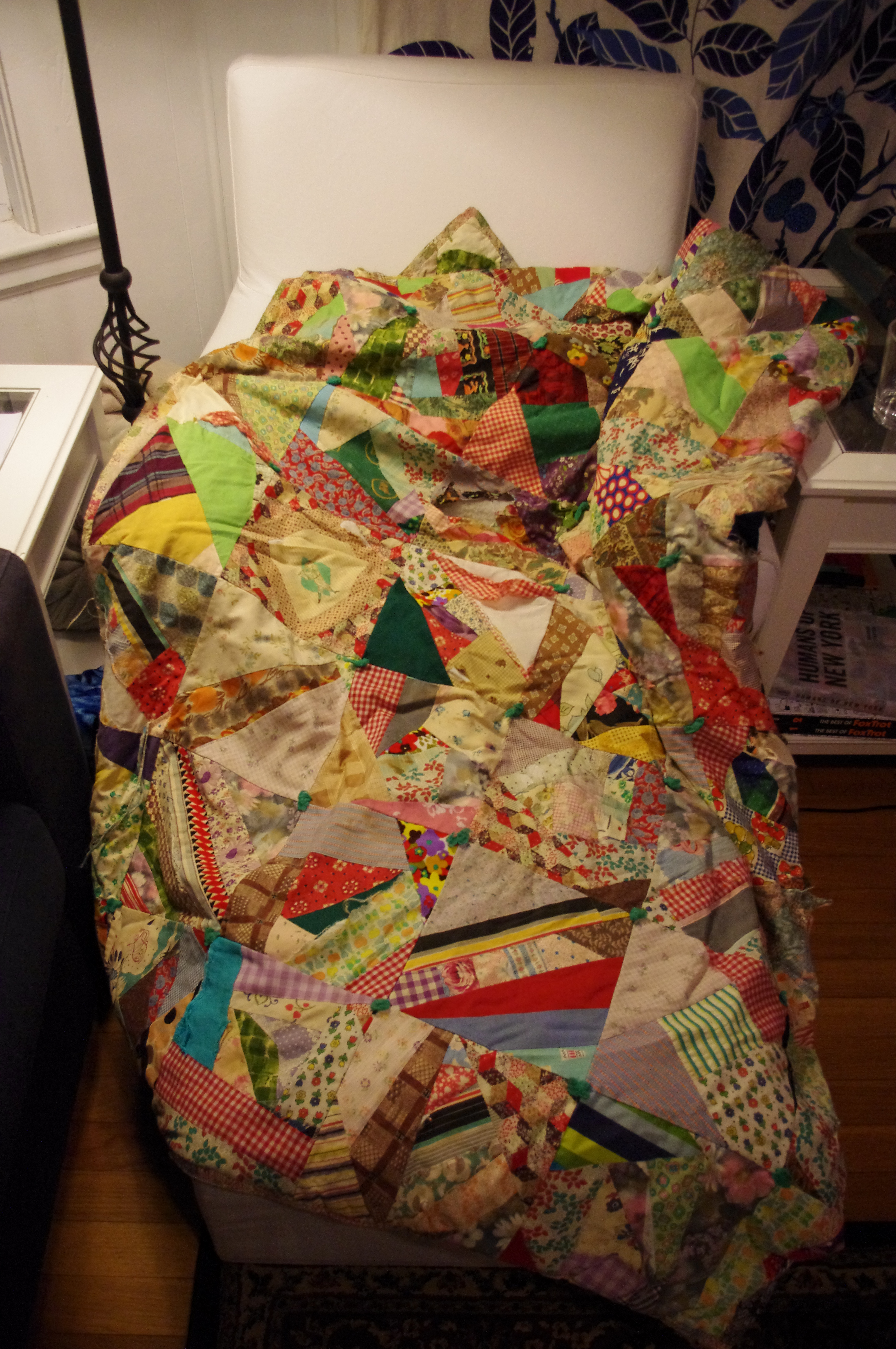
What is a crazy quilt? The most practical of all quilts. The depression quilt. Here’s mine:
My crazy quilt
My sister’s quilts are made with cotton fabric of a consistent weight. The fabrics are selected for color and pattern, and cut to create the design – then sewed back together. It’s an art form – a lovely one. But creating a quilt like that is certainly a cost. Fabric costs almost more in a fabric store than clothes do in a clothing store.
But the fabric on my crazy quilt was not purchased for its loveliness or pattern. What you see on my quilt are the dress shirts, worn out skirts, curtains, blouses, dresses, slacks and tablecloths all worn out past repair or reworking. My grandmother collected the fabric from worn out garments (and buttons – we had her button box for a long time and it was super fun to play with!) and then when a child was born she reached into that treasure trove and put together a quilt. I’m quite sure a few of those squares come from my mother’s childhood dresses. I have cuddled myself in the castoffs of my ancestors, put together to warm me by the thriftiest of them all.
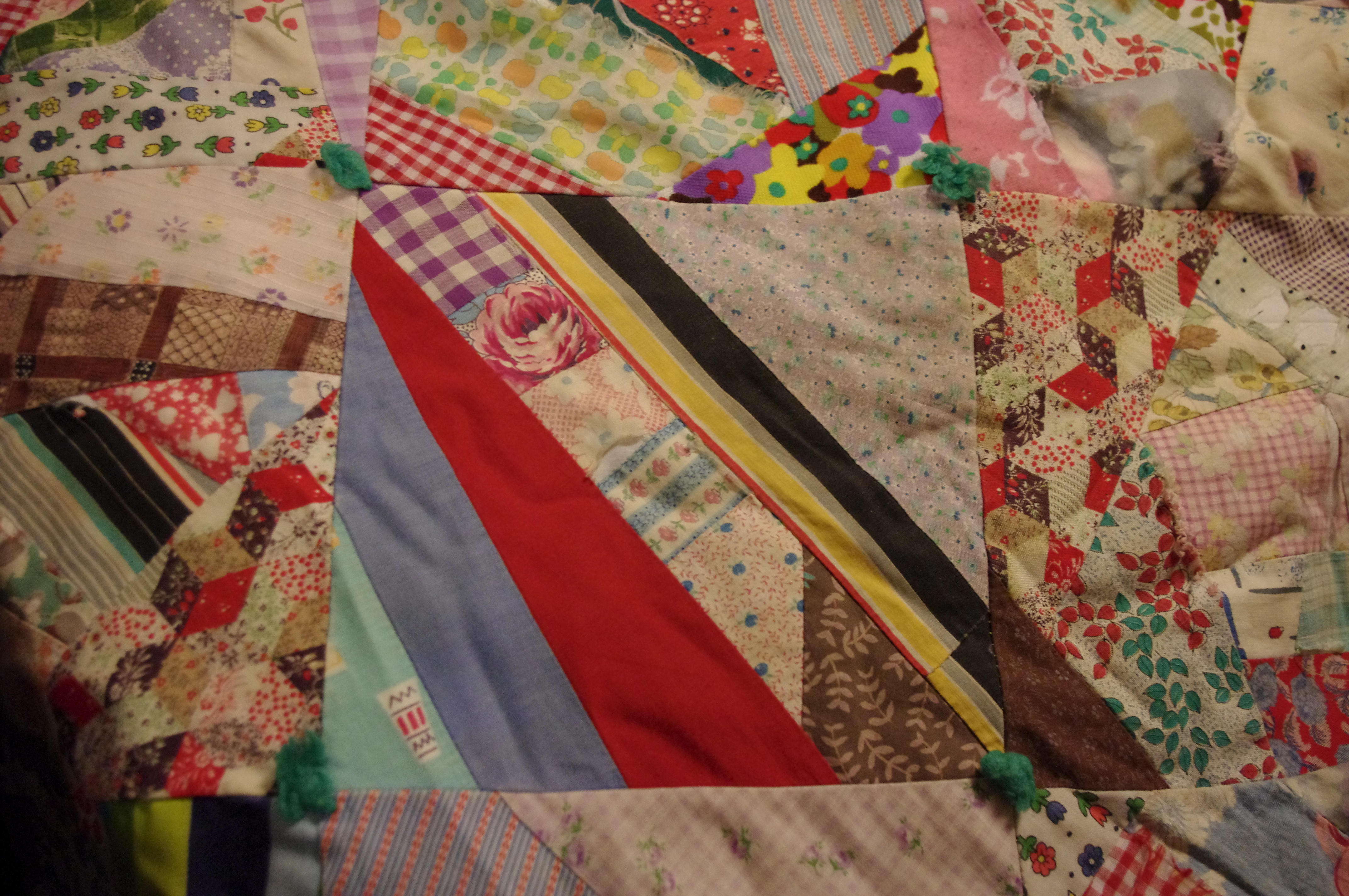
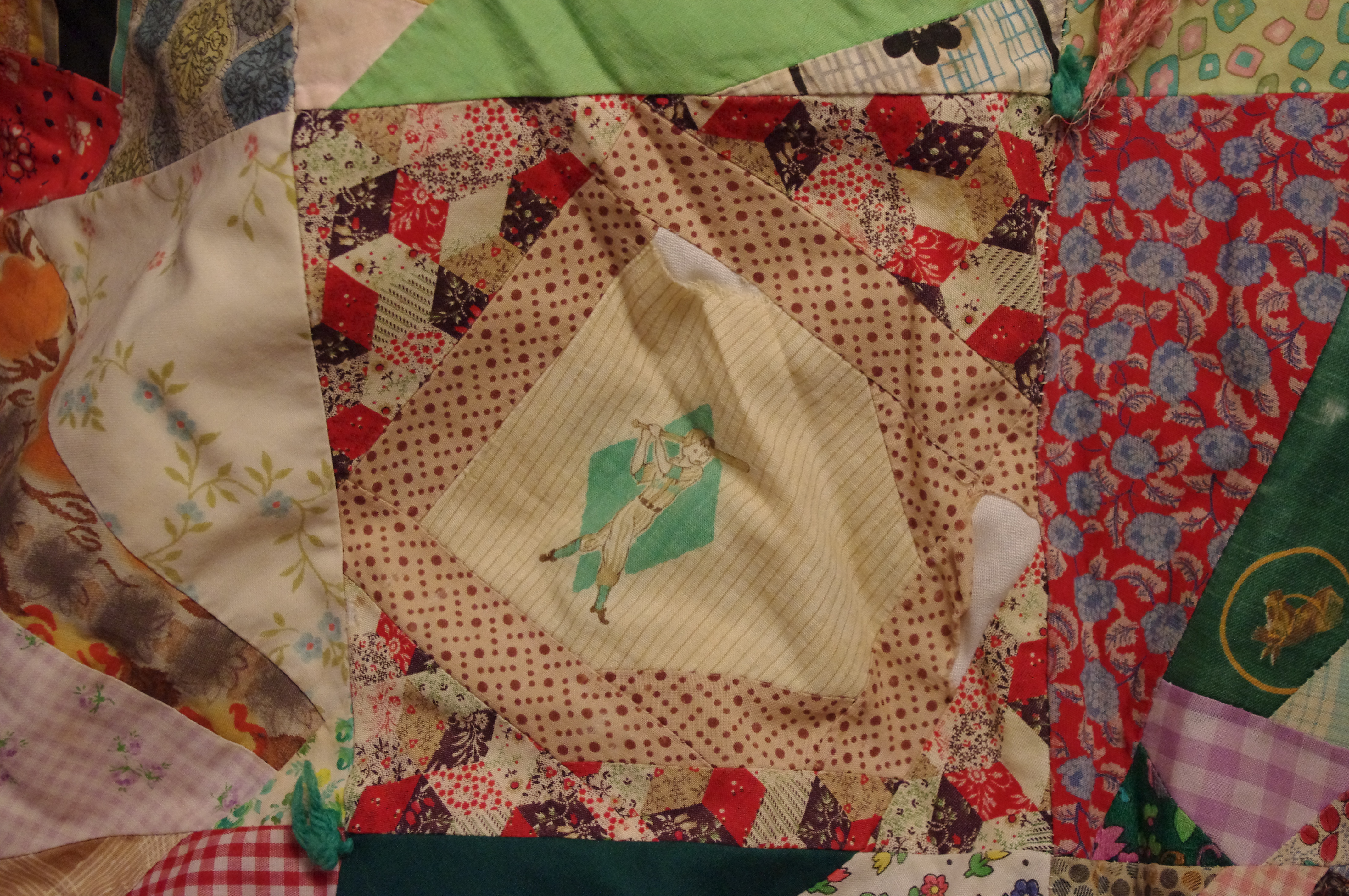
You can see how each quilt square was put together by different pieces of fabric – whatever would fit. There are no squares on my quilt made of a whole piece of fabric, although the same fabric will show up in multiple squares.
This block has no fewer than 12 different fabric pieces
Each of those tiny, tiny squares of fabric is sewn to its partners to create the block. What a labor of love. How long did she spend composing the squares – piecing them together like a puzzle? I can see the thoughtful look in her eyes – rimmed by old-fashioned golden spectacles – as she contemplated the pieces. (She had a tremendous sense of spatial reasoning. She was famous for being able to pick the perfect size tupperware for leftovers at a glance. She also cleaned our clocks regularly at Chinese Checkers. She died when I was in my late teens, so I knew her well.) And each of those seams is TINY. Not an 1/8th of an inch more fabric than was absolutely required for those seams was spent.
My favorite block
The differences in the kinds of fabric (there are thick cotton fabrics, thin gingham pieces worn almost to the woof, synthetic fabrics – all manner of clothes) mean that those unforgiving seams have pulled apart in many places – unrepairable because there isn’t enough material to bridge the gaps. The different squares were then sewed each to the other. The actual quilting portion of the quilt was incredibly simple. She sewed the filling and the back on at the edges, and then tied each quilt-square corner with a green yarn knot. I think this all meant that she could put together the entire quilt on her regular, workaday sewing machine – without any specialized machinery. Practical to the utmost.
There’s a lesson in that crazy quilt. My great grandmother was born in 1900. She was coming of age in World War I, and was a young mother when the Great Depression ravaged a generation. She watched all the young men of her daughter’s age go off to war when World War II hit. I can imagine her as a ruthlessly effective Rosie the Riveter. (She actually was a switchboard operator.) She learned – and she taught – that waste was not only morally unacceptable, but that the ability to make the best things with the least waste was a skill to be proud of. (Well, modestly proud of. She wasn’t a big fan of pride.)
My home and my life overflow with good things. I have bags of perfectly good clothes and toys I’ll summon some charity to haul away for me. I never know what to do with the spare buttons that come with my clothes – my memories of her keep me from just throwing them away, but I might as well since I never repair any clothing. But perhaps, in her memory, wrapped in two generations worth of love-wrought quilts, I could consider myself pleased with what I have that is durable, of great value, and be content.
One of my favorite nights of the year is Burns Night, hosted by my dear friends Dave and Maggie.* The hallmarks of Burns Night, in addition to the Haggis and Scotch, are poetry and song. On the best of the nights, we’ve taken turns – breathless – in the living room sharing words and music. We usually begin with actual songs and poems written by Robbie Burns. (“My Love is Like a Red, Red Rose” often gets sung more than once.) We recite his poetry. (Cally’s rendition of “Ode to a Haggis” is breathtaking.) Dave reads “Address to the Deil”.
Somewhere around an hour in, one of us gives the Toast to Robbie Burns. I was on duty a few years ago and actually read a biography of the Bard of Scotland. Since then, I’ve been on duty in case there’s some failure of speaker to arrive.
Then we start slipping into the vaguely Celtic. Adam does his priceless rendition of “Maids When You’re Young Never Wed an Old Man”. Maggie’s father lifts a mournful voice for “Kathleen Mavourneen”. There’s Shakespeare, Byron, Tennyson – by heart or from the books that lay scattered at our feet.
We slide fully into just poetry, and just song. Nick recites Kite. We belt out “Barrett’s Privateers”. Cori’s liquid voice slides through “Jock o’ Hazeldeen”. The night ends swaying, holding hands, singing “Auld Lange Syne” (all verses) while looking into the eyes and hearts of these people to whom we have grown suddenly, unaccountably close through these greatest magic-makers: poetry and song. We have all fallen in love with each other in the silence after the singing. I leave with a joyful heart, and can’t wait for the next year.
But I’ve never done it at one of my parties, for all my love and passion for it. Why not? I’ve wondered often.
During Christmas and Easter, I often stand at the front of the church as I play my trumpet. It’s a day a lot of visitors come, of course, and I can watch them as they worship with us. There’s a particular kind of visitor I haven’t quite come to understand yet. The stand with the congregation during the hymns. They often even hold the hymnal in their hands. But they remain stoically silent – jaws clenched and unmoving as the rest of us sing. I wonder: are they there against their wills? Do they think they “can’t sing”? (Do they think we can?!) Do they think that church is something you watch, instead of something you do?
Last year I toasted decked in my tam – thanks to Joe for the picture!
That is – I think – the heart of it. We have become a world of watchers. We don’t sound good enough. We aren’t skilled enough. We were told when we were little that we can’t carry a tune. Please, for heaven’s sake be quiet. We all hear the world’s best musicians and artists (remixed, studio supported) every day. How can our voice compete? It can’t. And so we shut up. And our neighbor/friend/partner/kid is also not nearly as good as what’s on the radio, so we make fun of them. We have an entire tv genre built around making fun of people for thinking they can sing. In truth, the moment Adam and I first met was over our shared defiance of this cultural norm. He was walking down the hall of our dorm singing “Money Can’t Buy Me Love”. Instead of giving him the “you’re weird” look, I picked up the chorus. (Prescient, eh?)
I love to sing, even though my voice is decidedly mediocre. I love to hear my friends sing – even if they’ll never be Brandy Clark** I love to look in their sincere and vulnerable faces as they recite a poem they learned by heart when they were fourteen. I love Nick’s sock puppet hand, Callie’s slicing of the Haggis, Dave’s delightful “deil” and Cori’s key change on “Jock o’ Hazeldeen”. On those Sundays when I couldn’t find faith in my heart, I still came to church to sing the old old songs with my friends until faith could find its way back.
Where to go from here? I wish I could call on you all to sing – in public, with your friends. But even I’m too chicken (too wise? too often shot down? too defeated?) to call my friends to song. Perhaps instead I can remind you that the joy is not in the passive listening, it is in the listening to a friend. There is something about singing together which is powerful and precious. Sing to each other, my beloved companions. Quote poems. Sing to me. And together we can fill the world with a joyful noise.
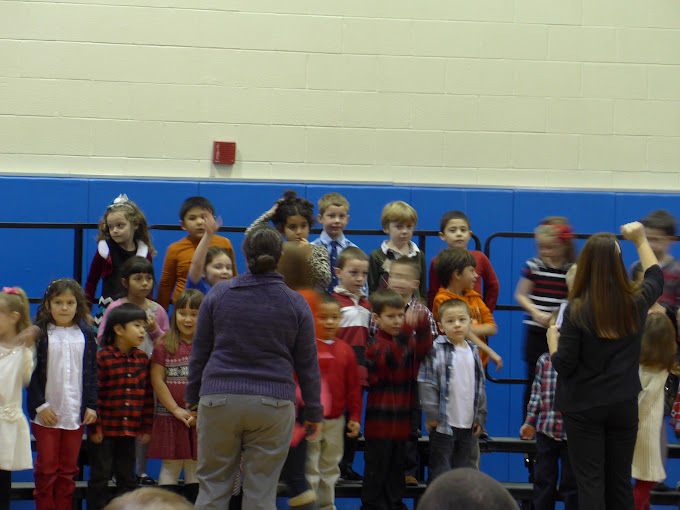
Thane (top row) singing at his school’s winter concert
* New people at Burns Night sometimes ask how I know Dave or Maggie. My favorite reply is that I married him/her. It’s true. I did.
** I don’t remember ever hearing Brandy play guitar or sing in high school. I can’t remember if she was even in choir, and I’m pretty sure she never got a solo in our high school concerts.
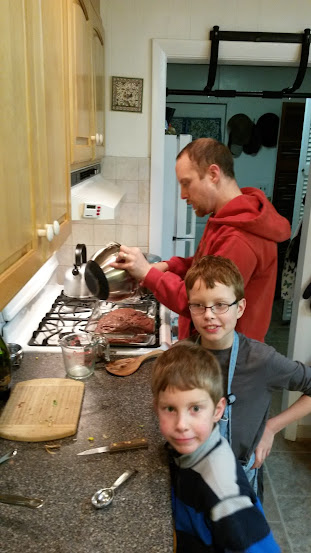
Grey made this cake from a Cook’s Illustrated recipe. At 9, he’s already a better cook than I was when I graduated from college.
So you might have heard that New England is looking at a wee bit of snow tonight. Just a trace. Hardly more than two feet, with hurricane force winds. I mean, barely hurricane force – no more than Category 1!
Tonight, the great city is quiet. The blanket of softening snow has begun to fall, but the vast dimensions of the sky have not yet opened their portals to loose the flakes upon us. In another hour, by law, we will be contained to our homes with those children who lay slumbering in guaranteed-snow-day anticipation upstairs. There is no sound of traffic outside – no airplanes flying overhead. There is the hum of the furnace and the creak of a hundred year old house settling in the cold night air. The winds are sliding past – not yet howling or moaning. The house is warm and slightly messy – scattered with Transformers, stuffed animals, cables & little boys’ socks.
The entire region on every side gives a great exhalation from the normal pace. We lay down our commutes and our schedules and our appointments. We forgo our childcare. We do not go into work. (Although – curse of the age – work we must tomorrow since our labors depend hardly at all on our physical location.) In the morning the world will be transformed into twisting snow, cutting us off from the burdens and comforts of our society and demanding that we take a few moments to think of who we are and what we are doing in this world. We will shut the doors against the icy gale, but open the curtains to see the power of the storm. Before the world resumes anew there will be shared meals, laughter, sledding, video games, board games and baked goods. Some of those moments will soak into the souls of my young sons, and become the definitions of winter, of storm, of blizzard.
Assuming the power stays on (we’ve never **knocking on wood** in the seven years we’ve been there had the power go out in any meaningful way), this storm will be for us an interregnum. A gift. (I know it won’t be that way for everyone. We are very lucky in our circumstances.) For us it will be a time set apart.
Tomorrow, I’ll probably live-blog it for you – not so much because I think you’ll be fascinating, but because our era allows us to feel most connected when we are most apt to be isolated. I’ll tell you whether it’s a lark, or getting a bit scary. We’ll ponder together the likelihood of school on Wednesday (low). We’ll be joyful and funny and snowbound together. Tonight, I feel great gratitude for the circumstances of this storm, that brings us together even more than it keeps us apart.















 My Truant Pen