Whatsover is good: Camp Wilmot 5k

https://www.campwilmot.org/donate

Finally, brothers, whatever is true, whatever is noble, whatever is right, whatever is pure, whatever is lovely, whatever is admirable–if anything is excellent or praiseworthy–think about such things. – Philippians 4:8

I don’t know if this rings true for you, but lately it seems like every topic of conversation, every news article, every new thing I’ve learned is something awful. Ranging in severity from the bad behavior of celebrities I like to the climate cataclysm already breaking over our heads (and of course, let’s not forget COVID), it feels like everything is awful and nothing is good.

My interpretation of the Barn and Farmhouse

So when I am able to find something that is truly good and really meaningful – and also beautiful – there’s hardly a greater gift that I could be given. My kids got to spend three magical weeks at Camp Wilmot again this summer. Despite screen deprivation, they love to go. They spend three weeks in nature being active and creative. They build meaningful relationships with others, and are nurtured and loved by some of the most kind and caring people I have ever met. There is silliness and smores and stars and songs. They come back inspired, and better people. Of all the influences in my children’s life, Camp Wilmot is one of the most profound and positive.

Peace Like a River at Blueberry Beach

They’re not alone. Camp Wilmot is small, but reaches over a hundred children in its ministry. Over half the children do not attend church anywhere – this Camp is what they experience of God’s love as shown by Christians. A very large percentage of the campers are also only able to attend due to the generosity of donors who set up Camperships. This camp MATTERS to these kids, these counselors, these directors – and the parents who love them. It creates loves, and hope. It is a beacon in a dark time.

Next Saturday, I’m headed to Camp Wilmot to go run in the 5k to raise funds for a campership. I would be incredibly grateful if you would be willing to support me (and this awesome ministry, and my kids who love it with their whole hearts) with a financial donation at https://www.campwilmot.org/donate . Or come join in the fun! Register and run too!

Grey leading Bible study at Camp Wilmot

Over the coming year I’ll probably be talking a lot more about Camp Wilmot. As I come out of my rest period in my life of faith, I cannot imagine a more worthwhile work than to help this camp thrive in this generation and the next. Please be patient with me if I talk about it. And if you feel inspired, like I am, please join in community. Join the 5k. Sign up for the newsletter. Adopt a cabin. (Sponsors weekends was fuuuuuuun!) Rent the site in the winter. Sponsor a kid to attend. Pay attention to this beautiful, true thing among us.

Be a sheep

My tiny, rural home county of Lewis County (approx the size of Connecticut with approx the population of Somerville MA) made the national news this week. The Governor of Washington has made masks mandatory to attempt to slow or stop the crashing wave of Coronavirus infections. In response to this legal edict, the Sheriff (you know, the hand of the law) for the county got on a bullhorn (maskless) and advised people that the choice of whether to follow the law was theirs. His exact words, repeated more than once, were “Don’t be a sheep”.

Not a shepherd

As someone who loves people in Lewis County, and worries about their safety and well being, I have a lot of thoughts about this medically, socially etc. But the thing that really struck me was how profoundly un-Christian this advice is.

You see, throughout the Bible – and especially Jesus’ words – he over and over again talks about his people as sheep. There are incredibly clear stories that came immediately to mind, putting God’s beloved in the role of sheep. The first is, of course, the parable of the Wandering Sheep (Matthew 18:10-14) “If a man owns a hundred sheep … In the same way your Father in heaven is not willing that any of these little ones should perish.”

Of course, we have Jesus as the Good Shepherd (John 10) “The one who enters by the gate is the shepherd of the sheep. … Very truly I tell you, I am the gate for the sheep. … I am the good shepherd. The good shepherd lays down his life for the sheep.”

If you’re Catholic, you should care a lot about being a sheep, because of John 21:15 when Jesus, THREE TIMES, asks Peter for one thing, “Again Jesus said, “Simon son of John, do you love me? He answered, “Yes, Lord, you know that I love you.” Jesus said, “Take care of my sheep.” This is part of the story that establishes Peter (Simon = Peter if you’re confused) as the Pope. The Pope to this day carries a stylized shepherd’s crook.

The last story comes as a warning (Matthew 25:31-46). Jesus has just explained that in the end, we will be judged on whether we have fed the hungry, given water to the thirsty, clothed the naked, welcomed the stranger and visited the prisoner. (I often wonder why religious rights folks haven’t been fighting restrictions against prison visits harder – or at all – for infringing their religious duties). But the end is an apocalyptic scene, where at the judgement day …

“All the nations will be gathered before him, and he will separate the people one from another as a shepherd separates the sheep from the goats. He will put the sheep on his right hand and the goats on his left. Then the King will say to those on his right, ‘Come you who are blessed by my Father, take your inheritance, the kingdom prepared for you since the creation of the world. … Then he will say to those on his left, “Depart from me, you who are cursed, into the eternal fire prepared for the devil and his angels.”

So take a longer thought. If you are a Christian, should you want to be a sheep? Or should you fight against being a sheep? Will you be led, and guided, by the law, medicine and the need to care for others? Or would you rather be an individualistic goat, wandering in your own free, will not caring who you harm? And if the latter – how do you square that with being a Christian?

Be a sheep. Wear a mask.

Baaaa!

The mysteries of the Holy Spirit

Then the word of the Lord came to Jonah a second time: “Go to the great city of Nineveh and proclaim to it the message I give you.” Jonah obeyed the word of the Lord and went to Nineveh.

Jonah 3:1-3

My family believes in two concepts that are not very common in our modern American parlance. The first is calling. The concept is generally that if you pay attention and are open (and obedient), you may discover a purpose divinely intended for you. You have the choice, in those circumstances, to either embrace the call and follow where it leads, or reject it and follow where you will. (Well, unless you’re Jonah. Then you’re just stuck.) The second thing is related. Christians believe that ten days after Jesus ascended into heaven, the Holy Spirit (or Holy Ghost, or paraclete, or spirit, or dove, or tongues of flame, or what you will call it) came to us and landed upon God’s people and changed them. And we believe the Spirit is with us today. It is the Spirit, in our theology, that sends us those calls we may or may not ignore.

In my family, we believe the Holy Spirit is perilous, and that calling is both real and usually profoundly inconvenient. As an example – my parents spent 4 years as missionaries in the Congo in Africa, where I was born. When they came back to the states, my mom went on a speaking circuit talking about the mission and the work. The little old ladies would swoon and tell her, with a three year old me on her hip, that she was so NOBLE. She’d always reply that if she was really noble she’d teach middle school. Well, my mom retired a few years ago from a 20+ year career as a middle school teacher. She’d often advise us children, “Never say what’d you’d do if you were noble!” Inside that joke is a belief – being open to hearing what God asks of you leads to you doing those things, even if you don’t want to. Don’t pray for God’s guidance unless you’re actually willing to take it, or like Jonah you might find yourself in Ninevah, pouting.

My own greatest calling was an anti-call. My junior year of college it occurred to me that I might have to do something for a living after college, and that reading medieval literature was not actually a job. (Even less a job when you don’t read Latin.) I had been given a grant for that summer, $3000, to do a cool internship or something. This was well before internships were the expected route for every college graduate. I’d spent the prior two summers waiting tables and working temporary jobs. I applied to a bunch of internships. I was really excited for NPR (form letter rejection), and also submitted to be a summer volunteer with the PCUSA, applying the hard work I’d done on my Spanish as a missionary. I got a call from the PCUSA asking me, “How’s your Portuguese?” and found myself headed to Mozambique, instead of to South America.

This felt like call. I had been very faithful in service of my small church community. My understanding of faith was only enriched by looking at 2000 years of how differently we’d approached the same God and scriptures. My gifts were so clearly useful to a church: I’m musical, I write well, I speak well, I’m pretty organized I care about people deeply. To me, this was clearly the beginning of a call which would likely end up with me pastoring a church. I prepped my besotted fiancee that this was a possibility. He was behind it all the way. And then I took the (at the time) world’s longest commercial flight from JFK to Johannesburg to start a summer of mission.

My friends, if you believe in call, you must believe in not-call. The complete absence of call, or clarity that this is NOT what God demands of you. Without the not-call, there can be no valid call. And never has anyone been so not-called as I was that summer. It didn’t destroy my faith (or even, I think, harm it that much?) but it was so the opposite of being invited and encouraged to pursue a career in the church that I never even looked at seminary. I focused on my half-hobby of writing web pages, and it’s been 20 years of technology since then.

It’s been a quiet few decades for call as I’ve gone from maiden to matron. The last 20 years, I’ve been a faithful and loving member of a small congregation, giving of what skills and time I have to serve God there. I’ve been a deacon, an elder on session (our governing board) for like 15 years. I taught Sunday School. I co-ran the youth group. I served on worship committee, christian education, hospitality, membership, stewardship, personnel and nominating committees. I’ve run the web presence, and restacked the web site twice. After our beloved pastor retired, I not only took on the Christmas Pageant, I also led the mission study taskforce as our interim pastor died of a brain tumor, and our pastor search after a long time in the wilderness.

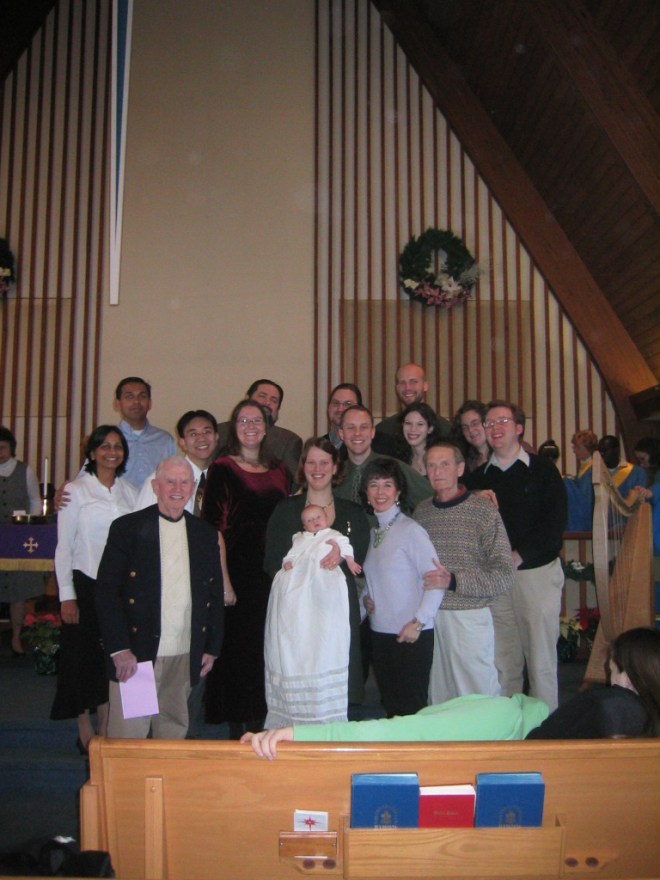
My children were baptized in the church. I’ve vowed to other children as they were baptized. My roots there are broad and deep and filled with love.

Grey’s baptism

If you’d asked me, I would have told you that my funeral would be held there.

And then I was called, by the Holy Spirit, to leave. I was, am, deeply confused. Faithfulness is part of who I am. I love my church and congregation deeply. I have sacrificed much for this group of people. I have washed dishes and windows, and watched the children grow. I have preached sermons of encouragement and vulnerability. I do not understand how or why I am called away from the people I love. Like Jonah, I fought it for a long time, not believing that I could possibly be called to do anything as stupid and drastic as breaking up with a beloved congregation. What for? Why was I not being called TO something?

Truly, I don’t know. I can’t even tell you how I know it was being called, other than it seemed to be something outside my own volition and consistent and unmistakable.

I’m not sure why. I have some theories. These last few years I poured an unsustainable amount of me into the work of the church. I knew it was a burnout rate, but I did it anyway in love. But this year, I reached the end of myself. There was no more to give, and I was incapable of resting in pews while I watched my friends overworked. There is the sense of a breaking point reached, and I reached mine. Again, it was not my faith that was destroyed. But rather, how I express my faith HAD to change or it might in fact be sacrificed on the twin altars of duty and habit.

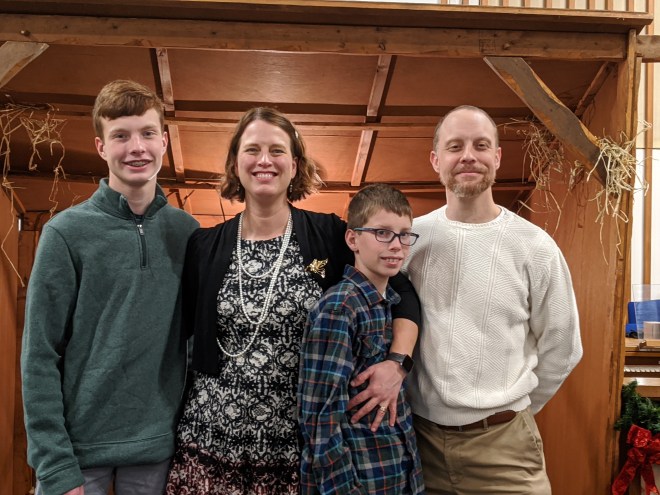
In Bethlehem

So I made a decision. I sat with it. I talked to a few people. (There are remarkably few resources on how to break up with your church with love.) I prayed. I sat some more. I spent months thinking, praying, and wondering if this could be right. And then, after Easter, I shared my decision with session. Since then, I’ve been gradually mailing my bewildered friends notes explaining myself, as best I could. On Pentecost, I hiked a mountain – a place I’ve often found close to God – instead of wearing red and singing hymns of discipleship and the Holy Spirit and tongues of flame.

I don’t know what comes next. I think that rest is a part of it. Part of God’s promise and commandment to us – both – is that we may and must rest. I will pray, and read the Bible, and sing hymns. I will climb mountains. I will visit other congregations and worship as a stranger. (Zoom is actually great for this…) And I will listen for that still small voice, and for it to call me to something, finally.

Pentecost

The darkest day

Holy Week is usually one of my favorite, most distinctive weeks of the year. I did not grow up going to Maundy Thursday or Good Friday services – I’m not sure why that wasn’t part of our faith tradition, but it wasn’t. For a generally cheerful person, I’ve always had a soft spot for candelight and minor keys. And Holy Week is full of contemplative music, hard realities and truths that you don’t really want to hear but desperately need to. In a usual Holy Week, I would have been at church Palm Sunday, Maundy Thursday & Good Friday (and probably practiced trumpet for Easter at all of them!)

This year is, of course, different. This year, there was no sitting in a darkening sanctuary listening to the 7 Last Words of Christ and watching the light in the parking lot flicker, as I have every single year for two decades. There were no Taize pleadings to Jesus to “remember me when you come into your kingdom”. The days and weeks have begun to blur together in a sameness only relieved by the gradual, gorgeous unfolding of spring.

But even in a normal Holy Week, there is always this Saturday. Today was actually bright and fair, with brisk winds and waxing sunlight, budding trees, vibrant forsythia and the burgeoning promise of a world soon to bloom. There was little dark about it, other than the day’s statistics on the number of dead mowed down by this novel virus. But today, in the liturgical calendar, is the worst day. Worse, maybe even than Good Friday. In the Easter story, today is the day after Jesus died, while his body lay unprepared in a tomb that wasn’t his. It was the day when the disciples and the women woke up – if they slept at all that night – to a world where hopes had turned to ashes. This day abounded in the bitterness of betrayal: Judas’s betrayal (another unburied body). The betrayal of all the plans. They MUST have thought on this day that Jesus could not possibly be who they hoped he was. He was dead, and the Messiah had not yet brought liberation to the people of Israel. They must have felt sick – how much of what he had taught was true and reliable? How much of their sacrifice had been worthwhile? Had they thrown their lives away on just another pretender? And … what exactly was going to happen next? Were they going to follow him to a criminal’s execution? Would anyone be left to be the son to Mary?

Of all the many dark days whose story is painted in the Bible, this Sabbath might be the very darkest. Hope was irrevocably lost. The worst had well and truly happened. The body was cold. More was likely on the way.

It feels a bit like that now, in this pandemic time. All through January and February, watching the headlines, I thought that this virus would burn itself out or be contained, just like SARs or MERs were – or stay distantly awful like Ebola. Like the apostles – or even Jesus himself in Gethsemane – I hoped that this would once again pass us by. But here we are, locked in our homes, in fear and in shock that our world can be so abruptly transfigured. Fear crawls on the back of astonishment, worrying us about how much worse this will become. Will it be my parents who die? Or me? Will I still have a job? Will this be the next great depression? Of all the people I know and love, who will die and be counted in the daily statistics tallied at 3 pm by the governor? When will I venture onto Facebook and learn that I will never again see someone? Or worse, when will that phone call come through that isn’t just a “How are you doing?”

We are in the deep darkness of the Saturday after Good Friday, friends.

But. There would be no Christianity and no Christians if the story really ended as badly as it appears to – if there were no chapters after “So they went and made the tomb secure by putting a seal on the stone and posting the guard.” There was real loss on that Saturday. Judas. Jesus as a living man. Mary never again held her son. The world was never the same again. But in this dark hour, let us remember the Easter story, that out of this darkest of days arose a new hope, so powerful as to reshape the entire world for the next 2000 years. Even death was not the end to this story, as it will not be the end to ours.

Tomorrow, when we rise to pancakes and baskets, we may feel like our cries of “He is Risen” are hollow. Like Easter itself is diminished under our collective grief and fear. But that’s just the thing about Easter, my friends. Without Good Friday and Holy Saturday, it’s just a confection – full of sugar and without sustaining substance. The power comes when we have despaired, and sat with our grief. Then we can truly become part of a world made new, in ways that we could not even imagine possible on Palm Sunday.

Were you there when they laid him in the tomb?

From the archives: What Happens When You Don’t Know?

I blogged for a long time before I switched to WordPress. I did an incomplete job of moving my writing from one platform (Livejournal) to another – partially because it was very manual. But a friend asked about my beliefs regarding the soul the other day, and I was reminded of this sermon I gave. I was surprised, checking the archives, that this one fell in the gap between platforms. Rereading it, I feel like it stands the test of time. This was originally published on 7/17/2007 after the first of two miscarriages, and before my second son was successfully brought into this world.

Job 39:1-4
Mark 4:35-41

The Book of Job is a story about people trying to understand God’s actions. In the story, the righteous man Job has horrible things happen to him for reasons he doesn’t understand. His friends spend several chapters claiming that they understand how God works, and that Job’s bad luck must be his own fault. Job complains to God, asking why he had such a tough time of it. God never answers that question for Job. Instead, God’s reply (in some of the most beautiful and poetic language that can be found anywhere in the Bible) is to talk about all the things that God understands, has done, and had witnessed that are far beyond Job’s ability to comprehend. Finally, Job accepts that while he might not understand why he was so miserable now, it was ok not to understand as long as his relationship with God was intact.

There is a lot to talk about in the story of Job. Right now I want to point out that it is possible for good people to misunderstand God’s nature, and believe the wrong thing about him.

Christianity has spent a lot of time and energy trying to decide what we believe about God’s nature. Some of the most divisive questions in the Christian church have been about that: Is Jesus both fully human and fully divine? What is the trinity? Is it three different people, or three aspects of the same person?

Belief is important. It can change how we act and what we try to do. If we believe that Jesus died and gave us grace for our sins, we act in hope and try to encourage others to do likewise, instead of falling into the inaction of despair.

But how we believe doesn’t actually change the nature of God. Job’s friends truly and sincerely believed that God was punishing Job for some sin Job had committed. God wasn’t – he had another reason. The conviction of Job’s friends didn’t change God’s nature.

Why is that important?

Sometimes I think that we’ve fallen into the habit of thinking that what we believe makes it true. This is easy to observe in a toddler, and fortunately I have one handy to watch. Grey is convinced that if he says that we are outside at the park often enough, then we actually will be outside at the park. A child can think that believing something makes it true. Adults fall into this sort of trap in much subtler ways. (Author’s note: I didn’t say, but one could argue a certain president of ours is doing this by claiming we’re winning in Iraq.) In some theological questions, where the Bible might not have much to say and there’s no way for us to test to find the answer, perhaps we can be forgiven for thinking that whatever we decide is true is actually true.

But God’s true nature doesn’t change based on what we think, and for that I am grateful.

Why?

Well, what happens when we don’t know what to think?

Most of you know I recently had a miscarriage. I’m hardly unique in this. I was stunned at how many of my sisters in these pews had gone through one or even many miscarriages. (Author’s note: I got three more miscarriage stories after this sermon.) Anyway, in the course of my recovery from this, one of the questions I was asked was whether I had any theological doubts or uncertainties that had been raised by the miscarriage.

There are certainly lots of questions to which I do not know the answer. When does a pregnancy turn into a person with a soul? Was my pregnancy even at that stage? What happens to the souls of children who are never born, if they have souls? When does a person accumulate enough actions and intentions to be judged and forgiven by God? For that matter, just what is heaven really like? On some of these issues, such as the miscarriages, the Bible is nearly silent. On others, such as what heaven is like, it is very mysterious and hard to translate to a concrete vision.

So when I look at my own experience and wonder: was there a child, and if so, what happened to them? It’s a question to which I will never have a concrete answer on this side of salvation. I don’t even know what I believe.

And that’s when I realized the beauty of the unchanging nature of God. I don’t HAVE to know what happened, in order for the right thing to have occurred. This possible child isn’t waiting in some limbo, pending me making up my mind as to what God does with early miscarriages. God has already acted, and if there was a baby with a soul, it is in God’s loving hands. I do not need understand, agree, believe, or consent for God to fulfill his covenant and relationship with this other person. I do not need to understand for the right and proper thing to have happened.

That raises another uncomfortable question, though. What if I don’t like what happened? What if it was something bad instead of something good?

I am at peace there, too, because I have faith. That’s where our other Bible story of the day comes into play. The disciples are in a tight spot, with a boat that may at any moment break apart and drown them all. Jesus is sleeping through what they fear might be his last moments alive. They wake him up. “Hey!” they say. “Don’t you care that we’re all about to die!” I imagine that they’re not saying he should do something, they’re waking him up to tell him to prepare himself for the worst. What can anyone do in the middle of the sea, in a horrible storm? I mean, there are miracles of returning sight to people with milky eyes, and then there’s commanding the very weather to act unnaturally. Doctors can return sight or it might come back on it’s own, but no one can command the weather. But Jesus does, and he comments on their lack of faith.

Well, I do have faith. I believe that God is good, and kind, and loving. If there was a soul in place, I believe that he holds my unborn child in his hands and has carried that child to a good end. I trust in that not only for this Schroedinger’s baby, who may or may not have ever existed as a person, but I also trust it for myself. I believe, in the end, that God loves us and cares for us. And so, when theology goes dark and God’s plan is unknown and unknowable, and we do not know what the right thing is to believe, then have faith friends. For we do know that God is good, and his steadfast love for us endures forever.

Me, then

Sermon: Becoming a Matthew 25 congregation

I was asked to preach the sermon in my church, Burlington Presbyterian, this past week. Since I’m way behind on the blog posts, I figured I’d give you this writing instead!

Matthew 25:31-46

31 “When the Son of Man comes in his glory, and all the angels with him, he will sit on his glorious throne. 32 All the nations will be gathered before him, and he will separate the people one from another as a shepherd separates the sheep from the goats. 33 He will put the sheep on his right and the goats on his left.

34 “Then the King will say to those on his right, ‘Come, you who are blessed by my Father; take your inheritance, the kingdom prepared for you since the creation of the world. 35 For I was hungry and you gave me something to eat, I was thirsty and you gave me something to drink, I was a stranger and you invited me in, 36 I needed clothes and you clothed me, I was sick and you looked after me, I was in prison and you came to visit me.’ 37 “Then the righteous will answer him, ‘Lord, when did we see you hungry and feed you, or thirsty and give you something to drink? 38 When did we see you a stranger and invite you in, or needing clothes and clothe you? 39 When did we see you sick or in prison and go to visit you?’ 40 “The King will reply, ‘Truly I tell you, whatever you did for one of the least of these brothers and sisters of mine, you did for me.’

41 “Then he will say to those on his left, ‘Depart from me, you who are cursed, into the eternal fire prepared for the devil and his angels. 42 For I was hungry and you gave me nothing to eat, I was thirsty and you gave me nothing to drink, 43 I was a stranger and you did not invite me in, I needed clothes and you did not clothe me, I was sick and in prison and you did not look after me.’ 44 “They also will answer, ‘Lord, when did we see you hungry or thirsty or a stranger or needing clothes or sick or in prison, and did not help you?’ 45 “He will reply, ‘Truly I tell you, whatever you did not do for one of the least of these, you did not do for me.’ 46 “Then they will go away to eternal punishment, but the righteous to eternal life.”

Be better. Do better. Be healthier. Waste less. Save more money, time, calories, trees. Just take ten minutes a day for exercise, financial planning, meditation, rinsing your recycling, stretching, dental hygiene or vigorous exercise. Call your elected representatives, write a letter, watch the debate, be informed. Cook more at home, from locally-sourced, sustainable food sources that are healthy and tasty and your whole family will eat. All your kids really need from you is your time and attention. But don’t forget that you need to do your job too – show up on time, work hard, pursue career growth, put in the extra effort. Go the extra mile. And no matter what, make sure you get enough sleep.

I don’t know about you folks, but I’m absolutely exhausted at the end of the day – or sometimes even the beginning – by the list of things I should be doing. It often seems like there’s no aspect of my life where I don’t get constant messages on how I need to improve. It’s hard to know where to focus. Is flossing more important than composting? What if I’m trying to save money, but healthy foods are more expensive? What if being an informed voter makes it hard for me to sustain my mental heath?

When Trina asked me to do the sermon today, I knew I wanted to talk about the verses of the Bible that best describe what I believe God’s people should be doing in the world. Those of you who know me have heard this Matthew 25 passage before. It’s so clear and actionable: see a person suffering and help them. When we do that, we serve God in the purest way. I imagined a sermon where I would lay out Jesus commands here and inspire us all to answer the call of the Presbyterian Church to commit to being a Matthew 25 congregation. You know, to work just a little harder. And then I remembered that you are probably just about as tired as I am.

And this from the Jesus who said, “Come to me all you who labor and are heavy laden and I will give you rest!”

I would still like for us to respond to our denominational calling to be a Matthew 25 church, but instead of asking you to do more I thought I’d take a moment to talk about what we already do. This group of faithful people you see around you has already dedicated their life, sweat and love to responding to Jesus calling, and here’s how.

I was hungry, and you gave me something to eat.
This might be the most central mission of the Burlington Presbyterian Church, from our smallest to largest moments. At coffee hour, so many Sundays, you will find food prepared for you by loving hands. Next week, we’re looking for volunteers to feed our Presbytery visitors. They love coming here because they know they’ll eat well. All of us know that on Mondays, Farmer Dave uses our playground as a distribution point for the fresh, healthy, sustainable produce he grows. You probably also know that the extras from the farm share go to the Burlington Food Pantry. But did you know that the refrigerators the food pantry uses to store that food were donated by BPC for just that purpose? Not only that, but among our members are those who have dedicated their working and volunteering lives to that pantry, to ensure that our neighbors are not only not hungry, but fed with nourishing food.

When we together stand before God, he will recognize our cooking.

I was thirsty, and you gave me something to drink.
In our world of seemingly endless, nearly free, perfectly safe tap water, this almost feels like an anachronism. But so much of the world doesn’t get to turn on a tap in the kitchen and get as much clean water as they want. You may recall a year or two ago, our Sunday School classes devoted their year to raising funds for safe and sturdy water jugs for folks who have to walk to get their water for cleaning, cooking and drinking.

We also serve the thirsty in another way. Did you know that our church is home to an Alcoholic Anonymous group? In this case, we welcome those who are thirsty for something that is harming them, and provide them instead with a chance to find living water.

When we see the cup in Jesus hand, it will hold water we have given him.

I was a stranger, and you invited me in.
Almost two years ago, I joined some of our fellow church members at a dinner in Lowell. This was a refugee welcome dinner. We brought food (always!) and then broke bread with people who were coming from terrifying situations around the world. I met a man from my country of birth, Congo, who told of the murder of his family and his panicked flight from that war-torn country, followed by long months alone in a packed and arid refugee camp before coming to this cold, strange place. I’ve kept in touch with Louis since then, and helped him in small ways. We have been growing our relationship with those groups who welcome strangers like him to this, our strange land. We are as much moved and changed by this hospitality as are the people we meet.

When we meet Jesus, we will recognize him because we welcomed him into our homes.

I was naked, and you clothed me.
I checked the bulletin this morning to see if we had started putting in the Wish Tree notifications. Every year, pajamas and underwear make their way to kids through our loving generosity.

When Jesus judges us, he will be wearing socks we have given him.

I was sick, and you looked after me.
Have you ever gotten a casserole or frozen meal when you had surgery, or were laid up? Chances are good if you’ve been here any length of time and let the deacons know you weren’t doing well, you have. I once contemplated whether I could convince the Deniers that my cold was serious enough to merit some of their beef barley soup (food again!). We have also done things like brought communion to folks who were unable to leave their homes, spent time in hospitals waiting and watching, and helped with household chores that were hard on aching joints. Many of these things are done very quietly, with great dignity. We have held blood drives, and opened our veins. Members of this church have even, on a few remarkable occasions, given of their very bodies in organ donation.

Jesus will recognize us from his sickbed.

I was in prison, and you came to visit me.
This is the hardest one for me. It is so in keeping with God’s call that just when you’re feeling good about what you’ve already done, there is one more thing that you still need to do. I have thought a lot about this – about the rules of American prisons that make it almost impossible for people to visit, about the well known dangers and risks of working with incarcerated felons, about how foreign and scary and strange this work is. I’ve also thought about how Jesus does not distinguish that these are innocent, safe people we should visit. I have some ideas on things we might do. But I’ll throw this one back to you. What do we already do? What can we do?

I hope that by the time we stand before our God, we will have served him here, too.

I believe we are, already, a church following Jesus’ calling in Matthew 25. I’m quite sure that I have missed many of our ministries that serve these purposes, and even more that don’t fit comfortably in the bounds of these commissions. I am proud and joyful to be a part of that with you. I would also invite you to go to the link in the resources section at the bottom of the bulletin, and read through what our greater church is thinking about.

In the deepest sense, however, I wanted to tell you that you are beloved, faithful, hardworking servants of God. I know that you make me proud, and I suspect you make him proud too. As the words of our first hymn say, “Well done, well done.”

Rainbows

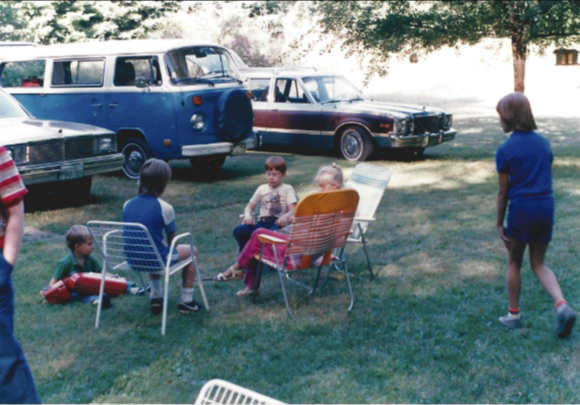
The only picture my mom could find of the car – the station wagon in the background.

The year was 1981, and my seat in the blue-with-wooden-panel station wagon was on brown plastic booster seat that would get sweaty in the sultry summer heat. There was no AC in “The Bluebird”. My parents, sister and I were just back from four years spent in the heart of Africa – Zaire – where they’d helped build a hydroelectric dam and run a regional hospital. I had never lived in the US before, and found Atlanta astonishing through the eyes of a two or three year old. The music playing on the tape deck was a “Maranatha Praise” album. And on the window where I could see it from my back seat, my parents had put a translucent sticker of a rainbow.

I loved that rainbow, and the way the light shined through it. I loved rainbows. I have always loved colors and the shifting iridescence of light. And that rainbow had a story for the tiny girl in the back seat. It was the story of Noah and the Ark. The impression Noah and the Ark has left on our culture is as a nursery decoration theme, with the boat and the animals and the rainbow. The full story is so much darker – it’s hard to believe that a cheerful nursery decoration is possible. The story is of Noah is one of the oldest recorded in human history. It lurks back in oral traditions in the millennia before humans learned to write our stories for each other.

Just a few chapters in Genesis after God created the world in seven days, he regretted it. “The LORD saw how great the wickedness of the human race had become on the earth, and that every inclination of the thoughts of the human heart was only evil all the time. The LORD regretted that he had made human beings on the earth and his heart was deeply troubled. So the LORD said, ‘I will wipe from the face of the earth the human race I have created – and with them the animals, the birds and the creatures that move along the ground – for I regret that I have made them.’ But Noah found favor in the eyes of the Lord.” (Genesis 6:5-8)

The righteousness of Noah and the mercy of God spared the human species and all life on Earth. God told Noah to build an ark and bring the animals with him. The waters covered the earth for 150 days killing every thing and every one that lived upon it. But Noah’s family and his livestock survived. And when Noah and his flock of people and animals emerged from the Ark, they righteously worshiped God and God made a promise in return. “I have set my rainbow in the clouds and it will be the sign of the covenant between me and the earth. Whenever I bring clouds over the earth and the rainbow appears in the clouds, I will remember my covenant between me and you and all living creatures of every kind. Never again will the waters become a flood to destroy all life.” (Genesis 9:13-15)

The story of the rainbow is of God hating the violence of humans and looking to destroy it – but of seeing something in us worth saving. Christians see it as a story of repentence, trust and a new start. And it’s a story of God’s promise to us (although I was always slightly freaked out as a kid at just how only one specific method of wiping out human life was removed – all the others are apparently still on the table). Historians think it might have its roots in a flood that we find in the archaeological record.

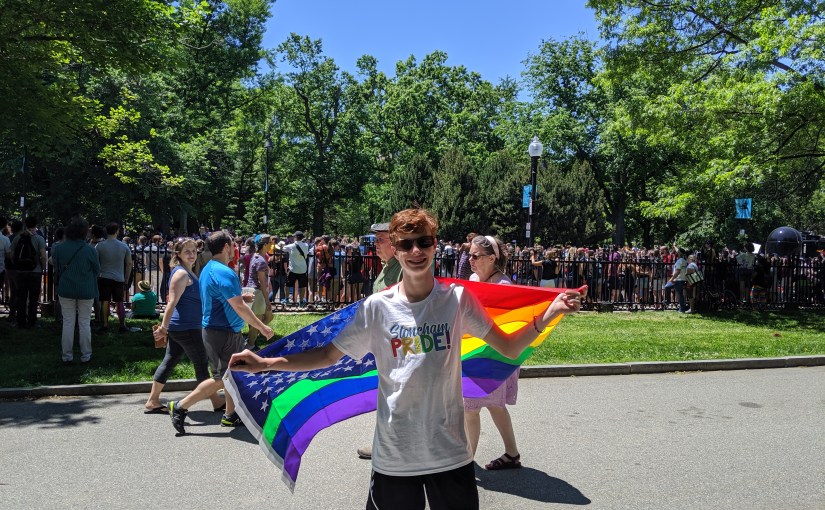
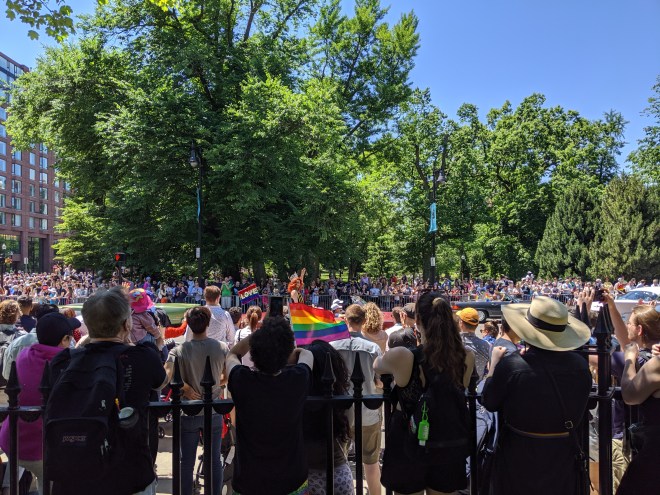
A picture of Boston Pride parade
Boston Pride parade

Today I still love rainbows. But on this June Saturday, they carry a second meaning to me. On the first truly glorious weekend of the summer, we worked our way into Boston to celebrate with many rainbow-adorned people. Once again the symbol of hope has risen in colors. I’ve never gone to a Pride parade before, mostly because I’m straight. I have been unsure what is supporting vs. where you are co-opting. But this year I have a reason to be there.

I found the absolute perfect shirt for this Pride celebration. It’s a picture of a momma bear hugging tight a rainbow baby bear. Grey walked through the common with a bracelet his friend made in pink, blue and purple – the bisexual colors.

Sporting Pride gear
Proud mom

We had an awesome time on one of the most glorious days I’ve seen in a long time. Boston Common was beautiful, and full of joyful happy people sporting signs and shirts and flag with words of love, welcome and joy. On the 50th anniversary of the Stonewall riots Boston Common was full of people openly and cheerfully celebrating. The parade was awesome, and included retirement homes, churches, school groups, banks, black & hispanic groups, costumed participants (Cos Players), political officials and aspirants and lots of short men and tall women. There was only cheering and whistling and joyful sounds to be heard. As we walked away from the tumult of the Common, my sons both told me that they were really happy we’d come. Thane asked if we could come again next year!

I’m really glad where we live in a world that remembers how to be joyful. I’m glad that the rainbow is still a sign of hope. It’s a sign that we are repenting from the violence of our past, and the harm we have done to our sisters and brothers. I looked out on that rainbow-clad crowd and had to think that on a beautiful day like this one, God must be glad that he made us, and glad he let us hang around.

My beloved bi son

NOTE: Grey read and approved this post!

Though much is taken, much abides

Though much is taken, much abides; and though
We are not now that strength which in old days
Moved earth and heaven, that which we are, we are,
One equal temper of heroic hearts,
Made weak by time and fate, but strong in will
To strive, to seek, to find, and not to yield.

Ulysses, by Alfred Lord Tennyson

I was running when my watch buzzed with a message from my brother, “Y’all seeing the fire at Notre Dame?”. At first I thought of the Fighting Irish. But the link, which I did not stop my pace to read, was from the BBC in Europe. So the other Notre Dame. I’ve been heart-sore lately.Good exercise on a day when the world was contemplating renouncing the despair of winter for the hopeful enthusiasm of spring was meant to be a brief panacea. I tried to put the fire out of mind (hoping it was minor) and focus on the daffodils.

Running through the well-kept houses and lawns of wealthy Winchester, I reminded myself how amazing our civilization is. It is so much easier to destroy than build. But there is so much more built than not. What a great weight of effort lay behind every vista. And to the pounding rhythm of my slow pace, the words came back to me: Though much is taken, much abides

I find myself greatly consoled by remembered poetry. You’d think that this would mean I spend more time reading and memorizing poetry, but humans are not so sensible. We do not always invest in the things that offer us the greatest returns. We do not avoid the things that bring us harm. But this poem is not one I’ve read. It is, instead, a poem that a friend has memorized. I remember one bright night, when we were all younger than we are now, when we went together to see a play – a musical. We all agreed that it was quite possibly the worst performance any of us had ever seen. But walking back together through the streets of Boston, through swirling mist and halogen light, he recited all of Ulysses to the city sky. I’ve likely heard him say this poem 20 times in our years of friendship. So it is unsurprising for me to hear it in his voice. My friend’s voice assures me, much abides.

When I returned from my run and saw the pictures of the flames, I thought nothing could survive. What was built over centuries and endured for longer centuries would be wiped out in the slow course of my 5k jog. I was comforted only by the memory of that poetry. “Much abides” I reminded myself. And indeed, from the implausible wall of flames much more was recovered – largely because of human planning, care and expertise – than I dared hope for. The windows remain. The bees remain. The gothic walls and buttresses were designed independent of the roof, so the one could fall while the others held. I read an amazing response (which I cannot now find) by a medievalist who long studied the cathedral at Reims. The scholar talked with great hope about how the Medieval architects had learned so much (from hard experience) about how cathedrals burned that they had built new ones to withstand conflagration. The churches were designed to burn, but yet abide. And looking at what remains in the rubble in Paris, that seems true. How clever we are, we humans, when we put our minds to resilience and preservation. How foresightful we can be, and have been. Much abides.

Today, as I write, it is Holy Saturday. Last night, I went to Good Friday services – my favorite of the year. There’s no sugar coating harsh truths on Friday night. We put ourselves in the place of the false accusers, the cowardly arresters, the sleepy and scared friends who fail at the first test. We speak of beatings and mockery and spears and nails in the flesh. We listen to a dying man make fun of another dying man. There’s no place on Good Friday for looking away or softening. I think it’s no coincidence that rarely are children present that night. (Although I was very, very glad that my youngest son joined me, for the first time. I’m not sure my children will be able to understand my faith if they never worship with me on Good Friday.) On this Friday night – and on the long Saturday that follows – we live in a reality where God himself has died and we cannot see how anything can ever be okay again. Hope is lost, and all that remains is cleaning up and moving on.

Of course, there’s always the rest of that story. I usually practice my Easter hymns on Good Friday (which feels like cheating, but practice you must!) Beyond hope, hope arrives. There is redemption for the failed and weak. There is forgiveness. Although there is also real loss – Judas is never forgiven. I sometimes wonder if he would have been, if he’d chosen repentance over despair.

As we look to rebuild Notre Dame, and the black southern churches destroyed by a hateful arsonist, I am reminded of another phrase caught in my mind lately, from Isaiah:

Your people will rebuild the ancient ruins
and will raise up the age-old foundations;
you will be called Repairer of Broken Walls,
Restorer of Streets with Dwellings.

Isaiah 58:12

As I looked for the right words to close my thoughts, my pastor posted a poem by her favorite poet, whose title caught my eye. I leave you friends, with a new poem. May it be a consolation. For much abides.

What Abides, What Returns

Camp Wilmot 5k

Running is not the optimal form of exercise for me. My left knee with its largely excised menisci probably shouldn’t have to endure the pounding of my not-inconsiderable frame. Running isn’t really optimal for weight loss. I should have a more varied workout regime to be fitter and healthier.

But about three years ago I figured out that this was a classic case of “the perfect is the enemy of the good” and laced up some shoes and went for a jog. I haven’t really stopped since, although I also haven’t improved. I’m slow – my “record times” are like 10:30/mile and my longest run is just over 4 miles. Still, I’m out there once or twice a week!

So when I heard that Camp Wilmot, scene of my children’s happiest memories and moral development, was doing a fundraising 5k to raise scholarship funds to be able to welcome more kids, I was mightily tempted. But then I looked at the date. September 22nd. On September 23rd, it will somehow be 40 years since my mother did all the hard work of introducing me into the world. My 40th birthday. The big Four Oh. And my husband had put a block on my calendar for the weekend, so it was right out. Couldn’t be done. Even though there was going to be a campfire and ceilidh and overnight and breakfast in the morning. In possible the most beautiful New England fall week of the year. Not possible.

Then the begging started. PLEEEEEEZE MOM! LET US GO BACK TO CAMP WILMOT.

So I asked my husband *exactly* when I needed to be back in Stoneham and the answer was: as soon as you’ve finished running the 5K. SCORE!!!! We’re headed to Wilmot, boys!

I don’t want for many things in this world (although any implication that I’ve bought every single one of the shiny iridescent school supplies I’ve encountered this year is true). But I really really DO want more children to have opportunities like Camp Wilmot. I have first hand experience seeing that it changes the life of the children who attend it. My kids come back thoughtful, kinder, centered, with a sense of belong and purpose. I know other kids hang on to it as a loving lifeline in a hard world. And I know that for a lot of kids, scholarships are the only way that lifeline is available.

So, if you are feeling like you are desperate to give me a gift for my 40th (or just interested in making a difference in kids’ lives), please consider a contribution in any size to Camp Wilmot. And if you’re starting to think that a sleepover, cookout, ceilidh & brisk autumn run or walk sound pretty tempting, it’s certainly not too late to sign up!

The prophet John Muir

“I must drift about these love-monument mountains, glad to be a servant of servants in so holy a wilderness.” John Muir – “My First Summer in the Sierra”

My friends, I’ve fallen head-over-heels in love. This is the literary equivalent of texting your bestie from the bathroom at a date to tell her that you have found *the one*. I can’t believe I’ve gone this long without really getting to know this man who is so very perfect for me.

My heart-throb

In a desultory fashion, I saw his book when I was up at Mt. Rainier buying All The Mt. Rainier Things. And I now own no fewer than two t-shirts that say “The mountains are calling and I must go” citing him and Rainier in the same breath. So before I headed off backpacking with my son I downloaded his “Nature Writings” – which start with his autobiography. His life starts out both hard and common. He speaks of the beatings, the fighting, the memorization that mark his childhood. To modern ears it sounds beyond brutal and brutalizing. In his teenage years, his father abandons him down a well for the better part of a day for days on end (where he nearly dies), and his growth is stunted by the heavy constant labors of plowing and toiling in fields. But somehow he wakes up hours early every day and invents (without the internet, or even many books) devices whose purpose I can’t even understand, never mind whose workings.

Somehow, from that drudgery and brutality, is born an open-hearted poet.

This man speaks to me in a way I thought only Tolkien could. He is a co-religionist in every sense. Like me, he was a Presbyterian, although raised in a much more stern and unforgiving religious environment. But he seems to find God in the same places I do – in the mountains and streams and forests. His love of nature is a worshipful reflection of a God whom he never seems to be able to see as nearly as cold and unkind and punishing as his father apparently did. While is story of his youth makes you want to pity him, you can’t. Because through the 16 hour days, the frozen feet, the stunted growth he’s always noticing the beauty and the loveliness of the world and people around him.

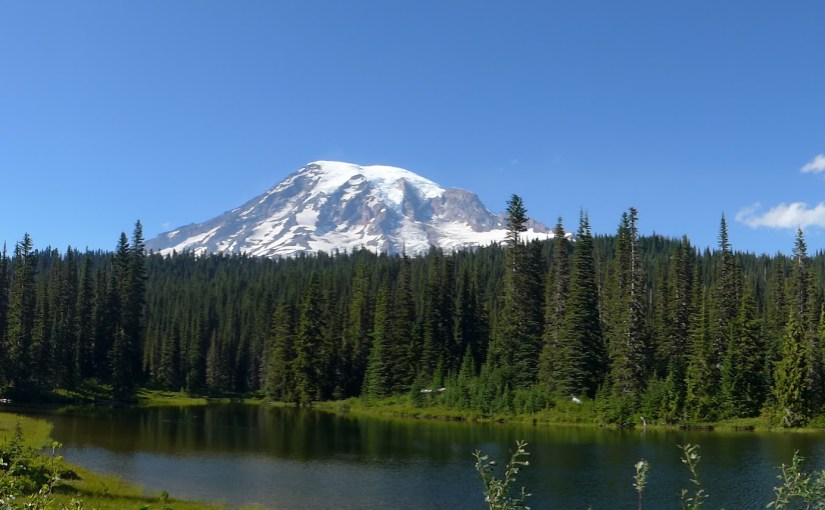
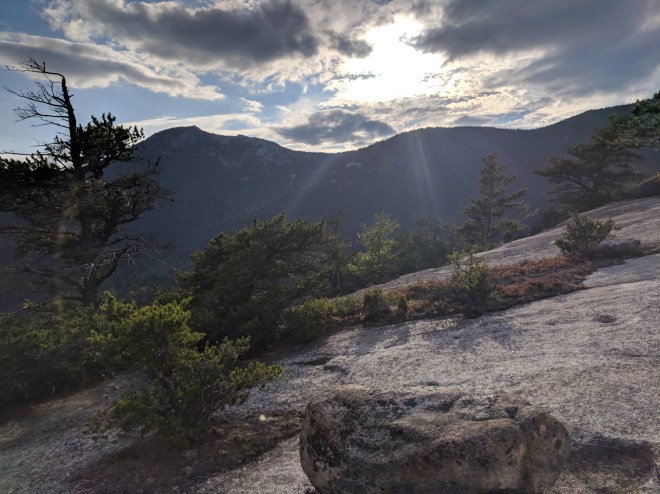
Me and the mountain that most often picks up the phone to call me

I’ve just started on his “My First Summer in the Sierra” and oh! How he speaks of the mountains! It’s like hearing someone praise your own beloved, but in words better than you could find. It’s like hearing a prophet speak of your faith, or finding a poet whose words express your heart’s great secrets. I thought that in reading Muir I’d have to put on my “reading 19th century white dude” filter (well-honed to note and then pass by mysogyny, colonialism, racism, and a belief that not only were the spoils of the Americas limitless they were the rightful property of white folks). I’ve been astonished to meet among the pages of these mountain praises the thoughts of a man who generally seems to see all other humans as of equal worth – a man who also understands the gift and limitation of nature’s bounty. Even as he leads sheep to fatten on alpine meadows, he laments the impact of mankind and our beasts on the world, “Only the sky will then be safe, though hid from view by dust and smoke, incense of a bad sacrifice.” (p. 208) One begins to understand by whose hand, and why and how, these marvels were set aside for us in the first place.

My reading has just begun. I start to wish that I had a lovely copy of his works – a Riverside Muir as you would. It seems almost sacrilegious to read his works on the most quintessentially modern Kindle. I feel like I should find a grove in which to encounter his texts as sacred witness to God’s most glorious creations.

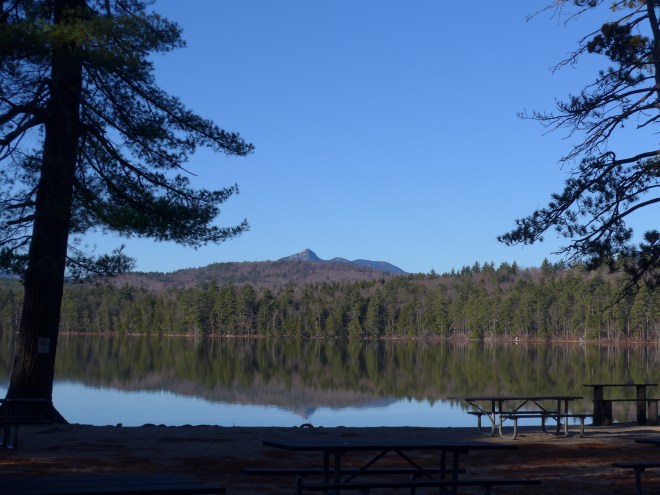
Chocorua from White Lake in November

There should be some great conclusion here – some wrapped up discovery. Instead there’s just a hopefulness – that his other writings refresh and inspire my heart so. The astonishing awakening of the morality and decency of those from whom we expected a more “of their era” myopia – and perhaps a similar inspiration to be better than our own era demands. The rising heart of someone who has discovered a whole body of work that seems designed to inspire them, and of which they’ve barely sipped. I can see my future self slowly meting out writings in moments of either great reflection or great need, to feed a famished soul.

“Oh, these vast, calm, measureless mountain days, inciting at once to work and rest! Days in whose light everything seems equally divine, opening a thousand windows to show us God. Nevermore, however weary, should one faint by the way who gains the blessings of one mountain day; whatever his fate, long life, short life, stormy or calm, he is rich forever.”

Mt. Chocorua at sunset

Muir, John. John Muir: Nature Writings (LOA #92): The Story of My Boyhood and Youth / My First Summer in the Sierra / The Mountains of California / Stickeen / essays (Library of America) Library of America. Kindle Edition.