A little bit of earth

I’ve always loved the idea of gardening. I was deeply influenced by the books available to me as a girl, and one of my spring favorites was “The Secret Garden” by Francis Hodgson Burnett, which spoke of the healing power of green and growing things, friendship, gardens, sunshine and good food. Many of my views of the world have shifted since I was a 9 year old in a farming town in Eastern Washington, but I still hold the virtue of those things.

As a side note, I think the current generation (and my more urban colleagues) just do NOT understand what it was to be book constrained. I’d read out the school library within weeks – at least of books interesting to me. The library in our town had a librarian deeply suspicious that we could possibly be reading what we were checking out, and wasn’t that much bigger anyway. We used to drive once or twice a month for an hour to go to the “big city” (editor’s note: NOT a big city) to go to their library. My sister adjusted by vastly expanding the realm of what she was interested in. I, on the other hand, read the same books over and over and over again.

Anyway. Love of gardening, right there with my love of survival (My Side of the Mountain) and love of native culture (Naya Nuki: Girl Who Ran). But alas, I am no gardener. Not least because I’ve spent the last 20 years with a farmshare, and the LAST thing I needed was more zucchini. But the urge. The urge is still there.

We are in the Zeno’s Paradox stage of our year long home renovation project, where we’ve been a week away from done for a month or two now. (Stupid rain. Can’t paint when it’s raining.) But I finally decided that a garden couldn’t wait on trivialities like whether we had gutters installed. I did mostly wait for them to lay our new walkway (due to the excavating). But my plan was to replace what had been a front yard with a front garden.

We lost quite a bit of the front growable area due to doubling the size of the room that was our front porch and is now our solarium and balcony. It was already postage stamped sized, and mowing it took more effort to lug the mower from the back yard than to actually push it around. Resodding seemed like a mistake for such a small area. But it’s quite shaded, and a little hilly. And there are gas lines, sight lines, sewer lines and a brand new Cultek rainwater system to think of. I decided on three governing principles:

1) Shade
No pretending it’s full sun. It’s not full sun. Parts of it are a lot closer to full shade. Don’t even try to tell me that the 30 minutes of direct sun it gets between May and September on sunny days = full sun.

2) Edible
I am not doing the farm share this year. So my tolerance for a harvest is higher than it’s ever been. In fact, I don’t quite know what to do with myself if I don’t have an excess of some sort of produce. I’ve been thinking about my favorite parts of the process. I love making jam, which there are plenty of stuff that suits itself to jam. Making pies likewise is vastly appealing. But I’ll add to the the list syrups, which I like to add to seltzer water in lieu of a soda. And also the fruity toppings for cheesecakes. So things like serviceberry, aronia (chokecherry), or rhubarb. I’ll have a few things to do with them.

3) Native. At least ish.
I’m on a quest to eliminate invasives. But also, there’s an entire lexicon of American native fruits and vegetables we don’t eat. Not because they aren’t tasty, but because our colonial forebears preferred their familiar versions. Johnny Appleseed walked across our country spreading (cider) apples, but pushed aside the pawpaws that had been eaten in those places for millenia.

And then of course, there’s beautiful. Sometimes a girl just needs some peonies.

I spent the winter poring through seed and plant catalogs, making purchases that would come as a complete surprise to me several months later when they finally shipped. And then I discovered that Mahoney’s Garden Center had all those obscure natives and some I had not dared to imagine would be purchasable, that were only on my foraging list.

Here’s a quick rundown of what I put in my garden, so far. Let’s see what survives.

Shadblow Serviceberry Shade, edible, native
I only get one tree in this space, and I’ve dedicated my one and only shot to the serviceberry. The serviceberry (or Saskatoon or Juneberry) is both edible and delicious, with a rich heritage. If you don’t bother picking it, the birds will do it for you. It’s a favorite. It’s also a beautiful tree in blossom and in fruit. It doesn’t get too large (12-14′), and has beautiful flowers. I mean, I already have three pawpaws in back. I could stand more variety. I’ve, of course, never HAD serviceberry, so hopefully I like it! It will likely be several years before I see anything.
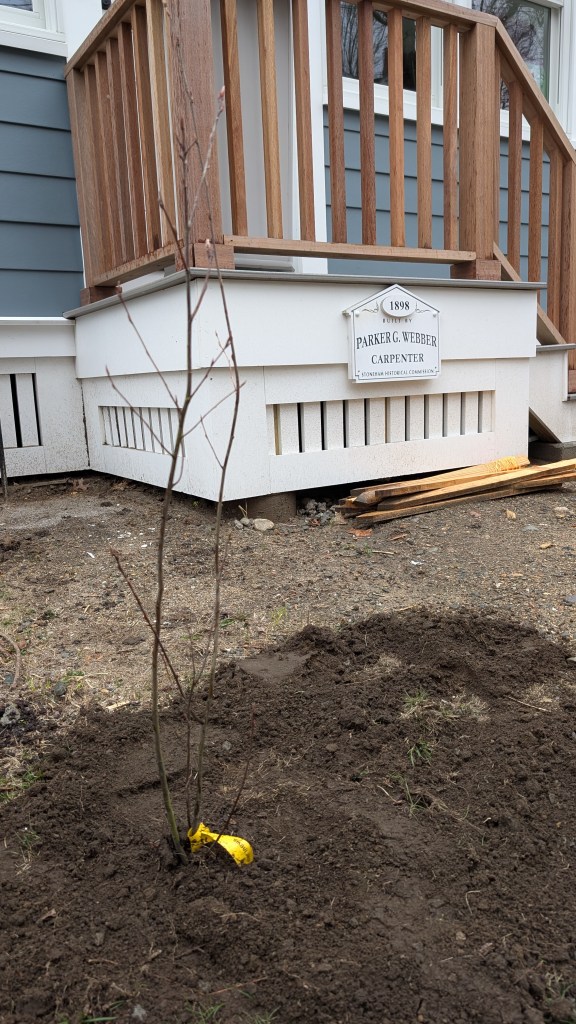
A tiny sapling planted in a barren yard
Doesn’t look like much – but remember this in a few years.

Canadian Ginger Shade, edible, native
I was SO EXCITED when I saw this at the garden store. I hadn’t even thought to have it on my list. But it is a shade lover, ground cover with a strong edible contingent and really weird, cool flowers. I’ve been thrilled at how it immediately bounced back from transplant and got right on the growing business. I’m not sure how much actual ginger I’ll get from my little garden, but it’s the possibility that matters, right?
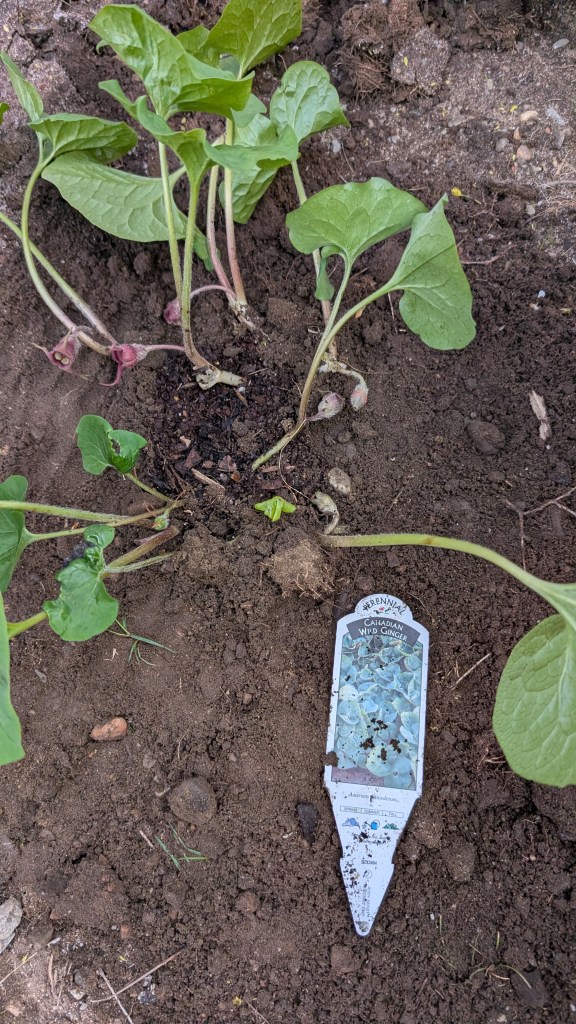
A recently transplanted Canadian Ginger with the card. You can see some neat low flowers.
It now looks like it’s never lived anywhere else.

Mayapple Shade, edible, native
This one has been on my “want to forage” list for a long time. I’ve found it twice – but neither time has the fruit been ripe. I love the cool shape of the leaves, and I had no idea it was possible to purchase for a garden. This one is having a harder time acclimating (I actually think it’s getting too much sun, which will improve when the serviceberry is less stick-like). I doubt I’ll get any fruit this year, but it will be a lot easier for me to get the timing right when it’s literally out my front door. I went from excited to unreasonably-excited-for-an-adult when I learned it was a MANDRAKE. I mean, share some awesome with other plants, mayapple.
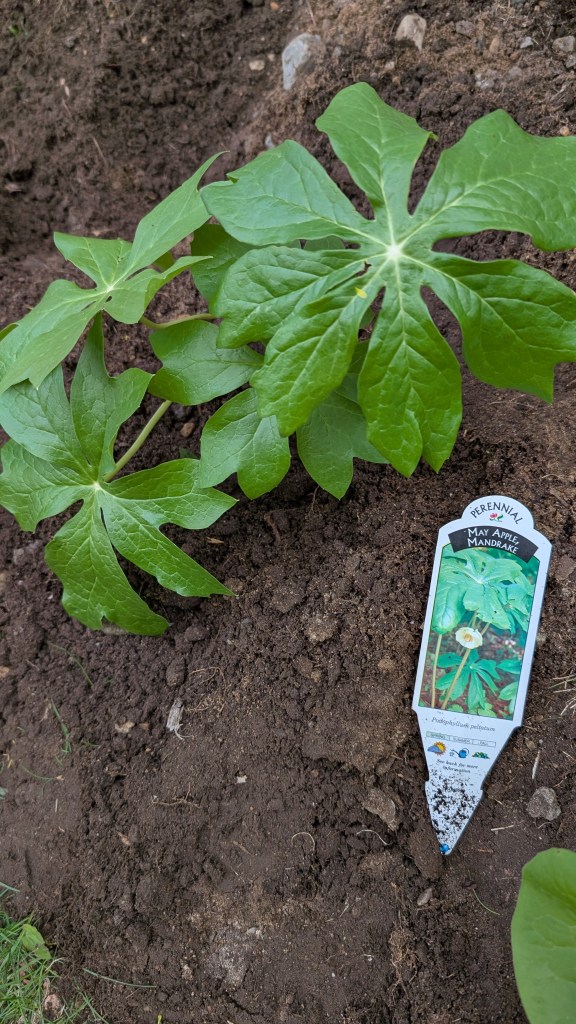
Some glossy green-leaved low plants
I adore those leaves

Rhubarb Edible
I really don’t like hostas. But they play an important role in the garden, where that role is “relatively low mounding green thing that doesn’t get in the way of the pretty plants”. But when I was pondering whether the local farmer’s market would open in time to get rhubarb this year (it’s often almost over before they’re open) it occurred to me that I could fill the ecological garden niche of hosta with a plant I liked a lot better. Plus, it’s ready for preserving before I get overwhelmed in fall! But it’s an Asian native, and needs close to full sun. Grey loves eating raw rhubarb.

Native flowers
There’s variation in JUST how much thinking I did. Some of these I thought about a lot. Some were like thinking of a perfect friend for a job. But I also went to Mahoney’s and just bought some native local flowers that looked cool. On that list I have Blazing Star (which I’m not sure I’ve ever even seen), Stonecrop which I had before and is never without bees, Shasta daisies with their long bloom, and a monumental cutleaf coneflower which I might not have read carefully enough gets 6-7′ tall. I planted that in front of the hose. We’ll find out which are friends, which are foes, and which doe well in their roles.

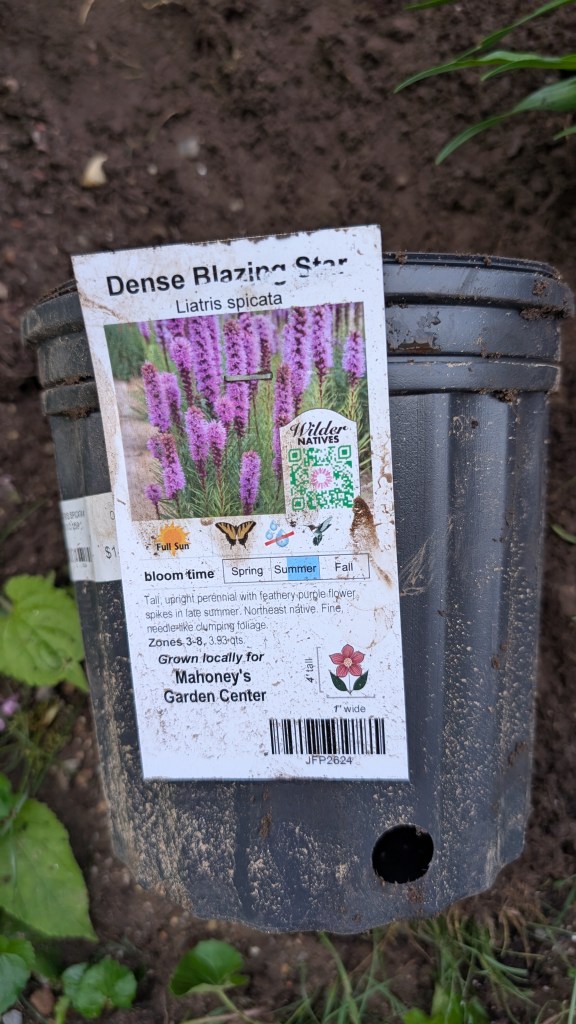
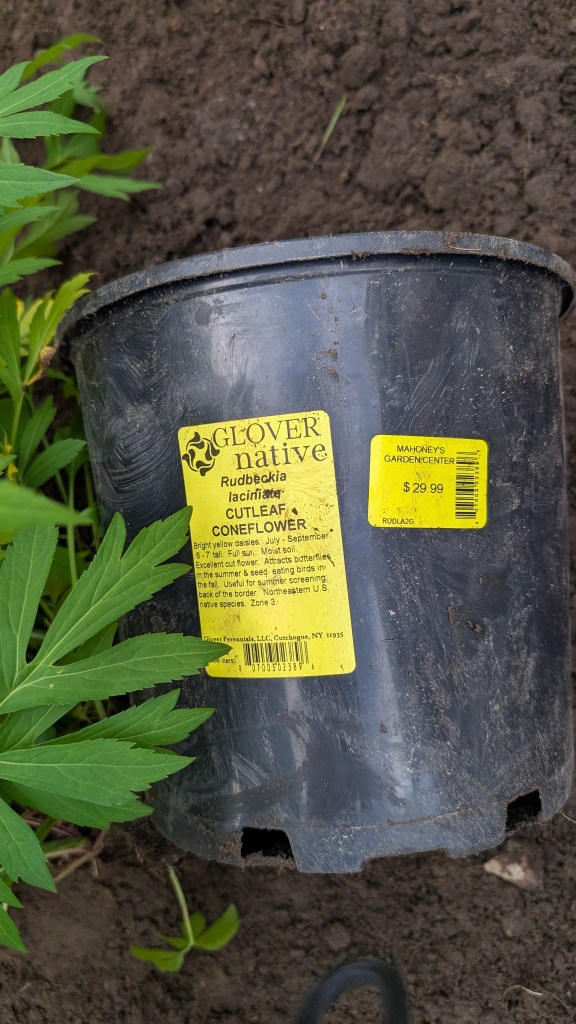
Just Pretty
I managed to rescue our bleeding heart from before construction. I think it got dug up and replanted three times. But while not going gangbusters, it survived! Also, well, you have to be pretty hard-hearted to create a garden and make no room for peonies. I planted creeping phlox all around the edge of the garden.

Strawberries & lupine
Over on the other side is my “kitchen garden”. Lupine doesn’t really count as native since I got a copyrighted cultivar (that was before I had my rhubarb revelation or things might have gone differently). But I have such fond memories of the alpine lupine on Mt. Rainier, and it’s taller brethren in my Washington home. I had another stroke of brilliance that surrounding the lupine with five different varieties of strawberry, for a summer where there will always be a mouthful, and to find out what does well in my spot.

I took a picture of each strawberry in situ so I’d be able to identify it later.

Walkway
Around the beautiful stones carefully laid down by my handsome husband, I planted four varieties of creeping thyme. The thought is that when mature, each step home will release a rich fragrance. They can handle light traffic. And it will help prevent erosion, right?

Kitchen garden
Abandoning all thoughts of natives, my herb-centric kitchen garden includes: two kinds of basil, chives, garlic chives, parsley, mint contained in a pot, celery (I’m curious), dill, rosemary, arugula and an actual planting of thyme for culinary purposes (although you can use the creeping thyme). I would plant cilantro but man that always bolts SO FAST!

My kitchen garden

And now I’m at the phase where every day, sometimes twice I day, I’m staring at the new leaves on my serviceberry, or pondering if my new peony just grew another inch. Is my mayapple acclimating? Are there any hidden strawberry blossoms? It’s such a glorious and hopeful waiting, the new garden. And in a month or so, after the 4th, I’ll go again to Mahoneys and come home with more summer treasures for my waiting garden.

25 years of Mocksgiving

At Mocksgiving on Saturday, someone asked me if I’d ever written about it. And on Bluesky, where you can find me as Fairoriana as pretty much on any platform, Wise Old Coot John Scalzi reminded us that having our own platform, that we control, means that there’s resilience in ecosystem. The social channels may change but our creation likely remains. I’ll admit that part of the reason I stopped writing so much is that the Facebook algorithm now more or less buries any content like this. If you are not writing for the engagement and audience, it’s called a “journal” folks. I have one of those too. But I like writing for people and I miss it, and I prefer the long form ~1000 word first person style that is blogging. So here you go. One post about Mocksgiving.

I should note, I have a personal commitment not to apologize for my lackluster posting schedule in the posts. Otherwise my last 5 years of posts would all start with “Sorry it’s been so long it’s been really busy and it got away from me” and that’s just tedious.

Anyway, let me bring you back to November of 2000. I have just turned 22. I have been married a grand total of 3 months and my college diploma is 6 months old. We are living in a Philadelphia duplex in Roslindale, Massachusetts, where the dishwasher is my husband and we have no microwave. We are paying $1200 a month for a three bedroom, one bath apartment with beautifully exposed woodwork and vertiginous stairs leading up to the two small bedrooms. We have one car, and two hamsters. I have just subscribed to Money Magazine, which sits by the toilet, due to a panicked realization I have no idea whatsoever how insurance actually works. My husband is working for USWeb/CKS as a coder. I’m a coder for a full remote company called Geekteam, which according to the Wayback machine at the time had a raffle for a Palm 3 and specialized in “ebusiness Obstetrics”. It was this one dude in Lewiston/Auburn Maine. The 9/11 attacks had happened only a few weeks before – our apartment was robbed the same day – and things still seemed unsettled.

But my in-laws, I had discovered, had a tradition of having their Thanksgiving meal at a restaurant. I was horrified (I was easily horrified back then) and promptly invited everyone to our apartment for the Thanksgiving meal. I was young, inexperienced, but not an idiot. I knew that making your first turkey for your entire new family of inlaws on Thanksgiving day proper was the way many a sitcom episode started. Those episodes usually ended with Chinese takeout and/or pizza, a la “A Christmas Story”. So two weeks before Thanksgiving, I bought a turkey and pleaded with my local college friends (over email, because we were savvy like that – this is before texting or social media were really things) to come and eat it with me. We called like three sets of moms regarding various aspects of turkey preparation. I made bread. We got cranberry sauce from a can. We used our wedding china for the first time. We had a BLAST.

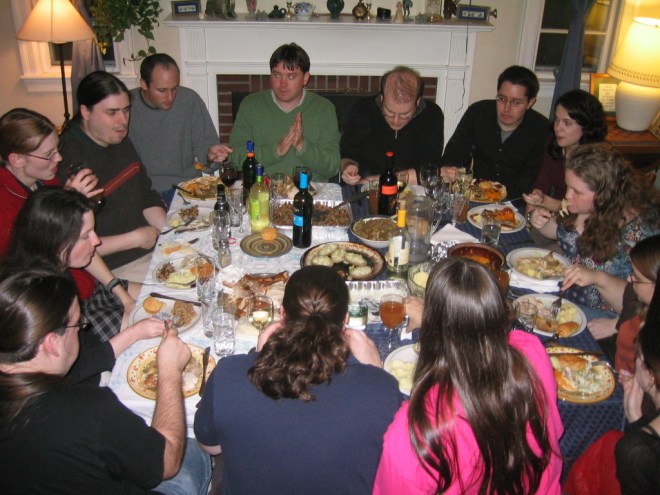
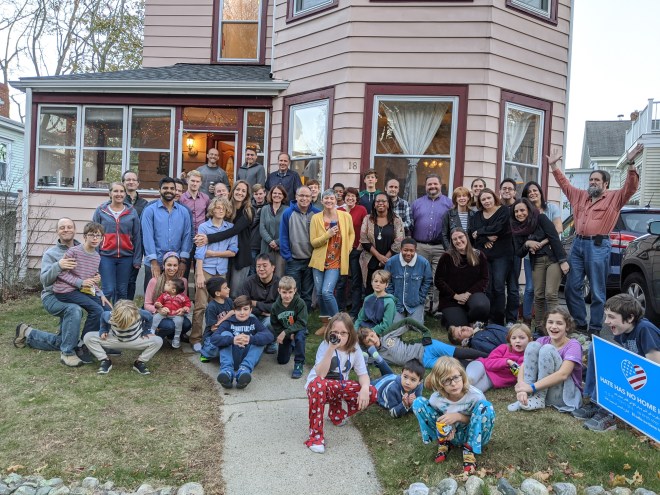
I did not end up hosting Thanksgiving for my inlaws – in fact I never did. But we had so much fun with our “Mock Thanksgiving” that Mocksgiving happened again the next year, and the following. It’s always been potluck and with many helping hands. I make the basics, my friends bring what they will. If you’re standing in the kitchen (or near the kitchen) between when the turkey comes out of the oven, you will be put to work. I usually start my preparations a week in advance, and spend the entire day before baking, prepping, cleaning and cooking. There were a few years there, in the early 2000s, where I threw out open invitations to my friends on Livejournal to show up who would. Now I have to be careful – we sat ~35-40 for dinner this year (simultaneously), and probably a total of 60 people were here at some point during the evening. The house isn’t big enough to seat many more.

I’ve hosted Mocksgiving a few weeks after giving birth (literally two weeks in the case of my youngest child). It’s snowed. We’ve deep fried turkeys and had turducken. The attendees have shifted and evolved as our lives have – only one of the original attendees was there this Saturday. During 2020, I mailed out recipe cards of all my standard recipes to my much missed friends. We’ve had the first of our friends who always flew in for the day die, and that taught me how grateful I was that he always made it and also to make sure you ALWAYS take a group picture. It started as a sleepover party, with breakfast the next day part of the deal. Now we all want “beds” and “a good night’s sleep”. We’ve played a thousand board games – I think Richochet Robot has been broken out after the pie since nearly the first year. We’ve welcomed neighbors, babies, friends of friends. I finally learned how to spell the word “meringue” without looking it up. An entirely different party began to happen on the second floor, as the kids required less and less supervision and developed their own subculture. Some years we just sent up pizza as an offering to the second floor and held our breaths.
One thing I’ve learned is that my experience of Mocksgiving is very predictable. I think the same things at the same times during this process I’ve executed so many times. The day before I wonder if anyone will come. When I make the lemon meringue pie I think the lineup of “yellows” for it is so beautiful. I always regret not getting the turkey in the oven earlier. I often “narrate” the experience to “you” – the imaginary readers of this blog. The fascinating things I tell you in my mind are more or less the same year after year.

So, maybe in the year to come I’ll talk a little more to you. Maybe if we’re not ONLY on Facebook, you’ll talk back. Maybe next year, I’ll recite the litany of Mocksgiving. And maybe we’ll all come away a little more fed and fuller from all that.

Reframing as a hobby

I’ve been getting a farm share from Farmer Dave for about sixteen years now. Once a week, I get a box of veggies and a box of fruits. (I used to get two of fruits until that memorable year when the watermelons went gangbusters and I ended up with ten of them….) But 22 weeks of figuring out what to do with the beets can wear down the spirit, and I was constantly feeling guilty about not using everything. (I hate beets.) So this year I decided to stop thinking of it as Nutrition and Healthy Eating and instead think of my farm share as a Hobby. So here’s how I think of it: you get points for using something. You get more points for a novel use of something. There are no deductions for not using something. So it’s only upside, no downside.

I figured I’d walk you through today’s fun-fun farmshare.

First, I cleaned out the fridge from all leftovers. This is a critical part of farm shares: admitting prior defeats. Not too bad this week – two cucumbers, a zucchini and some garlic scapes.

Used:
Apricot: I had a lot of apricots, and thought about making apricot jam. But I didn’t have QUITE enough, and apricot jam has a tendency to crystallize. So I decided to try something new and dehydrate them for dried apricots (I have some great recipes for dried apricots and also like to eat them.) We’ll see how that turns out. I’ve never done it before.

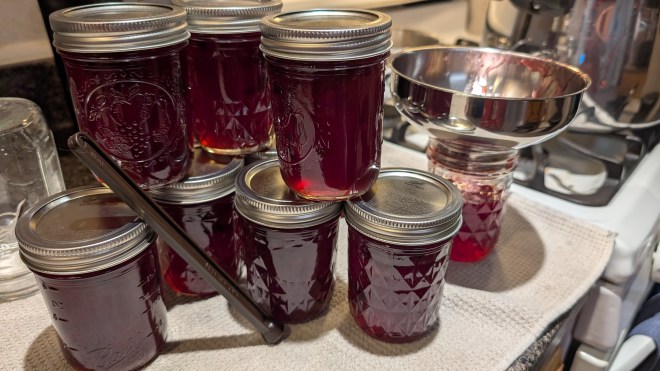
Plums: I had JUST enough plums (with the ones I saved from last week) to attempt a jam. Plum jam is one of my absolute favorites, and many of the last years weather has taken out our stone fruit so I haven’t had it. It’s definitely a mixed plum, but I’ll take it!

Have a Plan:

Garlic scapes: in a glass of water. They may end up in hummus or in pesto. But that’s a decision for another day.
Basil and thai basil: Imma gonna get me some sourdough and make some bruschetta. I also just ordered some pine nuts so I can make pesto. Maybe garlic scape and thai basil pesto.
Tomato: Going onto the bruschetta too
Kale: I probably will make soup – ribollata – with it sometime this week
Green pepper: gonna make chili tomorrow
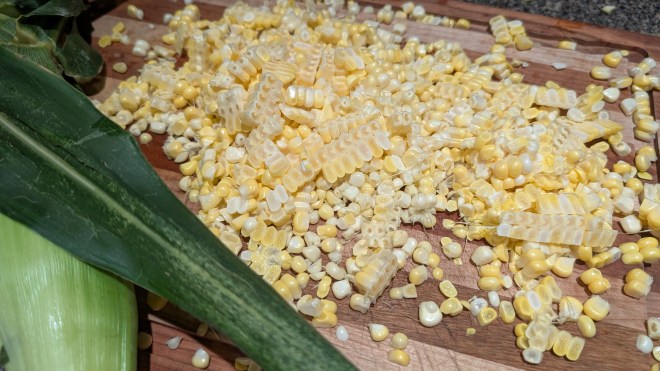
Corn: half into the chili, half into the freezer for chili later in the year

Blueberries: blueberry zucchini cupcakes with lemon buttercream frosting
Zucchini: see above
Cucumber: to be eaten with the hummus I’ll make with the ‘scapes
Summer Squash: I often just boil it and add butter and serve it for dinner, and then I’m the only person who eats any of it. But I do like summer squash.
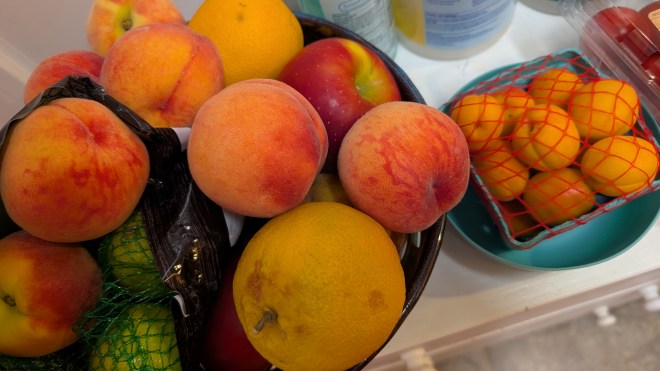
Peaches: I’d pretend I was going to make a peach pie, but honestly I just love eating the peaches over the sink with the juices dripping down my arms. If you can do that, you should do that.
Canteloupe: I dropped it off at my friend’s house, along with last week’s hot peppers.

Not Sure

Onions: I don’t have a very well formed plan. Generally these aren’t very urgent. I was toying with a french onion soup (except Adam can’t do cheese and that’s important). Maybe I’ll caramelize them and add them to french dip sandwiches. A few of them can go into the chili and ribolatta. But I’m not stressed about finding uses for onions.
Gem Squash: Absolutely no idea. This will likely end life in the compost bin. Let’s be honest.
Eggplant: One eggplant is the worst amount of eggplant. I pretend I might make moussaka, but if I’m making chili and ribolatta I’m NOT making moussaka too. And I’d need like two more eggplants for that.

What do you have in your life that feels like a burden but could be a game instead?

Aronia

As I emerge blinking into the middle stage of my life, firmly ensconced in children, career and suburban householding, I find myself increasingly aware of the oversized role “Naya Nuki: Girl Who Ran” by Ken Thomasma (see prior post) has played in my moral, educational and skills development.

Since I can remember, I have been fascinated by the question of “can I eat that?”. Oh, the wild independence of living off the land! Naya Nuki was followed in turn by all the greats of survivalist literature in my pantheon of imagination. Of COURSE there was “My Side of the Mountain” with the acorn pancakes and the algae. I mean, which of us didn’t want to run away from our families and support ourselves living in the hollow of an ancient tree with our forest friends? I also read “Robinson Crusoe”, obviously, and liked it well enough. But I read “Swiss Family Robinson” until the cover fell off (not realizing that it was closer to the fantasy of Tolkien than any historical account). How easy it was for the knowledgeable and hardworking to look to the land for all one needed! And lest you think that I only read white-savior-survival books, “Island of the Blue Dolphins” and “Julie of the Wolves” were also well-worn on my shelves. Heck, even in Tolkien Aragorn saves the day by finding kingsfoil by scent in the dark after the Nazgul attack on Weathertop, and Sam finds herbs to spice the survival meals he and Frodo subsist upon up to the gates of Mordor itself.

It was clear to me that in order to be the self-reliant, capable person I wanted to be – to be ready for anything from ringwraiths to shipwrecks to poverty – I would need to be able to forage competantly.

I even tried to take ethnobotany – a 300 level course – in college in order to accomplish this task. (It was pointed out to me that given that I hadn’t taken ANY botany classes this was probably not going to work. Alas. And also it didn’t teach foraging, so pthfft.)

Then I started a job, and lived in the city (compared to where I grew up), and had kids and you know. Somehow I’ve never been shipwrecked, lost in the woods, or on the run from orcs. But I’ve never lost my fascination with this idea of the virtue of knowing what it was you were looking at – and whether you could eat it.

For many years now I’ve had a farm share. It’s taught me a lot about the background skills of foraging. For example: spring greens. How to not by hungry by eating them. (Answer: not gonna happen. Please add cheese/eggs/beans/avocados etc.) It has also helped me understand the spikiness of foods in temperate climates. There are the hungry times, and the times where you can’t possibly eat it fast enough to prevent it from rotting. Foraging is all well and good when you’re on the run from your Blackfoot captors, but you need to also preserve foods if you have any intention of eating in February. And spoiler alert: most of the ways I know how to preserve especially fruits involve significant quantities of white sugar – an element likely to be in short supply in a shipwreck.

But there are pleasures that come with knowing your local flora beyond the practicality of eating it. Sure, I nibbled on a beach plum as I walked the Greenway Monday. (It was bitter still – needed to leave it longer.) But to look and not just see a wall of green but individual plants with their own personalities and uses. That particular quarter mile of Greenway has the easy ones: dandelion, crabapple, knotweed. It also has wild grape, the beach plum, staghorn sumac, chicory, milkweed, wild rose and many other plants crowding to our attention on overgrown verges – some edible, some not, so many invasive. I don’t usually eat them (except the crabapple when it bears), but I do enjoy saying hi to them. And I always VOW that NEXT year I’m going to try sumac lemonade.

The plot of land on which I live is devastatingly small – a tiny tenth of an acre mostly taken up by house and cars. But there are a few corners on which I may place a plant or two. And each of those plants is as attended to and beloved – my gaze falling upon them many times a day.

As avid readers know, I originally planted a Damson Plum, under the influence of yet another book (“Miss Buncle’s Book” by DE Stevenson). It was felled by disease before it ever bore a crop, although it was beautiful and gave glorious shade. But watching a British fruit felled by American disease (ah, how the tables turn!) I vowed to plant only natives in this small patch of Massachusetts I call home. Well, except for lilacs which are the “Pocahontas” version so clearly a North American native*. But I wanted these plants to be edible, in case of future food scarcity in which we would clearly live or die by whether my .01 of an acre bore food or not. I’ve discussed the paw paw investment I’ve made (only two of the original 4 pawpaws I planted yet survive – harassed by human intervention but those two are thriving and I’m hoping for flowers as early as next year). But in the corner of the yard, where I might plant a hydrangea or rose bush, I planted an aronia bush.

The varietal I planted is “Autumn Magic” – bolstering the bright autumnal scene of the back yard, with the invasive Norway maples looking all local in their coloring. Not chokecherry, mind, but chokeberry. I was searching for a North American native fruit I could turn to jam, jelly and sauce but couldn’t buy in a grocery store. This is a much easier task than you might think – so few of the delicious plants available are suitable to mass market production.

Many faces of aronia

With the example of the plum before me, I assumed it would be years (or never) before my Aronia bore any fruit. I didn’t get too excited when it laid out a glorious spread of blossoms: I’d seen that play before. I was pleased when flower turned to green fruit, but I thought that it was unlikely to be my own harvest. The nativeness in the plant was evident by the absolute deliciousness evidenced by the rabbits. The poor shrub, fast growing as it was, was of the utmost appeal to the coneys that invaded New England this year. No faster did a shoot appear than it was cut down by sharp tooth to feed the rapacious bunnies of the back yard. I clad it first in a plastic bottle, now in a vinyl sheath in an attempt to allow it to grow enough to survive the onslaught. And to my great surprise, the birds are far less interested than the rabbits in this ripe and appealing fruit.

And I’ve been rewarded to my great surprise with effulgent, ripe berries. I tasted one – tart on my tongue in the August heat. Adam muddled and decorated with them for a gin bramble. I ordered “The Forager’s Pantry” which features Aronia on the main cover, to extend my set of books and recipes for ingredients you can’t buy at Stop and Shop. The remainder of the unharvested berries is far too few for any serious purpose: pie or sauce or jam. But it gives me hope that my tiny back yard, with its stance on native plants, might yet provide a harvest of treats that are new to me, and old to this continent and those who have lived here so long.

I hope Naya Nuki would be proud.

A lowball glass filled with a pink drink and with a speared berry as decoration
Aronia Gin Bramble

*Not a North American native.

Mocksgiving 2020

I print photo calendars as Christmas presents for family, helpfully including birthday, anniversaries, and holidays. So it is that I know roughly a year in advance exactly when Mocksgiving and Piemas will fall, since I actually print them on the calendar. I used to have friends pinging me in July to check the dates and get the early bird fares.

So it is that I know with great certainty that in any other circumstance, today would be Mocksgiving. It’s 1:15 as I write, so at this moment the house should be filled with the aroma of a slow-cooking turkey, the remnants of glorious stuffing smell. I’d have the pots of potatoes and butternut squash prepped and on the stove. The porch would have five pies and five loaves of bread, and Adam would be setting up the bar. Half the furniture in the house would be moved and every one of the many table settings and chairs I have in the basement would be up and dusted. Often BJ would be at the table, talking to me while I cooked.

But it’s 2020. We’re moving furniture, but only as we put the house back together after our big window/living room project. The only people dining here tonight are the four of us Flynns (granted, with two of them being adolescent boys, the amount of appetite is like six, but still). There is no gathering, or feeding, or drinking, or board games, or catching up with people you see every year, but only once or twice. I knew today would be a hard day for me – harder than Thanksgiving – when it started becoming clear that there was no gathering small enough to be safe in the current environment.

So I decided to replace my love of feeding people with my love of sending people letters. I worked with Fealty Design (who designed our family crest) to put together a package of recipe cards from my little Mocksgiving cheat sheet document plus pictures of some of the 20 Mocksgiving celebrations I’ve hosted. And I sent most of them out late last week (although it took me a while to track down some addresses, and some I’m still missing).

The cards, front and back

I miss you guys so much. I miss writing a “live blog” of the prep, either for real, or only in my head. I miss gathering and hugging and the heat of many people and the sounds of laughter drifting up and down floors. I miss the 20 minutes after I’m done cooking and before the guests come where I transform from dumpy cook to glamorous hostess. We’ve all been alone so long, I find myself not really believing such days will ever come again, although with the recent vaccine news next Mocksgiving is not a Fool’s Hope. (Next Piemas probably is.)

Anyway, assuming you miss these things too, I have a few things for you. First, here’s a downloadable PDF of the recipe/picture cards. They’re designed to be printed on 5×7 cards, in case you want them. (If you don’t know how to reach me, just add a comment and I’ll reach out to you!) I also have quite a few extras – send me your address and I’d be happy to share!

Second, I put together an album of Mocksgivings through the years (although I haven’t gotten around to scanning the first two years yet). I’d love additions from attendees who might have taken pictures!

Here’s looking forward to next year, when we can turkey together once more!

Abundance & Want

This strange time in the life of the world is giving all of us room, space and perspective to see the world through unfamiliar lenses. It’s remarkable what doesn’t change (not enough hours in the day!) and what is fundamentally shifted and may never come back the way it was (tbd). We are all spending way more time with some people, and way less time with others. Our habits are changed – die-hard grocery delivery shoppers like me can’t get a slot while others try it for the first time. Few of us are commuting, and the commute is changed for everyone. We are cooking more and eating more takeout, but it seems like a long time since we sat with friends in a bar, or a movie theater or… anywhere.

This time has also created different senses of lack or insufficiency. Many, many, many people are now encountering true want. Millions have been laid off. Many are in quarantine and struggling to make sure they have enough of the basics. But almost no one can find toilet paper in the stores. With just a small number of hoarders and a small increase in the amount we all picked up for our homes, our incredibly finely tuned system, designed to produce precisely the right amount of TP and not a roll more, is struggling to keep up.

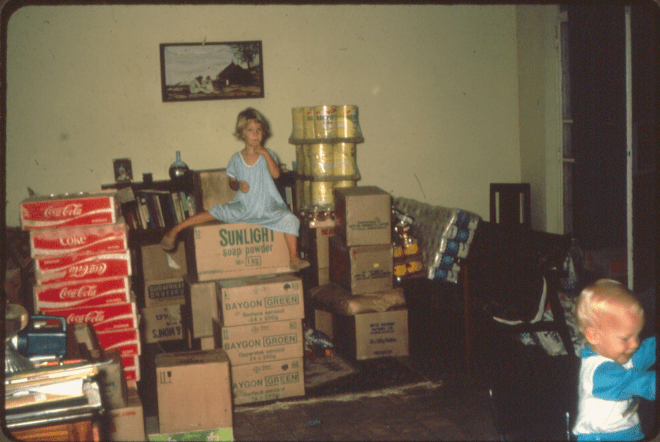
When I was growing up, grocery shopping was a once a month thing. We’d get fill-in milk, eggs and bread, but my mom did one big shopping trip to the base (my father was military retired) about once a month or two. When we lived in Northern Idaho, it was like a 3 hour drive – each way. And that’s how we shopped: buy absolutely everything you might need as though you live in a logging town in the woods 20 miles from the nearest podunk grocery store with five aisles – and absolutely no restaurants. This never seemed particularly hard. By my parents standards, this was the height of accessible food!

6 months of supplies in Africa

This is my parent’s supply drop when they were in Africa. According to my sister this represents 6 months of food. The massive amount of soda here cracks me up – my parents made many sacrifices, but not the sodapop! Of course, this was supplemented with bananas from the garden, eggs, chicken and local foods – which were neither plentiful nor varied. (For the record, I’m the waif in the lower right.) The picture on the wall still hangs in my parents house.

Anyway, this is how I learned to shop, and this attitude remains true, even though we live a quarter of a mile from a (usually) well stocked grocery store. So we were well prepared for a 2 week “eat what you have” plan. But into our idyllic backlog of Costco whole wheat pasta, there came the voice of want. Here I was, watching the Great British Bakeshow with dreams of dinner rolls, pies, cakes and donuts dancing through my head. And Adam makes bread for our family every week – and usually a few loaves to share. But then we did a grocery store run – and there was no flour to be had. We checked the pantry – and the flour supplies were paltry. We looked online, and they’re scalping flour. Peapod was out. Amazon was delivery 25 pound bags only …. in mid April. Costco was out. Target was out.

We began to feel the scarcity. Ah! To be in a well stocked house with plenty of time for yeast breads… and no flour!!! Adam got particularly obsessed. He starting calling Stop and Shop every morning. He went on grocery runs which were ill-disguised flour runs. He got anxious. And then, finally, we found flour at the local teeny Target. Enough flour. We left with 25 pounds of flour (which was our desired amount). And somehow this anxiety we’d been experiencing, this sense of shortage, eased. We had enough. Adam says it was fascinating to watch his own mind, which had been dwelling on wondering what shortages we’ll experience, how our supply chain will hold up, what the uncertain future holds. But somehow, with enough flour laid by, he is more sanguine that this world will work out ok in the end.

This time we will be confronted with unusual and unexpected wants. We are short of toilet paper, socialization, and time alone. But there are also moments of plenty, if we look for them. Did we lay aside enough Coke to get us through six months, like my folks did? Is there an abundance where there is usually scarcity somewhere for you? Maybe a little more time? Maybe more connection with your family? More phone calls? More patiently watching out your window as spring takes over from winter? More yeast breads? Where are you abundantly filled?

Abundance

I invent holidays

I’ve always admired people with great intent for their lives, who know exactly who they want to be and what they want to do and pursue those clear visions with purpose and determination. I’m hardly unfocused or unaccomplished, but I’ve come to realize in my middle years that what I really am is opportunistic. I have a general vision for the kind of person I’d like to be and the kind of things I like to do. But what I’m really good at is seeing a hole – an opening – and then leaping into it to make my mark.

This year’s Mocksgiving

Most especially, with holidays. You all know my calendar of unique holidays. We have Mocksgiving two weeks before Thanksgiving (November 16 this year – mark your calendars). That was followed by Piemas, coming up next weekend. Then Flynn’s Fiery Feast, which is still forming but seems to have the theme of “we can’t make up our mind whether it’s inside or out”. These are not fake holidays, for all their provenance is known and created. I have heard many times that Mocksgiving is a true celebration of gratitude, friendship like unto family and tradition. (The mock, for the record, is not mock as in mocking. It’s mock as in trial run. It turns out you can’t rename holidays after 20 years of having them under one name.) These holidays have traditions and rules that guide and govern them just as any other holiday does. They even have holiday attire. (I have a great pie-themed dress! I still need a better Mocksgiving outfit.) There are things we always do, the community of shared experience, the stories of what happened last time we gathered. They are entirely real.

Me, in my Piedress, eating Pie

This gift of inventing holidays has a lot, I generally think, to do with the open-mindedness and joyfulness of my friends to indulge my flights of fancy. I’m hardly the only person on the block to have a traditional celebration. Around here, we also celebrate Oktoberfest and Vinterfest and other shared joys.

But what made me realize that this was, perhaps, my calling in life was when I managed to invent a holiday at work. Now, I didn’t do this on purpose (and I can’t go into too many details). But a while back I invited some colleagues to join me in an activity on International Women’s Day. And I gave it one of those great trademark Brenda names. (Eg. a cross between lame, descriptive and memorable.) I had no thought of making it an annual holiday, just like Piemas. But a goodly number of people asked me very politely (and persistently) if we could please do it again. So we just celebrated this last week, from the least to the greatest of us, and I realized. This is now a *thing*, with a tradition, and set of rules and memory of past celebrations. People refer to it by name, and look forward to it, and are joyful when it comes. All I had to do this year was set the date, invite people, and they came gladly and with alacrity with their offerings, like a joyful potluck. You know, like Piemas. Or Mocksgiving.

There are so many people in this world that our niches of uniqueness become ever more granular. I’m willing to share space with the rest of the world and the things that make other special. But I like being the person who creates the joyful holiday. I think I’ll lean into that one.

What about you? What have you discovered you somehow end up doing over and over? Are you a person who knows what they want to do and who they want to be, and does it? Do you have any holidays of your own creation?

Scottish Haut Cuisine

Ye Pow’rs, wha mak mankind your care,
And dish them out their bill o fare,
Auld Scotland wants nae skinking ware
That jaups in luggies:
But, if ye wish her gratefu prayer,
Gie her a Haggis

Address to a Haggis – Robert Burns

My grandfather’s father came from Scotland to the mountain west just over a hundred years ago. My grandfather never stopped being a Scotsman. He was active in the local Highland Games. At my cousin’s wedding, there was a picture of all four of my father & uncles wearing clan kilts. And in his 80s, after decades of never traveling by plane, he decided to go back to the old sod and spent a month or so wandering around Scotland reintroducing himself to various long-severed branches of the family and being welcomed in with open arms.

As with so many cultures, cuisine plays a critical role in the transmission of this culture. Instead of curries or empanadas or stir fries, we had corned beef hash.

My mother is a midwestern girl, raised in California. But it was another century, so when she married my father she took over responsibility for making the corned beef hash. I think fondly on her tendency to forget the garlic salt, which only my grandmother could spot in omission. Often when we got together as a family, dinner would be corned beef hash (with accouterments) and a pie or two from my mother’s hands.

I HATED corned beef hash. It looked disgusting. It tasted disgusting. No sane person would eat it. But it was served to me over and over again in an era where there were no alternative food options and as a person under ten you ate the dinner that was served or you did not eat dinner. And so despite my dislike, I ate the stuff. By the time I was ready to head off to college and leave the familial fold, I liked it quite a lot. It was tasty (if you closed your eyes). And it tasted like family times and traditions.

Sometime in this century, I made friends with a man of Hungarian descent who (logically) hosts a Burns Night. It’s one of my favorite things – poetry, song, deep meaning and good company. And to accompany the beverages available, I often bring a batch of corned beef hash to share.

I was making the meal yesterday (it actually is better on the second day, so I make it on Saturday and freeze it on the porch. Then I carry it frozen to the celebration and heat it up there. I’ve been doing a lot of Blue Apron and Hello Fresh lately, which produces these lovely, colorful meals that are in many ways designed for Instagram. The contrast with Corned Beef hash was… stark. I also realized that 100% of the ingredients fall into two categories: preserved meats & roots.

So with no further ado, here is how to make your very own, highly Instagrammable Corned Beef Hash.

I recommend dusty cans – they taste better

Scottish Corned Beef Hash
From the kitchen of Carolyn Johnstone – long may her memory endure!
Serves ~12 hearty rustics
Prep time: 30 minutes – Cook time: 1 hr minimum (3 is better)

1) Boil 5 lbs russett potatoes, whole, with skins on
2) Chop 1/2 lb bacon (or a whole pound if you’re getting into the spirit)
3) Chop 2 large yellow onions
4) In a large dutch oven on the stove, cook together bacon and onions
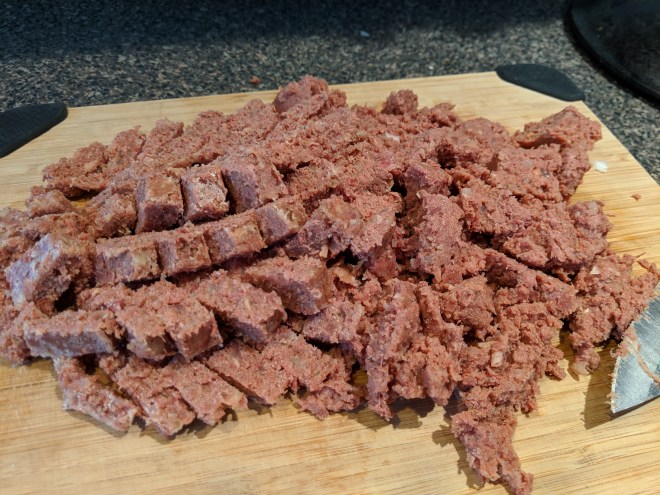
5) Open and cube 2 cans of “corned beef”. Make sure not to break the key or your life will be full of pain.
6) Once bacon is rendered and onions are soft, add corned beef.
7) Add 1 teaspoon garlic salt (optional if you’re my mom)
8) Once potatoes are cooked through, drain and let sit for a few minutes. Then by hand peel off the skins and cube the potatoes into the dutch oven.
9) Start by adding two cups of water (see note before)

The best way to cook this is to leave it simmering on your stove over the course of several hours. If you do this, you’ll need to add more water in as it gets thick, since this often leads to the dish getting burned. If you do burn it, just stir above the burned line and you’ll be fine.

Serve with:
Large curd cottage cheese
White Italian bread slices

What am I, chopped meat?
Potato skin residue
At the beginning of simmer

We Come Back Changed

Camp Wilmot was awesome for the kids. I picked them up too early on Saturday morning, and got great big hugs. They missed me (after two and three weeks, one would hope so), but they loved where they were and who they were there with. As we headed towards home, Grey said he didn’t know what he wanted more: to stay or to return home. Alas for him, there was no choice. It was time to go home.

Our communication with our kids while they were gone was… sparse. We got one dictated email and two letters. The letters arrived on the same day and spoke to the inability to find stamps. (Headdesk) Thane’s were loving, but low on news not related to the inability to find his stamps. Grey’s said he missed us, gave us a laundry list of stuff he wanted, and then told us he was experimenting with vegetarianism during camp. Given that the camp chef (Anthony) has a version of BBQ chicken that causes both children to wax rhapsodic, this seemed like a short-lived but great idea in the first week of camp. But when I picked him up at the end of week 3, he very politely and cooperatively let me know that he’d like to continue eating vegetarian (pescatarian, actually).

He said it was pretty easy, at camp. There was always a vegetarian option, and he ate that one. He said that sometimes he didn’t like it very well but he ate it anyway because he was hungry and it was food. That amazing concept is one greatly needed in our world!

Adam made bacon today, and Grey didn’t eat any. This is serious.

I’m fully supportive. At a few months shy of 13, this is a great age to experiment with different way of being. It’s an excellent time to explore intersections of identity, sacrifice, values & choices. I’ve let him know that he’s not allowed to become a pastatarian (a version of vegetarianism I saw often in college where the vegetarian in question ate few vegetables and many carbs). But he’s been eating salads lately. When you cut out one whole food group, you need to be open minded towards the others. I’d love for him to discover the many great foods available in our modern world which do not hinge upon meat. This is an experiment for all of us – no shame if he lets it run it’s course or decides it’s not the right road or the forever road for him.

That’s the most of the visible of the changes, but there are others as well. Both kids seem more thoughtful about what matters, and careful with the thoughts and feelings of others. They’ve slowed down, detoxed from screens, gotten great base tans and made new friends. They’ve exercised their moral muscles. They are changed, grown, matured. They are a step closer to being the people they will become, and I’m really impressed and pleased with who they are. And even though the house stayed really clean while they were gone, I’m glad to have them back.

Now that Grey’s on this health food kick, he’s gotten serious in the kitchen too. He and a friend fantasized about this cake for days, and then they got together and made it happen. This is a quad layer cake with vanilla frosting AND icing. It’s got crushed pop-tarts and chocolate bars. But it has strawberries, which makes it healthy, right? Right? And heck – it’s vegetarian.

Diabetes on a plate

A lethal serving is about 1/2 in wide slice…

The chefs

All around the mulberry bush

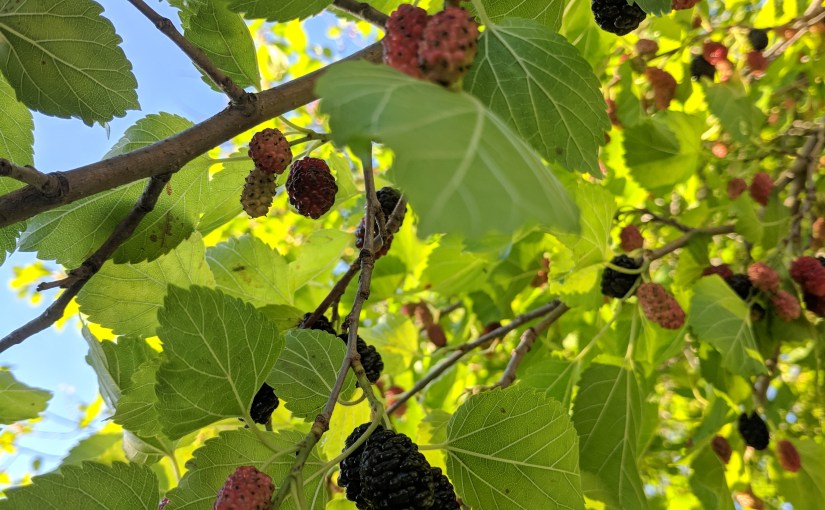
A few years ago, I took a walk in my neighborhood and found this strange tree. It was growing what looked like blackberries – only a bit skinnier and thornless. I, of course, did not eat a strange plant randomly growing by the side of the road. But not too much later, I got my copy of my much-thumbed, much-beloved foraging book. Reading through my book, in the cold winter nights, and contemplating how I could possibly make up flash cards to teach myself the identifications, one of the entries flashed past my eyes with recognition. “If I hear someone say they found a blackberry tree, I know it’s a mulberry”.

Huh. A mulberry.

Like so many people, my full experience of mulberries involves a monkey and weasel, engaged in not-too-good-natured athletics. But that had led me to expect a bush. This was a tree, half crowded over with invasive vines and taller trees. But half in and half out of the shade, it drops its bounty onto the sidewalk.

I had a hunch that it was about ripe, this time of year. And so I walked down with Thane to check it out. And lo, there were mulberries. I tasted one. It was delicious. I shared one with Thane. He liked it too. We came back with a sheet and two big paper bags.

The foragers
Mulberries don’t all ripen at the same time
Not all the mulberries were easy to reach
Berry stained hands
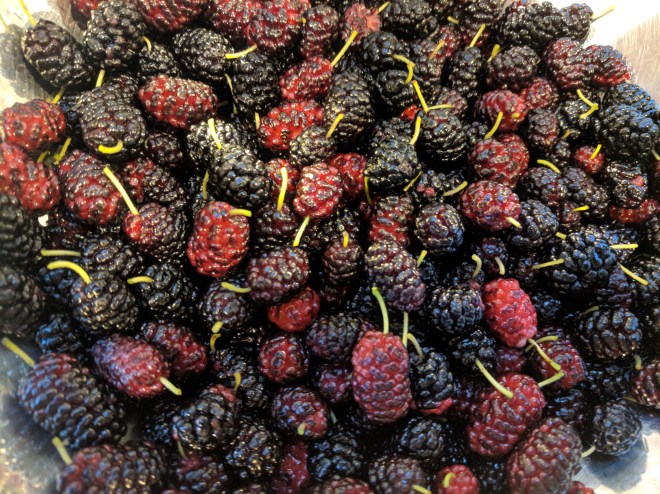
The bounty
Next generation of jam makers

Thane and I had a lovely time gathering the berries. There was a bit of climbing involved. I tried the recommended trick of shaking onto a sheet, but it didn’t work. We had very hard rains last night – I wonder if they knocked all the ripest ones down ahead of time.

Once Thane and I got (most) of them home. They’re pretty tasty. There wasn’t really enough for a pie, or a batch of jam. But I decided the opportunity was too critical to let pass, and I decided to make *half* a batch of jam, using a “berry” recipe from one of my books. It worked. Thane now filled with a tremendous sense of accomplishment, and the new but fervent belief that his favorite berries are mulberries.

To the victor, the spoils