
One of my Facebook friends posted her Goodreads account with the lure that she actually posts updates and reads the updates of others, with the poignant comment “I’d like it if more of my social news were about reading”. In an era where all of us are thinking about how to game the algorithms to see content that makes our lives better, not worse (which is a great time to note that Facebook absolutely will do everything in its power to hide my blog posts – subscribe at http://mytruantpen.com), this plea struck me.
I’m spending a week in a cabin in the woods with my husband. We have to work during the day, but there are no chores (or even TV here), so I packed an unreasonable amount of books and art supplies in case my mental curiosity was piqued. (Last time I did this, I also brought a number of reference books for the book that I would totally write if I had the time. And by “the time” I mean “locked in solitary confinement for several months or that one time I knocked out 10k words in a weekend”. As opposed to the book I actually did write and is halfway between a novella and a novel and I can’t bring myself to edit – access to the file upon request. It involves local history and werewolves, and I really need to go about changing some of the names.)
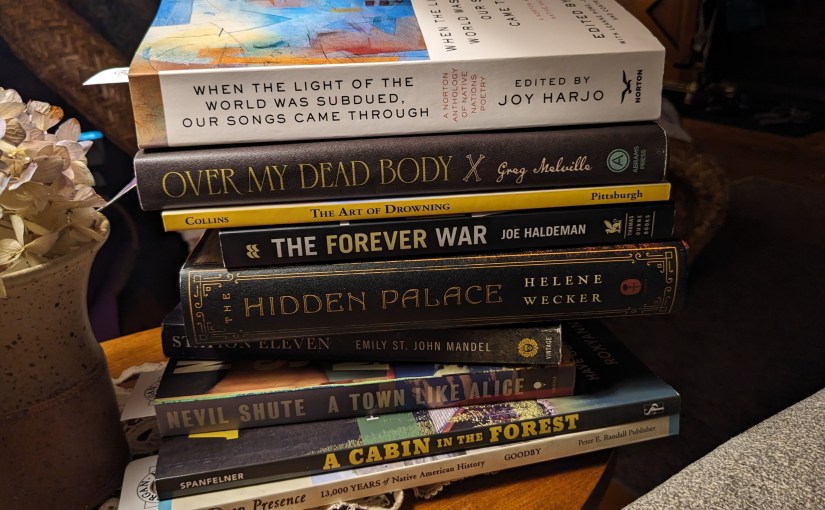
ANYWAY, my point is that this is a stack of books I brought to a cabin in the woods without the intention to show off. So it’s very authentic. Except for the bit where it represents who I wish I was to myself, as opposed to whom I am (which is a person who reads a LOT of comic books before bed, and trashy novels in the bathtub).
My only regret, such as it is, being that I JUST finished one of those gnarly and deeply intellectual books of a level of academic interest and vocabulary that one leaves conspicuously on the coffee table for years praying someone will ask if you’ve read it so that you can affirm “Yes, it was excellent. Let me tell you about the Appalachian Orogeny.” According to the image search I just did (I found it unlikely I had not managed to SOMEHOW work it into the social media record that I was in fact reading such a weighty tome), I have been reading it since January. The fact I finished might be a miracle on the order of the weeping statue of Akita.
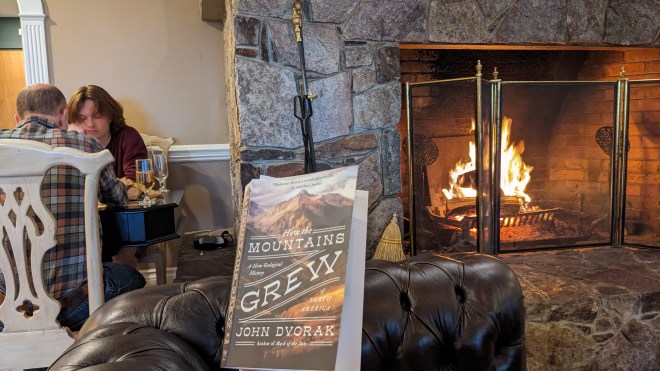
But How the Mountains of North America Grew was actually a GREAT book, if only consumable one chapter a week. When backpacking last year, I had a life-changing encounter with a geologist at the Carter Hut who spent a captivating two hours regaling an enthralled hut about the history of the world leading to his truly novel proposed solution for combatting global warming. I loved his enthusiasm, and was thrown back to a teenage romanticism about the name of the proto continent from the Ordivician upon which my home is built: Avalonia. So while I was making bad decisions in a book store this winter, I came home with this tome of geography with the intent to be able to look at the rocks under my feet with greater understanding. I still can’t tell a schist from a gneiss, but I did find the books strangely reassuring. I actually also learned a bunch of stuff I didn’t know before. Like about how the planets moved in their orbits as they formed. That the earth at some point had rotated north to south (part of why there are tropical fossils in the Arctic). That there’s a single geological corollary to global warming (much slower, but we can learn). That big continents lead to iceball planets and smaller ones to more temperate, or even warm planets. How much hotter and how much colder it’s been. That our planet has had three vast universal continents and will have a fourth and final one before Earth’s heat is spent and we move no longer – and that to-be continent has already been named. That it looks like agriculture staved off an ice age in the Holocene. That the boundaries between eras are geographically specific with a golden spike – and that geologists have just selected the spot for the distinction between the Holocene and Anthropocene. I love learning new things, so it was worth having to look up some of the more confusing vocabulary multiple times, and STILL not having him talk about the gigantic 10,000 foot volcano that exploded in New Hampshire 122m years ago leaving behind its magma chambers (an element in my new book, which is why the omission is so tragic).
ANYWAY. That book isn’t in my current “to read pile” so I will not speak of it here.
What is in my pile? Let’s go bottom to top:
A Deep Presence: 13,000 Years of Native American History by Robert Goodby was just added to my collection today in another ill-advised trip to a bookstore. In my defense, it was raining. I’m also really, really interested in the history of the folks who lived in these lands before us. And it’s surprisingly hard to track down anything readable on the topic – never mind having had even the vaguest introduction in formal education. I was answering a QR code on a lamppost in Cambridge about how I learned about indigenous people in school and was contemplating just how profoundly influenced I was by Ken Thomasma visiting my elementary school in 2nd grade. I spent the next five years pretending I was Naya Nuki. But the East Coast folks had 200+ years more erasure than the Shoshone, and it’s much harder to find their stories. I’m pretty pumped about this one.
A Cabin in the Forest by Roxyanne Spanfelner. Completely and totally unrelated to my desire to be Naya Nuki, I’ve decided to feed my fantasy of a cabin in the woods with some books so I can claim to be doing research. Why, just today on a long drive I solved the problem of my husband not wanting to do hot tub maintenance by putting a hot springs on my imaginary property! This is the kind of innovative thinking you get when you read. I have not started this book. I probably should write to the author with the “hot springs instead of hot tub” tip for husbands who don’t want to use their degrees in chemistry.
A Town Like Alice by Nevil Shute. Fun fact: my parents got my name from a Nevil Shute book called “Crooked Adam”. “A Town Like Alice” is on the list of books I’ve always thought I ought to read, that everyone loves and raves about, and that I have never read. If we’re being honest, I will never read this book. Unless that whole “solitary confinement thing” happens. For the record, that did actually happen to me once and it STILL wasn’t enough to get me to crack the covers on Piers Plowman which will still be unread when the Anthropocene turns into the Cockrochocene.
Station Eleven by Emily St. John Mendel. This book looks really good. I’m sure I will enjoy it. I will definitely read it BEFORE “A Town Like Alice” and WAY before “Piers Plowman” – but I think it’s been traveling in my to-read pile for a year, and this is likely its last chance before I actually give up on it.
The Hidden Palace by Helene Wecker – I read the first book in this series and enjoyed it. I am about halfway through the second book and er… not gripped. The several years between readings have not improved my recall of secondary characters. This has a very mild chance of actually getting read so that I can stop thinking I should finish it.
The Forever War by Joe Haldeman. I’m wanting this to be a bit like Scalzi’s Old Man’s War. I mostly listen to Scalzi on audiobook (which might have something to do with Wil Wheaton as the narrator), but mostly because his plots and characters do not require full attention to consume. This is in the Station Eleven likelihood zone.
The Art of Drowning by Billy Collins. Unusually, I don’t remember why this book entered my collection. I know I put it on an Amazon wishlist, and my husband dutifully bought it for me for Christmas. But why it was on the list? I do not recall. One of my friends just started an MFA in poetry and our back yard fire conversations have been a little hot and heavy on the meaning of poetry lately, so in my packing I thought it would be salubrious if I were to read up on some poetry that had been written in the last two centuries. Salubrious is the kind of word you suddenly know when you have taken up reading poetry for fun. I promise that I’m likely to read at LEAST three poems in this book, none of which will be limericks or start with the line “Roses are Red”.
Over My Dead Body: Unearthing the Hidden History of America’s Cemeteries I’ve always liked cemeteries and living in New England we have some very high quality examples of the art. So I’m always game for another discussion of how embalming is a Civil War artifact. This one actually had a couple interesting moments for me – it’s much more social commentary than I was expecting. But somehow in all my Naya Nuki heroine worship I’d never absorbed that NINETY PERCENT of the people living in North America died when Europeans arrived. Holy cow. It’s staggering to imagine what that does to society, and when paired with an invading force with novel technology. Well. It’s amazing we have as many survivors and surviving stories as we do. Anyway, I’m about halfway through this book. I’ll finish it, but it wouldn’t be my top recommendation on the topic of dead bodies and what we do with them.
When the Light of the World Was Subdued, Our Songs Came Through. I’m not sure I would have dared buy this one today if I’d realized it was a Norton Anthology. I believe by law those can only be purchased by students taking the class and that you are actually forbidden from reading them cover to cover. But this builds on my theme of desired American understanding, and intent to read poetry that is not iambic pentameter (as much as I adore iambic pentameter). I read the introduction and first chapter on the front porch this afternoon, and really wish they had a map. My knowledge of tribal geography and the current names of tribes… well, let’s say the only reason I know that Diné = Navajo come from having free-based the complete works of Tony Hillerman in my bathtub reading time. (Which I highly recommend, btw.) Anyway, hopefully the book police don’t find out about me reading this one.
I like reading with real paper books best. But I also read on the Kindle (mostly novels that I can read in one or two sittings and by sittings I mean “in the bathtub”). I also listen to audiobooks on my drive. I prefer books I’ve already read or that aren’t too complicated, given my divided attention. I just finished “rereading” the “Rivers of London” series on audiobook (brilliantly narrated, may I add) and am looking for my next commute companion if you have any ideas.
So…. that’s what I’m reading. (Except I’m not reading, instead of reading I’m writing this post, which is deeply ironic if you think about it.) What about you? What are you reading? How much do you read? What do you make sure you always have with you but never read? What will you definitely read if you’re ever put in solitary confinement, but definitely not before? What do you wish you were reading? How do you read? Let me know!






 My Truant Pen