The Moon in the Sahara

I was flying at full gallop over vast black stone desert on a white stallion named Ayyur – moon in Berber. The red dunes of Erg Chebbi rose over the horizon, and as we drew closer the minarets of Merzouga rose above the heat shimmer like a mirage. “Zir” I murmured, and the already fast strides of the stallion lengthened until the hoofbeats behind me started to fade.

The scene I saw

This is not the opening line of a romance novel. It is, in fact, a moment that I lived through on Friday, in the life I actually live. It was also one of the most remarkable journeys of my life.
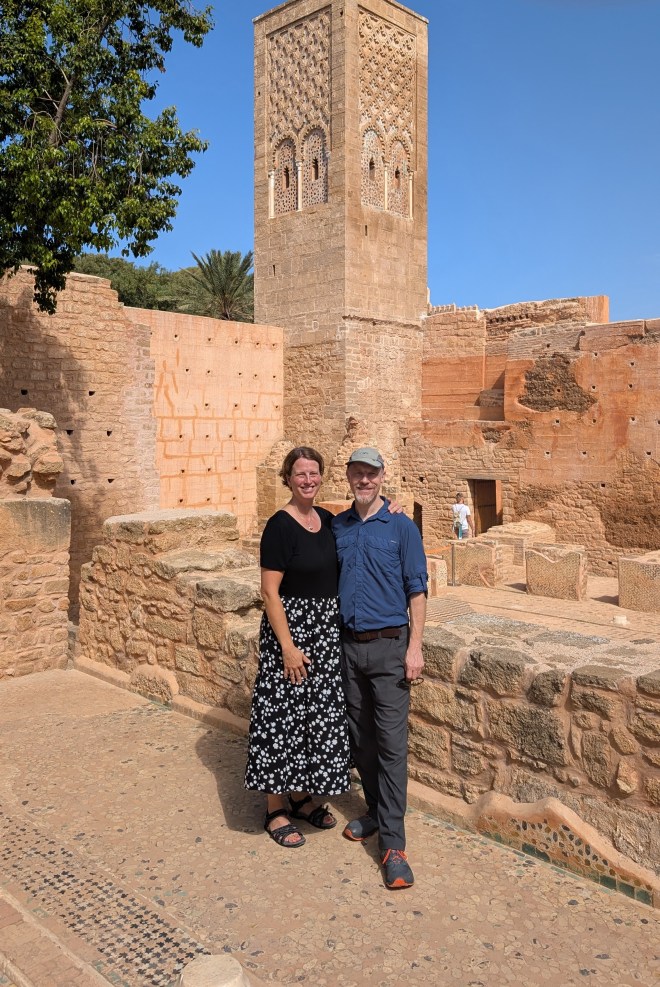
A white couple standing in front of an old yellow brick structure with a bulue sky above
The Chellah Necropolis in Rabat

My husband and I celebrated 25 years of loving marriage this summer. We’d thought of going to Italy, but couldn’t quite settle on what or where – the possibilities seemed too endless. But I read an article about camping and riding in the Sahara and I thought of the brief and brilliant glimpse I’d gotten a few years prior. I’ve never worked with a travel agent before, but I just felt overwhelmed by trying to find the thing I wanted that would be safe. (I was originally thinking of Algeria, but the terrorism warnings daunted me.) So I knew of a travel agent – specializing in adventurous crazy trips – and I reached out to her to see if she had some ideas. Jane totally came through for us! She put together a brilliant trip for us, finding some amazing options I would never have found in a month of boring-meeting Googling. (And amazingly the trip was much less expensive than when I had planned a similar one a few years ago – cooler stuff AND less $$!)
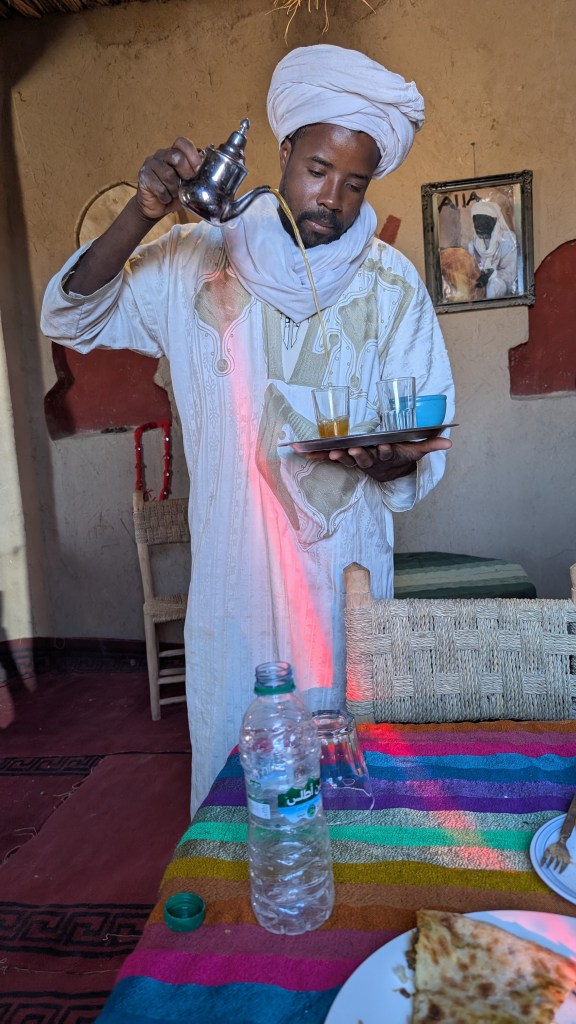
A black man in a white robe pouring mint tea from high up, with a strip of red light cutting across him like a sash
Lunch at the Cafe Alla where we encountered “Berber Pizza”

We had a great time in Rabat, but the adventure really began when we stepped out of the Jardin des Marzouga to an alley with three horses in it. We have ridden horses a few times before – but I’m not sure I’d ever galloped (at least on purpose). We’d taken a single lesson ahead of time. We packed our bike helmets and gel saddle seats (brilliant addition), but here we mounted our horses, abandoned our luggage, and started our adventure. It was tentative at first. How do I make this thing go left? Right? Faster? Slower? We tried our first gallop and the ground seemed to move very fast, very far below me. After our first lunch, a multi hour affair while our horses rested and were cared for in the heat of the desert day, there was a horse swap. I’m not sure what was up with my first horse, but it was scratched and I was give Ayyur. (My husband was taken from Ayyur and this is a great sacrifice of love that he barely complained about.)
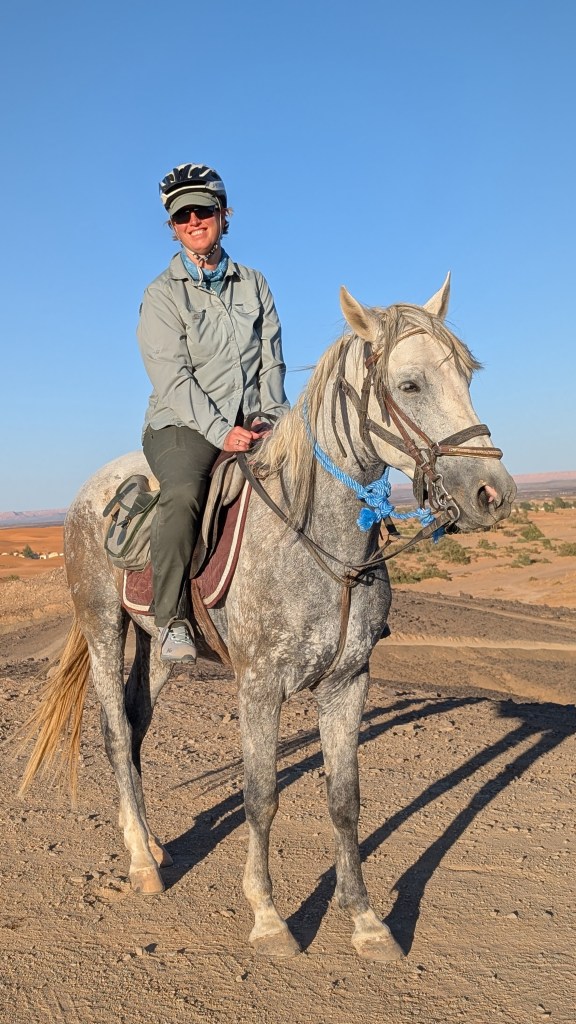
A woman in green pants and a green shirt on a white horse in a red desert
Ayyur and me

Ayyur is an Arabian/Barb stallion, and an absolute dream. He loves to run, and to go straight and fast. He was an easy horse to ride with a fast walking pace and faster gallop. I never had to tell him to go fast or go faster – my husband behind me would say “Zir!” to his stallion and Ayyur would break into a trot (which… Adam’s horse Sultan required a lot more cajoling to go fast and had a slower walk, so it wasn’t uncommon that he’d be trying to catch up).
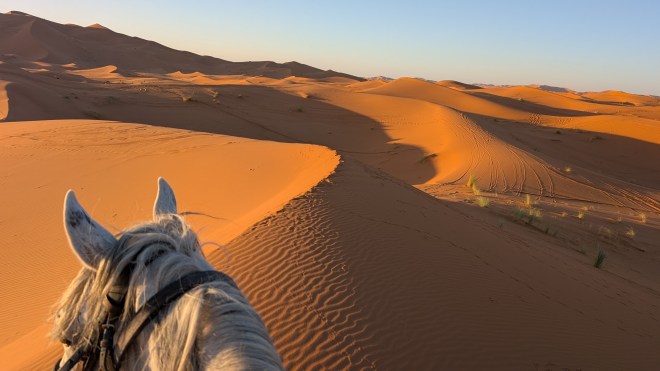
Red sand dunes with stark evening shadows, and the neck and ears of a white horse
The best view in the house

My friends. I have read fantasy novels all my life. I love historical fiction and fiction fiction and historical history. All these things involve horses. Much of the history of the last 3000 years horses have played critical roles. The very first chapter book I ever read was called “First To Ride” and was about the first person to tame a horse. Horses are in the Iliad (extensively). They play a role in almost every major battle, exploration, or journey. How many times have I read about horses, and riding horses, and horsemanship? But it’s all been theoretical. In America, they don’t let folks like me with little experience gallop across deserts (I’m sure for good reason). But to be on the back of a horse that loves to run, in the middle of a trackless desert (we started galloping only on soft sand where a fall was much less likely to end in tragedy). It was like seeing the sea for the first time, or actually touching snow after a lifetime spent reading about it. The power and speed and connection is unlike anything I do in my regular life. I am still not a horsey person, per se, but I get it now.

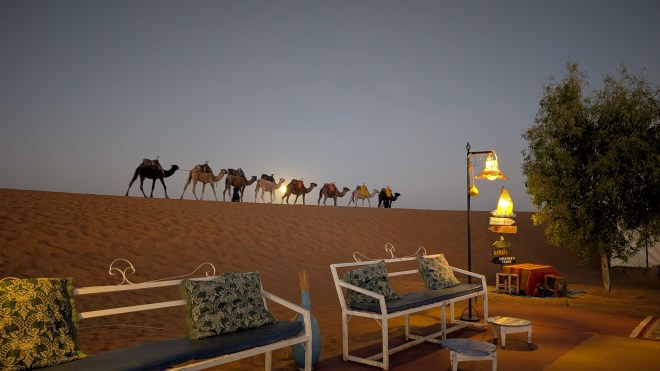
Goats watching moonrise
Just regular old camels by moonlight

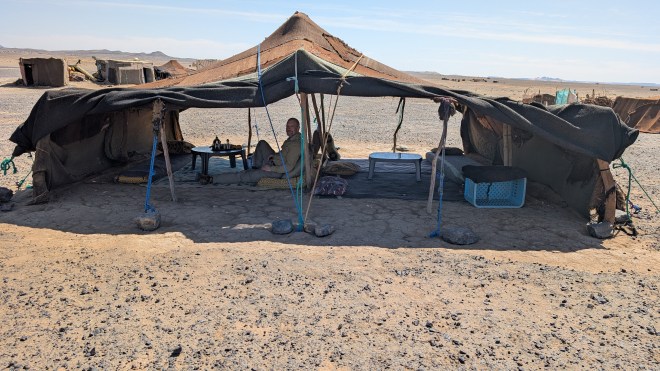
While I can and will wax rhapsodic about my mount, there were a couple other really high points of our journey. We spent 4 days with our horses and guide, Yassine. One of the lunch siesta breaks we spent under a nomad tent on a plateau between the dunes and the closed and highly monitored Algerian border. There were a number of nomad camps we passed that day – they were all very neat and orderly, but looked so hot and comfortless. I can’t help but think there are some stories there.
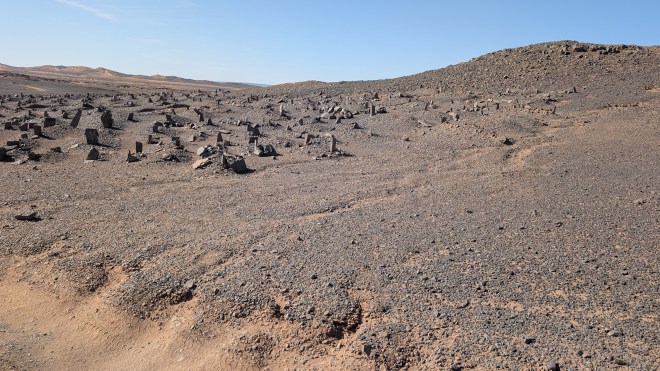
Amazigh graveyard – for a mining town that was vanishing into the sands
A low tent with only two walls, with sticks of wood and a roof of canvas. An American man sits in it and looks to the camera.
Siesta in a nomad camp

One of the afternoons we abandoned our guide and went with a geologist on a quest for fossils. The amount and variety of the landscapes in the Erg Chebbi is astonishing. And we were treated to seams of Ordovician, Devonian and Silurian fossils. You didn’t have too look too hard to find them. They’re being actively mined by hand with folks deep down in holes. We got to see a bunch of different kinds of fossil fields, and I hiked a small mountain.
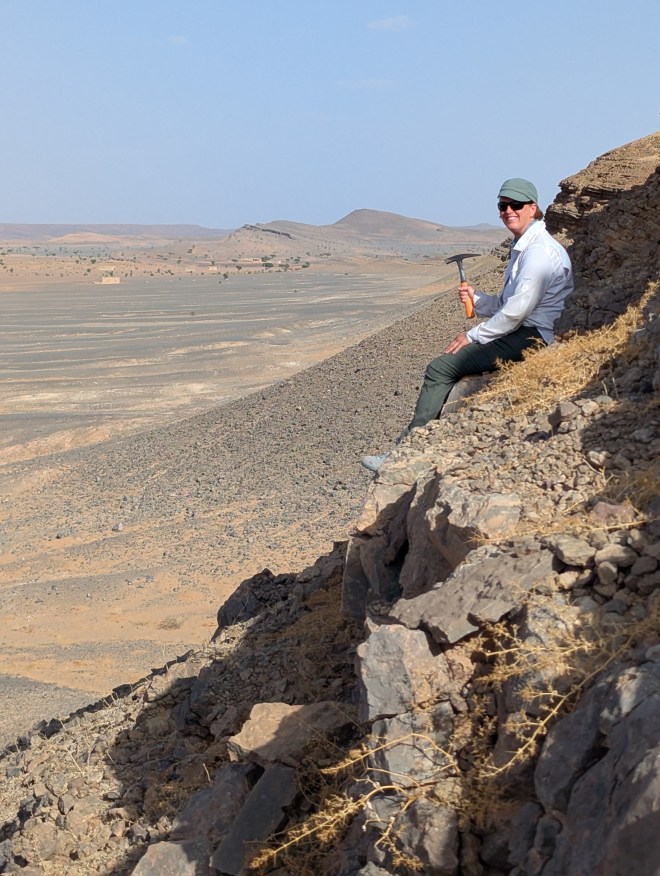
A woman holding a mining hammer on a very steep portion of a desert mountain
Getting up was the easy part. Getting down… I was half tempted to use that hammer as an ice axe.
A black fossil with incredibly dimensionality embedded in a rock in a plastic bin
I have never seen such a dimensional fossil. This one was in process of being liberated from its surrounding rock

After one brother (Hamid) finished teaching us about geology and fossils and showing us some of the incredible natural history of Morocco, he brought us to the most remarkable desert camp we’d seen: Andromeda Astro Camp. This entire camp is constructed around the stars and the need for dark skies. The meal was carefully planned around the arrival of real dark and the moonrise. All the lights were pointed down, and dimmed as we were walked by brother Moha through the constellations and stars – both the traditional western versions and some of the Amazigh legends and sky-scenes. The camp was so incredibly amazing and comfortable that Adam and I were bummed that we weren’t staying there. I would HIGHLY recommend to anyone who values quiet and dark and learning.

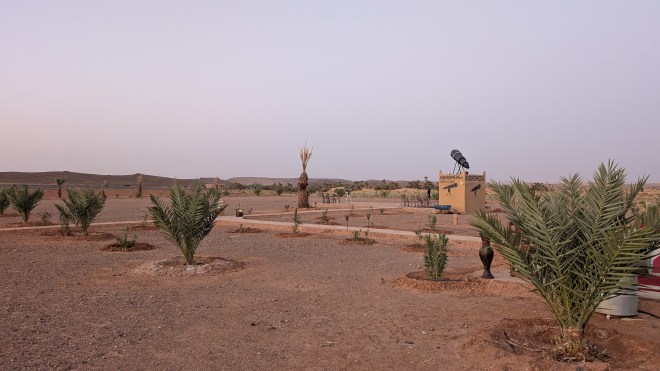
A couple on the top of a dune, with a long expanse of desert and the setting sun
Watching the sun set from the Andromeda camp
A view of the desert with a huge telescope and pathways
Andromeda Camp

That night, though, we were slated to spend camping wild (instead of glamping). Hamid drove us through the dark night across trackless deserts, with the moon chasing behind us. As we got closer he started slowing down, being guided in to the spot by a blinking flashlight wielded by Yassine, our guide from Merzouga Horse Riding. He’d set up our tent and a table in the interstitial dunes between desert and oasis. It was amazing. We sat in the dark of the night, drinking Moroccan mint tea (or as the joke we heard in nearly establishment named it, Berber Whiskey), and marveling at what our lives were in that quiet moment. Truly, it’s hard to express the peace and contentment from being honestly tired, greeted as a welcome guest wherever you go, climbing mountains, riding horses and listening to the desert winds. I never wanted to leave. To fall asleep in true quiet and dark, with the only sound being the nickering of the horse you’ve started to love picketed nearby. Well. It’s hard to explain how incredible that was.

A night scene with a few tents and horses picketed nearby
The campsite
A brightly lit green tent in a desert setting, with stars shining above
It was even more peaceful than it looks

There is so much more to be told, and felt. But I do not wish to bore you. I do want to remember every bit of this trip. And I do want to commend to you the wonderful things we found there –
* Our travel agent, Jane, who put this all together
* Merzouga Horse Riding – the kindest guide, the most incredible experiences, and possibly the best horse out there
* Andromeda Star Camp – doing cool stuff that is different from the standard and requires courage and conviction. To value darkness and silence in a brightly lit, noisy world is precious and rare.
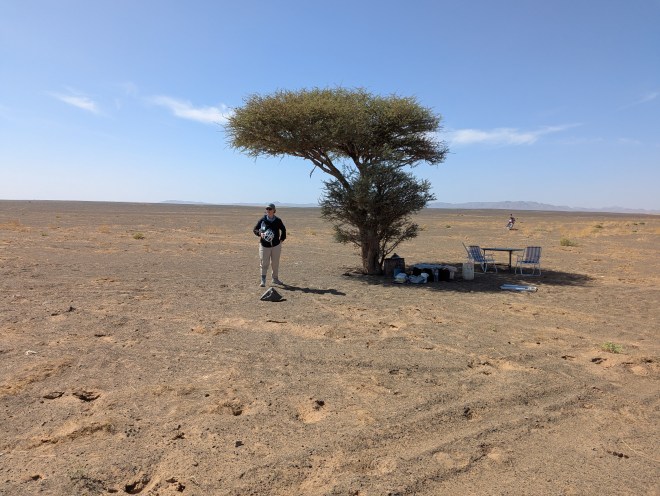
A woman standing under a lone acacia tree. In the shade of the tree, a table has been set.
Our lunch spot the last day

Drop me a note if you want more details! And if you want to see what I mean by a gallop – here is one (I’m the one way ahead).
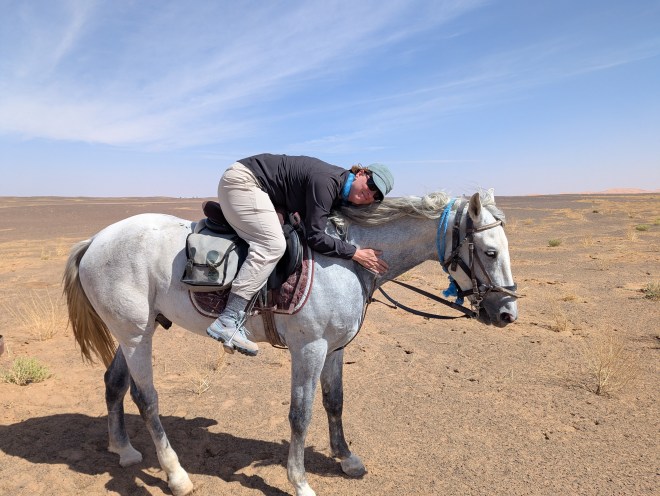
A woman hugging a horses neck from the saddle
I did not want to give Ayyur back!

A little bit of earth

I’ve always loved the idea of gardening. I was deeply influenced by the books available to me as a girl, and one of my spring favorites was “The Secret Garden” by Francis Hodgson Burnett, which spoke of the healing power of green and growing things, friendship, gardens, sunshine and good food. Many of my views of the world have shifted since I was a 9 year old in a farming town in Eastern Washington, but I still hold the virtue of those things.

As a side note, I think the current generation (and my more urban colleagues) just do NOT understand what it was to be book constrained. I’d read out the school library within weeks – at least of books interesting to me. The library in our town had a librarian deeply suspicious that we could possibly be reading what we were checking out, and wasn’t that much bigger anyway. We used to drive once or twice a month for an hour to go to the “big city” (editor’s note: NOT a big city) to go to their library. My sister adjusted by vastly expanding the realm of what she was interested in. I, on the other hand, read the same books over and over and over again.

Anyway. Love of gardening, right there with my love of survival (My Side of the Mountain) and love of native culture (Naya Nuki: Girl Who Ran). But alas, I am no gardener. Not least because I’ve spent the last 20 years with a farmshare, and the LAST thing I needed was more zucchini. But the urge. The urge is still there.

We are in the Zeno’s Paradox stage of our year long home renovation project, where we’ve been a week away from done for a month or two now. (Stupid rain. Can’t paint when it’s raining.) But I finally decided that a garden couldn’t wait on trivialities like whether we had gutters installed. I did mostly wait for them to lay our new walkway (due to the excavating). But my plan was to replace what had been a front yard with a front garden.

We lost quite a bit of the front growable area due to doubling the size of the room that was our front porch and is now our solarium and balcony. It was already postage stamped sized, and mowing it took more effort to lug the mower from the back yard than to actually push it around. Resodding seemed like a mistake for such a small area. But it’s quite shaded, and a little hilly. And there are gas lines, sight lines, sewer lines and a brand new Cultek rainwater system to think of. I decided on three governing principles:

1) Shade
No pretending it’s full sun. It’s not full sun. Parts of it are a lot closer to full shade. Don’t even try to tell me that the 30 minutes of direct sun it gets between May and September on sunny days = full sun.

2) Edible
I am not doing the farm share this year. So my tolerance for a harvest is higher than it’s ever been. In fact, I don’t quite know what to do with myself if I don’t have an excess of some sort of produce. I’ve been thinking about my favorite parts of the process. I love making jam, which there are plenty of stuff that suits itself to jam. Making pies likewise is vastly appealing. But I’ll add to the the list syrups, which I like to add to seltzer water in lieu of a soda. And also the fruity toppings for cheesecakes. So things like serviceberry, aronia (chokecherry), or rhubarb. I’ll have a few things to do with them.

3) Native. At least ish.
I’m on a quest to eliminate invasives. But also, there’s an entire lexicon of American native fruits and vegetables we don’t eat. Not because they aren’t tasty, but because our colonial forebears preferred their familiar versions. Johnny Appleseed walked across our country spreading (cider) apples, but pushed aside the pawpaws that had been eaten in those places for millenia.

And then of course, there’s beautiful. Sometimes a girl just needs some peonies.

I spent the winter poring through seed and plant catalogs, making purchases that would come as a complete surprise to me several months later when they finally shipped. And then I discovered that Mahoney’s Garden Center had all those obscure natives and some I had not dared to imagine would be purchasable, that were only on my foraging list.

Here’s a quick rundown of what I put in my garden, so far. Let’s see what survives.

Shadblow Serviceberry Shade, edible, native
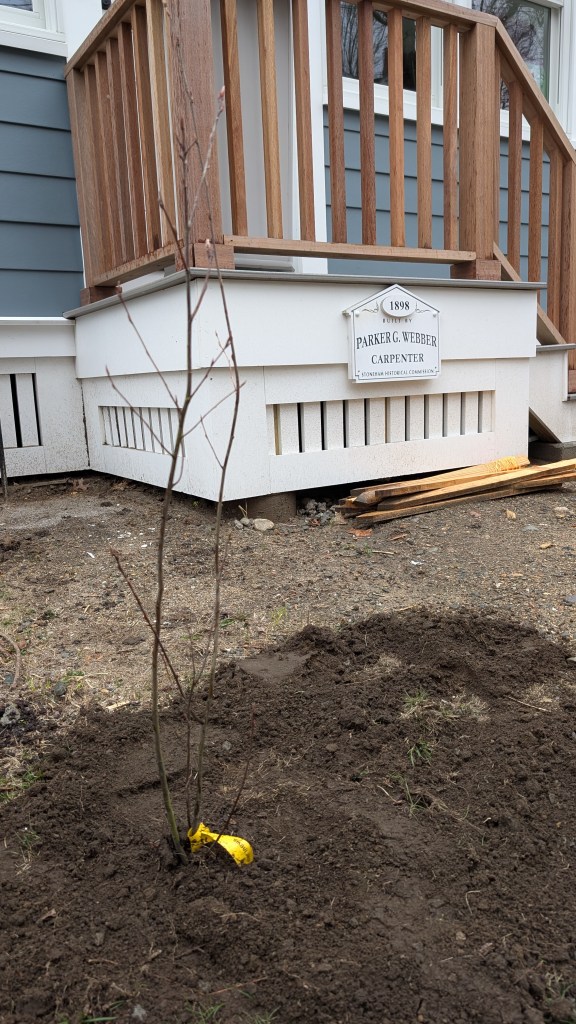
I only get one tree in this space, and I’ve dedicated my one and only shot to the serviceberry. The serviceberry (or Saskatoon or Juneberry) is both edible and delicious, with a rich heritage. If you don’t bother picking it, the birds will do it for you. It’s a favorite. It’s also a beautiful tree in blossom and in fruit. It doesn’t get too large (12-14′), and has beautiful flowers. I mean, I already have three pawpaws in back. I could stand more variety. I’ve, of course, never HAD serviceberry, so hopefully I like it! It will likely be several years before I see anything.

A tiny sapling planted in a barren yard
Doesn’t look like much – but remember this in a few years.

Canadian Ginger Shade, edible, native
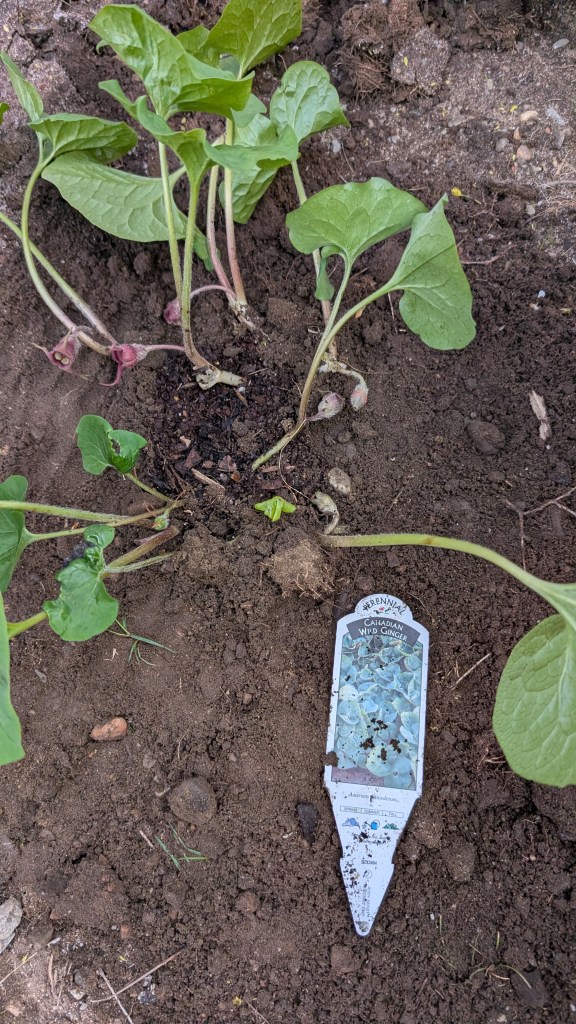
I was SO EXCITED when I saw this at the garden store. I hadn’t even thought to have it on my list. But it is a shade lover, ground cover with a strong edible contingent and really weird, cool flowers. I’ve been thrilled at how it immediately bounced back from transplant and got right on the growing business. I’m not sure how much actual ginger I’ll get from my little garden, but it’s the possibility that matters, right?

A recently transplanted Canadian Ginger with the card. You can see some neat low flowers.
It now looks like it’s never lived anywhere else.

Mayapple Shade, edible, native
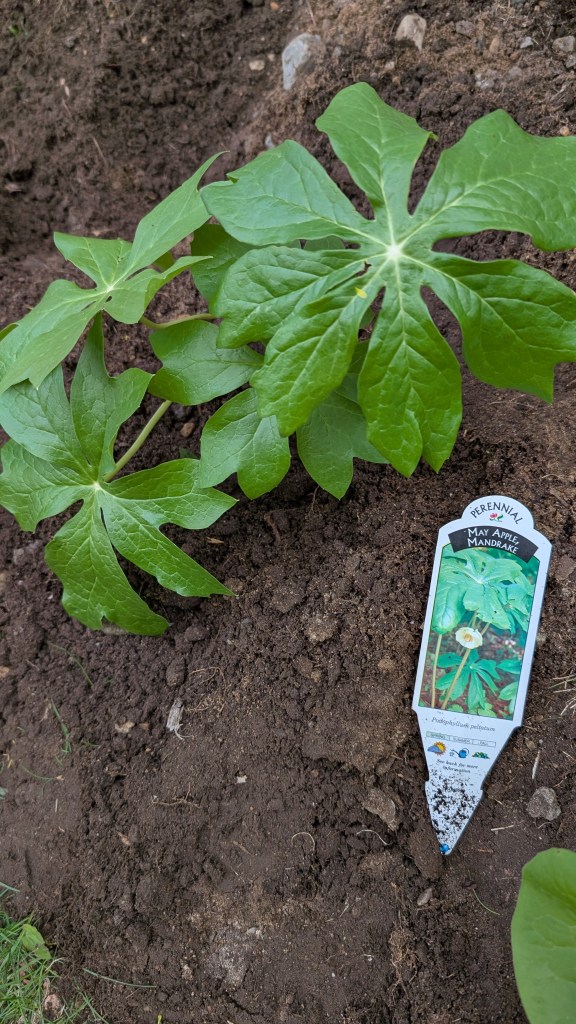
This one has been on my “want to forage” list for a long time. I’ve found it twice – but neither time has the fruit been ripe. I love the cool shape of the leaves, and I had no idea it was possible to purchase for a garden. This one is having a harder time acclimating (I actually think it’s getting too much sun, which will improve when the serviceberry is less stick-like). I doubt I’ll get any fruit this year, but it will be a lot easier for me to get the timing right when it’s literally out my front door. I went from excited to unreasonably-excited-for-an-adult when I learned it was a MANDRAKE. I mean, share some awesome with other plants, mayapple.

Some glossy green-leaved low plants
I adore those leaves

Rhubarb Edible
I really don’t like hostas. But they play an important role in the garden, where that role is “relatively low mounding green thing that doesn’t get in the way of the pretty plants”. But when I was pondering whether the local farmer’s market would open in time to get rhubarb this year (it’s often almost over before they’re open) it occurred to me that I could fill the ecological garden niche of hosta with a plant I liked a lot better. Plus, it’s ready for preserving before I get overwhelmed in fall! But it’s an Asian native, and needs close to full sun. Grey loves eating raw rhubarb.

Native flowers
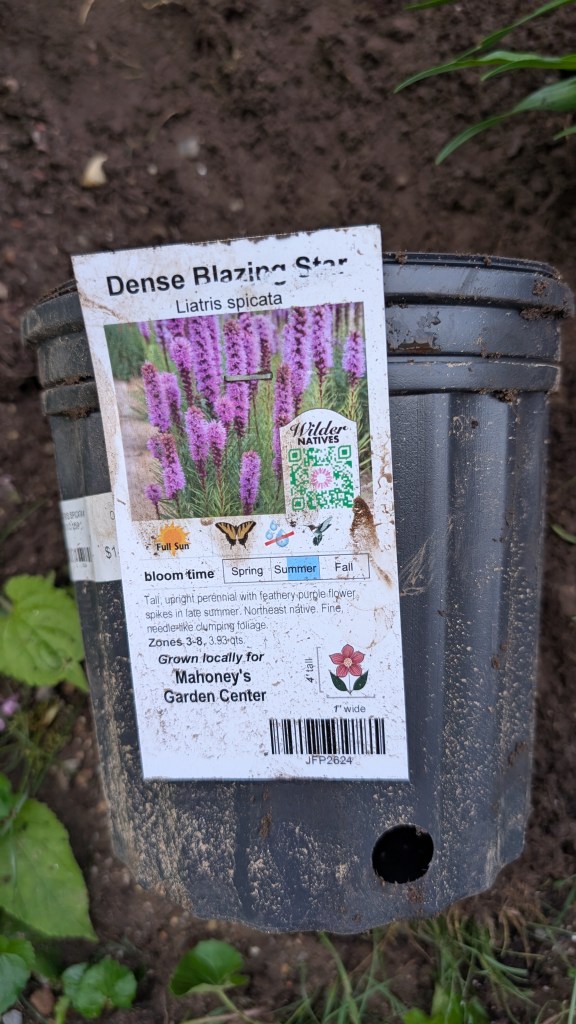
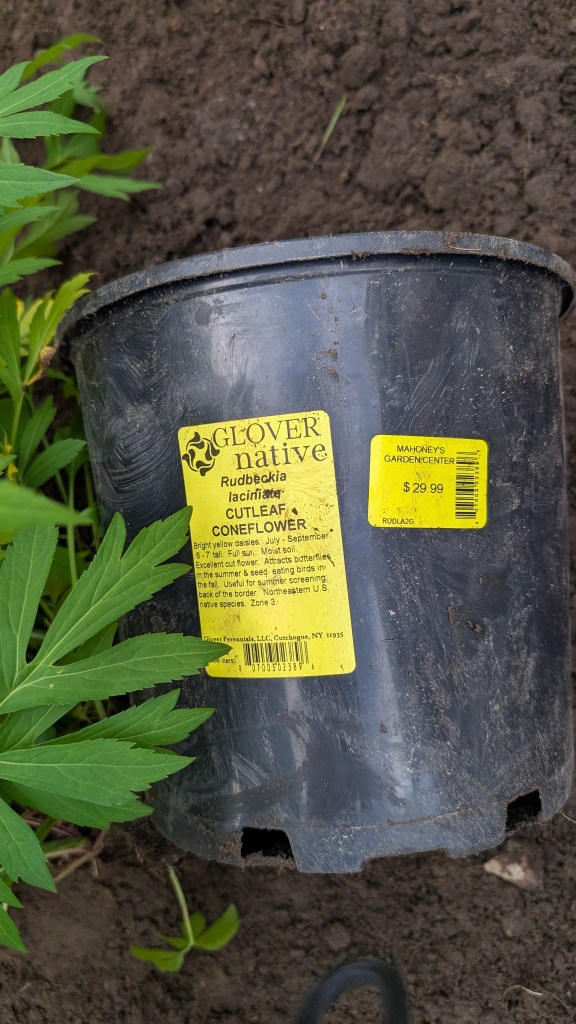
There’s variation in JUST how much thinking I did. Some of these I thought about a lot. Some were like thinking of a perfect friend for a job. But I also went to Mahoney’s and just bought some native local flowers that looked cool. On that list I have Blazing Star (which I’m not sure I’ve ever even seen), Stonecrop which I had before and is never without bees, Shasta daisies with their long bloom, and a monumental cutleaf coneflower which I might not have read carefully enough gets 6-7′ tall. I planted that in front of the hose. We’ll find out which are friends, which are foes, and which doe well in their roles.


Just Pretty
I managed to rescue our bleeding heart from before construction. I think it got dug up and replanted three times. But while not going gangbusters, it survived! Also, well, you have to be pretty hard-hearted to create a garden and make no room for peonies. I planted creeping phlox all around the edge of the garden.

Strawberries & lupine
Over on the other side is my “kitchen garden”. Lupine doesn’t really count as native since I got a copyrighted cultivar (that was before I had my rhubarb revelation or things might have gone differently). But I have such fond memories of the alpine lupine on Mt. Rainier, and it’s taller brethren in my Washington home. I had another stroke of brilliance that surrounding the lupine with five different varieties of strawberry, for a summer where there will always be a mouthful, and to find out what does well in my spot.

I took a picture of each strawberry in situ so I’d be able to identify it later.

Walkway
Around the beautiful stones carefully laid down by my handsome husband, I planted four varieties of creeping thyme. The thought is that when mature, each step home will release a rich fragrance. They can handle light traffic. And it will help prevent erosion, right?

Kitchen garden
Abandoning all thoughts of natives, my herb-centric kitchen garden includes: two kinds of basil, chives, garlic chives, parsley, mint contained in a pot, celery (I’m curious), dill, rosemary, arugula and an actual planting of thyme for culinary purposes (although you can use the creeping thyme). I would plant cilantro but man that always bolts SO FAST!

My kitchen garden

And now I’m at the phase where every day, sometimes twice I day, I’m staring at the new leaves on my serviceberry, or pondering if my new peony just grew another inch. Is my mayapple acclimating? Are there any hidden strawberry blossoms? It’s such a glorious and hopeful waiting, the new garden. And in a month or so, after the 4th, I’ll go again to Mahoneys and come home with more summer treasures for my waiting garden.

Open my eyes, that I might see

Two weeks ago I went to my eye doctor for that irritating annual appointment that they require if you want to wear contact lenses. They asked if I wanted to pay $40 for the picture of my retina. I don’t do that every year, but every so often it seems fine to check. The optometrist took a look at it, and showed me some pictures. She handed me a pamphlet for foods with lot of lutein and a preliminary diagnosis of macular degeneration and something else I didn’t even hear after I heard the words “macular degeneration” – which I knew to lead to incurable blindness. I managed to significantly fail an exam I’d never taken before. Good news though – my prescription hadn’t changed! I had no symptoms anything was wrong.

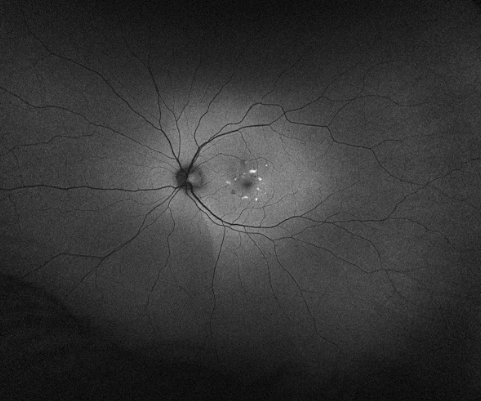
A black and white picture of the inside of an eye with the optic nerve visible and a white circle around the fovea
The white dots around the fovea are the area under question

One of the advantages of middle age is you’ve learned not to panic. I remember at 22 I found a lump in my breast and spent the time between diagnosis and follow up convinced that my life was too beautiful to be allowed to continue. I would leave my beloved groom a heartbroken widow at 25! I would never have children! I hadn’t been to all that many funerals, but the “Sleepless in Seattle” veiled funeral in a hilltop with a beautiful view and distraught mourners seemed about right. It was, my friends, happily just a weird lump.

Since then I’ve had a number of life-changing initial diagnosis that didn’t happen. I mean, just 18 months ago I wasn’t going to be able to hike again with degraded cartilage and too young for a knee replacement. That was actually an infestation of knee mice, easily solved with a scoping and I was back on the mountain not two weeks later.

Still, it’s an arresting thought that you might be going blind. I’ve always been imaginative and somewhat romantic, or dramatic. I’d look out the window while I worked and look at the blush of sunset over the trees where the hawk reposes and wonder how many more sunsets I would have. I looked at my paints and my papers and the unfinished paintings strewn across my desk. You’d think I’d be most grief stricken at giving up art, but instead I was DEEPLY grateful that I’d spent the last five years practicing LOOKING at things – really seeing the color of the snow, or the way light played through leaves, or the blueing of hills as they fade into the background. If I were going blind, that rich set of memories would be a consolation – to have known something better before you lose it forever is better than having taken it for granted.

And going blind sure sounded like it was an option.

I was not consoled when the ophthalmologist would see me in the next week. It’s not a great sign when the specialists are suddenly available. I went to see the owner of the practice, who had many decades of experience under his belt. He got still and sober when he saw my images. (Of course, we can never trust anyone else’s tests. For the second time in a week I got my eyes checked for glaucoma and dilated etc. etc.) He asked where I had grown up – which in my case is tropical Africa, home of mysterious diseases. No really, my birth country is where most of the really bizarre ones lately have come from. This was not a reassuring set of questions. He said he had no idea what it was (and he spent like 5 minutes trying to figure out the closest ICD10 code) but it seemed like an emergency and I needed to go see a retinal specialist ASAP. It was after 4, so they said they’d let me know the next day when the appointment would be. He affirmed that blindness was a real possible outcome here.

In good news, I didn’t have to wait long. In bad news, when a top specialist will see you tomorrow you don’t have what you might call warm fuzzy feelings.

I sat in the waiting room, the youngest person there by 20 years, not excluding the caretakers bringing tottering nonagenarians with rhuemy eyes, as my pupils grew larger and larger and my phone grew less and less visible. I couldn’t help but wonder if this was some preview of the gradual indistinction ahead of me. How do blind people distract themselves in waiting rooms? Audio books?

The retinal specialist had clearly once read a book on bedside manners, which he executed by rote. (The consensus in the waiting room was “he is fast” which is a lovely way to describe brusque.) But you don’t go to an expert because they make you feel good, you go because no one can figure out what’s happening to you, and they’ve seen hundreds of thousands of sick eyes and may know what they see.

Not to keep you in suspense, but the news is as good as it could be. He said, with brisk certainty, it’s Pattern Dystrophy. A genetic (not bizarre tropical) condition where the garbage removal system of the eyes doesn’t do all it’s supposed to and leaves mounds and caverns in the macula. The prognosis, he said, was good. Very very few people with this condition lose their sight and most are able to drive or read a newspaper their whole lives (or until they get something else). It definitely isn’t macular degeneration. He was, he said, comfortable leaving it there and just monitoring it. We could also do a formal diagnosis, and it turns out that The Dude Who Studies Genetic Retinal Diseases works at Mass Eye and Ear. So I’ll go do the formal thing and maybe enroll in a study. This is different than not having ANYTHING wrong with my eyes. I am now able to identify some … wobbles in my vision. Some of what I was figuring was just being that age is actually these deposits.

The only thing I need to do is to look at the Amsler Chart regularly to make sure no enterprising blood vessel decides to make a break for it through the thinner covering of my eye. This is the test I unexpectedly failed in the first appointment. Look at the dot in the middle of the grid one eye at a time. Do all of the lines stay straight? They don’t for me. There are wiggles in it. I was charmed when I first saw it. How do they do that optical illusion? But the illusion was actually the distortions in my macula.

A grid with a dot in it
The Amsler Grid

One of these days, I won’t be able to dodge the diagnosis. The lump will be cancer. The knee will be shot. The spots will be blindness. We all die of something, and we’re lucky in a world with good medical care (at least for now) which means many of us end up surviving things like cancer to go on and die of something else. But yesterday I watched the sun blush the snow-covered top of Nobility Hill and smiled to know I’d get to keep on watching that scene for years yet to come.

The Iranian Chest

My in-laws spent their working years in Saudi Arabia, working for the Arab American Oil Company. Well, he did. She taught ballet to princesses, ran the high school musical, created works for art and visited the souk very regularly. When they came back to the states, the always generous benefits included moving the contents of their household. This is the only explanation that can exist for how an incredibly, incredibly carved wooden display case with thick glass doors came from swirling deserts sands to suburban New England.

A five foot tall dark wooden display case with four glass front panels. It's heavily carved and filled with glassware.
The Iranian* Chest**

We call it the Iranian Chest. But, as was her wont, the card for the purchase has been kept with it. The address clearly shows the store was the “Arabic Palace of the 17th Century, in the middle of the Street called Straight, the largest oriental store. Damascus, Syria”. It’s origin is the street on which the Apostle Paul was baptized. So while the piece may well have been made in Iran well before the Revolution, that’s part is shrouded in mystery and history. It’s also not a chest. Miriam Webster defines a chest “a container for storage or shipping
especially : a box with a lid used especially for the safekeeping of belongings”. This piece of furniture is certainly not a box for shipping.

A black and white tiled room with a couch and chair, a chest and a wooden table. It looks slightly sterile and unlived in.

After six months of expense, irritation, dust, construction etc. our new room – the solarium – is ready for occupation. The furniture arrived on Saturday, and sits sort of awkwardly in a corner waiting to be lived in. I spent all yesterday visiting consignment stores trying to find inspiration for the right piece of furniture. (Why consignment? The color of the decade in furniture seems to be beige and I want this room to be rich in depth of color and pattern. So used furniture will suit my needs much better. Plus I like it.) I found this great side table, which I meant to take the place of the chest, for $60 with tax, but it’s too tall for a coffee table. So the quest continues.

The above described Iranian chest in a different room with two boxes on the top.
The prior locale for the Iranian Chest.

From the beginning, we’d had plans from the beginning to make the awkward corner of this new room the home to the glassware and barware, mostly because the dimensions suited the Iranian Chest perfectly, which had previously lived slightly awkwardly in a corner of our living room.

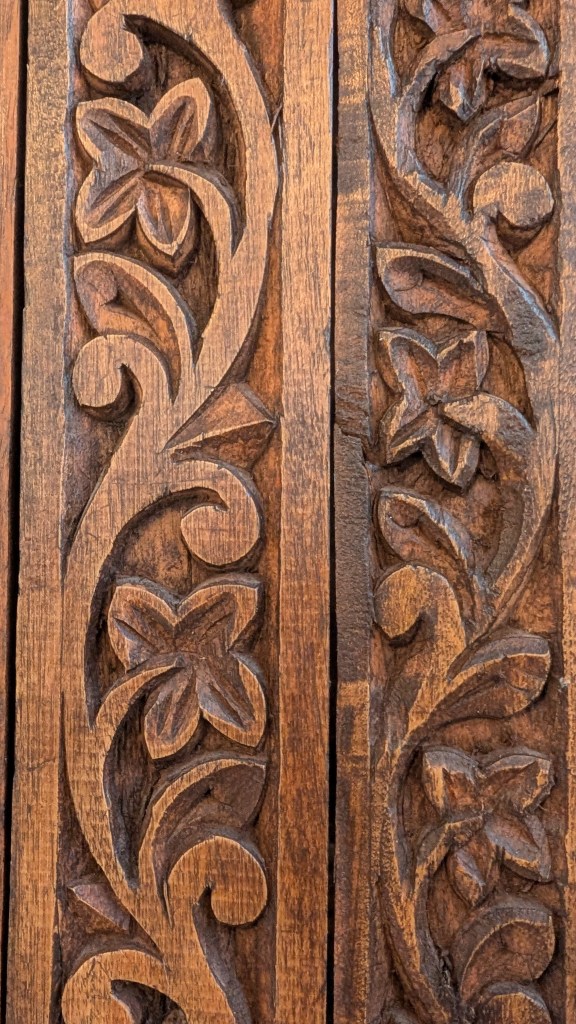
For the first time in the life of my children, I cleaned out the chest thoroughly, marveling and wondering at it. It’s an object that has real presence, and one that has forever been in my sons’ lives. I find it a bit of a contradiction. The entire front, with a clever double-hinged set of doors that allows it to open more than 90 degrees, is heavily carved with a rich floral pattern, hiding the second set of hinges. It has clawed feet raising it up off the floor. The top lip has a cresting wave of flowers creating a protective ridge for whatever is placed on top of it. But the actually wood, despite the excellent workmanship on the carving, is as rough as it had come out of the planer. There’s no attempt at sanding or polish. It’s richly stained, but you can see that the color of the underlying wood differs significantly. And in some spots – especially the wood keeping in the glass panes, it’s clear that the wood is either of poor quality or very, very old. Or both. I have no idea how old this chest is, other than “older than 25 years”.

A close up of richly carved wood in a floral scene
Hand carved do you think?

The real terror of this piece of furniture, though, is the glass. It has two glass shelves and they terrify me. If you are older than 40, most of the glass you’ve dealt with is delicate, generous, light… safe. You missed the era of the true plate glass. The shelves are the better part of an inch thick. In one or two spots, they’ve chipped off and bend the light with a wicked carelessness. The edges of the shelves are sharp enough that they’d slice flesh easily. And if they were to shatter, the shards would be fearsome foes that might, like a serpent, bit hard in death. I confess to wanting to defang this furniture. I’d rather buy some tempered high weight bearing, non-fatal glass and have it cut to size and fear my furniture less. But that’s the kind of thing you’ll “do later” aka when you’re dead and your kids inherit your stuff and have to decide whether they want to keep it.

A wooden display case with glass doors, filled with glasses and glassware (and tiki in the bottom)
All filled up and cleaned.

I wonder how many years it will be before the Iranian Chest moves from this spot. Maybe we rethink the room and move it again. (Or not – it was VERY HEAVY and I don’t think we could have moved it without moving straps!). Maybe it is here when I leave this house for the last time, and my sons keep it where it stood. Maybe something else. As I refilled it with the accumulation of glasses (mostly sets which have at least one broken), it pleased me to take a moment to truly look at – truly think about – something so deeply as I got to with this object today. It’s the first accumulation of memories in this new room, kneeling on this warm tile and putting memories back into an old object from another land and time.


The next day….

Having quickly written up the mystery and the artifact, and gotten into the car to go visit my eldest at college on a day best spent indoors with hot cocoa, I figured I’d call my mother-in-law, and get the actual scoop. This serves, I think, as a useful example of how my mind and imagination work.

1) She’s never called it the Iranian Chest and had no idea what we’re talking about. Only my husband has ever called it that.
2) It was purchased at Desert Dreams in Dhahran Saudi Arabia. They would take old furnishings or carvings like doors or windows and repurpose them to modern use. So the reason it looks like two totally different styles of workmanship and wood is because it is in fact from at least two totally different eras. She says that the front doors were reclaimed from old windows. I wonder if the hinging was original or added? I’m guessing original.
3) The card in it came from ANOTHER purchase, most likely of a marquetry backgammon set we have hanging on the wall of our game, I mean, dining room. She remembered George immediately.
4) Aramco would seriously ship anything home. This display case was bought probably 40 years ago.

Tanque Verde with Shari Blaukopf: or MISE West magnificence

Last year, I decided three days before the start of the workshop that I wanted to be in Tucson, painting. My watercolors were not dry in the palette before I was on a plane to Arizona (and in point of fact I finally got the last of the gold-green explosion off getting ready for THIS year). But I’d fallen in love with Tanque Verde Ranch last year, and thoroughly enjoyed my first foray into urban sketching with Shari Blaukopf as part of the extremely well-run Madeline Island School of the Arts (MISE). So this November, as things started to darken, I figured that it would be the perfect time to spend a week with the only distraction from watercolors being the superb food dished out three times a day by the friendly and talented staff at the ranch.

In 2024, I’d been four weeks post-op from knee surgery, which somewhat reduced my hiking aspirations but not at all reduced my hiking longings. So this year I gave myself some extra time before and after to hit the iceless mountains of the Sonoran Desert. If I’m all praise for the actual workshop, I have nothing but calumny to pour on the heads of Payless Car Rentals – which kept me and dozens of others waiting for 3+ hours for the rental cars we’d reserved, or the Hilton resort I stayed at which sneeringly told me that if I wanted to charge the EV rental car which had been my only option I was welcome to spend several hours hanging out in the parking lot of town hall to do so… but I’d find no welcome in their facility.

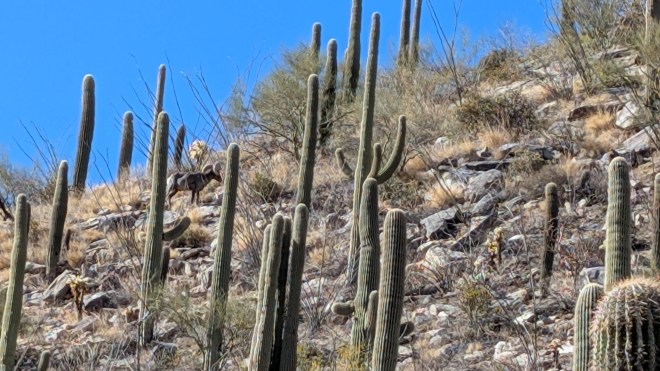
I still managed to get in a good hike, but these shenanigans probably took 3 miles off my intended course with their time suck. I digress. I had a great hike, and managed to see THREE big horn sheep which was really cool and also they are extremely hard to pick out.

A rather pixelated photo of a hillside covered with saguaro cactus. You can just barely make out the shape of a big horn sheep on the hill.
It’s not AI, I just had the digital zoom cranked up all the way so you could see this bad boy.

My usual self is a lot of things to a lot of people: mother, wife, friend, daughter, employee, boss, mentor, board member, volunteer… the list is long. I love all these things and wouldn’t set them down. But the allure of going somewhere where no one knows me and I don’t have to live up to anyone’s expectations of me is strong. My mother has a hilarious schtick about her belief about going to college, and how she’d finally be the lay-dy (you should hear her say the words) she knew she was in her heart of hearts. I went in with the same idea. I’d be reserved. Quiet. A mysterious presence who spoke only with her brush and astonishingly beautiful selection of 37 colors (none of which was Prussian Blue, to the astonishment of all assembled). For once in my life I’d be quiet. Fade to the background. Unobtrusive.

As my mother discovered when she went to college and was still herself, I found myself not two days later (successfully) attempting to convey “Scheherazade” in charades with some of the world’s greatest color geniuses. Oh well.

Day 1: Into the fire

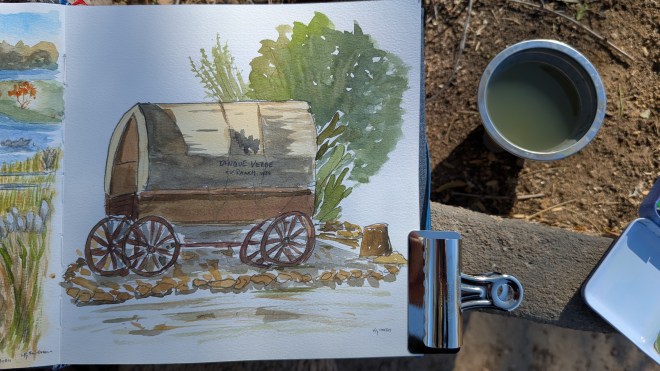
Little can strike terror into the heart of a bad drawer like wheels. Many of our bold number quailed when our first assignment was a covered wagon with an excess of spokes and shadows. There’s nothing like watching an expert wave a brush across a page and a brilliant, colorful, characterful painting just appears, and then tackling it yourself. This was a warmup effort – my shadows are particularly disappointing. But they can’t all be winners.

A covered wagon in bright sunlight
Please notice how there are a bajillion spokes

A watercolor of the covered wagon
There are more things wrong with this than are right with it. The shadow on the canvas is extra not great, and my foliage is a consistent weak point.

Day 2: Paints up!

A two page watercolor spread, with an agave plant and barrell cactus on the left page, and a desert scene on the right
Days 1 & 2: A spread of cacti and a desert scene

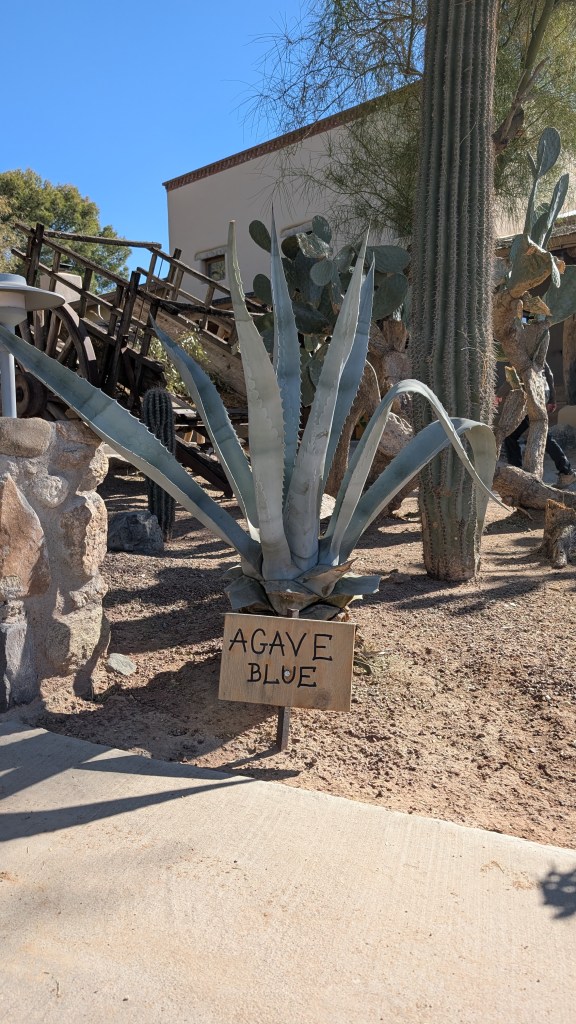
A blue agave plant with a wooden label in front of it
Sure it looks easy to draw, but how do you do that fold on the right side?

After I finished my wagon, I turned around and painted two of the cacti – one on either side of the walkway. I’d done some swatching ahead of time and had a brilliant idea for the color of the agave (which I was quite pleased with). Drawing the agave was haaaard. The barrel cactus might be one of my strongest paintings to that point. I keep finding myself looking at it. I didn’t fill all the space with paint (an error I’m particularly susceptible to), and left some glints to keep it interesting.
This was my second time painting nearly this exact desert scene (I’d tried last year too). Both of them were rather disappointing. I love love love mountains and want to paint them beautifully, but this scene didn’t convey the feeling I was going for.

Day 3: Tucson Botanical Gardens
You have no idea how exhausting painting can be. Also, it was _cold_ out there. There was ice that didn’t melt during the day, which is practically unprecedented in Tucson. I seriously questioned whether I shouldn’t just stay in the incredibly soft and cozy bed all day and maybe come out for a bit of a hike and call off the botanical garden. But I’m glad I didn’t.

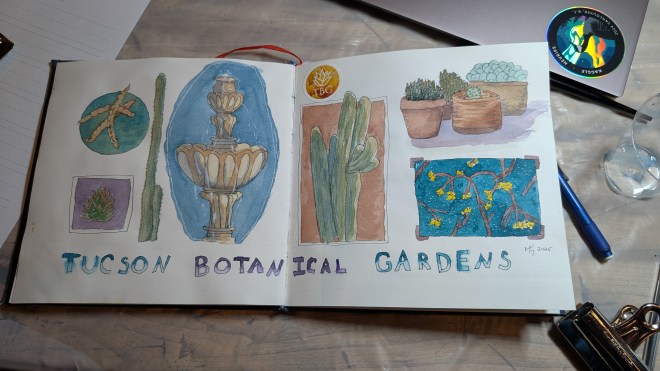
A two page spread of watercolor and ink vignettes from the Botanical Gardens, including a fountain, some cacti, and a small set of pots.
7 small paintings in one day

I was mostly pleased with this. The fountain was very difficult drawing for me. My ink drawings end up sort of cartoony like the fountain, and I think I need a new strategy. Or to embrace that as my style. I particularly like the cluster of pots in the top right – I was captivated by the real thing. The red cholla with the yellow blossoms on the teal background created a problem. Everyone likes it, but the value was all wrong for the rest of the vignettes. I tried to fix it with the lettering, but I’m not really sure I did.

A collection of pots with succulents and cacti in them.
I now want a shelf of these succulents and cacti in my house. I’m sure it would be just like this.
A picture of a terra cotta fountain with a woman behind painting
My fellow sketchers are in many of my reference photos

Day 4: The Old Homestead
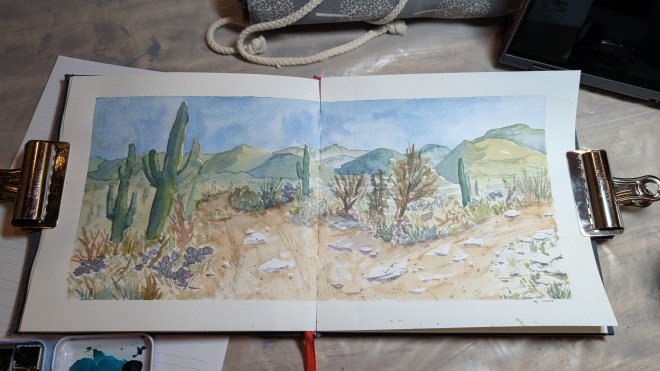
The old homestead on the top of the hill had been the spot of some of my more successful paintings last year, so this year I decided to skip it and take another crack at the disappointing panorama. I’m not saying this is my best painting ever. But … it very well might be. I’m half-sad it’s in a sketch book and I really can’t frame it or display it. It’s not perfect (my foliage continues to bedevil me) but the mountains are right. And I really GOT the rocks for the first time.

A two page spread of a desert panorama done in watercolor
Now this one I’m very pleased with
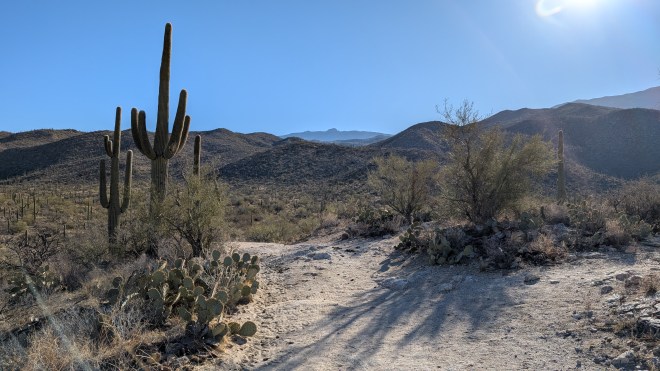
A dusty trail in the Sonoran desert with clear blue skies, saguaro and creosote bushes.
I think the trail is the key to my problem: I needed to lead the viewer INTO the picture instead of having this horizon barrier between you and the desert.

Day 5: Farewell to Tanque Verde
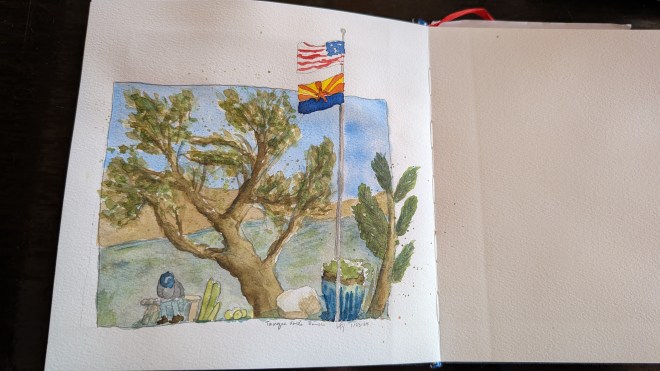
After a week of the subdued hues of the desert, my eye kept being caught by the bright colors of the US and Arizona flags. I decided to practice my foliage (definitely a work in progress), attempt a human figure (this guy ended up somehow being a figure in many of the classes paintings – maybe because he took a contrarian viewpoint?), and use some bright colors. It’s not a great painting – the values are too close, the tree on the right is weird. But reps count.

A watercolor of a figure under a tree with a flag breaking through the frame
Those colors are still flying. I do really like the Arizona flag.
A picture of a man sitting below a tree, with a flagpole to his side.
I had to go back later and take another photo of the flags to get the colors right, but the second photo doesn’t have the figure

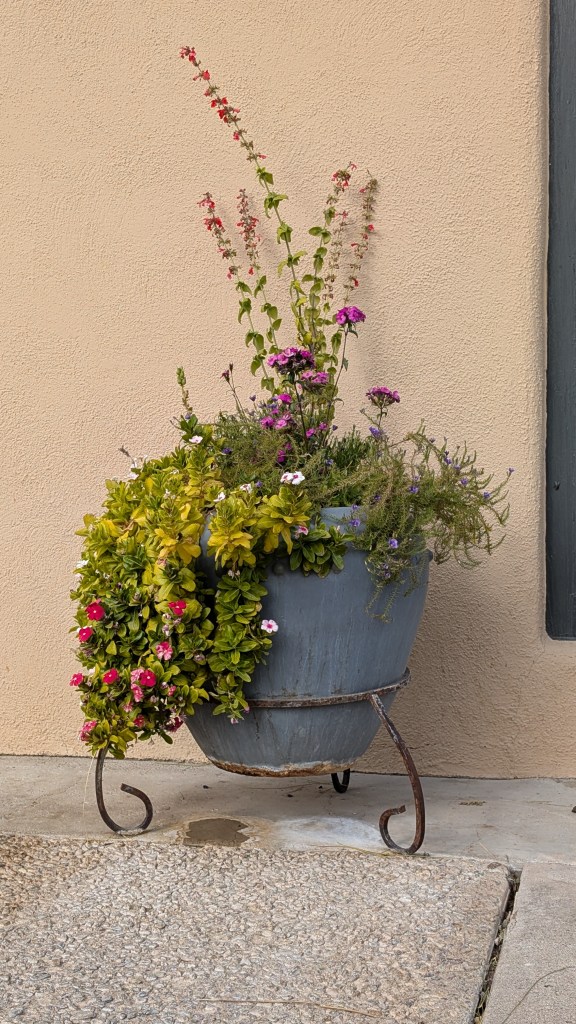
My last full painting of the class (I started a third one) is one that I don’t think I could have done at the beginning of the week. I’d admired this pot and its flowers all week (one of the fun things about a class like this is how much it sharpens your noticing muscles). I had finished my first painting and there was still time left, so I plopped down after lunch and did a super simple sketch and then just enjoyed non-desert colors. This is loose and fast and fun and I think you can feel that when you look at it. It shows a lot more fluency than I started the week with.

A beautiful pot on an iron stand full of greenery and flowers, against a warm beige wall
I mean, how can you be in a painting class and walk past this every day and not paint it?
A watercolor painting of a large blue flower pot overflowing with greenery and flowers against a beige wall
It’s not fussy. It was fast. And the shape and shadow are good. I’m especially proud of how … organic the edges of the painting are.

I would 100% recommend the teacher, class and location to anyone interested (if not the rental car company). I’m now ready to collapse into an exhausted heap (seriously how is painting that tiring). And tomorrow I’ve got a hike planned before I fly back to frigid New England on Sunday.


Just a quick reminder for folks that you can catch my shorter form work on Bluesky.

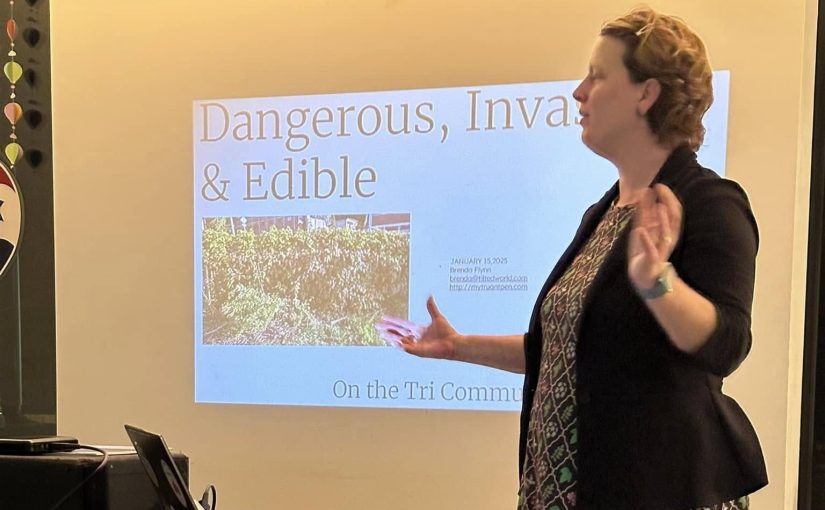
Dangerous, Invasive and Edible: Plants of the Stoneham Greenway

View my presentation: Dangerous, Invasive and Edible: Plants of the Tri-Community Greenway

It can be a mistake to volunteer. For several years on my company’s paid volunteering day, I’ve opted to do invasive species removal. Mostly it gets me outside and is light and satisfying physical labor. But it has the nasty side effect of teaching me to clearly identify local invasive species. And every time I take a walk along the Greenway – particularly fertile ground for those – I just can’t stop noticing the invasives (as well as the noxious and edible plants I’ve trained myself to notice). In October, in a burst of civic enthusiasm, I noted a Keep Stoneham Beautiful meeting, figured I had two hours to spare, quickly snapped a picture and description of the plants in question (easy to do since that particular narrative runs through my head every walk), and tossed it like a glitter bomb in their unsuspecting open meeting.

A middle aged white women, mouth open while speaking, holds several books on indigenous food and foraging
Showing my sources – although missing the book I use most

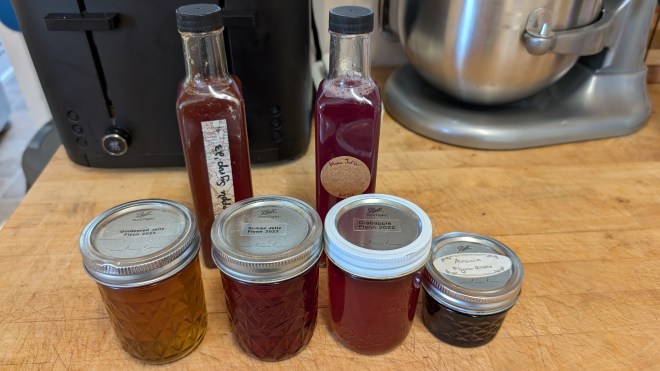
They were EXTREMELY gracious about it. And then, in a move I really should have anticipated, they then wanted me to DO something about it. We settled on a community education talk. So this last week, I added baking some homemade bread into a busy work day (I admit it’s somehow a jarring role shift to go between the highest high tech and baking bread back to back). And then I brought my slides, several books, two syrups I use for flavoring seltzer, three loaves of warm bread and four jams to the Common House in Stoneham. It ended up being a packed house. It’s a small space, so packed was probably only 20 people, but we had a lively discussion with a lot more talking about goats than you might expect. (Renting goats probably our only non-herbicidal solution to the poison ivy problem.)

My presentation really focuses on an extremely small section of trail. It’s probably 2/10ths of a mile. Everyone in the crowd knew exactly what I meant when I said things like “it’s where the Montvale Plaza used to be” or “it’s on the downhill side near the Y”. It can be easy to forget how, in a physical community, we have this shared context of places we (mostly) all know. It allowed this conversation to be incredibly specific, in a deeply satisfying way. It wasn’t about invasive species in general: it was about that stand of knotweed right where the new housing is going up, but on the other side of the trail.

I had a really fun time. I loved watching people try out my jellies. People especially enjoyed the chokecherry (aronia) and crabapple. The sumac was good but wasn’t anyone’s favorite. And only a few holdouts though that the goldenrod jelly was enjoyable to eat (although heaven knows it’s a complex flavor). I foreshadowed the coming of the pawpaws. And the bread was very popular!

Four jars of jelly and two bottles of syrup
All of this is locally sourced and much of this was foraged. I did plant the aronia, and the plums are from my farm share.

One of the things I like about this kind of community work is that it is something we can DO. Most of my suggestions don’t require approval or collaboration or fundraising or even other people. Or if so – only small groups are really needed. It shouldn’t be a divisive issue to find a way to get rid of the poison ivy where our kids play. Sometimes, there’s so much in the world I feel like I can’t fix, that I have to remind myself to ask the question what CAN I do? And this is something I can do.

Next on the schedule: walks of the area this spring, with narration! And maybe goats.


Thanks to Jeannie Craigie for the pictures!

The bodies of books

I’ve been thinking a lot lately about the physical object of books, as opposed to the content of the books themselves. The generous allotment of bookshelves in our home is full to bursting, which makes it difficult to buy more books – an unacceptable status to remain in. These shelves were made by my husband, and designed to accommodate our collection – the awkward height books, the comic books, the mass market paperbacks. It’s easy to get rid of a book you don’t like, or a forgettable book you can’t remember only hours after shutting the pages. We give our extras to the Book Oasis which has led on several occasions to me seeing a book in the window and being all like “How odd, I think I’d love that if I didn’t already have it!” only to be reminded that I HAD previously had it and had donated it. But the last few weeks, with the towering stacks of unread books next to the bed taking on menacing proportions, I had to admit it was time to get rid of some books.

Here’s how I figured it. I would clear out a book if all the following were true:
1) The physical object was not uniquely special to me. (Eg, a meaningful gift given to me, inscribed)
2) The physical object was not beautiful and delightful in a way that made me want to read it instead of it’s ephemeral kind
3) The books was easily replaceable (not out of print, etc.)
4) The physical form of the book was not particularly useful (for example, cookbooks are best in actual paper)

What this really meant, was most of the mass market paperbacks went into the donate pile. I mean, I really do love Tamora Pierce, and Brother Cadfael, and Dorothy Gilman. But truthfully many of the physical copies of the books of theirs I have will not survive a multiday reading. The yellowed and cracking pages of an 80s paperback that was never meant to last make me think of the Waldenbooks in which it was so likely purchased – of another fading era. I also donated one or two of my (cough) SEVERAL copies of books like The Lord of the Rings books. I’ve read several versions of those physical books into pulp, but I have some really nice and sturdy ones that can withstand a reread.

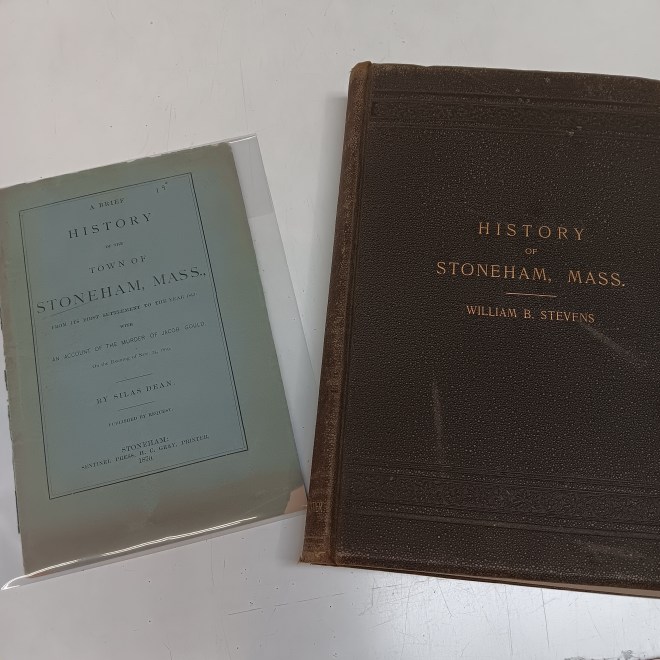
The question of the durability and survivability of books was highlighted due to one of the most delightful gifts I got this Christmas. An actual physical copy of Silas Dean’s book “A Brief History of the Town of Stoneham“, which I have read as a digital book and of which I have a very bad reprint.

Two old books, a think blue pamphlet on the left and a thicker brown book on the right.

It’s shocking, in person, how delicate and destroyable this venerable book is. The front cover makes it clear that it was the 19th century version of a vanity publication. The paper itself – though in very good condition in my book – is thinner than newsprint. The cover is barely thicker cardstock. There can’t have been that many copies made. A few hundred? A thousand? And given that it was printed 140 years ago, I wonder how few have survived to the modern day. I know of three or four – perhaps more – and obviously some libraries had them (that’s where the reprints come from). But fewer than 100 seems almost certain. The object itself is both delicate and precious.

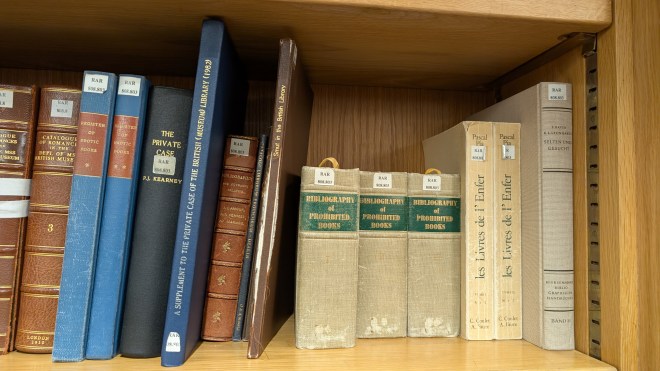
This trip we’ve made to the UK has ended up being very book centric. The reading room at the British Museum felt like a museum exhibition to a kind of reading that once happened and does no more. What a glorious space, now the home to tourist selfies. The British Library was much better – the books are still there in their fleshed embodiment. Getting my reader’s card was the most thrilling souvenir I could have obtained. In my brief hour in the reading room there, I encountered the thick multi-volume set “The Bibliography of Prohibited Books”.

A shelf of old cloth bound books
“Bibliography of Prohibited Books”

I read as much of the forward as time allowed, and the author vehemently made the point that the smut and erotica of former eras is much rarer, less known, and harder to obtain than the first folios of Shakespeare. “Any fool with money can buy one of those”. They were rarely listed in estate sales, often not even summarized in wills, not included in the lists of belongings, not documented anywhere. Even the libraries refused to catalog them. It gave me pause – that these “shameful” books should be sought after, collected, enjoyed and then lost or stolen. We forget how much the internet has changed what is known and knowable. I didn’t finish the forward, but the three volume set of thick books tells me the author was at least somewhat successful in his aim of naming what was, and perhaps what was also lost.

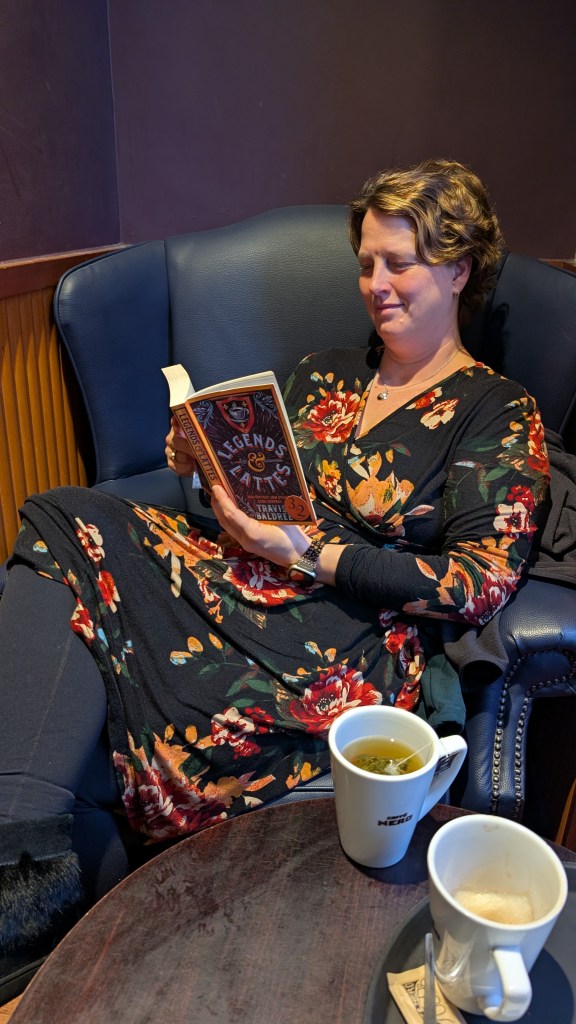
A middle aged woman in a floral dress happily reading in a blue armchair with a cup of tea in front of her.

In Edinburgh, one of our first stops was Blackwell’s Bookshop which had an astonishing collection of beautiful books across three levels. It is amazing so many books have been published. We all came away heavy laden (see what I mean about needing more shelf space?). I think my favorite part was how invitingly curated it was – little cards recommended WHY you might like a particular book, and the tables with attractive displays were well themed. I particularly liked the “Romantasy” section. It was spacious, comfortable, brightly lit and wherever my eye fell was a book I wanted to read. There was an art section of the store, and in it were these notebooks. The innards of old books had been removed and replaced with blank paper – giving an old object new life. I’ve always been reverential in how I treat books (never underlining or highlighting), and horrified at the idea of destroying or damaging a book, never mind throwing it away. But looking at the titles on the shelves – these books were never going to be read again. It’s a strange inverse of the ebook. The contents of the book have been removed, but the physical object is retained.

I’ve decided, as my New Year’s Resolution, to try to read an average of a book a week for a year – where “read” can mean physical book, audio book or ebook. I’ll be tracking my journey on Storygraph. (So far I’ve learned that I’m “currently reading” a rather unreasonable number of books.)


What are you reading? How do you prefer to read? What books can you not part with?

A plea to singer song-writers

We have entered the time of year when I want to listen to Christmas music 24/7. I love the classics – give me a Deck the Halls or Joy to the World any time. I particularly love early music in all forms, but the medieval Christmas classics are favorites. I love a good Personet Hodie or Boar’s Head Carol. In fact, I once went and looked through all the albums with a Boar’s Head Carol in it to try and find some new music. I love Vince Guaraldi doing Charlie Brown’s Christmas Carol. But my favorite albums are the indie, fully original ones.

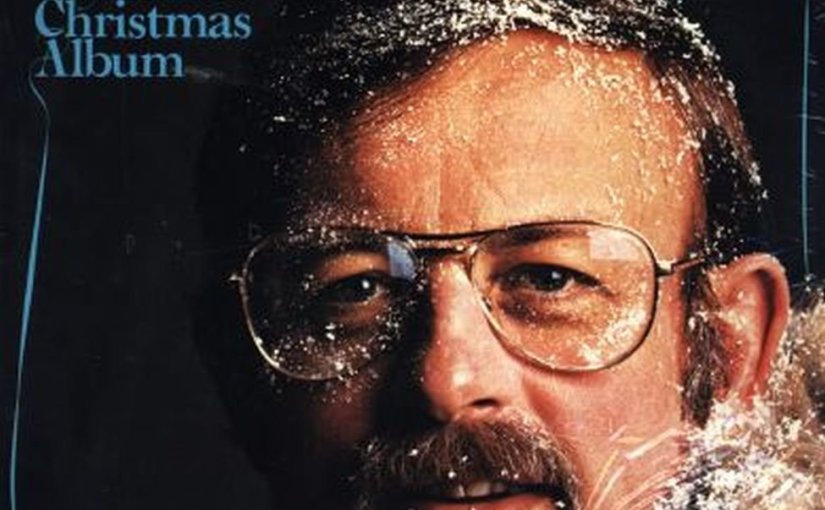
You know the genre. The one hit wonders. The guy who used to be big 50 years ago but only his Christmas albums is still listened to. The artist who never made it big but has the cult following – including me. My favorite Christmas album is the Roger Whittaker Christmas Album with the fake snow on his beard. I have deep and meaningful thoughts about “Darcy the Dragon”. My husband’s is the Kingston Trio’s “Last Month of the Year”. Neither of these are just covers of the same 50 songs – they include some historic ones but also some really deep discoveries and some new songs. In recent years I’ve added to this pantheon Sting’s “If on a Christmas Night” and Maddy Prior’s “Gold, Frankincense and Myrrh“. Sting’s hearkens back to the middle ages. Maddy’s is all original.

But I want more.

I don’t have enough Christmas music to listen to it 24/7 for a month without getting bored. And I don’t want just another cover of Santa Baby or I’ll Be Home for Christmas. I’ve been harassing Bombadil (very politely!) begging them for a Christmas album. I really want one of theirs. But I also want one by Brandy Clark, and the Mountain Goats, and Belle and Sebastian. How has Taylor Swift not taken a crack at this? When Kendrick Lamar drops a mid November album, I want at least one song on there talking about Christmas Eve. I want Shaboozey to overtake his own #1 spot with the banger of the summer by making a banger of the winter we can pull out every year for the next 50, getting all nostalgic about those 2020s and what a time that was. I want some songs that talk about the now – the ever expanding Black Friday, the traffic on the way to the holiday, the wishlists that tell you exactly what to buy, the difficult conversations with family members you only see twice a year. I know it all seems prosaic and boring now, but so were the songs that now seem quaint and atmospheric. I want today’s artists to be poets of our era and pass along the flavor of it to our future selves and our children and the grandchildren who will ask us, confused, what Cyber Monday really was. Or to expand our holiday music – add in the Diwali can’t-stop-singing, the atheists song, the Kwanzaa carol. Bring in the Australian tunes (I do love “Six White Boomers” and “The Longest Day“) talking about the Christmas heat.

Of the twelve months of the year, only one of them does not throw away what is old but pulls out the ancient and brushes it off year after year. I think that to truly pursue artistic immortality, to speak further than the hour, the artists should turn their eyes to the holidays and give us a full month’s worth of music worth listening to.


If I’m missing a great album that understands the assignment, drop it in the comments for me!

Why would they DO that?

I woke up this morning to the snow falling softly onto the frozen Vermont lake outside the cabin window. There’s a certain satisfaction one gets in the snowfall when you don’t have to go anywhere anytime soon, and my sense of well-being was enhanced by a Thanksgiving spent in stillness, in this remote and lovely place, with two full days of going-nowhere and doing-nothing planned.

It’s also the perfect setup for the horror movie/novel where you spend half the time yelling at the protagonist. WHY would you hide in the root cellar from the zombie attack when your car is RIGHT THERE? The key to a good locked room or horror scenario is when you can neither get in nor out. This is a vanishingly rare circumstance in real life. Perhaps a cruise? Although most of them stop places all the time and there’s Coast Guard etc. etc. It’s even harder to do a proper locked room/horror scenario now in the cell phone era. People either have to have the towers go down, be SO remote that you’re out of cell range or (I’m seeing this more and more which just makes me feel OLD) set it in the 90s before the ubiquitous arrival of cell phones.

Sure, I flirt with this kind of scenario a few times a year. There’s the backpacking and hiking. Sometimes we’re truly on our own in those circumstances, but honestly on most of the trails in New Hampshire’s White Mountains you’ll meet a whole posse of friendly people with satellite phones. Every once in a while I go rent a cabin in the woods by myself for a few days. One time I even managed to kind of get myself snowed in at one. But it was nothing a shovel and some salt couldn’t actually fix. Plus I had heat, wifi and cell coverage the whole time. We go camping of course, but most of the campgrounds are small mobile town with very thin walls and that one guy who thinks we all want to listen to his music. Heck, White Lake State Park is in easy walk of a Dunkin’ Donuts.

It’s gradually been made evident to me that my perfect vacation getaway is actually the horror movie scenario. But it’s only half of one. I mean, this Vermont lake is great, but there’s way too many other houses in view. And I can hear the plows working on the road on the other side. Pffft. 3/10 can’t get out in case of zombie apocalypse. For a very long time, I had a daydream about being a fire lookout. Now THERE is a great horror movie setup! Miles up on top of a mountain, watching what’s coming with no way out that doesn’t involve a 5 mile hike, abandoning your post, and hoping someone will pick you up at the trailhead. Of course, my daydreams of this vocation failed to understand that I’m an obligate extrovert who cannot go 48 hours without human contact. But still, the purity of the scenario pulls at me. Why? I don’t know. I think it has to do with being truly alone, independent, and ruggedly capable. Which sounds great as long as I have good wifi and snacks and I’m toasty warm.

The snow is slackened tonight, the plows are out, and tomorrow will dawn bright, clear and cold. There was no reverse 911 call. The tv was not on in the background talking about the escaped terrorist/madman/murderer. There were no mysterious footprints outside the door. The wolves were not baying to the full moon. Instead, I watched the Macy’s Thanksgiving Day parade on the couch with my sons on either side and husband across from me, all of us fully pajama’d, caffeinated and snarky. Then we sat around the table for a few hours and played “The Zone” – a horror RPG where survival is not the goal but collaborative storytelling is. (My sons are very capable of creepy imaginings – make me proud they do.) I worked on my Christmas cards. We made a steak dinner from Hello Fresh. The fire has been going all day, and the balsam fir Yankee Candle is burning on the table. It’s the time of year when the sun is fully set by 4:15 and 9 pm feels like 2 am. Christmas music is playing quietly.

It’s not the excitement of a vampire attack, but it will do for now.