The Bargain of Benjamin Gerry

Benjamin Gerry is said to have been a man of great courage. The following incident will prove it to be the fact. At that time this country was inhabited to a considerable extent by wolves. On a certain day, Gerry was out either for labor or business. He called upon a family, living upon or near where the Almshouse now stands, about dusk. It was thought rather dangerous for him to return home; however, having an axe with him, he proceeded homeward, but before proceeding far, he came in contact with a number of wolves. He braced himself against a large tree and pitched battled with his antagonists. The neighbors heard the conflict, notwithstanding he was left to conquer or die. He conquered, and returned home. In the morning, he went to the place where he fought, and there found that he had killed no less than four wolves, the fifth having walked off, leaving blood to show that he also had been wounded…

The house … afterwards occupied by the father of Benjamin Gerry .. was formerly known as the Matthews place. It is thought to have been built about seventy years since… At the season of harvesting a quantity of pumpkins were carried into the garret; one evening while the father was absent, and the mother with the children and other members of the family sat by the fireside, a noise was heard; something appeared to be coming down the stairs. It came stamp, stamp, down the garrett stairs; it then came to the entry stairs, which led to the lower door, and with increased force, came pound, pound into the entry below. There the noise ceased. The afrighted family waited with great anxiety for the return of the husband and father. When he returned, the news was communicated to him. He repaired to the entry, when on opening the door a good lusty pumpkin was reposing on the floor. Whether the house was ever afterwards haunted, is not known.

Gerry remained here for many years, but was called upon to fulfill his engagements, made previously to settling here. He left his wife and children, never to return; as it is said he fell during an engagement with a foreign enemy.

A Brief History of the Town of Stoneham, Massachusetts: From it’s First Settlement to the Year 1813 With An Account of the MURDER of Jacob Gould on the Evening of Nov. 25, 1819

Written in 1870 by Deacon Silas Dean


Everyone said my father was the second bravest man they knew. This was an old yarn they’d spin out. I think Scotchman Hay told it best, wicked grin curving around the stem of the pipe which was the only thing he’d brought from the old country. As stories about him told, whenever we were confident he was not listening, he’d even left his clothes behind when he showed up naked in my father’s barn. He had been running, as he said, from an impression aboard a redcoat war ship. But he brought the pipe, and he kept it with him.

“Ye see, my lad,” he’d say above a haze of blue Virginia smoke, “The bravest man I know’d was braver than he was wise. It was Phillips, laddie, who was the bravest I ever did meet. Why, he was out with the other men, a few years after the unpleasantness with the British, chasing after some Indians who murdered a local family. They followed ’em all the way to Concord – and a long way it was too. The sons of the forest were hiding in a rye field, and Phillips – he was warned they were there. Told him to be on his guard, they did. Told him that there was death and trouble in that field. But he answered in his decided way that ‘I am not afraid of the black rogues!’ Scarce had the words escaped his lips, ere a musket was discharged. Phillips took a fatal wound, sprung several feet off his horse and died right there on the spot.” So see, you dunna want to be the bravest man, son. You want to be the bravest man alive, lad. And your father, he is that.”

As my father’s eldest son, I worshiped him from afar, working hard on my labors to win his approval, and facing all life’s young challenges with the resolute chin and unwavering hand that seemed his legacy to me. But the closest I ever came to shaming my name was that All Hallows Eve night when he made his name as the bravest man alive.

As the sun on that day reached it’s zenith, my father made known to us that he intended to go up to see Richard Holden before dark, for he had promised his aid in setting some foundations for a new house before the ground froze for the winter. We’d spent a long morning in the uncommon heat of the fall day harvesting all our pumpkins from the patch. They’d done well this year and were plump and plentiful. We had a time carrying heavy loads of them out from the fields and straight up the stairs into the garret, where they’d be safe from freezing. Even my littlest brother had to take a hand carrying one small pumpkin at a time up the narrow, dark stairs.

It was heavy work, and we were all tired by the time the sun reached the top of the day. I hadn’t thought my father would then go on to more heavy work at the Holden’s – which was quite a walk away besides! But Benjamin Gerry was a man of his word, and he said that he thought as he carried the pumpkins that the cold might come early this year, and he had said he’d help. So weary though he was, he left after wetting his lips and tasting a morsel.

Wanting, as I did, to make my father proud of me, I returned to harvesting the fields. Without the watchful eye of my father, my brothers found other occupation in fishing nearby Doleful Pond for stripers, and I cursed them under my breath as I carried heavy load after heavy load up the rapidly dimming stairs. As the evening purpled, my mother greeted me with a cold heavy mug of cider, and turned with her faithful broom to sweep the stairs of all the mud we’d tracked in with our labors. Her face had a look of concern under her bonnet.

“Mother,” I asked, “I thank you for the cup! This year’s press is particularly fine I think. Does something give you fear?”

She turned in the black door frame, broom in hand, and looked back at me. “Well, son, I don’t doubt I’d not dare to say such a thing if your father was here. But it’s All Hallows Eve. In the old country, we’d be extra careful on such a day. We’d not go haring off to our neighbors’ so late when the work could just as easy be done on All Saints Day. Your father is a honest and brave man, and takes no stock in foolish nonsense. But I can’t help but wish he was already home tonight.”

As I sat and listened to the hiss of her broom on the rough planks, I couldn’t but think that she was right. I lit the main lamp, as the room grew dark and my brothers returned with their catch. Then I lit a second, and hung it over the door frame. I tried to tell myself that the full moon rising thick, twined about by wisps of flog, over the great expanse of the ocean between us and the old country was a good thing. My father was not yet home, but with such a bright moon he’d hardly need a lamp to find his way.

My mother had just latched the door to the stairs and switched from her cleaning apron to the cooking apron and was putting on our dinner when we heard, thin against the cold air of the night, the voices of the wolves raised in fearful chorus, rising and lapping over each other like a braiding of fell songs. My heart knew fear. My father was out there. The wolves were hunting. And it was All Hallow’s Eve. My mother’s face in the lamplight looked pinched and scared as she raised her face to the one glass window whose shutters remained open, to look at the moonlight streaming past.

“I’m sure father will be home soon, mother” I comforted her. We sat at table, my father’s place laid but bare of food. I led us in grateful thanksgiving, letting the food cool a bit as I asked that my father return safely to us, when we heard the first stamping sound from the attic, as though of men’s boots. After a quick Amen, I turned to the window to see if it might be my returning father. It wasn’t. I sat back down, and started in on my porridge.

“Stamp, stamp”

The sound was clearer now. It was certainly not outside the house. It was inside. My littlest brother left his place at the table and climbed onto my mother’s frail lap. My younger brothers, the twins, exchanged guilty looks. Poor five year old Paul dove under the table and couldn’t be brought out.

“I must’ve stacked the pumpkins wrong. A pile must’ve knocked over. Maybe if I’d had a little help,” I shot a meaningful glance at the twins “They might’ve been piled better.” Wee Tommy began to wail “I tried to help but my legs is too smaaaaaallll” he bawled.” “Crying is for sissies, Tommy. Father will be wroth if he catches you at it. Besides,” I added – a little ashamed of my temper – “I didn’t mean it for you.”

Stamp. Stamp stamp.

There was far too long between those thumps to be a settling pile of pumpkins, and we all knew it. We waited in silence, holding our breaths, the lamplight flickering over uneaten porridge and fish still steaming on the table.

Stamp stamp stamp stamp.

“Dear God, it sounds like it’s on the last stair” said my stricken mother.

There was a knocking – a polite rap – on the door to the garret stairs, as if some stranger waited there requesting entry. I thought of my father, and of his bravery, and I called out “Who is it who goes there.” The only answer was the howl of the wolves.

We waited a few minutes. I looked at the porridge – my appetite vanished despite the labors of the day – and thought of what my father would do. I took up my spoon and begin to eat. After a few moments, my family did likewise. My sister Ruth had almost coaxed young Paul out from under the table, and the twins started arguing about who’d caught more fish, when the rapping came again from the door. This time, it came louder.

The spoons clattered to the table. I held mine in limp fingers. Paul fled under the table, and after a moment of quick reflection, Ruth went with him.

Over the next hour, the banging grew and increased in intensity, pounding on the door as though the very fist of the devil knocked and sought entry. Four great crashes it gave, quick against each other. The door shook and rattled with the battering from the darkness on the other side. I looked at the latch and wondered if it would hold. I took the splitting maul from the side of the door – my father had taken the axe with him when he went to the Holden’s, as there would be cutting to be done for the posts – and stood in front of the door in case it should break. My mother, sister and brothers all clung to each other – backs pressed against the far wall – porridge and fish alike uneaten. After the fourth crash, there was a smaller pounding, and then all fell silent.

When the door flung open, I nearly jumped out of my skin. Not the door to the garret, no. But the front door. And in strode my father, limping, carrying an axe covered in blood and brains and fur – as he himself was.

He stopped short when he saw me, pale as February, facing the door in fear.

“What’s happening lad?” he asked.

“Father,” I gulped. Here he was covered in blood, and I needed to explain that there had been knocking on the door, and we had been scared by it. I was saved from this when the door gave the most terrific crash.

“Ah, I see.” He said. It seemed like he did. He was totally unsurprised. He walked over to the door, raised the sturdy latch, and the moonlight through the yet-unbarred window streamed past the golden lamplight to reveal what had knocked.

There, at the landing to the door, were five pumpkins. Or rather, they had been five pumpkins. They were smashed to smithereens. Their pulp reached all the way up the walls in gory orange entrails – up to even the ceiling itself. It showed brilliant against the new whitewash. In the oozing pulp, you could see the tops of four pumpkins scattered amidst seeds. On the third stair up there stood a more whole pumpkin. It was cracked down the middle, and juice leaked down the stairs in a trickle, but it looked to my fevered mind as though it was escaping from the slaughter below.

My father raised his axe and smote the last pumpkin, smearing it on either side with red blood. The blade bit deep into the stairs, almost cleaving the broad board in two.

He turned back to us, staring white-faced and wide-eyed.

“I smell fish.” He said, “Is there enough for a hungry old man?”


I was a man grown, and my own eldest son was the age young Paul had been, when my father got news that he was needed and that he must go. In the few days given him to prepare, he found time to pull me aside.

“Elbridge” said he. “Do you remember the pumpkins?”

I’d always thought it remarkable that a man of such courage, a man who on that fateful All Hallows Eve had slain four wolves with a back against a tree, and then come home to cheerfully dispense with our fears before digging into my brothers’ ill-gotten-fish, had been very kind in not teasing us about our fears of that day. In fact, he’d never spoken of it, even as the legend of his battle with the wolves was the talk of every tongue, and the 16 pound bounty he’d claimed from their pelts had allowed my father to pull me from the fields and send me to Harvard, an act which would change my life. The only change was that we no longer planted pumpkins. Given that none of us could even stomach a pumpkin pie, this seemed no odd thing to me.

“I do father. Will you throw my fear and cowardice in my face now, when you have forborne to do so for so many years?”

“Nay” he said. “Before I go, I wanted to explain. You see, there was something great to fear that night. I never should have left under that cursed witches moon, on that cursed night, in the twilight. You know the story of how I set my back to a tree and faced those wolves. It was a mighty pack. I killed four and mortally wounded the fifth before the others fled. But what I never told anyone was that it was uncanny. I knew as they circled me in the dark, the full moon gleaming off their eyes, that I was already as good as dead. I prayed as hard and fast as I could. It’s possible that I forgot to be quite a good Christian man at the worst possible time, and I found myself praying for a bargain, to anyone who might be listening.

“It came to mind mind that someone was very curious what bargain I’d make. I said I’d pay later if I could come through this all right and make it home. I said that for each wolf I’d kill, I’d ask for a year years. It made no sense, even in my head, even as my axe spun around me.

“But it came to me that my bargain was granted, and that my family would be let to know too. That part didn’t seem quite… nice shall we say.

“So I laid about me with my axe. I killed two easy. The third I took a wound in my leg as I killed it. The fourth is the one that got me arm. And the fifth knocked me down to the ground and it’s teeth were bared to rip out my throat when I laid about with the axe and managed to knock it off me. It slunk away bleeding, and the rest of the pack went with it, but…”

He paused from oiling his old sword.

“Well, son.. it talked to me as it went, laughing. It said, “Four of us killed. Very good. That’s four years. And I’m wounded, you might call me almost a fifth. Not quite five. But when not quite five are come, it will be your time to make good on your bargain, Benjamin Gerry, and present your soul to the one you bargained with. You know old Jack. He makes a good pie, and a better bargain. Go home to your family. Jack o’ the lantern knocks on their door too. And think to that day when you will be called upon to keep your part.

“And then, son, he faded into the darkness. And I came home and found the four and a half pumpkins, and I knew.

“That was four and a half years, ago, Elbridge. And now I’m called – old though I am – to go fight with my former legion. I think that I shall not escape death again. But I wanted you to know. Never again plant those devilish gourds. And never make a bargain where your soul is at stake. Pray for me, for I will never see your face again nor know aught of heaven’s joys.”

That All Hallow’s Eve, I found on the front steps of my house a pumpkin, carved with a face like a wolf, gleaming in the light of a full moon.

Of my father, no word ever came again.

Notes:
1) Silas Dean makes it clear that Benjamin Gerry was not actually the father in the pumpkin story – only that it was Benjamin Gerry’s father’s house prior to the incident.
2) Scotchman Hay did come off a boat and did work on Benjamin Gerry’s land, and there WAS a naked sailor who showed up naked in a barn, but it wasn’t Scotchman Hay, it was a man named Hadley. There are no fewer than three residents of Stoneham who got their start jumping overboard from unwelcomed stints in Boston harbor.
3) The story about Phillips is also in the book, and much of the language is exactly what Silas Dean used in telling the story. Nineteenth century authors were often very racist and one-sided. They omit to remember in their writing that they were conquerors who had stolen much of this land from the native folk they rightly feared.
4) I’m not sure exactly where Richard Holden’s land’s, or the Matthew’s place, are. We know that the wolf attack took place near the Almshouse – which is now the Senior Center and the soccer fields nearby. I often think of this when I watch my sons play soccer there, and wonder just where Benjamin stood in his fight for his life against the wolves.
5) Silas Dean says that Elbridge Gerry served in the Madison administration. There’s an localish Elbridge Gerry who signed both the Declaration of Independence and Articles of Confederation, but did not sign the constitution. That Gerry doesn’t seem to have grown up in Stoneham. His father owned major mercantile resources, and was less likely to be out late at night taking on predatory carnivores. There was also a line of Elbridge Gerrys in Stoneham, but none of them were born to Benjamin. I think Silas may have gotten confused with the reoccurrence of such a rare name.

Charlestown End – The Old Burying Ground

Jacob Gould's Grave
Jacob Gould’s Grave

The Old Burying Ground in Stoneham was opened to visitors today. For years it’s been opened on Halloween weekend – at the exact same time as the town trick or treating. So I haven’t been able to go. But I’ve been falling in with the historical crowd lately, and they realized that we parents love history as much as our kids love candy and were awesome to set up this great second session this year.

Familiar faces
Familiar faces

My trip to the Burying Ground this last Halloween kicked off an extremely fun month for me. I was doing Nanowrimo with a friend. I saw this amazing tombstone with its rich old story of Jacob Gould “barbarously murdered by ruffians in his own dwelling” and I looked it up on Google. Google books led me to more of the story in Silas Dean’s gossipy 1843 history of Stoneham (which is right there an argument on how awesome the internet can be!) and I went down a monthlong rabbit hole of local history and lore while I wrote a werewolf book about the strange misadventures. I had an absolute blast, although I sadly have not finished the book.

I did learn what they found when they opened the three crypts. New life goal: be there when they open one of the three crypts.

Rare to get a government tombstone for a nurse

They had three reenactors there, all of whom were excellent. One played the role of a Civil War nurse (who apparently had to be older than 30, of high moral standing, and rather plain). She told the story of how Hannah was buried in sight of the house she’d grown up with, across the alley on Oriental Avenue. And I stood there, in ground set aside at the turn of the 19th century where were buried Revolutionary War heroes, slaves, native Americans and pilgrim-folk and I thought about what it is to be at home.

He could have seen Shakespeare's plays as a young man.
He could have seen Shakespeare’s plays as a young man.

Many of the people lying there were not Stoneham born. They came from England, Wales, Africa… or as far as from Maine or Connecticut. They came to a frontier town, or a sleepy bywater. They came to a new place and built a place for themselves there. When they died they consigned their remembrances to the uneven soils of this burying ground. Hundreds of years later, we walk by twice a year to greet them. And where they were strangers to me last October, as May came I greeted them instead as friends.

Mt. Rainier
Mt. Rainier

My heart has long lain in the rugged stark mountains of the West. It’s a land that feels as though history lies lightly upon it. The stories of the people who first lived there have never been told to me. The stories of my people are short – the town I grew up in is just over 100 years old. There are residents who remember the first people there. But for most of my life, I’ve been FROM Washington.

I think that may begin to be changing. I’ve lived in New England 20 years. Sixteen of those have been in Massachusetts, and eight of THOSE in Stoneham. How can I turn my back on Deacon Silas Dean, Jacob and Polly Gould, Benjamin Gerry, Elizur Wright, Parker G. Webber and the cast of folks – brave, strong, moral, funny and complicated who have also moved here from elsewhere, and made it their home? Fortunately, the question of home is not one you have to put exactly one answer to on a form. We may come from many places. But as I learn more here, meet more friends, run into more people at the store, and walk even the graveyards with familiarity, I find myself more and more at home.

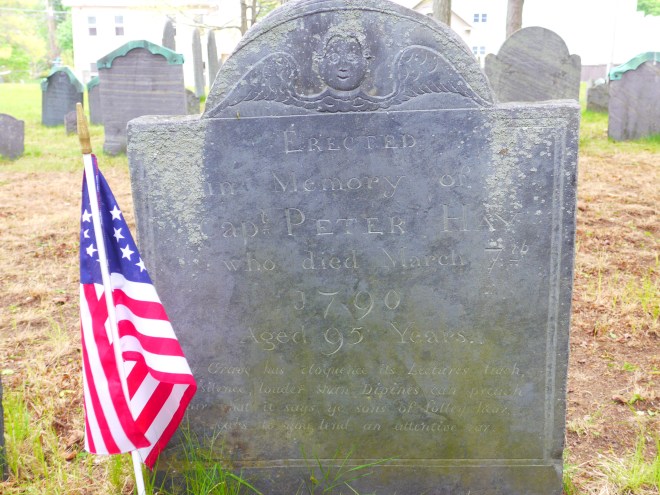
This creepy cherub is totally judging me.

Enjoy all my pictures from the day at the graveyard!

More on Nathaniel Dike

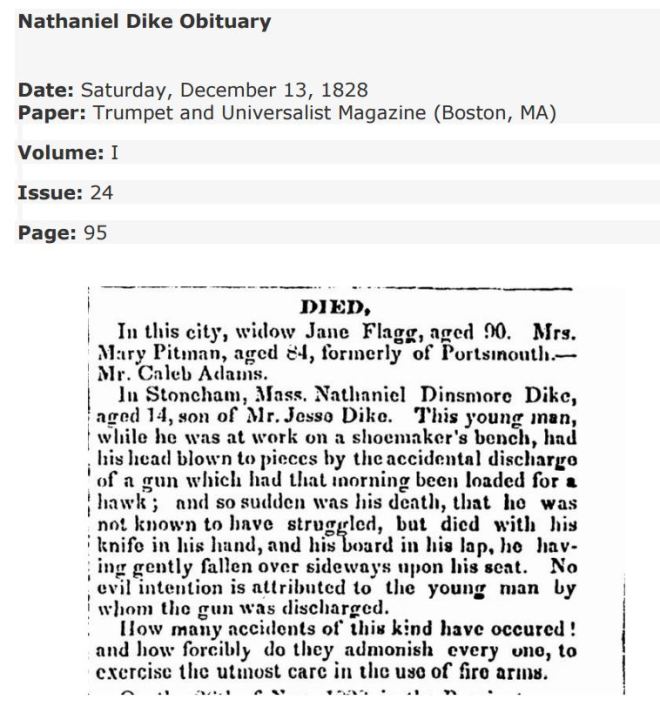
In my last post, I included a picture of the final resting place of young Nathaniel Dike, killed in a firearm accident. One of the joys of small town (or at least, not ginormous town) life is that several members of the Stoneham Historical Commission read my blog. The commission chair, Marcia Wengen, sent me some more information on Nathaniel, which we both thought you might find interesting!

A boy killed by a friend playing with a gun.... a hundred and fifty years ago.
A boy killed by a friend playing with a gun…. a hundred and fifty years ago.

Thought you and your audience might find this obituary for Nathaniel Dike interesting. This accident pre-dated Stoneham newspapers and so my researcher had to look to Boston editions. Interesting that the name of the shooter is withheld, just as it would be today

The style of headstone leads me to believe that he may have been buried elsewhere initially.

The style is suggestive of others stones in the OBG (Old Burying Ground) but there is no record of his removal to Lindenwood.

The Stoneham Cemetery (sometimes referred to as William Street Cemetery and on the grounds of Old Central School) was consecrated in 1844, so I think it unlikely he was moved from the OBG across the street. In the DPW file I found records of Stoneham Cemetery burials moved to Lindenwood (ca. 1899), but alas Nathaniel is not among them.

Nathaniel Dike Obituary

Our house

Our home in the snows of last year

When we were in the house hunt, one of the houses we looked at was a house in Woburn that had been built in 1720 or so. It had a weird layout and a rather disastrous crack in the chimney that ran up the center of the house, and we didn’t end up offering on it… but I thought it was awfully cool. Paul Revere would have ridden past that house when it was new built. So when we found this house (with a lovely lack of disastrous masonry), it didn’t seem all *that* old. The decor was dominantly an 80s horror (helloooo shag carpet and paneling!). The date on the paperwork said it was ~1900. I had hoped we might find some cool old treasures when we moved in, but the prior occupants did an exceptionally good job of clearing out the attic and basement. There were no boxes of old letters we might find, and no ghosts have haunted our sleep. (Well, except the ghost of fraudulently uninstalled insulation.)

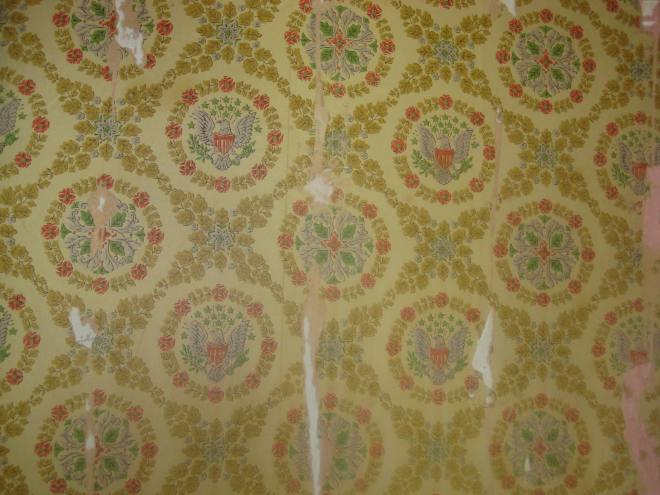
But as we have very gradually updated rooms, we’ve found these hints of how old our house really is. Most of the walls, under the ugly paneling, are plaster and lathe covered by some truly hideous wallpaper. We had a very brief oral history from the prior owner, which mostly told us the house had been in the same hands for nearly fifty years and they’d raised seven children here. Also, her late husband had done all the “improvements” himself, with his two left hands comprised entirely of thumbs. (Ok, maybe that was my interpretation…)

These eagles are now hidden behind the drywall in Thane's room
These eagles are now hidden behind the drywall in Thane’s room

And then she was gone to Florida, and the history of the house felt like a blank slate.

But as I got a little more involved with Stoneham – as part of the bikeway kerfuffle and got to know the Historical Commission folks. One of them came by one morning with a full writeup on my house. We spent the morning in fascinating discussion of the building.

The Nobility Hill Historic District

It was built in 1898, and the funds to build it were provided by the guy (Lorenzo Hawkins) who built the beautiful white mansion right up the hill from me. That lovely house is a anchor of the Nobility Hill Historic district (which I learned about at the same time). The house, at nearly 120 years old, has been owned by ten owners, and four of those ten were in the 40s. The builder was a man named Parker G. Webber, who also lived in the house for two years after he built it. It changed hands for $100 in 1944. There was also this really cool list of the occupations and names of the people who lived in the house on various dates. In 1943 the house was occupied by Eleanor Keenan (34, housewife), James Keenan (36, bus driver) and father-in-law Joseph Keenan (69, shoe worker). Likely there were a passel of kids then too.

More questionable wallpaper choices

Glancing up and down the list for 1948, I noticed a 96 year old resident in my dear neighbor’s house down the street… a 96 year old named Parker G. Webber. He lived with what must have been a second wife, Alice F. Webber (77, housewife). So fifty years after he built my home, he was living in close sight of it. He must have spent the greater part of his life on this block – perhaps he built most of the houses in it, and not just mine. It’s this wonderful connection to imagine the care that must have crafted my home from a man who was proud enough to live in it and willing to look at his work every single day thereafter.

By the way, the list of occupations is fascinating. There are tree surgeons, a “dier”, a “grinder”, a “burner”, someone mysteriously in the “egg bus.” (A house on Franklin Street has a prestidigitator. Now that would be some exciting history!)

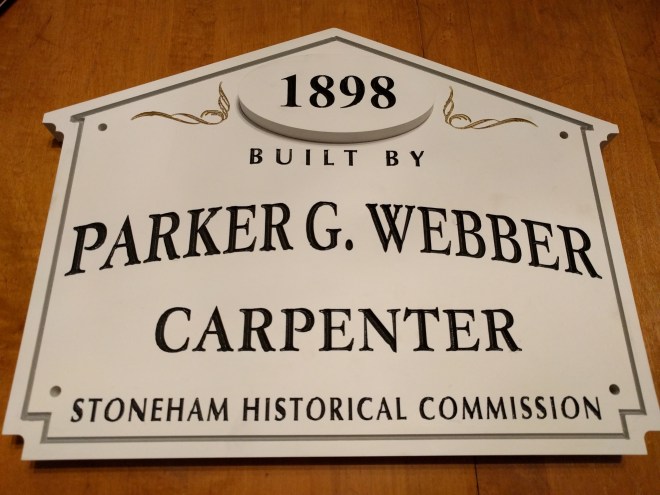
After the visit (well, some time after) I got around to signing up for a Historical Marker for the house ($55 is the bargain of the century, and they’ll help you fill it out). In New England, this isn’t a particularly old building, but 120 years old is not pathetic, either. The commission says anything over 50 years qualifies, and this most certainly beat that. I settled on the name “Parker G. Webber” to grace the sign, in honor of the man who had built the house with such craftsmanship a century and a score ago. The signs are all hand made (and come with the research!), so it took a little while before I got it. But I just found it on my porch this week, and I can’t wait to get it placed in a prominent location on my house!

Thanks for building my home, Parker

The warm woods

The December weather was astonishingly temperate

The weather this winter has been exceedingly unwinterlike. It’s barely dropped below freezing since the thaw finally came last winter. The powerful El Nino that holds us in its thrall is bringing late September temperatures to a December-dark world. So much so that our activities last weekend were a hike and a bike ride. I had thought we’d put the bikes away for the year, but I was wrong!

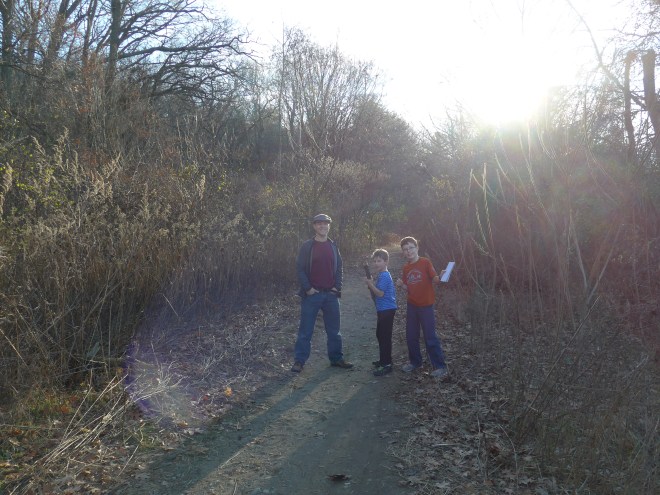
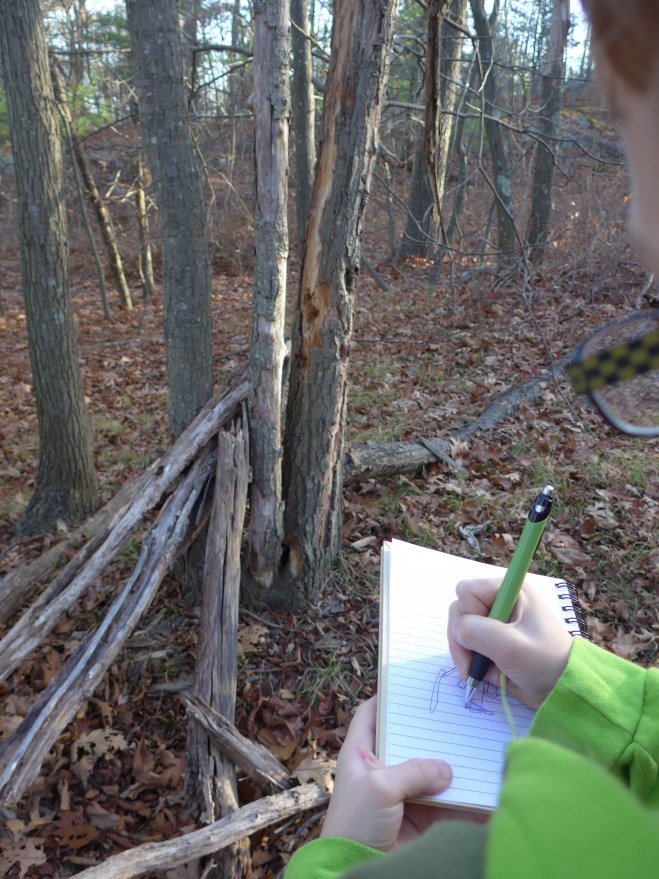
The hike was more adventurous than anticipated. We started at about 2 pm, with about two hours of good daylight, with an unambitious course. I wanted to visit Doleful Pond, mostly because it’s named Doleful Pond. I also wanted to see the remnants of the old trolly line decaying above Doleful Pond. That section of the Fells is criss-crossed by unmarked trails. It’s easily the most-lostest section of the Fells. But I had not one but two maps! We would prevail! Grey stopped and sketched an interesting section of trees.

The artist at work
The artist at work

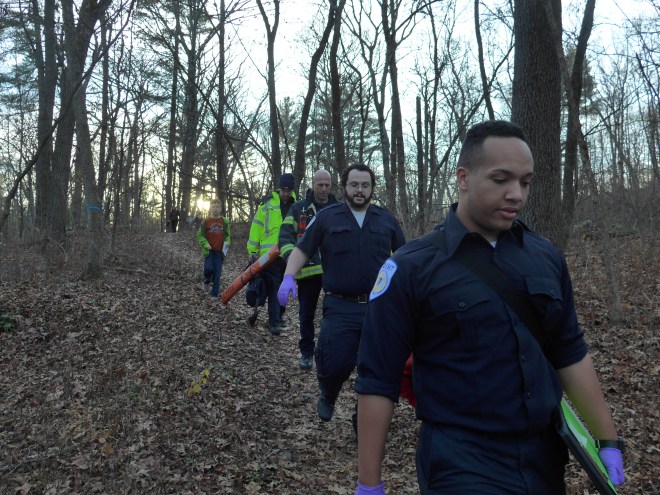
As we course corrected (despite my preparations, we had managed to be on the wrong trail. Sigh.) I saw a woman being held up by a man and limping badly. I called out to them and we booked it down the hill to see if they needed help. They did. She had badly broken ankle. We were 3/4s of a mile from any road access. I called 911 and then took off with Grey to guide the emergency responders to her location. Adam kept the backpack and got her foot elevated and worked to keep her from going into shock while we got help. Grey and I made excellent time to the trail head – but it served to make it clear to me that there was no way we were getting her out that way. (I actually slipped on some of the trail and have a livid bruise to show for it now). We met the fire crew and paramedics at the Bear Hill entrance. We drove partway up something that was generously marked as a road but that quickly became impassible to even to their manly 4 wheel drive. (Even under the circumstances I thought it was pretty cool to ride in a fire pickup through the Fells!)

A strange procession

We didn’t get nearly far enough. I led the crew the rest of the way to her on foot. I hadn’t realized just how much of first responding was improvising. As the paramedics stabilized her ankle, my maps became invaluable as we tried to find a better way to carry her out. That was my biggest lesson: maps can be the most critical first aid tool you have. They finally got her on a backboard and carried her out of the woods, and our stories diverged again.

Watching nervously
Watching nervously

The boys did an amazing job. They were both upset by her injury. But Thane was excellent in the role of comforter and care-taker. Grey’s feet had wings as he went with me to find help. I was really grateful, in a strange way, for this chance to show them how it is we should respond when need arises for helpers to help. I also felt really, really glad for the comprehensiveness of our first aid kit and hiking gear. It was a great reminder why we never go into the woods without it.

We walked out – never having seen Doleful Pond – just as the sun was setting.

She’s been in my prayers since. I hope that maybe the bone wasn’t broken at all? I hope her healing is fast, and that we run into her again on some trail in the Fells.

Stoneham History

The murder of Jacob Gould

The weekend before Thanksgiving, the Stoneham Historical Commission held their annual two-hour opening of the Old Burying Ground. For years I’ve wanted to go, but that was usually the time I’d hold Thane’s birthday party. It also coincides with the town Trick-or-Treating. This year, Grey and Thane decided that they were too big/cool/old to do that. I have mixed feelings about that, but grabbed the chance to go visit the cemetery I’ve long wanted to see. It’s usually closed since it’s not quite safe for wandering. There are leaning tombstone and depressions (marked off with yellow caution tape on this day). While this makes for good daydreams about the haunted cemetery, it’s less good for someone who really would like to wander it.

One of the first gravestones I checked out was one of the most dramatic. It stood higher than my head, and had outrage practically dripping off the chiseled headstone. It detailed the 1819 murder of Jacob Gould “who was barbarously murdered by some ruffians in his own dwelling”. There were deaths heads and warning epitaphs and poignant poems (all the things I love best of old graveyards), but this was one of the most intriguing headstones I’d seen.

When I got home, I looked it up on Google. You see, November is National Novel Writing Month (NaNoWriMo). I decided to do it this year. (Because I’m crazy. That’s why.) So I was on the prowl for a good novel premise. Murder by ruffians seemed like as good a place to start as any. So I had a reason for my investigation.

My very first search on “Jacob Gould murder” hit the biggest paydirt imaginable; namely “A Brief History of Stoneham, Mass, From Its First Settlement to the Year 1843: with an Account of the Murder of Jacob Gould, on the Evening of November 25, 1819” by Silas Dean. Silas (I feel like he and I are on a first-name basis now) wrote an absolutely hilarious and riveting account of Stoneham. It includes ancient ruins, naked dudes, wolf attacks, haunted houses, Indian raids, aggressive bugle players, people who died of stupidity, mysterious springs, ne’er-do-well pranks of the first water… I could hardly tear myself away from reading in order to start writing. It’s possibly the most entertaining primary source I’ve ever read.

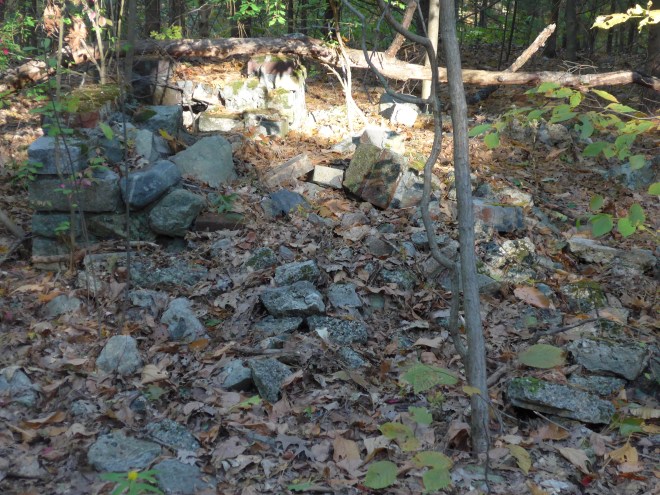
Ruins in the Fells in Stoneham - this might well be the house where Jacob Gould was barbarously murdered.
Ruins in the Fells in Stoneham – this might well be the house where Jacob Gould was barbarously murdered.

I felt like I won the novel-writing primary source lottery. And I started to get really into the research of the early history of the town (before the boring shoe-making bits). Once I started pulling at the thread of local history, I pretty easily uncovered more fascinating details.

For example…

Wright's Tower
Wright’s Tower

Boston commuters pass Wright’s Tower every day. I’m standing next to it in this picture. Well, Elizur Wright for whom the tower named was kind of amazing. He:

  1. Was an abolitionist, who was arrested under the Fugitive Slave Act for
  2. Basically invented actuarial tables, which make life insurance possible for all of us. He read life insurance literature for fun.
  3. Invented and manufactured two new kinds of faucet fitting type things
  4. Ran a newspaper, which got sued for calling out liquor manufacturers
  5. Translated La Fontaine’s Fables and wrote a foreward to a book of poetry by John Greenleaf Whittier
  6. In his copious free time, also pushed for the eventually successful passage of the Massachusetts Forestry Act, which is why we get to hike in the Fells and why they erected a tower in his honor

I mean, I’m impressed with myself when I get my blog post out on time. I didn’t make major contributions in four or five totally different spheres. And yes, he did find the time to marry and beget children too. I’ll admit – I’m kind of a fangirl now.

Anyway, I have these wild and crazy thoughts about how to get this really awesome information about this town out there. Who, living in a town founded in 1725, wouldn’t like to hear about some of the hijinks that happened nearly 300 years ago where they currently stand? I’m going to contemplate that question while I see how many other really cool things I can uncover in my research.

I’d also like to beg your indulgence. I’m attempting to turn all these cool facts I’ve uncovered into a novel. NaNoWriMo requires about 1668 words a day if you’re going to write a 50k novel in the month of November. I’m already well behind. But it’s going to be extra hard to write a thousand word blog post on top of the 1600 words I need to write every day to have a hope at completing this thing. So I might be… terser than usual this month (and/or obsessed with Stoneham town history).

Mysterious constructions in the Fells

The Golden Summer weekends

You know, it’s hard to find a time that is a good time to write a post. By definition, times that I’m free and don’t have something else I should be doing are times that I’m completely exhausted by the living of life. Case in point: now.

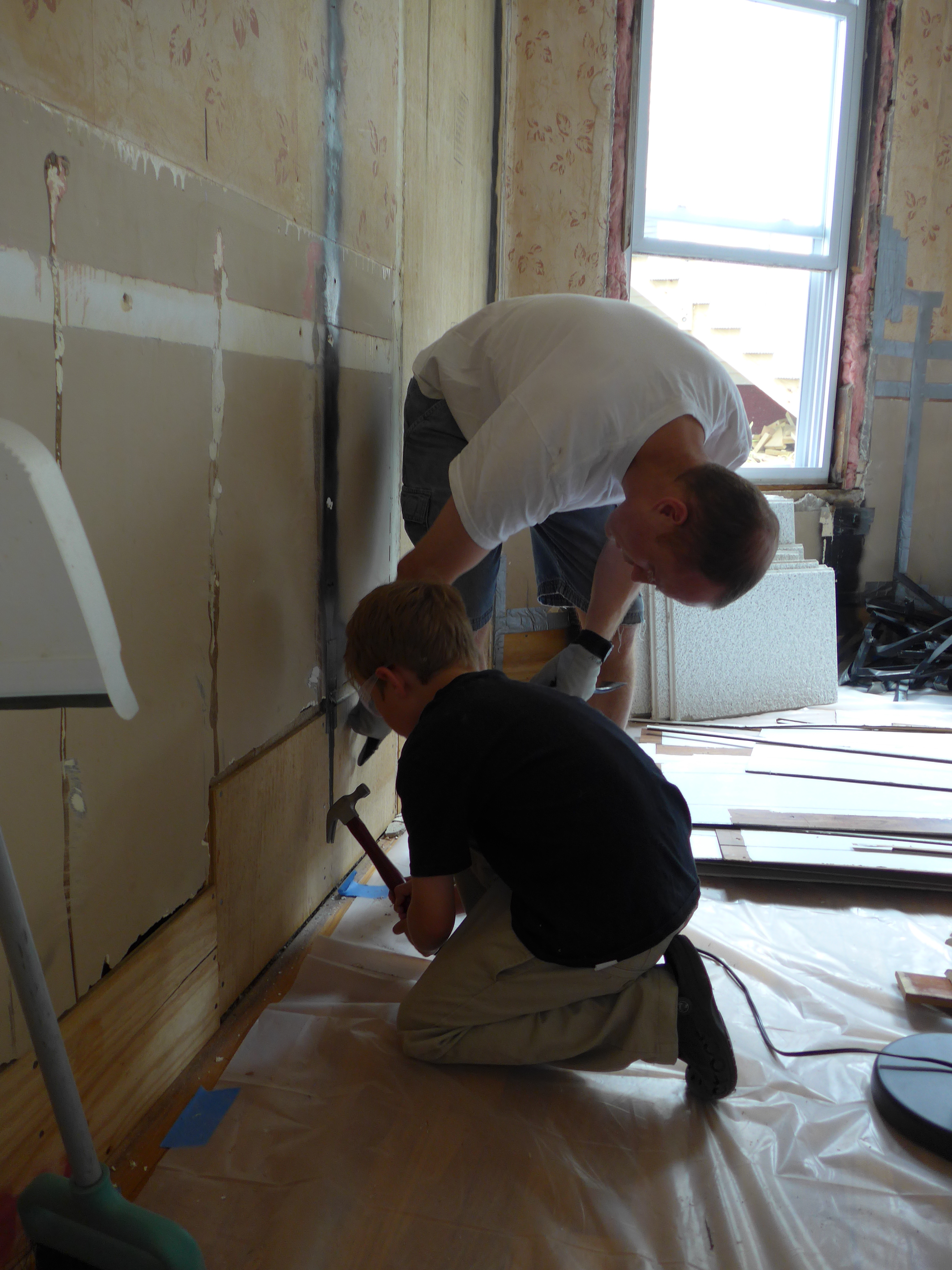
But the weekends have been lovely lately, and this one was no exception. Friday we demolished our living room. I surprised some people on Facebook by demolishing the living room without announcing ahead of time what we planned. It’s a simple project on paper: take down the drop ceiling and cheap wooden paneling. Drywall the walls and ceiling. Replace trim and paint. For a pair of softwarey types doing the work themselves, this is no easy task. (And let’s be clear – Adam is doing 99.5% of the work. I’m “project managing”.) I anticipate it should be done before Mocksgiving.

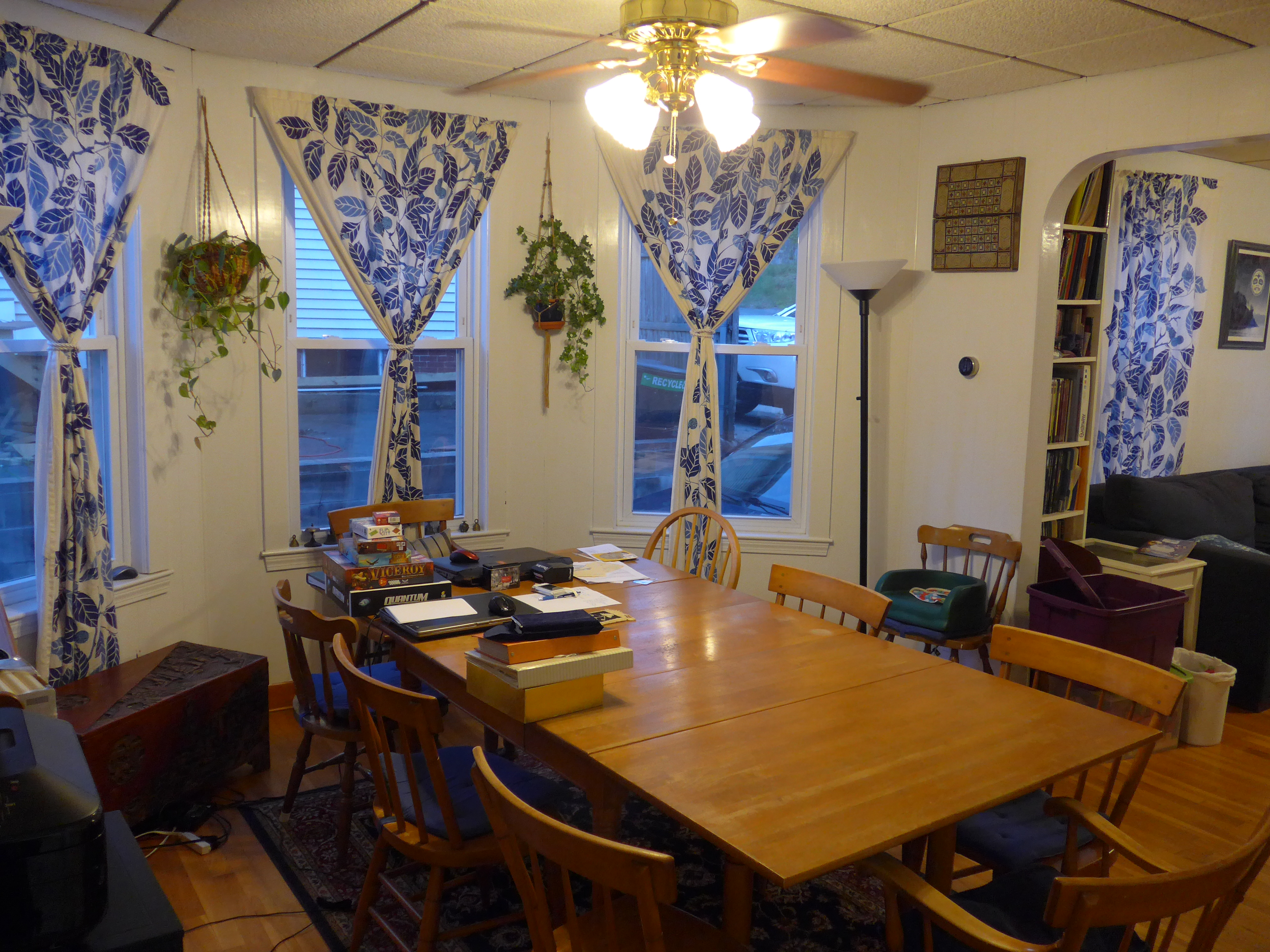
This weekend we managed to turn our lovely dining room:

Lovely, functional dining room

Into a disaster area:

Disaster in progress

What is it about improving things that so often makes them worse before they get better? We’ve completely finished the demo, and are ready to order drywall. Adam got the furring strips (firring strips?) for the ceiling today. Then he twisted his ankle bringing the heavy stuff in. This may slow things down somewhat. While he was doing that, I was visiting a friend after surgery. It seems like half the church is emerging from the surgeon’s knives, but all of them successfully so far!

The littlest carpenter

The weather this weekend has been outrageously glorious. It’s a bit too cool to drive a person to the beach (the Atlantic remains quite cool even in August). But yesterday we FINALLY after YEARS of thinking we should probably do that some day, went boating on Spot Pond. It was ludicrously easy for us to obtain three boats: two single kayaks and a double. We spent a glorious hour or so lounging around a place I’ve driven past a thousand times, but feeling like we were in the middle of nowhere. The boys particularly enjoyed looking for buried treasure on some of the islands.

Spot Ponding
Spot Ponding
Looking for buried treasure

Today started with church, as Sundays so often do. Church is taking up a lot of extra thought-cycles with me right now. I’m chairing the Mission Study Taskforce, and feeling very much pulled to ask some really big questions about what it means to be a church, and where The Church (not just my little congregation) will be in 50 years. It’s clear that we won’t be doing what we’re doing now (which is more or less what we were doing 50 years ago, and very reminiscent of what we were doing 200 years ago). I’m feeling really excited about rethinking how we can serve the core needs of God and people (I’ve narrowed it down to three: sacraments, worship/teaching and community – and none of these require a big fancy building).

When I got home, I was oppressed by the number of things I have to do. I swear, the dirty dishes breed when my back is turned. I dealt with this oppression by wandering the neighborhood. You see, I have a long-neglected project to drum up support (by which I mean money) for a historical marker for the Nobility Hill Historic District (which my house abuts). So I figured I’d go take pictures of the coolest houses. At the very first one, I met the brand new owner and spent half an hour chit chatting about the house and the neighborhood. She seems very cool. Then at the next house I stopped to chat with the owner for a while as well. I couldn’t help but think what a neat neighborhood it is I live in.

My new friend watering her garden

I was on call this weekend, and will be next as well. That makes it hard to do a big adventure, since I need to be in cell range and within 1/2 hour of an internet connected computer. But these small, glorious adventures in the fractally-rich spaces around my home and community, well…. I was just called upstairs to comfort a disconsolate child who tearfully opined that he didn’t want to grow up and leave this home. (See also: massively overtired) I comforted, but I feel the pang too. This stage is so sweet, this life so golden, that I wish I could slow down the falling sands of time. I told him what I do in the face of such urgent sweetness. I take pictures, and I write down the stories of those times, and store them up against whatever may come next.