25 years of Mocksgiving

At Mocksgiving on Saturday, someone asked me if I’d ever written about it. And on Bluesky, where you can find me as Fairoriana as pretty much on any platform, Wise Old Coot John Scalzi reminded us that having our own platform, that we control, means that there’s resilience in ecosystem. The social channels may change but our creation likely remains. I’ll admit that part of the reason I stopped writing so much is that the Facebook algorithm now more or less buries any content like this. If you are not writing for the engagement and audience, it’s called a “journal” folks. I have one of those too. But I like writing for people and I miss it, and I prefer the long form ~1000 word first person style that is blogging. So here you go. One post about Mocksgiving.

I should note, I have a personal commitment not to apologize for my lackluster posting schedule in the posts. Otherwise my last 5 years of posts would all start with “Sorry it’s been so long it’s been really busy and it got away from me” and that’s just tedious.

Anyway, let me bring you back to November of 2000. I have just turned 22. I have been married a grand total of 3 months and my college diploma is 6 months old. We are living in a Philadelphia duplex in Roslindale, Massachusetts, where the dishwasher is my husband and we have no microwave. We are paying $1200 a month for a three bedroom, one bath apartment with beautifully exposed woodwork and vertiginous stairs leading up to the two small bedrooms. We have one car, and two hamsters. I have just subscribed to Money Magazine, which sits by the toilet, due to a panicked realization I have no idea whatsoever how insurance actually works. My husband is working for USWeb/CKS as a coder. I’m a coder for a full remote company called Geekteam, which according to the Wayback machine at the time had a raffle for a Palm 3 and specialized in “ebusiness Obstetrics”. It was this one dude in Lewiston/Auburn Maine. The 9/11 attacks had happened only a few weeks before – our apartment was robbed the same day – and things still seemed unsettled.

But my in-laws, I had discovered, had a tradition of having their Thanksgiving meal at a restaurant. I was horrified (I was easily horrified back then) and promptly invited everyone to our apartment for the Thanksgiving meal. I was young, inexperienced, but not an idiot. I knew that making your first turkey for your entire new family of inlaws on Thanksgiving day proper was the way many a sitcom episode started. Those episodes usually ended with Chinese takeout and/or pizza, a la “A Christmas Story”. So two weeks before Thanksgiving, I bought a turkey and pleaded with my local college friends (over email, because we were savvy like that – this is before texting or social media were really things) to come and eat it with me. We called like three sets of moms regarding various aspects of turkey preparation. I made bread. We got cranberry sauce from a can. We used our wedding china for the first time. We had a BLAST.

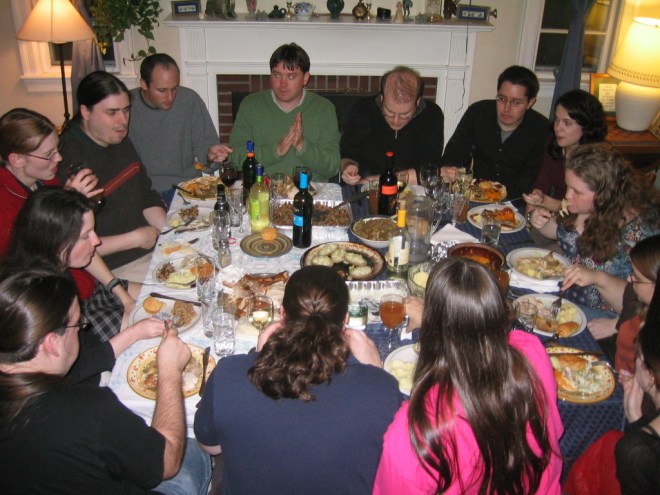
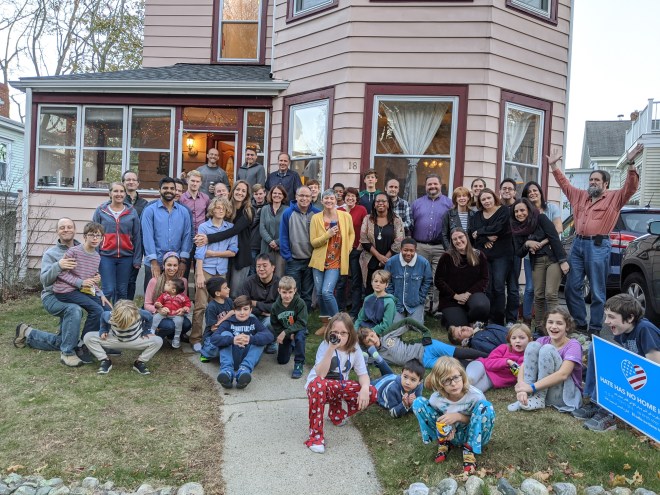
I did not end up hosting Thanksgiving for my inlaws – in fact I never did. But we had so much fun with our “Mock Thanksgiving” that Mocksgiving happened again the next year, and the following. It’s always been potluck and with many helping hands. I make the basics, my friends bring what they will. If you’re standing in the kitchen (or near the kitchen) between when the turkey comes out of the oven, you will be put to work. I usually start my preparations a week in advance, and spend the entire day before baking, prepping, cleaning and cooking. There were a few years there, in the early 2000s, where I threw out open invitations to my friends on Livejournal to show up who would. Now I have to be careful – we sat ~35-40 for dinner this year (simultaneously), and probably a total of 60 people were here at some point during the evening. The house isn’t big enough to seat many more.

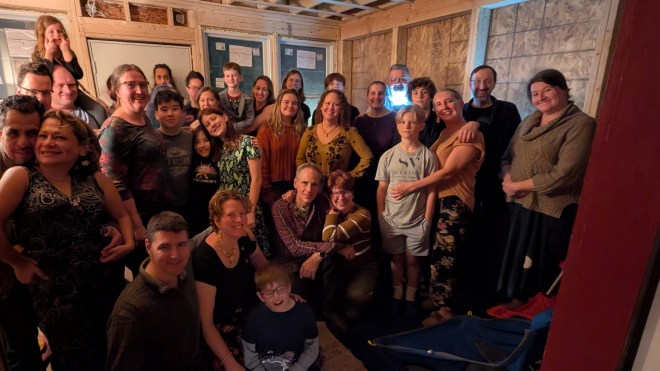
I’ve hosted Mocksgiving a few weeks after giving birth (literally two weeks in the case of my youngest child). It’s snowed. We’ve deep fried turkeys and had turducken. The attendees have shifted and evolved as our lives have – only one of the original attendees was there this Saturday. During 2020, I mailed out recipe cards of all my standard recipes to my much missed friends. We’ve had the first of our friends who always flew in for the day die, and that taught me how grateful I was that he always made it and also to make sure you ALWAYS take a group picture. It started as a sleepover party, with breakfast the next day part of the deal. Now we all want “beds” and “a good night’s sleep”. We’ve played a thousand board games – I think Richochet Robot has been broken out after the pie since nearly the first year. We’ve welcomed neighbors, babies, friends of friends. I finally learned how to spell the word “meringue” without looking it up. An entirely different party began to happen on the second floor, as the kids required less and less supervision and developed their own subculture. Some years we just sent up pizza as an offering to the second floor and held our breaths.

One thing I’ve learned is that my experience of Mocksgiving is very predictable. I think the same things at the same times during this process I’ve executed so many times. The day before I wonder if anyone will come. When I make the lemon meringue pie I think the lineup of “yellows” for it is so beautiful. I always regret not getting the turkey in the oven earlier. I often “narrate” the experience to “you” – the imaginary readers of this blog. The fascinating things I tell you in my mind are more or less the same year after year.

So, maybe in the year to come I’ll talk a little more to you. Maybe if we’re not ONLY on Facebook, you’ll talk back. Maybe next year, I’ll recite the litany of Mocksgiving. And maybe we’ll all come away a little more fed and fuller from all that.

48 on my 46th

Yesterday I had the biggest hike of my life. The many different methods of tracking disagree wildly on all these, but it was about 20 miles, definitely had 7 distinct summits, required about 6000 feet of elevation (both down and up), took 13 hours, clocked 60k steps, and involved approximately a bajillion rocks and two good friends. When we stumbled into the parking lot a few hours after dark, Anthony said, “Congrats. You have OFFICIALLY completed the 48 New Hampshire 4000 foot mountains.”

My official hike log – thanks to SherpaAnt for the fun tracker.

Mostly that green line in the middle

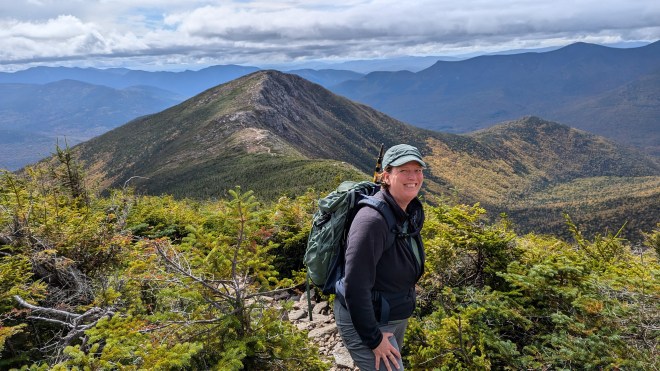
I wrote back in July about my history and love of hiking – and my struggles with a bum knee that threatened to end my career. I thought a lot about how this has all evolved. On my 46th birthday, I finished my 45th, 46th, 47th and 48th peaks as part of the NH 48. This hike was left to last because there’s NO GOOD WAY to get to the Bonds in less than 20 miles of hiking. I talked a few of my friends into joining me (one who has done it before and the other of whom didn’t ask enough questions ahead of time). We came up the day before, and did a fun little 5 mile hike up Mt. Hale and over to the AMC Hut at Zealand. (Of Mt. Hale my friend was like “I hope the summit view is worth the hike!”. Friends, there is no summit view at all on Hale.) We laid in the middle of the river to watch night overtake the sky and the Milky Way emerge, and were in bed asleep by 9 pm. Up with the sun the next morning for an AMC hut breakfast, and out the door by 8 am already in a hurry. Up, up and up on the rocky trails, with the first view (and cell signal) at ZeaCliff.
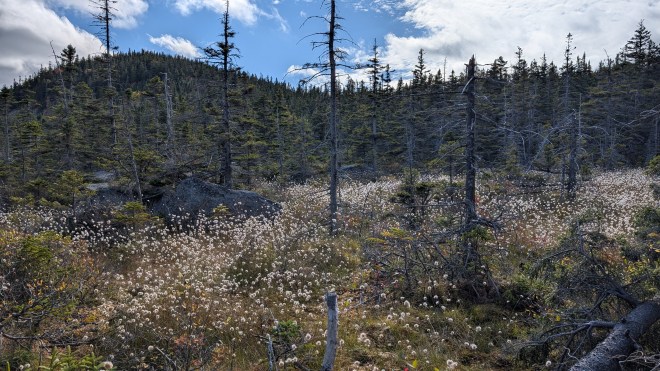
Really pretty meadow on Lend-a-Hand trail near Hale.

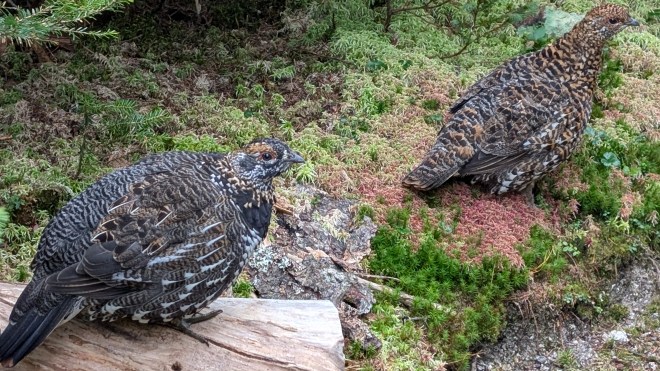
Right before Zealand (also no views), we got a visit from a friendly grayjay looking for a handout. More surprisingly, we encountered a flock of ~7 blue grouse blocking the trail and strutting their shockingly good camouflage – which broke up a very long and rather undifferentiated UPHILL. Zealand was disappointing, but Guyot was surprisingly alpine and beautiful, with a gigantic block of quartz the size of a head marking the cairn at the summit. We were ready for lunch, but not even a third of the way through our mileage. We slammed in some sandwiches and moved on.

Blue Grouse

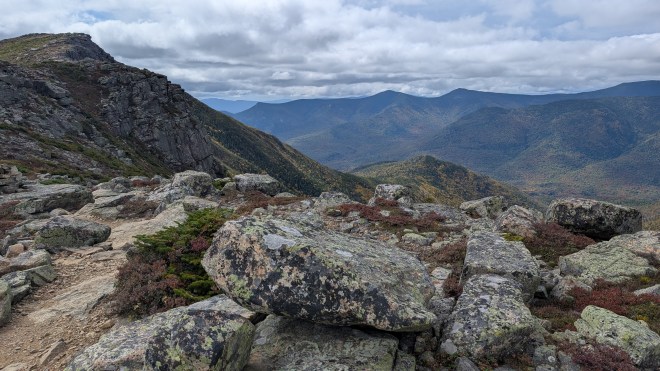
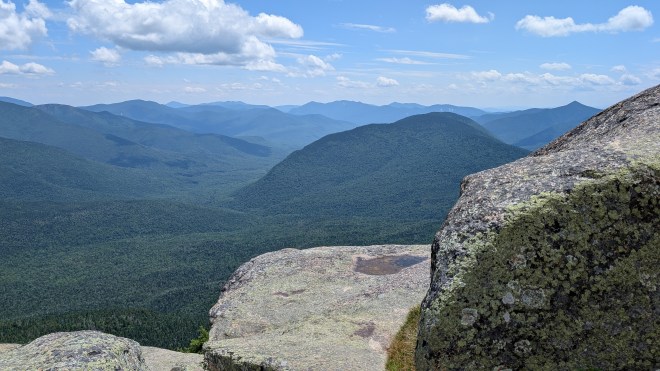
We passed right by the trail marker for West Bond, and pushed up the hill to Bond. The summit there was glorious – in the very middle of one of the greatest wilderness areas of the Northeast. No matter where you look you see nature, not roads or buildings. It was amazing. The Presidentials behind, the Twins and Garfield and Galehead to the right. Across the Pemi Wilderness you have Franconia Ridge, and in the middle isolated Owl’s Head. To the left hard-to-spot Carrigain with Chocorua behind stands across from the Hales. Every single one of those mountains I have hiked up with my own two feet as part of my quest for the 48 – they are old friends filling panoramic views. I think my favorite part was looking back into the mountain ranges we’d already traversed. Hale was blued with distance, and it seems impossible that person in a morning could have come as far as we’d come. And ahead? To the left, Bond Cliff. To the right, West Bond. The only two that remained to me.

Grey Jays do not look like murderous thieves. We were a mile+ into our day when we stood at that knob right behind the bird’s left shoulder.

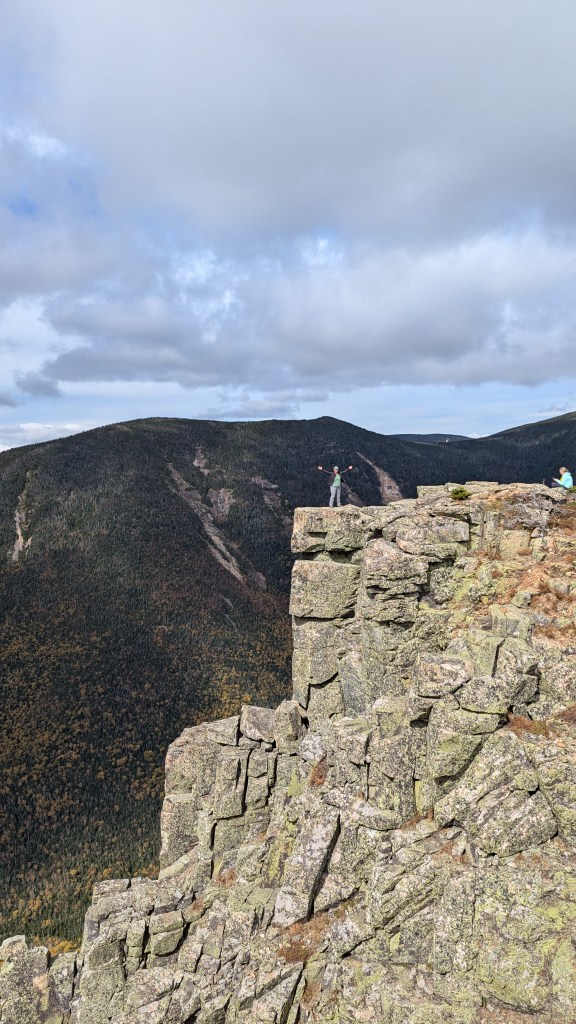
I wish I could have spent more time on Bond Cliff. The iconic photo taken on the edge of a cliff was absolutely terrifying and made my already shaky legs tempted to wobble. We took pictures and chatted with a hiker who’d last been there in 1983 via a bushwhack who got all three of us in a photo. In the lee of a boulder, Anthony lit a candle for my birthday cupcake. Tradition dictates the wind blows it out for me, but this time I got to blow it out for myself.

Yes, it’s as scary as it looks.
That little notch that comes out in the upper left hand? That’s what we were standing on.

But we couldn’t linger long – daylight was already waning. The push BACK up Mt. Bond was the most grueling of the trip so far, and my legs were already burning along with my lungs. It grew quiet on the trail as we focused on foot placement and breathing. We barely had time for any summit yoga on Bond before we pressed down the trail. There was still one more to go. We dropped our packs to lighten the weight as we took the half mile spur up to the West Bond summit – in the still heart of the wilderness with mountains and valleys and rivers and slides on every side. Anthony had brought balloons saying 48 – but we had neither breath nor time to inflate them. We celebrated the completion with a prosecco toast and sat in a place you cannot get to without walking for miles and miles and miles. My heart was light, but my feet were heavy, and we still had a long trail ahead.

Can you see the 48?

I know people do these trails FAST but I don’t understand how. I need to carefully pick each footfall to prevent breaking my ankles or wrenching my knees. There’s only so fast I can go on that terrain. And so we began the long march out. Several times we calculated the distance, hours apart, and each time we figured it was about five miles. It stayed five miles for at least five miles. The light failed just after we turned down the hill from ZeaCliff, and by the time we hit the hut and our overnight gear it was full dark – which it probably would’ve been smart not to leave my headlamp with the overnight gear. I had a momentary thought that after 12 hours of hiking and 17 miles and 7 summits maybe we should just admit that we were toast and spend the night – but the lure of “showers” and “our own beds” was too strong. The last 2.9 miles out in the dark were blessedly flatish and smoothish, although “15 minutes” became the new “five miles” in terms of misleading estimates.

Where we watched the stars

Today, I am so sore I can hardly walk. But mostly my heart is happy. Doing this on my birthday might seem like a weird celebration, but growing older can sometimes seem like growing lesser. I could not have done this hike last year (due to knee issues). Ten years ago I could barely do a hike half as hard. Even twenty and thirty years ago – I was not in the training and position to do this hike. Here at 46 I’m doing the hardest thing I’ve done – successfully, and with friends. It’s so affirming to see this as growth and progress.

Sitting on the trail

What next? I plan on hiking mountains for fun, and not because they’re on a list. Maybe I’ll do some lakes and waterfalls. We’ve already started brainstorming weird and unusual routes that will show us things we haven’t seen. Maybe a few bushwhacks. But I’m already missing the wild winds and rocky heights of Bond Cliff, and know I’ll be back again some day.

Reframing as a hobby

I’ve been getting a farm share from Farmer Dave for about sixteen years now. Once a week, I get a box of veggies and a box of fruits. (I used to get two of fruits until that memorable year when the watermelons went gangbusters and I ended up with ten of them….) But 22 weeks of figuring out what to do with the beets can wear down the spirit, and I was constantly feeling guilty about not using everything. (I hate beets.) So this year I decided to stop thinking of it as Nutrition and Healthy Eating and instead think of my farm share as a Hobby. So here’s how I think of it: you get points for using something. You get more points for a novel use of something. There are no deductions for not using something. So it’s only upside, no downside.
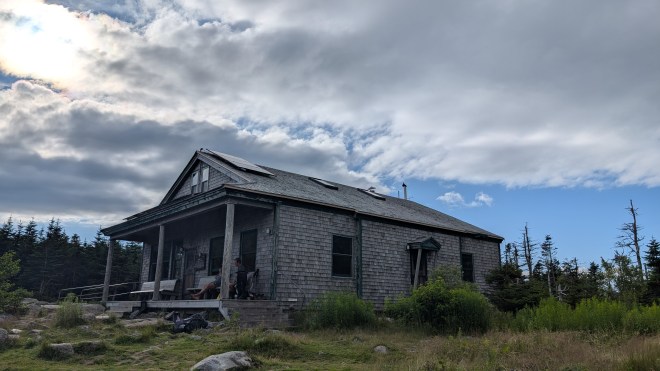
I figured I’d walk you through today’s fun-fun farmshare.

First, I cleaned out the fridge from all leftovers. This is a critical part of farm shares: admitting prior defeats. Not too bad this week – two cucumbers, a zucchini and some garlic scapes.

Used:
Apricot: I had a lot of apricots, and thought about making apricot jam. But I didn’t have QUITE enough, and apricot jam has a tendency to crystallize. So I decided to try something new and dehydrate them for dried apricots (I have some great recipes for dried apricots and also like to eat them.) We’ll see how that turns out. I’ve never done it before.

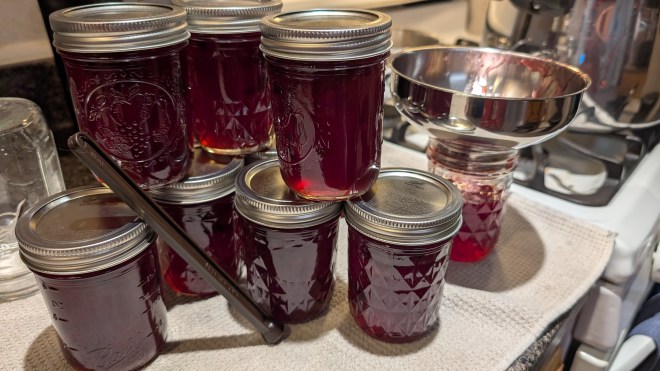
Plums: I had JUST enough plums (with the ones I saved from last week) to attempt a jam. Plum jam is one of my absolute favorites, and many of the last years weather has taken out our stone fruit so I haven’t had it. It’s definitely a mixed plum, but I’ll take it!

Have a Plan:

Garlic scapes: in a glass of water. They may end up in hummus or in pesto. But that’s a decision for another day.
Basil and thai basil: Imma gonna get me some sourdough and make some bruschetta. I also just ordered some pine nuts so I can make pesto. Maybe garlic scape and thai basil pesto.
Tomato: Going onto the bruschetta too
Kale: I probably will make soup – ribollata – with it sometime this week
Green pepper: gonna make chili tomorrow
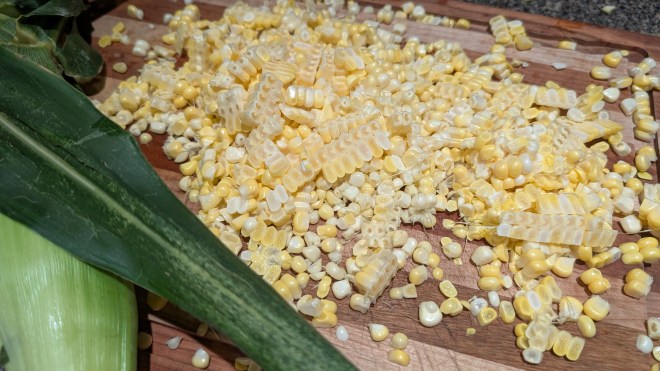
Corn: half into the chili, half into the freezer for chili later in the year

Blueberries: blueberry zucchini cupcakes with lemon buttercream frosting
Zucchini: see above
Cucumber: to be eaten with the hummus I’ll make with the ‘scapes
Summer Squash: I often just boil it and add butter and serve it for dinner, and then I’m the only person who eats any of it. But I do like summer squash.
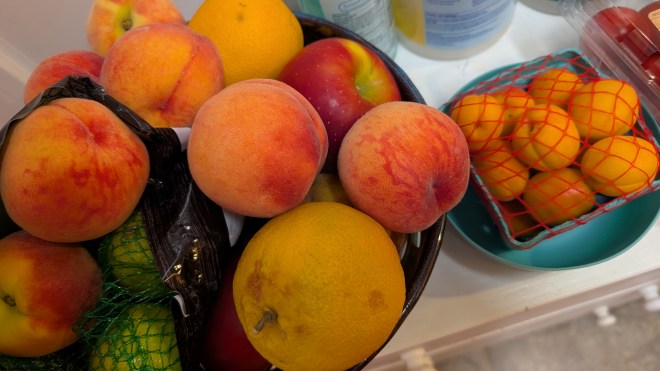
Peaches: I’d pretend I was going to make a peach pie, but honestly I just love eating the peaches over the sink with the juices dripping down my arms. If you can do that, you should do that.
Canteloupe: I dropped it off at my friend’s house, along with last week’s hot peppers.

Not Sure

Onions: I don’t have a very well formed plan. Generally these aren’t very urgent. I was toying with a french onion soup (except Adam can’t do cheese and that’s important). Maybe I’ll caramelize them and add them to french dip sandwiches. A few of them can go into the chili and ribolatta. But I’m not stressed about finding uses for onions.
Gem Squash: Absolutely no idea. This will likely end life in the compost bin. Let’s be honest.
Eggplant: One eggplant is the worst amount of eggplant. I pretend I might make moussaka, but if I’m making chili and ribolatta I’m NOT making moussaka too. And I’d need like two more eggplants for that.

What do you have in your life that feels like a burden but could be a game instead?

Back to backpacking

I keep this photo on my dresser. It’s in a flip display of photos, mostly taken on the same trip, from a long ago era when the indulgent person would have two copies of each snapshot – one to keep and one to give. Or one to display and one to save. There are some pretty pictures in the display, but this is the one that’s always showing. It’s my mother, my fiancée and me in the parking lot of Sunrise on Mt. Rainier, wearing backpacks. My mom is only a year or two older in that picture than I am now. We’re loaded down with tents, sleeping bags and ground pads on our external frame nylon packs for four days doing the North Side of the Wonderland Trail. It was a great hike, and one of the many times I dragged people I love up and down mountains.

For a long time, I was in a no hiking zone. Small children were not a good combination with “I’ll see you in three days”. Plus, solo hiking as a woman has only very gradually become more common and less unusual (and therefore safer). Heck, back in the 90s, there were fewer women hiking altogether. I remember that there was a charity fundraiser at my mom’s school, and I put ALL my money on a backpacking trip led by a father of a friend who was also a National Park Ranger. It had never occurred to him a girl might want it, and we had to come up with a chaperone (my cousin) to join me. (On the plus side, it was an amazing trip!) Not only that, but I tore my ACL when I was 19 (I had no ACL in this picture, unbeknownst to me) and didn’t get a new one until my 30s.

In 2017 the hike up Chocorua with this friend might be the most tired I’ve ever been in my life. I just hiked the exact same route over the 4th and it was a fun jaunt.

About seven years ago, I finally got back to it (after much pining and yearning and a bit of attempting). I dragged more friends up more mountains, despite knee-related setbacks, full time work, bad weather, long drives and all the other forces that conspire to keep me off the mountains. And over time I’ve gained experience, practice, confidence, straight up skills (for example I am now Wilderness First Aid certified), and an encyclopedic ability to talk for 9 straight hours up and down a mountain plus four hours of driving, about every single hike I have done and want to do. I’ve hiked 43 of the 48 4000ft+ mountains of New Hampshire, plus trails in Idaho, Utah, Washington, Arizona, Greece and pretty much anywhere I can sneak away and find a mountain.

Map by SherpaAnt

In the rarest of events, a gap in work responsibilities lined up with the kind of mountain weather that inspires normally responsible people to call in sick with White Mountain Fever. I knew I had to get up there, and for more than just a day trip. I leaned heavily on my usual hiking buddy but he had actual responsibilities. So I decided it was time to take the next step and do a solo overnight trip. Now, I have the gear and probably the experience to do it as a backpacking trip. But there’s a wonderful alternative in the Whites – the Appalachian Mountain Huts that follow along the Appalachian Trial. I’d had my eyes on the Galehead Hut. I don’t “need” any of the mountains around there to finish my 48 (I have a plan for those), but the Pemigewasset Wilderness is spectacular – and nowhere more beautiful than it is from Mt. Garfield. So I booked a local hotel on Wednesday night, and an AMC hut for Thursday. I hit the trail bright and early Wednesday.

Looking at Owlshead in the middle of the Pemi wilderness from Garfield summit

Mt. Garfield is a good haul up, and the heat had improved but not gone away. Still, I got up in good speed and lingered long on the sun-warmed rocks of the summit, looking out over the bowl of the Pemi wilderness, naming the mountain-friends ringing it. Owls Head – in the middle – is one of the most challenging mountains to reach since it’s so far from any trailhead. Franconia Ridge to the right shreds the clouds and egos of challengers, and I had been tempted to try to get over that way. But I definitely wouldn’t make a 6 pm dinner if I went right before I went down. There are some truly crazy people who do the “Pemi Loop” – or the entire bowl made of mountains you see here. I met at least two people who were doing the whole thing in one day. No matter what you undertake, you’ll find folks doing it ten times harder than you dare dream. And that ignores all the “thru hikers” doing all 2200 miles of the trail from Georgia to Maine – I met a bunch on this hike.

There’s a teeny white dot in the right of this photo, in the forest. That’s the Galehead hut, where I needed to be in ~5 hours for dinner.

The Appalachian Trail between Garfield and Galehead is one of the gnarliest sections of trail on the whole two thousand mile expanse. There’s this one amazing section where you come to a creek, and you can’t figure out where the trail goes, until you catch the faint white blaze halfway down the waterfall that the creek becomes. You then descend down the waterfall for the next exciting section. I showed the path to a thru hiker with a trail name of Stumbles. He swore in disbelief that this was the plan. This is when you’re happy you paid attention in the Wilderness First Aid class, but I didn’t end up needing any of it.

Seriously, it’s impossible to photograph how steep and stupid the trail is.

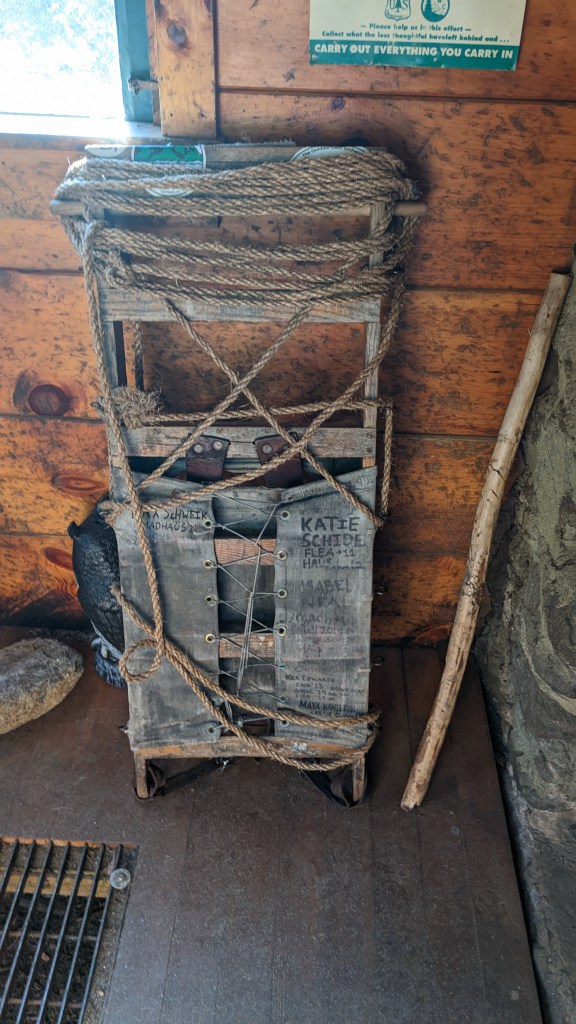
I made it down, across and back up again to Galehead hut, where I dropped pack and went up the extra half mile to claim rights to the very uninspiring summit. I love staying at the huts. You get to meet all kinds of interesting people. The Croo serve you a five course meal. There’s usually some sort of talk (last time I went it was an AMAZING geology talk that kept me rapt – this time it was a less academic discourse on Leave No Trace). The lights go off at 9 pm (so the Croo can go raiding the next hut for their stolen knight’s helmet), and you sleep in a bunk in a bunk room with as many as 12 co-ed bunks. It’s good bedtime comes early because they wake you at 6:30 for a three course breakfast so you can hit the trail early and they can start the next dinner. All the food and gear is brought up by the Croo on their backs using backpacks – which not only have not changed design in 100 years I swear some of them are that old.

A Croo backpack from Carter Notch Hut – they regularly load this with 80 pounds
Galehead Hut

I did get up early and enjoy a three course breakfast. It’s always disheartening to look at where you’re going (and encouraging to see where you’ve been). I went up to South Twin (a notoriously nasty section of trail – I really picked the fun ones), and then across to North Twin whick had been socked in on the New Year’s Day hike I’d last done it. Back to South, back down the gnarly trail – all on one of the most gloriously beautiful days I’ve ever hiked in. It took a real effort of will to force my shoes to the lowland trail (which – this is probably the shoes last hike since the tread has all but worn off). I loved every bit of it. The honest effort. The embrace of the pack. The cheery greetings and friendly conversations with all your fellow hikers (as one put it, all ecstatic with being in the mountains on such a fine day). The hundred year tradition of the huts. The trails that got away today, but which you will hike tomorrow. Following the sounds of the stream down the mountain in companionship. The keeness of the summit winds. The wildflowers and ferns and dense spruce of the krummholz.

Rest well, good and faithful footwear
There’s so much beauty besides the summits

I feel so lucky to have gotten this hike. I was one of MANY solo women hikers out there – it’s certainly more common and accepted, and the camaraderie of the trail makes you feel far from alone (I also carry a satellite beacon with an SOS function). I can’t wait to get out there again!

The “Braided Bandits” took this picture for me

Here’s my full photo album if you’re interested!

16 years later

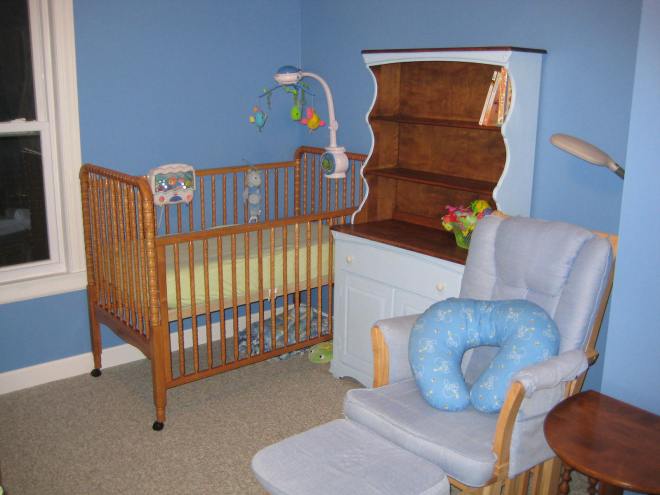
Just about sixteen years ago, we replaced the shag carpet in the smallest bedroom with pile carpet, drywalled over the wood paneling, installed an overhead fan, and painted the bedroom the cheeriest imaginable blue – all to welcome home a baby who would be joining us a month later. One of my fondest last memories of my father-in-law was the look on his face when he left to run an errand when the walls were primed and returned to find them a saturated robin’s egg color.

The room as it was when we bought it

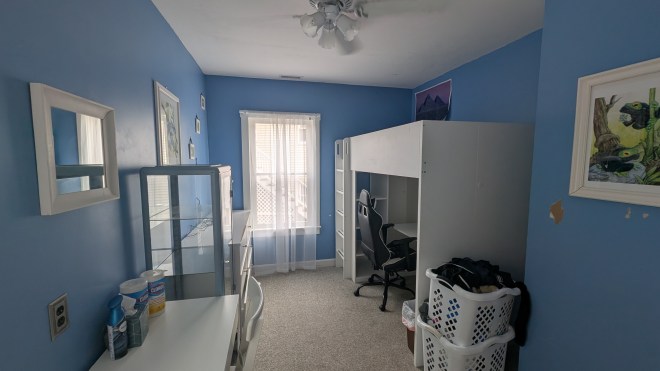
As these things go, that room started with a changing table and crib. Then there was a mattresss on the floor and bins for toys. The percent of those toys that were LEGO rose steadily over time. A display case was added. A short loft allowed for a little more space in the tiny, morning-light bedroom. Desks replaced toy bins. Technik took over from trains. Vivariums came and went, leaving permanent water damage behind. Bookshelves sprung up. Guitars appeared. During the pandemic, the short loft was replaced with a tall loft with a cavelike structure for uninterrupted virtual living.

That room was home to nighttime feedings, thousands of books read (mostly on Scooby Doo and dinosaurs), generations of stuffed animals, imaginary play, legendary LEGO builds, beloved cardboard boxes replacing furniture, fierce running gun battles of the Valorant variety, and a lifetimes worth of dreams.

But the boy who goes with the blue room is now a young man and clocking in somewhere over 6′. You cannot spill over the edges of a loft bed, and he doesn’t fit in a twin even diagonally. And getting a queen sized bed into that room will require every inch of space. The boy’s older brother, the high school graduate, will find himself in a dorm room this fall and entering (one hopes) the ever decreasing return cycle until the day he comes to stay and calls it “going home” when he leaves. HIS room is nearly double the size. So it’s time for him to be moved into the teeny room when he’s here and for the younger child to finally be able to stretch out in bed for the first time in years.

Current status: getting rid of the furniture to begin the remodel

I would make the teenager clean out his own room, but he’s on week 3.1 of 5 of being Not Here, so I’m doing it for him. It’s hot and sweaty work. The walls that were the pride and joy of our labors 16 years ago need to be patched and painted. The trim needs to be reaffixed. Let us not speak of the condition of the carpet. I’m posting on the local Everything Free site most of the furnishings of a child’s room, to be replaced with a guest room. So I spent some sweaty time putting away a childhood into plastic crates and carrying it to the basement. The boxes will return to the second floor, but the childhood is gone forever.

Time only runs one way, and the children only grow. It will be nice for everyone once this move is made. But I can’t help being wistful for what I’m saying goodbye to.
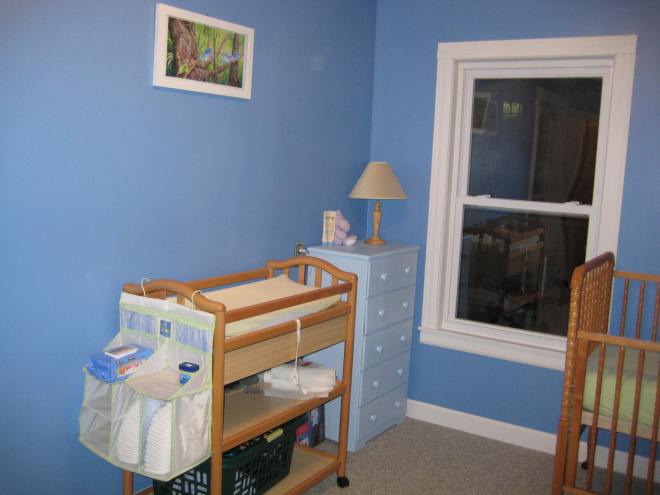
My baby on the day he came home to his room

Stoneham Town Election: April 2, 2024

Hello Stoneham voters! The daffodils are up, the sun is shining, and it’s time to go to Town Hall and elect our representatives for another year! I’ve been impressed at the transformation of the information available to voters in the 16 years since I first gazed in dismay at a local ballot with absolutely no idea who the candidates were or what they stood for. So much more is now available, mostly through the hard work of our local civil servants. But for those of you who still text me asking how I’m planning on voting, here’s the breakdown!

First some resources:
Election Tuesday April 2nd, 2024 7AM-8PM at Town Hall
Sample Ballot
Candidate Statements
Candidate forum
I also read the candidate statements in the Stoneham Independent.

Now for my picks:
YES:
Raymie Parker has been serving Stoneham for several years. It’s difficult, time consuming and thankless work that probably pays way less per hour than snow shoveling for the DPW. She’s always been thoughtful, prepared, present, hard working, honest – really everything you would ask for in a decision maker for the town. I appreciate that she continues to innovate and is very available to hear perspectives and concerns.

David Pignone is also a candidate for re-election. I have seen less of his work up front than I have Raymie’s, but his reputation and service in the community is deep, and with his work in the schools he has a front row seat in some of the big challenges facing our structures.

NO:
Stephen Ternullo (no publicly available site). I drive past his house regularly, and while I’m glad he recently took down the “F**K BIDEN” signs (note that his did not include asterisks) he still has up several similar signs using language I was not allowed to use growing up. His tag line on the yard signs is “I will be your voice” but I don’t have a potty mouth so I’m not sure that’s true. I do not want a town government that is uncivil, and the face he puts forward to his community is not one that speaks to collaboration or with whom I think it would be easy to work.

Robert Verner (no publicly available site). For this candidate, I rely on the information in the candidate statements. Our community will be opening a brand new high school in the fall, and a lot of his statements were around starving that school of resources – which is a bit like buying a new car and then not driving it because you don’t want to spend gas money. Cutting resources was pretty much the only thing he talked about, which actually seems wasteful to me given how much we’ve already invested.


I would love to be able to offer guidance on the Constable race, but I have no insights there. So if anyone has any thoughts, please drop a comment! See you at the ballot box on Tuesday!

Make the color my own

What if you could possess a color? Own it, understand it, live with it through the moods and vagaries of light and paper? It’s been about three and a half years I’ve been painting with watercolors. The very first time I tried, the book instructed me to mix the blues and yellows in proportion. I squeezed out from a tube blue and yellow in the approximate proportions. It took me the better part of two tubes before I gave up and called it good enough. It seemed like a pity to throw away the rest, but what could you do?

Yeah, for those who don’t know like me? You can “resurrect” watercolor indefinitely by adding um, water. And when they recommend you mix it, they’re talking about the released watery watercolor you would paint with. A tiny dab of watercolor in a palette can last you months and many paintings.

Good thing it was the cheap student watercolors.

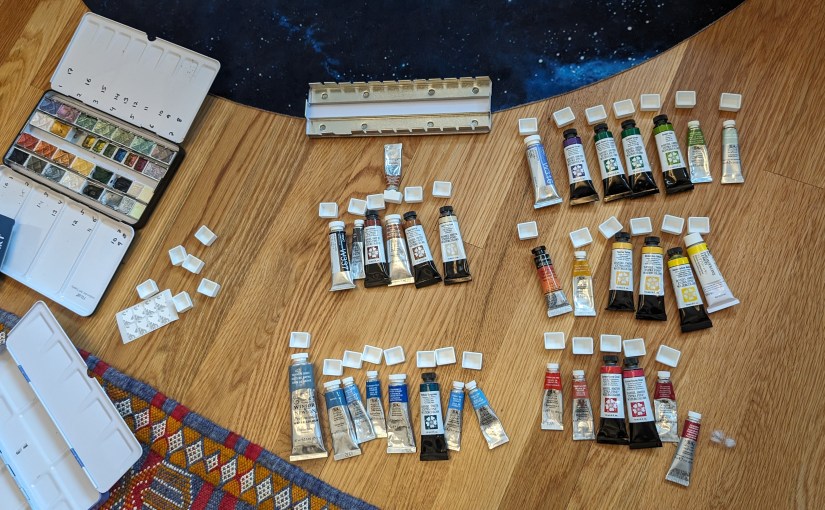
When I loaded up my palette yesterday, with a number of new colors, the watercolors were not the cheap ones. I try to tell myself that the hobby is inexpensive by comparison to, say, golf. Or bass fishing. But the contents of my paintbox are truly a treasure. Loading a palette is a labor of love – equal parts tedious and delightful. My left hand got sore from the threaded tops of the tubes, stuck on by paint. There was the planning and the labeling and the decision making … can I live without Bordeaux? Which yellows will I want for the desert? But the best part of all is the swatching, where you dip a tip of your brush into the thick virgin paint and then release it with water onto the paper. Will it be creamy? Transparent? Will it granulate? Will the color of the paint and the color of the watered paint be the same or wildly different? Will the water reveal one pure color, or a prism of many? And most critically – did you guess right about the variety and value and hue in your ordering of the swatch?

The desert palette

In light, I love all colors. Perhaps green most, since it’s the garment of my beloved nature in the places I have lived. But in paint, my heart belongs to indigo. Students of history know how important indigo was to the commerce of the colonized Caribbean. Blue pigment was always a problem in the history of paints. There’s the fantastically expensive lapis lazuli pigments. There’s the ecology destroying but fugitive woad of the Picts. Blues are hard to find. And indigo is not just blue, it’s exceptional. The indigo paint is so creamy and consistent, versatile, kind, assertive, trustworthy. When I have indigo on my brush, I have no fear. If I were limited to one paint for the rest of my life, it would be indigo. I remember the first time I tried to use Cerulean blue. It’s a pretty blue – like a robin egg or a spring sky. But it came across my page chalky, inconsistent. I thought it must be a defective batch but no. Granulating is the technical term. A wash with it is like rolling the dice on paint coverage. Per instructions, I loaded Cerulean into my palette, but we will never be on dear terms, Cerulean and me.

A thousand faces of indigo. All indigo, all the time. If you’ve ever seen me paint a night sky, it was almost certainly indigo.

The last year or two I’ve been reading my way through the histories of pigments and paints. My palette covers a hundred thousand years. I have the yellow ochre that neolithic priests painted in flickering firelight on deep cavern walls in the airless belly of the earth. I have the Venetian Red that colored so many lions and trousers and buildings in medieval and renaissance paintings. I do NOT have mummy brown, alas, since we no longer find the best use of mummies to be loading them onto our paint brushes (or burning them as fuel for locomotives). But I also have a whole palette of the unspellable quinacridones: gold, coral, magenta, rose, red, violet. Those paints “break” in this astonishing way where the thick paint and the watered paint are entirely different colors. The poisonous arsenic has been removed from the greens, and replaced with the perylene and the pthalos. What color does not come in cadmium? All these minerals and chemicals and discoveries (the history of mauve is a real page-turner – Wikipedia doesn’t do it justice) come with their own characteristics and traits – the personalities of the paint. Some of my paints I hardly ever use (Potters Pink, Terra Verte) but love for their connection to the earth and artists before me.

I have put together a number of palettes in my short history of painting: for a particular book, for a particular season, as I learn which ones I love and those with whom I will maintain a polite distance. But this palette has an entirely different slant than my White Mountain or Northwest art. I need the yellows, the purples, the red earths, the subdued depth of the desert greens to capture Arizona.

I can hear the confusion now … Arizona? Do you not live in New England in January (which, btw, is mostly a hundred variations on blue and blacks palette wise). Well. Here’s how it is. I’m switching functions at work from one to another, and it was taking a while and I didn’t have all that much to do while we made the switch. And it was a quiet week on the ol’ calendar. And last weekend I started looking at watercolor retreats I might be able to do this winter/spring, since with graduation etc. we are not likely to travel as much as a family this year. And the best one that didn’t conflict with anything was … this week. I feel wildly impulsive and out of character! Who flies to Arizona at the last minute? Surely this is irresponsible of me. But yet, here I am.

Look! Proof! Definitely Arizona.

I’ve never been to Arizona (well, I may have driven through when I was 13 but that really doesn’t count). I’ve never seen a saguaro. I’ve spent far too little time in the desert of any ilk. I do not object to 80 degree instead of 18 degree weather. But in two hours I’ll land in Phoenix and wend my way to Tucson, for this workshop. I brought my hiking shoes (and yes, extra water bottles) in the hopes of hitting Saguaro National Park on the way. I have no idea what to expect: I haven’t done something like this before.

But that’s really more than half the point. In these middle chapters of life, we face the choice on whether to invest and focus on continuing to grow and change and learn new things – or whether to hone our existing expertise and enjoy the mastery we have worked for our entire lives. Of course, it’s a nuanced choice: we all have to figure out how to use the new way to watch movies, and every skill we once had comes on the journey with us. I find myself hungry for curiosity, and enthralled by the worlds out there I never knew existed. Who knew that paints had such personality and history? A child of the magenta/cyan/yellow screens would never guess such a truth. What other wonders await out there, just asking for me to ask the right set of questions to unlock them? I’m itching to find out. And see a few new sights in the process.

Edited to add:
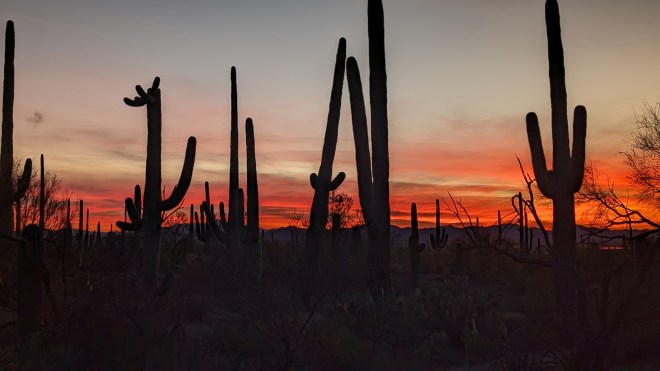
I wrote that on the plane. Then I got here, spent an annoying amount of time in the airport and drove down I10 to Tucson feeling depressed at the nature of the billboards (casinos and personal injury lawyers mostly). But Saguaro National Park made up for all of it. The watercolors start tomorrow!

Golden hour among the cactus
Can you make out the sundog here? (Parhelion for the pedantic.)
If I told you that the sunset was far more vivid than the camera saw, you’d call me a liar.

Culinary heritage

Many people talk about how amazing their culinary heritage is. Nana made the best home made pasta. Or no one makes dumplings like my great-aunt. Or childhood memories are full of groaning tables full of latkes and love. If your childhood memories of food include things like “colors” or “vegetables” or “texture” – well, bully for you. ‘Cause I’m of Scottish heritage, and the one dish that always made an appearance when the Johnstone Clan got together was corned beef hash.

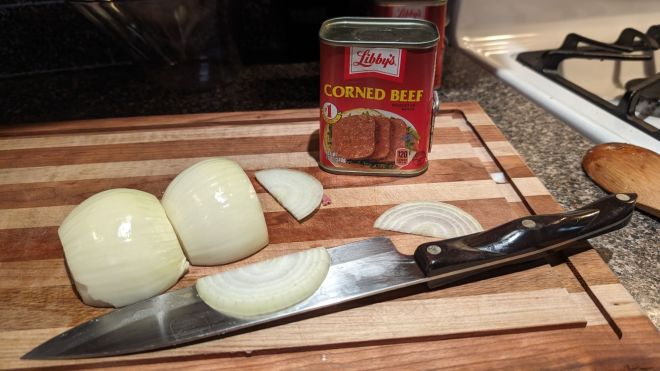
The recipe for corned beef hash is as follows:
– Half a pound of bacon
– Two onions
– Two cans of corned beef (the ones you open with a “key”)
– 5 lbs of russet potatoes (boil the hell out of these first in their skins)
– 2 to 3 cups water
– 1 tablespoon garlic salt

In a large dutch oven, cook the bacon. Add the onions. Chop up the corned beef (not slicing any fingers on the weird pot things that exist in no other food type than potted meats). Add the water, and then pull the skins off the potatoes (burning fingers in the process optional) and chop into large cubes. Add to pot with garlic salt, and then cook for a long time. Maybe a week.

Serve with (I am NOT kidding) store bought Italian bread and large curd cottage cheese. Proceed to die of scurvy. There is no part of this meal that has any color whatsoever (unless you put jam on the bread). It is also – and I am still not kidding – delicious. Even better as leftovers the next day. And hey, um, high in protein?

I loathed corned beef hash when I was a young girl, but I can hardly remember a family gathering where it wasn’t served. (I do not remember any of the other meals that may or may not have happened. I’m sure there was turkey and burgers etc. etc. but the corned beef hash is burned into my memory.) My grandmother became paralyzed when I was in high school, and following that my mother (who married into the Scottishness) took on the mantle of making the dish. Apparently, remembering the garlic salt was a challenge, and my grandmother never failed to point this out to my mother. I always think of her when I add the garlic salt.

Burns Night is just around the corner. The Scots may be somewhat culinarily deficient, but make up for it with their poetry and song and the power of their booze. I’ll put on some bagpipe music (also endemic in my childhood, and I also actually like it), and contemplate Rabbie and his works, and miss my grandparents. And heck, maybe I’ll have some leftover delicious corned beef hash for lunch.

Gone the sun

Day is done, gone the sun,
From the lake, from the hills, from the sky;
All is well, safely rest, God is nigh.

Taps first verse

Back when I was a girl, it meant something to be a girl. Namely, that you couldn’t join the Boy Scouts under any circumstance, you took Home Economics instead of shop, and that your acceptable instruments in band were flute, clarinet and saxophone (sax only for the rebellious). I was underwhelmed by this definition of girl, and picked up trumpet with a cussed determination which served me in good stead. I opted to take shop instead of home ec, making me the lone girl in a class of 26 boys (I am old, but not older than Title 9). Alas, I never cracked the Boy Scouts. But I came from a family for whom Scouting was a deep part of our identity. My grandparents ran a Scout camp in Washington State. My father and his three brothers (what can I say – my grandma also liked boy stuff better than girl stuff) were all Eagle Scouts. My godfather was such a foundational member of the Order of the Arrow that his license plate was “BSA OA”. And my undimmed passion for nature and survival and camping meant that I was as close to a Boy Scout as I could get. I was even given a Boy Scout axe when I was 13. This was less exciting than it could be because I was expected to USE said axe to help split the several cords of woods my family used to heat our house of a winter. But still, there was a deep satisfaction in the boy-sized blue-painted single-bitted axe with the gold embossing.

So my adventures into trumpet involved bugle calls very early on. Reveille is fun to play, especially when you’re the first one up and the grownups permit you to be deeply irritating. Charge is also fun. Many bugle calls are more or less picked up by ear. But I had an ancient leather-bound manual, dramatically stained, that I think may have belonged to some ancestor of mine – a great grandfather of some ilk. As I recall, it was a 1918 Army Manual (although searches for it online claim that no such thing exists, so who knows – maybe this one?). And it had a whole section of bugle calls. Not just the three or four we all know, but mess and fix bayonets and a whole host of others. But of course most iconic was taps. Twenty four notes that look very complicated when written, with dots and emphases and fermatas. In the deep romanticism of my youth I played it mournfully in the dark of the cold church where I usually practiced. (My father also required me to learn Last Post, which I managed by dint of a battered third trumpet booklet bought in a used book store in Edmonton Canada. Ah, the days before the internet were hard folks. I was never quite confident whether that last note was meant to be unresolved or whether it was a chord and I was playing the third trumpet part.)

In high school, I contracted with the local funeral homes to play taps for veterans funerals – which only happened a few times. Memorably I played for several of my classmates as they met grievously early ends. I’ve played for the beloved veterans and relatives in my own family who have died: my grandfathers, my father-in-law, my godfather. It’s hard to play through your own grief, but the 24 notes are so familiar and almost instinctive that I have never yet failed.

You get a little bored waiting for the funeral cortege

For a long time, I volunteered with an organization that provides live buglers for veteran funerals. The color guards almost never have a live bugler anymore. (They have an MP3 player that looks like a bugle, which horrifies my heart for some reasons. In that role, I attended dozens of internments. It is a fascinating thing, to be part of the funeral apparatus. The time at the graveside is always approximate, and you end up waiting with the gravediggers and the color guards. The gravediggers were fascinating, with dirty boots, doing a job they did every single day. Some of them spoke about the inhabitants in the graves as you would about friends. The color guards were a real mixed bag. The Marines were always so buttoned down and proud (and uptight) and rarely spoke much to me. The Coast Guard usually was quite chatty. My favorite was the Navy because they were covered by the crew of the USS Constitution in their antique uniforms. You could almost tell which branch of the service by what vehicle they drove in. (Hint: Marines drive truck. Coast Guard drive sedans.) I played in funerals from an active duty death where I was carefully vetted and the brass were lined up in gleaming rows in the snow in Lindenwood to modest internments with just a few folks. I watched new color guards practice the folding over and over before the family arrived (and I have seen funerals where they had to fold the flag more than once). I’ve seen Catholic internments aplenty where the priest spoke the words without hearing them. I was privileged to join the family for a Chinese American veteran at Mt. Auburn, which was a very distinct funeral experience. Everyone turned their backs as the coffin was winched down, and they insisted I leave with a red envelope with $20 to avoid bad luck. I never accept payment for playing taps, but I kept that one. I learned to park where I wouldn’t be blocked in, to stand in a place where I could be seen but not blast the mourners, and exactly what invisible signal meant it was my turn. Almost without fail, a family that has held it together up to that point begin their weeping when I began my playing. It was an honor and a privilege and I miss it and I should really try to find a way to perform that service again.

This all comes to mind because I was recently enticed to join in Stoneham’s “Field of Honor” for the daily playing of taps at 5 pm, and I got to play today. (Full story here: look ma, I’m on TV!) I got to speak to some of the veterans afterwards, and it reminded me of how much does still unite us. We can come together and consider the flags that mark those who have made sacrifices: of time, of comfort, or the ultimate sacrifice of their lives for the common good. On this day, the eve of daylight savings, when the darkness seems to leap ahead and stifle the sun, we can remember that there have been dark times before. We all cry when taps is played. But the darkness will not last forever. The dawn will come soon.

I used to be an adventurer, then I took an arrow in the knee

Something like 25 years ago, I went skiing for the first, last and only time. I came down the very first slope I attempted on a sled, and didn’t walk without a limp for 9 months. But in the vast wisdom of a teenager who really didn’t understand how insurance worked other than it could go horribly wrong, never got it checked out.

About 12 years ago, I jumped off a small wall, and something went horribly, terribly wrong in my knee. Having mastered the art of insurance, I got an xray which showing nothing wrong and did a summer of PT which fixed nothing. I finally got an MRI which showed that I had no trace of an ACL left, two tears in my meniscus, two cysts, and a bone bruise. I went under the knife for the first time and emerged with a cadaver ACL, a lot less meniscal tissue and a script for PT.

In that dozen years, I have tried to keep my body strong and active, knowing that considerable residual damage lingered in my left knee. I’ve hiked 40 of the 48 4000 foot mountains in New Hampshire. I’ve run 5ks in scenic local paths to stave off weight and stay in shape for the summits. But I’ve always known that there would be a price to pay for all damage I’d accrued to that knee.

Last summer, we did a fun (and cold) two day backpack trip across the Carters. The descent was long and hard and I was wearing a heavy pack, and I could feel my knee go numb under the shock of miles of hard descent.

Last winter, I went for a run and my knee got swollen afterwards. I waited a week or two and went for another run, and my knee blew up again. Having learned from the last time, I immediately went to the doctor and demanded a full set of images of hard and soft tissue.

A black and white picture of two knees from an MRI
The knee bone is connected to the shin bone

We all knew that there was stuff wrong with my knee, and the images showed there was stuff wrong with my knee. The surgeon who had done the surgery lo those many years before recommended I get a Peloton. So I rented one (which is a thing, by the way) and worked on rebuilding strength and fitness and finding I secretly enjoyed Cody Rigsby. And the swelling went down, and the strength built up and I started edging my way back onto the mountains after a winter sidelined. I got a few good hikes in: Morgan/Percival. Welch-Dickey. Waumbek. There were also a good number of cancellations with the double whammy of the rainiest summer ever and a knee which just wouldn’t quite be reliable. We cancelled the Bond Traverse on Juneteenth when the temperatures looked dangerous with wet weather.

If you look at the knees here you can already see severe swelling

In July, we had a few weeks before our planned Katahdin Knife Edge three day camping trip. And we needed to know if the knee was up for it. So we headed up Madison by Airline Way. Several thousand feet of elevation, bruising terrain and a nice mile long scramble up from the hut. I made it up, although looking at pictures my knee was ballooning well before I summited. And on the way down, I slowed to a crawl – a mile an hour – and gritted my way down, wincing with every hard landing. When I got to the parking lot, my left knee was a vast swollen moon of pain.

Two dirty knees. One is very swollen.
One of these things is not like the other

It took three months for the swelling to fully subside. The Katahdin trip fell prey to the dual threats of not being able to walk and also hyperthermic rain. It has been a consolation that the wet summer has meant I’ve missed fewer opportunities than I might have otherwise. But tomorrow will be 80 degrees on a Saturday and I cannot cancel my plans and go grab Chocorua or make an attempt at the Bond Traverse under a full harvest moon. I limp when I rise, and my knee has just now been able to be crossed again with a full range of motion.

Fine, I’ll also add in kayaking.

I’m too young for a knee replacement. There’s no obvious surgery to do next. My doctor, when I saw him again, recommended getting a new hobby. “Have you thought about kayaking?” I turned 45 this year. That means that if I have as much ahead of me as behind, I’d live to an honorable 90 years old. It’s both old enough to have accrued permanent damage, and too young to accept that damage will forever limit me. But I can’t imagine four more decades with no more summits. No more times gazing across at a mountain range with the dawning realization that the peak over yonder is where you were planning on going this afternoon. I cannot relinquish the quiet of the trail down, when mind and body are exhausted and friendship is quiet in the glinting late afternoon light. Nor can I pass by the vistas that are only attained by strength, determination and the persistence of the body. I’ve loved hiking since I was a wee sprite, imagining myself a Bilbo crossing the Misty Mountains. Since I remember I’ve turned my eyes to the mountains, from whence comes my help.

When I was reading the Lord of the Rings for the first time, breathless in disbelief of the glory of it, I was also the nuisance of my neighborhood. I decided once to be entrepreneurial by selling hand-drawn pictures door to door – which earned me a remarkable number of ribbons candies and long conversations with lonely old folks in quiet houses with lace curtains and antimacassars. After the lecture my parents read me stopped ringing in my ears, I had a favorite of these new friends. Ernie. He was a few houses down the street, in a three story house on a tree-lined quiet street in a small, rural agrarian town. In the year or so I knew him, he never rose from his recliner. But he had an encyclopedic knowledge of every crook and drawer of every floor of his beautiful and packed house and would send me on quests to the crammed third floor (which in retrospect showed a feminine decorating hand that no longer had a matching recliner), or to the manly shop in the basement where odd devices and “tiger eye stones” were stored. I was 8 at the time. I have long since wondered about Ernie. My vague primary-colored memories of him were mostly wrapped up in the glorious book he had of pop-up elves or the tiger-eye stone he gave me (“I have been carrying one for 70 years and never saw a single tiger since I started carrying it”). But looking back, he was a man who had lived a rich and interesting life – almost certainly a combat veteran and a world traveler, as well as possibly an accomplished engineer. He knew many places, but visited them now only in his mind’s eye, and through the sun-drenched legs of curious young girls who could still venture to the mysterious lands of the second floor – wondering if some wardrobe there might transport them to another world.

I know it is the way of some things that only the fortunate get to be Ernie in his recliner with good-hearted but mischievous young visitors. How many friends and loved ones did he lose before he lost his legs? But I also think about the last adventure. The last mountain climbed. The last swim. The last road trip. The last time you visit your own attic. The contraction of the world to the recliner, the remote, the phone.

You might say that 45 is too young for such thoughts, but few of us know when our last time comes. What I do know is that I am NOT READY to have hiked my last peaks. I would like another 30 years, please, of watching the clouds break like waves on the shores of the Whites, tearing themselves apart on Franconia Ridge.

PT during the middle of the day is one way to feel young and fit

So now what? Do I hike twice a year, and limp for four months between? Do I take up kayaking with extreme prejudice? I got a second opinion, and now have a PT who has ALSO hiked the 48 4ks and can advise me with great precision “Yeah, so we start with Monadnock and we work our way UP to the Bond Traverse”. There’s hope that with very specific strengthening I can work around the damage that exists. And maybe compression braces, anti-inflammatories, ice and poles. Keep my strength up with the Peloton. Let the inflammation fall to nothing. Maybe I can make it work. Or maybe a scoping of the knee can clear out junk that’s getting caught in the joint and leading to swelling. My choices after that get grimmer.

I think every generation is shocked to discover ourselves aging. I look at the glorious strength and beauty of the children I have brought into this world – and how poorly they take care of that glory and how little they appreciate their resilience. Youth is wasted on the young – as it was on me.

But when I next stand on a windy summit, eyes turned hungrily to horizons that have welcomed generations and will intrigue generations yet to come, I will be grateful for another chance.

Once and future views